Showing posts with label French History. Show all posts

Thursday, January 18, 2018

Bayeux Tapestry To Be Displayed In UK For The First Time


The Bayeux TapestryImage copyrightGETTY IMAGES
Image captionThe Bayeux Tapestry is 70m (230ft) long
The Bayeux Tapestry is set to be displayed in the UK after France agreed it could leave its shores for the first time in 950 years, the BBC understands.
French President Emmanuel Macron is expected to announce the loan during his visit to the UK on Thursday.
He has said the tapestry - which depicts the Norman Conquest of England - would not be transferred before 2020.
The Times said the loan was subject to the outcome of tests to make sure the 11th Century artwork was safe to move.
The tapestry tells the story of the future William I's conquest of England, culminating in the Battle of Hastings and the defeat of Harold in 1066.
It is on permanent display at a museum in the town of Bayeux, in Normandy, and has very rarely been moved.
However, President Macron is expected to announce the proposed loan at a meeting with Prime Minister Theresa May in the UK this week.
The Times said the agreement was made after "months of talks between culture department officials in London and Paris" but it has not yet been decided where in the UK the tapestry will be displayed.

What are the origins of the tapestry?
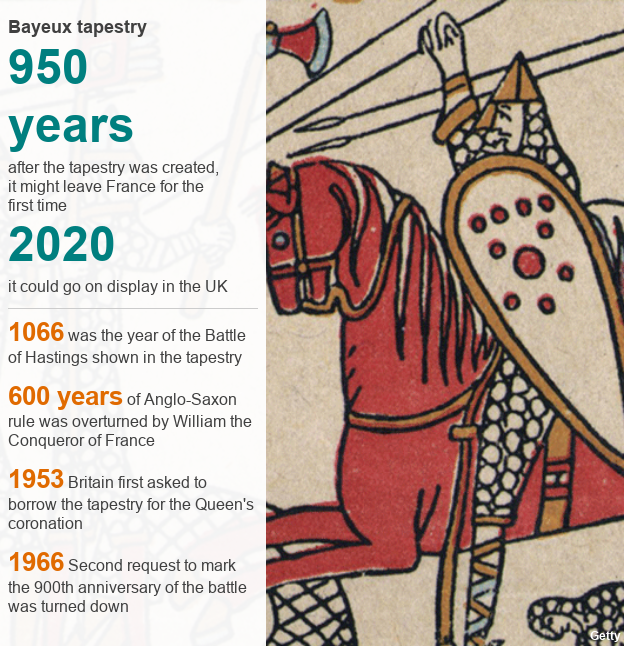
Facts and figures about the tapestry
Historians have long debated the origins of the tapestry, which is 70m (230ft) long and 50cm high.
The earliest written reference to it is an inventory from Bayeux Cathedral in 1476, but little is known about how or why it was created.
According to Reading Museum, which houses a replica of the tapestry, it was "probably commissioned" in the 1070s by the half-brother of William the Conqueror - the Bishop Odo of Bayeux.
Some say it was created by teams of nuns across England - not France - possibly in Canterbury, Kent.
In 2012, a PhD researcher at the University of Manchester said the artwork's needlework was "consistent throughout", suggesting one group of specialist embroiderers worked on it, in the same place at the same time.

What does it depict?

The tapestry shows the events leading up to the Norman takeover of England.
It starts with Edward the Confessor, who became king in 1042, on the throne and tells the story of his death and the questions over who was the rightful heir.
In 1066, on the day of Edward's funeral, his brother-in-law Harold was crowned king.
News of his appointment reached France and William of Normandy, who claimed he should be king as Edward had promised him the throne of England.
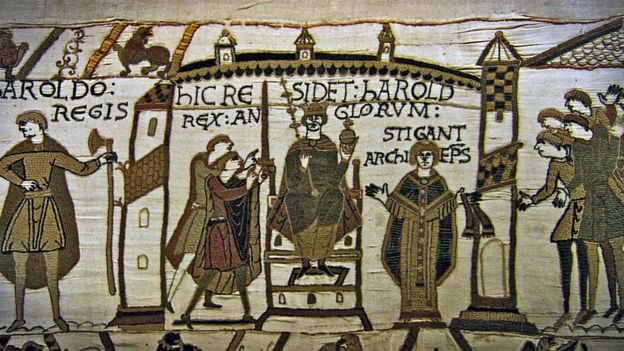
Harold is crowned king after the death of Edward the Confessor
Image captionHarold is crowned king after the death of Edward the Confessor
On 14 October 1066, William I and King Harold II came to loggerheads at the Battle of Hastings - one of the most famous battles in English history.
It is likely both sides had between 5,000 and 7,000 men each when they met in battle at a hilltop near Hastings.
Thousands of soldiers were killed in a day of a fighting, which ended in King Harold II's death.
It was a turning point in history as it ended the Anglo-Saxons's long reign of more than 600 years.

Where has it been exhibited?
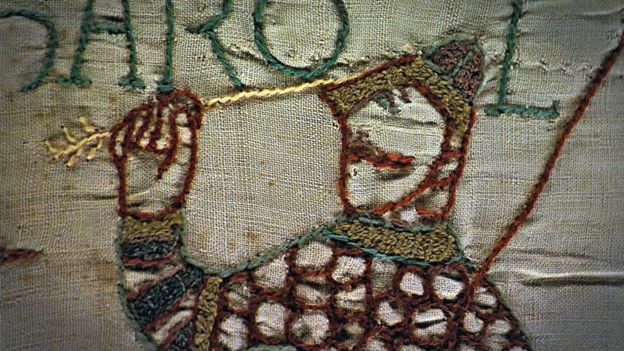
The tapestry shows a soldier being killed by an arrow in his eye, which could be King Harold
Image captionThe tapestry shows a soldier being killed by an arrow in his eye, which could be King Harold
Napoleon put the tapestry on display in Paris in 1804, while he was planning an invasion of England.
It was then exhibited in Paris for the second time in 1944, during World War II, before it was returned to Bayeux.
Mr Macron's offer comes after previous attempts to bring the tapestry to Britain failed.
One request is thought to have been made ahead of the Queen's Coronation in 1953, while another was made for the 900th anniversary of the Battle of Hastings, in 1966.
Some have suggested the tapestry could be relocated to the British Museum if it gets the go ahead to come to the UK.
Dr Michael Lewis of the museum told the Victoria Derbyshire programme 1066 was a date "we all know" from being at school so it would be "amazing" if children could go and see the tapestry.
"For the wider public, people will be amazed about how long it is, and it definitely has a real impact when you see this work of art," he added.

Can it be moved?

Tests will decide if the tapestry can be moved safely and get to the UK in one piece.
BBC History magazine's Dr David Musgrove says its size, age and obvious fragility makes moving it a concern.
But he told the BBC Radio 4's Today programme moving it would also present an opportunity to conduct some interesting historical research on its dyes and fabrics.
Source: http://www.bbc.com/news/uk-42713552

Thursday, April 17, 2014

The Alliance Française Of Philadelphia To Exhibit Remarkable WWI Photos And Film Collection Of American Women Rebuilding France, 1917-1924


An Exhibition of Remarkable WWI-Era Photos and Film footage from 1917 to 1924 –
May 2 Reception and Talk by J.P. Morgan relative

The Alliance Française of Philadelphia, 1420 Walnut Street, 7th floor, Philadelphia, PA 19102, is hosting the exhibition AMERICAN WOMEN REBUILDING FRANCE, 1917-1924, from the
Anne Morgan Archives of the Franco-American Museum, Château de Blérancourt, France with the support of American Friends of Blérancourt and the Florence Gould Foundation. The opening tour of the exhibit is at 5:30 PM on Friday, May 2, 2014, followed by a talk by Miles Morgan, grand-nephew of J.P. Morgan, and refreshments at the Land Title Building, 100th South Broad Street,10th floor. The Exhibition
will be open from April 28-May 12, 2014.

The exhibition consists of reproductions of WWI-era photographs and rare silent film footage that bring to life the extraordinary work undertaken between 1917 and 1924 by 350 American women—all volunteers—who left comfortable lives in the United States to help the war-ravaged civilian population in Picardy, in northeastern France. The dynamic leader of this effort was Anne Morgan, daughter of financier J. Pierpont Morgan. A “modern woman” well ahead of her time, Anne Morgan commissioned professional photographers to document the devastation in France: their work, which is shown here, was used in fundraising for the war efforts and for stimulating volunteerism. Anne Morgan went on to found the American Committee for Devastated France (CARD), which was focused on reconstruction. The volunteers helped with agriculture, livestock, providing health care and supplies, educating the children, teaching families home economics and actual re-building of war-torn areas. This special traveling exhibition originated at the National World War I Museum in Kansas City in 2010, and was then displayed at the Morgan Library & Museum in New York City. Since then numerous cultural centers, galleries, historical societies and libraries in various American cities have shown the exhibition and many more have scheduled it for the next few years. During this WWI Centennial year, commemorations of the “Great War” are taking place nation-wide, enabling Americans to better understand its profound significance to this day. “AMERICAN WOMEN REBUILDING FRANCE” powerfully shows what it meant in real human terms. This exhibition is made possible through the generous support of the Florence Gould Foundation, the French Ministry of Culture and Communication, and RMN l’Agence Photographique de France.


 THE FRANCO-AMERICAN MUSEUM, CHÂTEAU DE BLÉRANCOURT is a unique French national museum located in Picardy, a region in northeastern France. It was created in 1931 out of the destruction of World War I and the triumph of French-American solidarity. Its founder: Anne Morgan, a daughter of the well-known financier J.P. Morgan. Anne Morgan spearheaded aid and later reconstruction efforts in the region.

From the beginning the museum was the repository of one-of-a-kind historical documents attesting to this special relationship. In addition, it is the only museum dedicated to French-American relations The Franco-American Museum has also kept acquiring artwork by great artists focused either on French painters who chose American subjects or Americans who were trained or inspired by France. Thanks in part to the American Friends of Blérancourt’s success in fundraising, the Museum has been able to expand in size, adding sumptuous gardens and a brand new educational annex, and will reopen in 2016.

THE ALLIANCE FRANCAISE OF PHILADELPHIA  Since its founding in 1903, the Philadelphia Chapter of the Alliance Française  (nonprofit) has encouraged the study of the French language and literature, promoted French culture and fostered friendly relations between France and the United States with a uniquely Philadelphia touch, style and tradition.

The Alliance Française school has two campuses (Center City Philadelphia and Bryn Mawr College), a faculty of more than twenty and a yearly registration of 1500 students. The school offers a wide variety of courses designed to meet the needs of all students, from complete beginners to those who are fluent in French and want to further their conversational and/or grammatical skills as well as their knowledge of French civilization and culture.
AMERICAN FRIENDS OF BLERANCOURT (AFB) is an American philanthropic group based in New York with an office in Paris. It was created in 1985 at the suggestion of the Chief Curator of Paintings at the Louvre Museum (Pierre Rosenberg) to raise funds for the expansion, the gardens, and the new educational programs and technology of the Franco-American Museum, Château de Blérancourt in Picardy.

The founder and chairman, Mary-Sargent d’Anglejan-Chatillon, and president, Eugénie Anglès, have worked with a motivated membership to expand and make known a unique museum that celebrates four centuries of French-American friendship. AFB offers a variety of activities to its members including trips to private chateaux
in France and visits to private art collections and gardens in France and other countries, an annual gala dinner in New York, a traveling exhibition of historic photos and films from the Museum’s archives, and a student exchange program. For the Centennial Year observances, AFB has organized a unique guided tour of the major WWI sites around Paris and in northern France in October 2014.