Late last month, Nasa’s so-called “Flying Swordfish” blasted off from California – promising 925mph flights without a sonic boom – and aviation experts say that it could change the face of holiday travel.
Nasa and Lockheed Martin’s X-59 quiet supersonic plane has taken offCredit: Lockheed Martin
Concorde famously offered high-speed flights across the Atlantic.
But the sound of the sonic boom has always been a major block to allowing commercial supersonic flights over land.
To combat this problem, Nasa and Lockheed Martin have been developing an experimental X-59 aircraft that doesn’t create a sonic boom.
Instead it creates a sonic “thump”, which is 75PLdB (perceived decibel level) – or “about as loud as a car door closing”.
“From takeoff at our Skunk Works’ Palmdale facility to landing at NASA’s Armstrong Flight Research Center, everything performed exactly as planned,” Lockheed Martin said.
“The X-59 moved with the kind of confidence that comes from years of innovation, teamwork and cutting-edge solutions.
“This flight isn’t just a milestone – it’s momentum.
“We’re proving that the future of flight can be faster and quieter than ever before. And we’re proud to be leading the charge.”
The jet is just shy of 100 feet long, and is capable of reaching Mac 1.4 speeds of 925mph.
And it cruises at around 55,000 feet, which is far higher than a typical jet that would fly at altitudes of between 30,000 and 45,000 feet.
It has a wingspan of roughly 30 feet, stands about 14 feet tall, and has been branded the “Flying Swordfish” in science media due to its shape.
And that design is no accident: it’s specifically designed to allow for “quiet supersonic” flight.
“In collaboration with NASA’s Quesst Mission, the Lockheed Martin Skunk Works team is solving one of the most persistent challenges of supersonic flight – the sonic boom,” Lockheed Martin explained.
“The X-59 will be used to collect community response data on the acceptability of a quiet sonic boom generated by the unique design of the aircraft.
“The data will help NASA provide regulators with the information needed to establish an acceptable commercial supersonic noise standard to lift the ban on commercial supersonic travel over land.
“This breakthrough would open the door to an entirely new global market for aircraft manufacturers, enabling passengers to travel anywhere in the world in half the time it takes today.”
Lockheed Martin wants to fly the plane over populated areas to prove to “US and international regulators” that supersonic flight over land doesn’t need to be a major disturbence.
And the aerospace giant says that it “could bring us one step closer to quiet supersonic travel for passengers around the globe”.
The shape of the aircraft is designed to reduce the loudness of a sonic boom to a “gentle thump” – at least as you hear it on the ground.
The X-plane does this by separating the shock waves that produce the sonic booms to make them quieter.
“The resulting supersonic ‘heartbeat’ is dramatically quieter than the disruptive N-wave boom generated by today’s supersonic aircraft”, Lockheed Martin said.
Sadly, it’s still unclear how long it will take for over-land supersonic commercial flights to become a reality.
Nasa and Lockheed Martin will need to conduct more tests to give flight watchdogs enough info to make a decision on their regulations.
And once those types of flights are approved, it will still take time for commercial aircraft to be built using a quiet supersonic design and then adopted by airlines.
According to the latest Longwoods International tracking study of Canadian travelers, 56% of them do not intend to travel to the U.S. in the next 12 months, down from 61% in April. Of those Canadian travelers whose travel decisions are being influenced by U.S. policies and politics, 76% cited U.S. tariffs and economic policies as a negative influence, while 69% pointed to political statements by U.S. leaders as a negative factor. Canadian travelers also had negative reactions to political discontent in the U.S., U.S. rhetoric about Canadian sovereignty and U.S. positions on various social issues.
“The slight improvement in potential Canadian travel to the U.S. is encouraging,” said Amir Eylon, President and CEO of Longwoods International. “But the U.S. Travel Association predicts that international visitation to the U.S. will decline from 72.4 million in 2024 to 67.9 million this year largely because of fewer Canadian arrivals.”
The percentage of Canadian travelers postponing their U.S. trip declined to 22%, down from 29% in April. At the same time, more travelers are shortening their U.S. trips, 15% vs 10% in April.
The survey was fielded October 9 to 15, 2025 using a national sample randomly drawn from a consumer panel of 1,000 Canadian adults, ages 18 and over. The sample is representative of Canadian demographics for age, gender and province.
Longwoods International is a leading travel and tourism research consultancy with headquarters in Columbus, Ohio and Toronto Canada, and offices in Illinois, Indiana, Michigan, New York, North Carolina, Tennessee, and Wisconsin. It conducts Longwoods Travel USA®, the largest ongoing survey of American travelers, as well as image, advertising effectiveness, advertising return on investment, sentiment, and other custom research in 12 countries around the globe.
More Information – Longwoods International: https://longwoods-intl.com/
To help you pick a ski resort for your next winter trip in United States, we looked to pro skiers, snowboarders and ski industry experts for their recommendations of the top ski resorts to visit in United States in 2015/2016. These top skiing resorts have everything you need for your ski vacation: plenty of snow, great terrains, gorgeous scenery, fine accommodation, excellent ski schools and offer great variety of winter activities.
Located in Teton Village, Wyoming, just south of the Grand Teton National Park, Jackson Hole is home to some of the most hair-raising slopes in United States. The resort is notorious for steep terrain and amazing scenery, the perfect stomping grounds to many of the world’s best freeskiers. The ski area receives an average of 450 inches of snowfall each year and boasts a vertical of more than 4,000 feet.
Located southeast of Salt Lake City, Alta Ski Resort is one of the oldest ski resorts in America (opened back in 1939) and has a high altitude with a base elevation of 8,530 ft. Whatever your ability, Alta Ski Resort has skiing terrain for you. Deep powder snow, soft groomers and gorgeous scenery help to create a memorable skiing experience. While known for expert powder slopes, Alta also has great beginner and intermediate terrain.
Snowbird, Utah, a four-season resort located up Little Cottonwood Canyon, just 6 miles east of Salt Lake City, Utah. All of Snowbird’s 3,240-foot vertical can be conquered in one lift ride via the resort’s aerial tram. This is the place where snow, luxury and terrain come together in a balance nearly unmatched anywhere else.
Vailis the ultimate Colorado ski resort. Its base elevation is modest for Colorado standards, at 8,120 feet, but that keeps oxygen a little plentiful for skiers pouring in from elsewhere. Vail Ski Resort is home to seven legendary back bowls spanning seven miles across the backside of the resort. The resort has great terrain options, excellent ski schools, and a large assortment of shopping and dining options.
Telluride Ski Resort is a ski resort located in Mountain Village, Colorado right next to the Town of Telluride. Mountain Village, which is effectively mid-mountain at Telluride, is at 9,545 feet, and the highest lift takes skiers to an elevation of 12,255 feet. All that altitude keeps snow cold and dry, fighting warming events well into mid-spring months. Averaging more than 300 inches of snow annually to match its 300 days of sunshine each year; Telluride is a Colorado ski bucket list classic.
Alyeska Resort is a ski resort in Girdwood, Alaska, some 27 miles from the city of Anchorage. Mount Alyeska is part of the Chugach mountain range and the Alyeska Resort is the largest ski area in the state. Alyeska Resort has built its reputation on steep terrain and deep snowpack, as the resort receives 650 inches of snow at the summit annually and offers 1,610 acres of accessible terrain.
Aspen Snowmass is a winter resort complex located in Pitkin County in western Colorado in the United States. Anywhere else, this would be considered four separate vacations, but not in Aspen, where skiers will find more than 5,300 acres of terrain between Snowmass, Aspen Mountain, Aspen Highlands and Buttermilk.
Grand Targhee runs a cat skiing operation out its backdoor, which gives skiers access to over 600 acres of terrain that’s often untracked powder. Riders get an average of 12,000 to 15,000 vertical feet per day, with 2,000 vertical feet per run. The resort offers a long list winter activities including snowshoeing and fat biking.
Park City Mountain Resortis a ski resort in the western United States in Park City, Utah, United States. Park City offers top ranked ski and snowboard facilities, with 7300 acres of terrain. During summer of 2015, the resort undertook the largest resort improvement project in the history of American skiing, linking it with neighbor Canyons Resort to create the United States’ largest ski area.
Taos Ski Valley is located in the Sangre De Cristo Mountains in Northern New Mexico,United States. The resort grants access to nearly 1,300 acres of skiable terrain and receives an average 300 inches of snowfall annually. The ski area has a great mix of terrain providing trails for all ability types and is home to one of the country’s highest rated ski schools.
A giant Uncle Sam balloon on 6th Avenue during the 2013 Thanksgiving Day parade. Photograph: John Minchillo/AP
The Design Museum asked New York architecture critic Julie Iovine to sum up the spirit of her city in 50 design icons. Here are 10 of her favorites
Macy’s Thanksgiving Day balloons
What is six stories tall, nine metres wide and 18m long? Any kid at heart in New York City knows the answer: Macy’s Thanksgiving Day parade balloons. Of the more than 50 on show each year, the largest, character balloons – whether Kermit the Frog, Snoopy, Dora the Explorer or Spider-Man – are so huge (weighing a minimum of 54kg/120lb) that each one takes up to 70 handlers to keep them tethered and afloat during the parade’s three-hour march to Macy’s home in Herald Square.
The parade, made even more famous by the 1947 Christmas classic Miracle On 34th Street, first took place on 27 November 1924. It was organised by Macy’s employees and, for the first few years, started in Harlem at 145th Street, rather than at the Natural History Museum on Central Park West. Originally, the parade included camels, donkeys, elephants and goats from the Central Park Zoo, with Santa Claus bringing up the rear on the last float – an ongoing tradition. But in 1927 the live animals were replaced by rubber balloons. The first character was Felix the Cat, made by a marionette-maker. In 1934 Mickey Mouse made his debut; Donald Duck arrived only in 1962. Today the chosen characters are an annual litmus test of pop-culture icons.
Most of the balloons are fabricated in a former Tootsie Roll factory called Macy’s Parade Studio, in Hoboken. Consultants in engineering and aerodynamics calculate each character’s flying pattern – vertical, horizontal or in between. Painted clay models are made to scale before the fabric is cut. The balloons were made of rubber up until World War II but are now made of polyurethane, with multiple chambers for all that helium.
The Macy’s Thanksgiving Day parade is attended by some 3.5 million people and watched by 50 million more on television. But for many New Yorkers the most memorable event takes place the night before the parade, when people are allowed to gather at 77th Street and Columbus Avenue to watch the gargantuan figures come to life as they are inflated through the night.
Anthora coffee cup
Leslie Buck designed the classic paper coffee cup in 1963. Photograph: AP
Whether crumpled in a trashcan or stacked on the shelves of the Museum of Modern Art design store, the New York coffee cup is instantly recognisable with its white-on-blue stencil, Greek key trim and three golden cups of steaming brew beneath the chiselled message, “We are happy to serve you”.
It is the to-go paper cup that launched a thousand Manhattan meetings (every morning) and served as instant shorthand for readymade New York attitude on innumerable television shows, from NYPD Blue to Mad Men.
Leslie Buck designed the paper coffee cup in 1963 as a gimmick to appeal to the Greeks who had taken ownership of many of the city’s coffee shops. Buck (originally Laszlo Büch, a concentration camp survivor from Ukraine) was an executive of the Sherri Cup Company in Connecticut. He made the cup blue and white like the Greek flag, added amphora-shaped vessels to the seams and called it the Anthora. It was an instant success.
At its peak in 2004, the company sold 500m of the cups, before merging into the Solo Cup Company. Ultimately, the cup design was retired from active sales, and took up a profitable new life as an iconic graphic appearing on key chains, cufflinks and ceramic mugs. Sightings of the real thing have become rare these days, as are the Greek diners themselves.
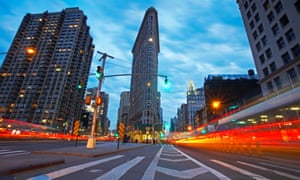
The 1902 Flatiron Building was nicknamed Burnham’s Folly by unhappy locals. Photograph: Allan Baxter/Getty
Never the tallest New York building but from the start one of the most inspiring to artists, the Flatiron Building is that wedge of steel, limestone and decorative terracotta forging skyward from the odd-shaped block created where Broadway and Fifth Avenue converge and cross below Madison Square.
Almost as soon as the Flatiron was built in 1902, Alfred Stieglitz photographed it in snowy twilight, balancing a crooked tree branch against its blackened geometry. Childe Hassam painted it in numerous portraits celebrating city life. HG Wells admired the way it went “ploughing up through the traffic” and Joseph Stella put it at the centre of his 1922 skyscraper-romancing five-panel, Voice of the City of New York Interpreted. Then, as now, the Flatiron possessed more stature than its modest 22 storeys would suggest, embodying in its unconventional shape and Renaissance detailing the dynamic thrust and romanticism of the city as it started to flex its powers.
Originally named the Fuller Building, the Flatiron was designed by the prominent Chicago firm DH Burnham & Co (Burnham was the architectural mastermind of the 1893 World’s Columbian Exposition) as the headquarters for the Fuller Construction Company. It was not always so popular with critics, who complained that there were too many windows, leaving no walls for bookcases and desks. And its early nickname, Burnham’s Folly, hints at the temporary reluctance of New Yorkers to accept the inexorable transformation of Madison Square from a posh residential neighbourhood into a hub of commerce. Soon enough, however, the whole area became known simply as the Flatiron District.
The National Debt Clock pictured in 2008, when a new digit had to be introduced. Photograph: Bebeto Matthews/AP
The National Debt Clock, ratcheting away in Midtown, was the brainteaser conceit of real-estate developer Seymour Durst, who personally researched and uploaded the numbers to a dot-based segment display (replaced in 2004 by faster LEDs) until his death in 1995.
Now racing past $18 trilllion, the clock stood at $2.7tn when Durst first determined to alert taxpayers to the total debt – along with numbers indicating their own slice of responsibility. It cost him $100,000 to install the 3m x 7.6m billboard, which was originally located a block from Times Square and then later moved to its present location at 1133 Avenue of the Americas.
In 2000 the clock stopped – the national debt was actually decreasing and the clock was not equipped to run backwards. It started up again in 2002 at $6.1tn and caused a brief, unfounded news flurry when it reached $10tn in 2008 and the clock seemed to have run out of digits.
The National Debt Clock is not the only counter around. In Union Square there is the Metronome, a 1999 art installation by Kristin Jones and Andrew Ginzel with a 15-space digital clock investigating the “nature of time” by simultaneously ticking off the seconds, minutes and hours until and away from midnight.
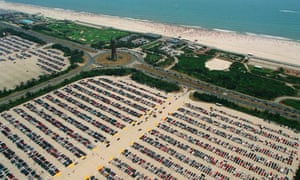
The 10-mile Jones Beach, created entirely out of dredged sand, has parking for more than 14,000 cars. Photograph: Stuart Ramson/AP
There is no understanding New York City today without factoring in Robert Moses, the 1920s “good government” functionary turned 1960s indomitable urban overlord, so brilliantly detailed in Robert Caro’s classic 1974 tome, The Power Broker.
Every expressway except the East Side Drive, seven major bridges, more than a thousand public housing towers, the United Nations, the Lincoln Center for the Performing Arts, 658 playgrounds and 673 baseball diamonds are just some of the projects he made happen, along with indiscriminate slum clearance, displacement of more than half a million people from their homes, and expenditure of more than $68bn (in 1968 dollars) on projects of his own devising, and almost entirely without accountability to city, state or federal government.
Moses’s ultimate dreams of an infinitely expandable car-centric metropolis, slashed by elevated super-highways and plugged full of mega-structures, were never fully realised – brought down by a middle-aged Greenwich Village lady, Jane Jacobs, who countered his Goliath-like visions with an even more powerful antidote, neighbourhood-scale community. Moses’s reputation has never fully recovered.
And yet some of Moses’s early accomplishments improved city life for all in still-tangible ways, especially the parkways and beaches he created on Long Island in the 1920s. There, his sensitivity to good design – stone overpasses, each one different from the others; bevel-edged wooden guardrails; luxuriously proportioned parks – made good on his belief that “nothing is too good for the people of the Empire State”.
His culminating effort was the 10-mile stretch of Jones Beach on the Atlantic, created entirely out of sand dredged from Jamaica Bay with parking for more than 14,000 cars, a water tank modelled on a Venetian bell tower, and an 8,200-seat amphitheatre (added in 1952) with an orchestra island set off by a moat. This middle-class leisure landscape – constructed in the teeth of violent opposition from Long Island’s Gatsby-esque estate owners – was entirely free to the public and of a standard, scale and quality rarely, if ever, since matched anywhere else in the world.
Current starting pitcher Michael Pineda sports the Yankees’ interlocking logo, designed in 1909. Photograph: Noah K Murray/USA Today Sports
Arguably the most famous logo in sports history, the interlocked N and Y of the Yankees’ insignia, worn on cap or T-shirt, is the sign of a true New Yorker, either in the flesh or spirit. The 1909 logo not only predates the white-with-pinstripes home uniform from 1936 (the oldest in Major League Baseball), but even precedes the team name: the Yankees were once known as the Highlanders, after the Hilltop Park ballpark at West 168th Street where they played until 1913.
The logo’s origins are a classic instance of cross-pollination in a city where money, power and style have always mixed. It was a former Irish police chief turned team owner who appropriated the distinctive lettering from an 1877 commemorative medal (honouring a policemen killed in the line of duty) that had been designed by Tiffany & Co, the luxury merchandiser.
In a sport as obsessed with traditions as it is with players’ statistics, the Yankee insignia is prized above all else: Sports Illustrated magazine keeps a running record of celebrities in Yankee regalia. Or, as New York Times reporter Richard Morgan put it: “The [Yankees] logo is just flat-out quintessential, distilled, pure New York.”
Water tanks at sunset on Manhattan’s Upper West Side. Photograph: ID8843724/GuardianWitness
As urban icons go, the water tanks of New York seem one of the most primordial, with their rudimentary wooden materials, ubiquitous hut-like silhouettes, and sludge at the bottom of the barrel. They remain graphic holdovers from the moment when New York City burst through the barrier of being a low-rise trade town on its way to becoming a skyscraper city
These water tanks became necessary when buildings grew taller than six storeys – too high for the pipes channelling water down from the Adirondack reservoirs. With tanks on the roof, water could be pumped up and then gravity would do the rest, maintaining water pressure below for everything from taps to toilets to fire hydrants. It still does.
There are around 15,000 water tanks in the city – virtually all installed and maintained by two families that have been in business since the 1860s: the Rosenwach Tank Company in Queens, and Isseks Brothers of Manhattan. Canadian cedar is the material of choice because it is lightweight enough to haul up to the roof, and because three inches of wood insulates as well as 24in of concrete.
Fashioned in the same way as barrels and strapped with galvanised steel bands, the wood expands when wet to stop leaks without the need for adhesives. The barrels can hold up to 37,850 litres (10,000 gallons) of water, and can last as long as 35 years.
By the 20th century, water tanks had become an enduring emblem of the city. In 1971, dancer and choreographer Trisha Brown composed her Roof Piece with dancers flitting against a backdrop of water tanks; in 1998, British artist Rachel Whiteread, looking for something quintessentially of the city, cast a water tower in resin for her first New York installation on a rooftop in SoHo.
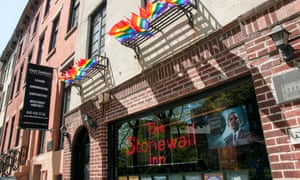
The Stonewall Inn was turned into a gay bar by the mafia in 1966. Photograph: Alamy
Long before the letters LGBT signalled anything, there was The Stonewall Inn at 51–53 Christopher Street. It was a dumpy nondescript joint in Greenwich Village but events here launched the gay liberation movement.
Originally a stables, then a speakeasy in the 1930s, The Stonewall Inn was turned into a gay bar by the mafia in 1966. It was the largest in the city, and the only one that allowed dancing. Inside, there was a long black plywood bar sturdy enough to support cross-dressing go-go dancers, a jukebox and a light bulb dangling from the ceiling that flashed to alert patrons to the frequent police raids.
But on the night of 28 June 1969, when some half-dozen police officers turned up, the patrons refused to budge and a riot broke out that lasted three days. However spontaneous and disorganised, it was the first time that gay, lesbian, bisexual and transgender people and Villagers had all united in common cause – and the world took notice. Within two years, there were gay rights groups in every major city in the United States and many other countries worldwide.
The Stonewall Inn itself lost its lease just three months later. A variety of local businesses occupied the space; renovations and alterations were made, but the spot has remained a touchstone site for gay people who set out from Christopher Street every June for one of the wildest, most inspired annual parades in the city. In 2000, The Stonewall Inn was made a National Historic Landmark.
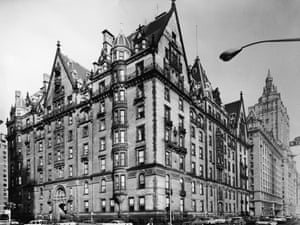
Completed in 1884, the Dakota was New York’s first luxury apartment building. Photograph: Authenticated News/Getty Images
The Dakota, so named because it was so far away from any place that mattered when it was built in 1884, has always stood out. Stranded on the edge of 72nd Street, across from a brand-new Central Park, the Dakota was not only the city’s first luxury apartment house but also, at a stately nine storeys, one of the tallest buildings in the city. A famous photograph from the 1890s shows skaters on a pond with the Dakota behind standing in splendid isolation.
Advertisement
It was developed by Edward Severin Clark, president of the Singer Sewing Machine Company, and designed by Henry J Hardenbergh, architect of the Plaza Hotel, in German chateau style. Facade ornaments play up the pioneering theme with carved arrowheads, ears of corn and the figure of a Dakota Indian over the entrance. Dragons are coiled around the cast-iron exterior railings for good measure. Loaded with luxurious innovations including its own electric generator, a wine cellar and nine-inch layers of sand and concrete between floors (for soundproofing), the Dakota was sold out before it was completed, although it attracted merchants and business folk rather than the high society Clark had hoped for.
Ultimately, the Dakota became best known for the many artists and performers in residence, including Lauren Bacall, Leonard Bernstein, Rudolf Nureyev, Judy Garland and, most famously, John Lennon, who was shot while leaving the building on 8 December 1980. Strawberry Fields, the memorial to Lennon organised by his widow, Yoko Ono (not without controversy when members of the city council attempted to have the spot dedicated instead to another song man, Bing Crosby), is right across the street from the Dakota in Central Park. Thousands converge there each year to enjoy the strawberry bushes and a mosaic, Imagine, donated by the city of Naples.
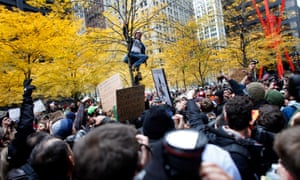
Open to the public 24/7, Zuccotti Park was an ideal camping ground for Occupy Wall Street protesters in October 2011. Photograph: Allison Joyce/Getty Images
Originally named Liberty Plaza Park, Zuccotti Park has since become famous as the granite-paved strip between Broadway and Church at Liberty Street where the protest group known as Occupy Wall Street (OWS) set up their camp in the autumn of 2011.
The choice of Zuccotti Park was no coincidence. Not only is Wall Street two blocks away, Zuccotti Park also turns out to be one of the city’s little-understood POPS, or “privately owned public spaces”. There are over 520 POPS around the city, often adjacent to the corporate towers that created them as concessions to building taller.
The Pittsburgh-based US Steel installed Liberty Plaza Park in 1968 as an added obligation mandated by 1961 zoning laws. Unlike public parks that close at curfew or POPS designated in later years that close from dusk to dawn, Liberty Park would be kept open 24 hours a day. In 2006, new owners renamed it Zuccotti Park.
It is said that the OWS organisers had planned to take over Chase Manhattan Plaza – more symbolically potent when targeting banks – but it was closed. Perhaps it was an urban planner among them who alerted the group to the technicality that made it very difficult to dislodge protesters from what they insisted on calling, once again, Liberty Park. Meeting tents, a kitchen, a generator and even a library were all part of the OWS encampment for more than two months, before a court order forced them to leave.
A clash on New Year’s Eve 2011 between 500 “We kick the ass of the ruling class” protesters and the NYPD was the last confrontation before the movement subsided, and Zuccotti Park resumed its life as a lunchtime retreat for office workers.
New York in Fifty Design Icons by Julie Iovine & The Design Museum is published by Conran Octopus (£12.99). Follow Guardian Cities on Twitter and Facebook and join the discussion