Showing posts with label #BritishAirways. Show all posts

Tuesday, July 3, 2018

British Airways’ Parent Company Has Launched A Budget Carrier Called 'Level'

British Airways is not a government-owned airline. The airline merged with Iberia in 2011 to form International Airlines Group (IAG).

British Airways’ parent company – International Airlines Group – has decided to spread its wings into low-cost short-haul flying with a budget carrier called ‘Level’.
‘Level’ may sound familiar – the group launched an airline with the same name earlier this year to fly low-cost long-haul flights from Spain to the USA.
karryon_level_airlines_staff
The new short-haul carrier is taking off on 17 July and will be based out of Austria where it will operate on 14 routes, including Vienna to London (Gatwick), Barcelona, Paris, Milan and Dubrovnik.
Initially, the carrier’s fleet will be made up of Airbus A321s fitted with Premium Economy and Economy. Each cabin comes with seat-back entertainment screens.
karryon_level_economy_airlines
The airline’s A321 has Premium Economy & Economy (pictured) cabins.
IAG Chief Executive Willie Walsh said ‘Level’ delivers more choice for those flying around Europe, while also contributing to Vienna’s economy by creating 200 jobs and providing affordable, reliable flights.
“We’re really excited about LEVEL which offers amazing fares, stimulating demand by providing people with more choice.”
Willie Walsh, IAG Chief Executive

Monday, May 29, 2017

Passengers Affected By British Airways IT Problems Eligible For Compensation

The airline was forced to ground all flights in Heathrow and Gatwick airports on Saturday after it experienced an IT system outage around the world. The disruption has continued to cause flight irregularities over the past few days.
Eve Buechner, founder and CEO of refund.me, strongly urges affected travelers to claim compensation from the airline. According to EU Regulation 261/2004, airlines are obliged to pay compensation to passengers who are delayed by more than three hours on arrival at their final destination, unless they can prove the disruption was caused by extraordinary circumstances.
“An IT failure is most likely the responsibility of the airline, and it is therefore legally required to compensate its passengers,” says Eve Buechner. “A situation like this cannot be regarded as an extraordinary circumstance beyond BA’s control.”
Delta experienced a similar incident in August last year, when a computer failure delayed tens of thousands of passengers. Unlike British Airways, Delta is not a European carrier and therefore not bound by EU law. However, refund.me was able to successfully secure compensation for passengers whose journeys departed from EU member states.

Friday, March 24, 2017

$149 Europe Fares? British Air Parent Rolls Out New Budget Airline

Image result for Level airlines


A new European budget airline is making waves selling bargain-basement fares between the USA and Europe. But this new discounter isn’t some fly-by-night upstart. Instead, it’s the work of British Airways' parent company International Airlines Group (IAG).
Level officially launched last week, its $149 one-way fares from California to Barcelona selling at a pace so brisk the carrier’s website strained under the demand. Level sold more than 64,000 tickets during its first 48 hours of sales, according to IAG.
That a major airline company like IAG has launched its own stand-alone budget carrier underscores a new wave of competition on trans-Atlantic routes. Fast-growing discount carriers Norwegian Air and WOW Air of Iceland have added dozens of new U.S. routes in recent years. Fares from the U.S. to Europe have dropped as low as $65 one-way as those airlines have added new routes and destinations.
So, for IAG – whose holdings also include British Airways, Iberia, Aer Lingus and Spanish low-cost carrier Vueling – Level is in part a way to fight back against its growing discount rivals. But IAG CEO Willie Walsh says it’s also an attempt to exploit a market that the company believes can be profitable.
Level’s first flights will come this June when it begins flying four routes with Airbus A330 aircraft. All of the carrier’s initial routes will operate from Barcelona. Two will go to California: Los Angeles launches June 1 while Oakland begins June 2.  The others will go to Punta Cana (June 10) in the Dominican Republic and to the Argentine capital of Buenos Aires (June 17).  Level will fly twice a week from L.A. and three times a week from Oakland.
Walsh says Level could be flying as many as 30 widebody A330s within five to seven years, expanding to additional cities across Europe and the Americas.
“Our ambition here goes way beyond what we’ve just announced,” Walsh said in an interview with Today in the Sky. “We’ve made it clear that we think this is a segment that can be competed (for) by IAG profitably. We wouldn’t do it if we didn’t believe we could be profitable.”
Of course, a number of industry observers have directly connected IAG’s effort to launch Level to one rival in particular: Norwegian.
Norwegian now flies dozens of routes between the U.S. and Europe. It’s set up one of its biggest bases at London Gatwick, an airport that  perhaps not coincidentally is British Airways’ second-busiest base. And Norwegian flies several of its newer U.S. routes from Barcelona, which is in the backyard of IAG units Iberia and Vueling and also where Level will launch its first flights.
Stoking the trans-Atlantic competition even further, Norwegian made headlines earlier this year by announcing a set of U.S. routes from the Northeast, putting flights on sale for just $65 from cities like Providence; Hartford, Conn.; and Newburgh, N.Y. The routes go to Irish and Scottish destinations that each sit close to the main networks of both British Airways and Aer Lingus.
Despite the increasing competition, Walsh pushes back against the idea that Level is aimed solely at Norwegian.
“I can understand why people take that view,” Walsh says, adding: “It’s much more broad than that.”
Walsh says IAG thinks there’s money to be made by moving into the market for budget trans-Atlantic flights.
“We go where the demand exists,” he says. “We’re very much focused on return on invested capital. We wouldn’t do this if we didn’t believe that the business is capable of generating the returns that we’ve targeted.”
Still, Walsh acknowledges the role Norwegian has played in helping to prove the segment is a viable one.
“We give credit to Norwegian for trailblazing some of the issues,” Walsh says about Norwegian’s aggressive attempt to bring a low-cost pricing structure to trans-Atlantic routes. “They’ve clearly demonstrated that the trans-Atlantic product can be unbundled.”
And while he does admit Level will give IAG a new tool to go up against Norwegian, Walsh insists IAG has lofty ambitions for Level.
"I’ve been very supportive of Norwegian in their applications for route licenses and approvals. I’ve made it clear that we will respond to what Norwegian is doing with a competitive response," Walsh says. "You could argue this is part of that competitive response, but it’s bigger than that. We believe this is a segment of the market that actually represents a great opportunity for us."

By , USA TODAY
Follow us @TraveloreReport

Saturday, November 19, 2016

Iran Tourism For Women: Safe Or Not Safe?

Image result for Iran tourism for women: Safe or not safe?


With sanctions on Iran being relaxed and airlines including British Airways reintroducing direct flights to Tehran, Iran is once again attracting foreign businesses and travellers. Having just returned from a one-month self-drive tour of the country, I can assure you the destination has much to offer.

Justine Oliver is an independent travel security specialist with extensive global expertise, who specialises in solo female travel. For the last 16 years she has advised multi-nationals, NGO’s, media organisations, educational establishments, companies and individuals how to operate safely abroad. From 2001 to 2015 Justine worked for Control Risks and then a joint venture between Control Risks and International SOS in London, providing all elements of travel security, incident and crisis management, business continuity and security solutions to clients around the globe. During this time, Justine delivered regular training to clients operating abroad or sending new travellers and ex-pats into foreign environments. She conducts training, both via webinar and faceto – face, to individuals and groups across Europe. Before specialising in travel security, Justine lived in Hong Kong for four years where she worked in development for the Hong Kong Cancer Fund. On leaving South East Asia, instead of flying home, Justine decided to spend 10 months sailing a 30-footsailing boat back to London with her future husband. During this time, Justine honed her writingskills by documenting her trip and her resulting articles were serialised in Yachting Monthly. Justine has travelled to and worked in more than 58 countries and has just returned from a five-month trip with her husband and two children, self-driving a 1957 Land Rover to Iran and back. Justine holds a degree in Combined Studies from Newcastle University. She currently lives in South West France.
Business, culture, history, landscape, food and the people are just some of the compelling reasons to travel to Iran, but one of the main barriers to visiting the country for many people is often their colleagues and friends asking ‘is it really safe to travel there?’
Western media often portrays Iran negatively. There is a widespread misunderstanding about the true nature and safety of the country, which is tainted by the reputation of some of its more politically unstable neighbours.
That’s why people are often stunned when they are told Iran, with the exception of a few  locations, is considered a low-risk country and a safe destination to visit.
As a travel security consultant, specialising in women travellers, here are my top 10 tips to ensure visitors have a safe and fascinating trip to Iran.
CRIME
Crime rates are low in Iran and many women travel to the country alone without facing any issues. As with travel to any destination, you should always take basic, common-sense precautions, such as not visiting isolated places after dark or finding yourself alone with men you don’t know. The rates of petty crime such as bag snatching and pick-pocketing are far lower than in western countries and serious crime against foreigners is even more rare.
CULTURAL DIFFERENCES
The main danger for women travellers is falling foul of cultural sensibilities. The country is Islamic and as a woman you are restricted in terms of your dress and behaviour. The risks to women are two-fold; the religious authorities and attracting male attention unintentionally. The latter is much less likely than in other Muslim countries such as Egypt and Pakistan, where it is not unusual to feel harassed by unwanted male attention. Iranians are incredibly friendly and welcoming, but are also very respectful of your personal space. You are extremely unlikely to be groped in Iran.
It is considered very rude to approach a woman without being invited to do so. You may well be stared at by both men and women, but this is likely to be from genuine curiosity and excitement that you are visiting their country. When making friends in Iran, which you surely will as Iranians are some of the friendliest people on earth, you need to be careful of making western-style eye contact with men in the group as you will cause them to feel uncomfortable or worse, they may take your eye contact as an invitation. Wearing sunglasses can help avoid inadvertently making eye contact with people you are not engaged in conversation with. Touching, patting on the back, shaking hands with males and other physical contact is not advisable.
CLOTHING
The religious authorities do pose a threat to women travellers and it is very important to adhere to the strict dress code by wearing the ‘Hijab.’ The word hijab can mean both ‘headscarf’ and ‘modest dress’, but in Iran it means that your hair and body should be totally covered and your upper body covering should not be too tight fitting and should hang low enough to cover your bottom.
Iranian women are roughly divided into two groups with more religious women tending to wear the ‘chador’ meaning ‘tent,’ a shapeless black gown that covers their entire body. The other group wears bright colours, and usually a ‘manteau,’ or thigh-length, lightweight coat over jeans. Testing the limits of what is allowed seems to be an Iranian sport, particularly in Tehran, but the Islamic police do patrol the streets and pull people in for inappropriate dress. Each city seems to have different standards and in more religious cities like Qom you will not feel comfortable in your brightly-coloured manteau and will want to wear neck-toankle loose-fitting black garments, as well as socks if you are wearing sandals.
Follow the guidance of local people. It is better to be more conservative and for locals to tell you that you can shed layers rather than for them to signal for you to cover up.
COVERING YOUR HAIR
No one veils their face Iran, but every woman past puberty must cover their hair and décolletage. In reality, every town and city follows these rules to a greater or lesser degree. In Tehran you will see some women with most of their hair uncovered and their head-scarves just pinned to the back of their heads, whereas in Tabriz, no one will have any hair showing at all. Take some hairpins to help keep your veil in place and be sure to remember it every time you leave your hotel room and leave your hotel room for breakfast.
EATING AND DRINKING
One of the things women dislike about travelling on their own is eating alone. Iranians are so friendly and joyful that it is unlikely that you will have to endure much solitary dining. Due to social constraints, men are unlikely to approach you but it is very likely that Iranian women, in groups or with their family, will invite you to dine with them. Don’t be surprised if they pay for your meal even if you have declined to join them!
ALCOHOL
Alcohol is illegal in Iran, but if you are invited to an Iranian family’s house, you may well be offered it. Be prudent in your assessment of the situation. There are harsh penalties for drinking alcohol and there is always the possibility that your guide or another guest may report the fact you drank alcohol to the authorities.
PUBLIC TRANSPORT AND GENDER SEPARATION
Public transport is safe to use but aside from the Tehran Metro, it is probably not the ideal mode of transport for a business traveller.
The Tehran metro is cheap, clean, air-conditioned and easy to navigate. At the front and rear of each train are women-only carriages. These were implemented for gentlemanly reasons rather than being sexist or discriminatory and can provide a less crowded and more comfortable experience, particularly during the rush-hour crush in the central carriages. Women may enter other carriages alone or with male colleagues.
Other modes of public transport also feature women-only sections and separation may be enforced on some buses.
TOILETS
Toilets are definitely a low point in what is otherwise a highly sophisticated society. Surprisingly, they are not always segregated. It is not uncommon to visit the bathroom in a restaurant to find that you have to walk through the men’s toilets to get to the women’s section. There is however always soap for which one is most grateful!
SWIMMING
The majority of hotel pools are not segregated, so unfortunately women cannot use them or even sit by them even if wearing the hijab. There are some segregated beaches, where the female swimming section is screened off, but these are few and far between.
ROAD TRAFFIC INCIDENTS
The main roads in Iran are very good quality, but driving standards are poor. Always check that your vehicle has working seat belts and sit in the back. Drivers will attempt to drive as quickly as they can; ask them to slow down if you are concerned and feign motion sickness if you are making no headway.
Cities are safe to walk around and often you will be in the shade of trees, even in cities, however crossing roads can be daunting, even at official crossings. Always look both ways even on one-way streets, especially when you near the pavement again. You may find it easier to ‘tag’ onto a local and cross in time with them. Even while safely sticking to the pavement, be aware of scooters travelling from both directions.
CONCLUSION
Iran is a fantastic country to visit. Certain nationalities still have visa complications and journalists or those involved in human rights can face greater risks, but for the average traveller, a wonderful trip awaits.

Monday, December 14, 2015

Prague: Finding A New Edge

people inside a cool cafe
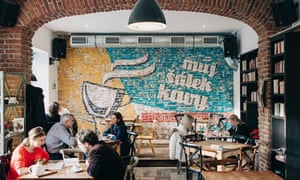
Fresh start: Muj šálek kávy, a speciality coffee shop in Karlín. Photograph: Ondrej Horak
With Old Prague now tourist central, David Farley follows local artists and hipsters to the Czech capital’s newly transformed outer neighbourhoods

The barista with the Salvador Dalí moustache refused to bring milk for my coffee. “Trust me,” he said, adjusting his man-bun. “It’s much better this way.” The snobbery didn’t surprise me. What did was that it happened in Prague, a place where, until the end of the last decade, coffee was little more than sludge. Even more shocking was that this was the Karlín district, a once-crime-ridden part of town closest to the Križíkova metro station that, until recently, offered little reason to visit. I was at Muj šálek kávy, one of a handful of speciality coffee spots sprinkled throughout the city. But a lot more than coffee culture has changed in the Czech capital.
When I lived in the Czech capital for three years in the mid-1990s, I spent my nights in the central Old Town and Malá Strana districts, where all the best places to eat, drink and shop existed. Now the centre of Prague, while still one of the most beautiful cities in the world, has given way to the march of mass tourism, and its denizens have retreated to the outer neighbourhoods. And although it’s hard for anywhere else in the city to compete with the aesthetics of Charles Bridge, Prague Castle and Old Town Square, I yearned for the other Prague, the one where locals – hipsters, scenesters and even coffee snobs – hung out.
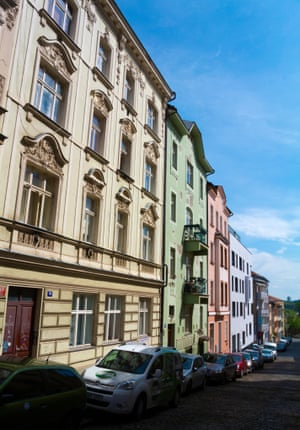
'Crammed with Art Nouveau and neo-classical buildings, some in need of love more than others':  the colourful Vršovice neighbourhood.
Pinterest
 ‘Crammed with Art Nouveau and neo-classical buildings, some in need of love more than others’: the colourful VrÅ¡ovice neighbourhood. Photograph: Alamy
I began my search in VrÅ¡ovice (pronounced Vir-sho-veetz-say), a neighbourhood that is a 15-minute tram ride from the centre of town. I lived here for about two years and, at the time, found little to entice me, save the bed I passed out in after a long day at work. At first sight, it looks no different from before. Set on a downward slope, VrÅ¡ovice is crammed with Art Nouveau and neo-classical buildings, some in need of love more than others. The cobblestones are uneven. Many of the streets have an intriguing curve to them. And then you see a shaggy-haired 25-year-old guy in skinny jeans come around the corner and enter what appears to be a vegan restaurant called Plevel. Later, you walk into a café and hear indie bands seeping from the speakers.
My home on this visit was the Czech Inn, a quasi-industrial hotel that towers at the top of Krymská Street, maybe the hippest lane in the city. I met up with Ondrej Kobza, the owner of Café V Lese, the place that got VrÅ¡ovice’s metamorphosis going. “After I opened Café V Lese five years ago,” said Kobza, who appears to be the unofficial mayor of the town, “I recruited my friends to open up places in the neighbourhood. Soon enough Plevel opened, then Družina, a creative arts studio moved in. That attracted a lot of artists. And it just kept going.”
Kobza always had his sights on more than just cafés. A couple of years ago they shut down the street to traffic and had a day-long party. He put a piano out for anyone to play. Now Kobza has placed pianos all around the city. His next project is public chess tables. “We have to reimagine the city to our liking and that’s what I’m trying to do.”
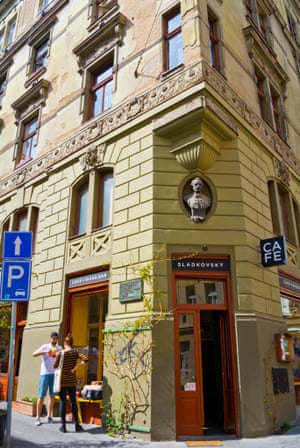
'Wes Anderson chic': Sladkovsky, bar and cafe, which does a mean goulash.
Pinterest
 ‘Wes Anderson chic’: Sladkovsky bar and cafe, which does a mean goulash. Photograph: Alamy
Later that night I popped into Café Sladkovsky – a pub/café bedecked in old photographs and kitsch wallpaper that could be described as Wes Anderson chic – and ordered goulash. This was a slightly different take on the traditional Czech dish, with boar instead of beef, and a potato pancake in place of the usual dumplings. It was a delicious twist on the original.
The next day, I walked across the Vinohrady and Žižkov neighbourhoods, a pleasant 25-minute stroll, to get to Karlín. Many of my Czech friends in their 30s and 40s had told me they had been hanging out here a lot lately. And so I came to Muj šálek kávy, the coffee spot that frowns upon the marriage of milk and coffee, to meet up with Jan Valenta and Zuzi Danková. They run Taste of Prague, a popular food-themed walking tour.
“The first time I noticed something going on in this neighbourhood was five years ago when this café opened up,” said Jan. But Zuzi pointed out that the area’s regeneration really goes back to the 2002 when the nearby Vltava river flooded, taking out centuries-old buildings and leaving the place practically abandoned. “That made property values very affordable and quickly there were a lot of new investments along the river.”
The office buildings make Karlín feel like an adult version of VrÅ¡ovice: during the day, upwardly mobile office workers flood the area’s cafés and restaurants. At Garage, a diminutive eatery, I dined on the Canadian snack poutine (French fries smothered in gravy). The owner told me this used to be a rough neighbourhood, “but the floods washed away everything, even the bad parts.”
The liveliest place in the neighbourhood, Lokál, a gastropub, was packed every night; Veltlin, a bar that only serves wine made from within the old border of the Austro-Hungarian Empire, was similarly crowded. But you sensed a difference in the clientele: while the younger locals might gravitate to VrÅ¡ovice, if you’re over 30, Karlín could be more your style. It certainly was for me – at least, once I’d learned to stop taking milk in my coffee.

Essentials

Flights from London Heathrow to Prague with British Airways (britishairways.com) start from £50 each way. At Czech Inn, dormitory beds start from £4, rooms with a shared bathroom start at £32, and rooms with a private bathroom start at £35 (czech-inn.com)

By David Farley


Sunday, October 4, 2015

British Airways Welcomes First Boeing Dreamliner 787-9


British Airways’ first Boeing 787-9 Dreamliner has arrived at Heathrow to take its place in the airline’s fleet. 
Following an eight hour 45 minute flight from Seattle, the aircraft (registration G-ZBKA) touched down at its new home at 08.50 local time.
It is the first of 22 787-9s the airline is set to receive from Boeing, with the next due to arrive in mid-October and a further two expected by the end of the year.
To mark the arrival of the new Dreamliner, British Airways has released a time-lapse video of the aircraft being built in Seattle.

Mitch Preston, British Airways’ flight technical manager for the Boeing 787 fleet and the pilot who flew the aircraft to Heathrow, said: “It’s always a privilege to be the first pilot to fly an aircraft on its delivery flight. I was lucky enough to bring our first 787-8 to Heathrow in 2013 too.
“Flying with just the small delivery team on board is a very different experience to a normal flight with customers on board.
“I’m really looking forward the first one of those – I think our customers will really enjoy the latest addition to our fleet.”
The new aircraft will start flying to Delhi from 
October 25th, 2015 followed by Abu Dhabi and Muscat from November 5th, 2015.
The 787-9 will also fly to Kuala Lumpur in December and in February the aircraft will start flights to Austin.
The 787-9 is 20ft longer that its 787-8 predecessor (of which the airline has eight), so as well as offering World Traveller (economy), World Traveller Plus (premium economy) and Club World (business class), there’s also room for a new First cabin – a first for the airline’s 787 fleet. 
The First cabin has just eight seats in comparison to the 14 seats available on other British Airways long-haul aircraft, giving even more exclusivity and privacy to customers.
Created specifically for the Boeing 787-9, the new cabin has been painstakingly designed based on feedback from First customers, to put comfort at the heart of the experience and make the very best use of the more intimate space.
The aircraft will now go in to an intensive ‘entry into service’ programme, which will include ground trials and familiarisation trips.
The 787s are the most technologically advanced aircraft in British Airways’ fleet.
Different pressurisation means the internal cabin altitude is the equivalent of 6,000ft, which is 2,000ft lower than on other aircraft.
This leads to greater humidity, reducing the drying effect of the cabin air, so customers arrive feeling more refreshed.
The aircraft’s smooth ride technology also provides extra comfort during any turbulence.
With a total of 42 787s destined to join British Airways, the aircraft is to become the mainstay of the airline’s fleet.

Wednesday, September 23, 2015

British Airways And Hereford Cathedral Send Rare Copy Of 1217 Magna Carta On Global Tour

British Airways and Hereford Cathedral send rare copy of 1217 Magna Carta on global tour
British Airways staffers proudly display an original copy of the Magna Carta

A global tour began yesterday to celebrate the 800th anniversary of the Magna Carta, one of the most important historical documents in the world. Over the course of four months, an original version of the document from 1217, accompanied by the only surviving 1215 King's Writ from Runnymede, will pass through seven countries, across four continents and 25 time zones, travelling a total of approximately 65,000 miles.
British Airways has provided leadership support for the Magna Carta 800 Global Tour, and on Monday, September 21, flew the document across the Atlantic in the airline's first-class cabin with a dedicated security guard.
On loan from Hereford Cathedral in England, both documents will continue from New York to tour stops in China (including Hong Kong), Luxembourg, Malta, Portugal, and Singapore, where it will be displayed at a number of public venues.
The "Magna Carta 800: Sharing the Legacy of Freedom" exhibition at the New-York Historical Society, one of America's pre-eminent cultural institutions, will be on view from September 23 through September 30, 2015. It is the first and only US stop on the global tour, and the documents will be on display alongside key documents relating to the creation of the United States from the New-York Historical Society Library.
"The Magna Carta is a hugely important part of our history and stands as a beacon for our values today," UK Foreign Office Minister Hugo Swire said. "The tour is a fantastic way of enabling people from America to Asia to see it first hand, and to reflect on all that it stands for."
British Airways Captain Ian Aird, who flew the charter from London Heathrow to New York's JFK airport, said: "VIPs regularly travel across the pond with us, but with a price tag of £24 million the Magna Carta and the King's Writ are definitely one of the most precious pieces of cargo we've ever had the honor of carrying. The news that we had such an important piece of history on board certainly created a buzz in our First class cabin."
The Magna Carta has played a key role in the history of democracy around the world and still forms part of British law today. The tour will demonstrate its international resonance while also showcasing British influence across trade, law, international values and democracy. In the US, Magna Carta remains a hugely respected symbol of independence and civil liberty, and is considered the catalyst for the development of modern-day democracy in the New World. The document established fundamental principles that inspired America's Founding Fathers when they wrote the US Constitution and Bill of Rights.