Showing posts with label #CzechRepublic. Show all posts

Saturday, May 5, 2018

Travelore News: Philadelphia To Prague Nonstop On American Airlines

Image result for American Airlines
 By Juergen T Steinmetz

American Airlines, brings the Czech Republic and the USA one step closer today, by launching direct service between Václav Havel Airport Prague (PRG) and Philadelphia International Airport (PHL). Flights are operated using Boeing 767-300 aircraft, providing more than 2,800 seats per week between the two cities, every day throughout the summer season.
Onboard, the Business Class cabin offers 28 fully lie-flat, aisle accessible seats arranged in a one-two-one configuration, plus personal Samsung Galaxy tablets loaded with the latest movie releases, hit TV programs, games, music and best-selling book excerpts. Flagship Business Class customers can also enjoy American’s enhanced international premium cabin menus, designed by renowned celebrity chefs. The Main Cabin features 21 ‘Main Cabin Extra’ seats, offering up to 7” of extra leg room. International Wi-Fi is also available for every customer on board.
American is the first airline to connect the Czech Republic and the state of Pennsylvania with a direct flight. From PHL, American’s largest hub in the Northeast, customers can connect onto nearly 120 destinations across North and Central America and the Caribbean. Connections from PHL with American include Los Angeles, Miami, San Francisco, Chicago, Las Vegas, Orlando, Cancun and the Bahamas. With short taxi times, enhanced connection facilities and four ‘Admirals Club’ Business Class lounges spread throughout the airport, PHL is well suited for easy and efficient connections.
“Prague is a vibrant new addition to American’s international network and we are pleased to offer Czech travelers more choice and more connections for transatlantic travel,” said Richard Muise, Director for Europe & Canada operations. “If Philadelphia is their final destination, Czechs will be able to explore all of the history, shopping and culture the “City of Brotherly Love” has to offer.”
Schedule:                   PRG-PHL                                   PHL-PRG
Arrives at PHL at 3:10 pm          Arrives at PRG at 9:05 am (next day)
“I am very pleased that today and for the very first time we welcome American Airlines at Václav Havel Airport Prague, at the opening ceremony of a regular service between Prague and Philadelphia. This step brings us again closer to meeting our strategy of extending our flight offer to North America, as one of our priorities in the route development. There is long-term interest in travelling to the United States, and a major transport hub like Philadelphia will offer our passengers not only a quick connection to this interesting historic city but also a comfortable transfer to other destinations across the USA or Canada. Already today, American Airlines will offer our passengers around 65 connecting flights with a fast transfer within 5 hours of arrival,” said Václav Řehoř, Chairman of the Board of Directors of the Prague Airport, adding: “We will do our best to make American Airlines’ route successful in Prague and make sure that the service can be extended from a seasonal connection at least by the following months until the end of the calendar year.”

American is in the midst of more than $3 billion in planned improvements to give customers a superior travel experience around the world. These investments include fully lie-flat seats; international Wi-Fi; more in-flight entertainment options and power outlets; a new, modern design for lounges worldwide including in PHL; and an upgraded assortment of complimentary healthy food, cocktails and more.

Monday, December 14, 2015

Prague: Finding A New Edge

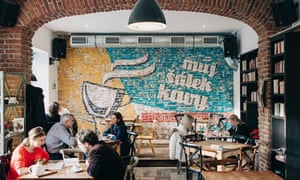
people inside a cool cafe
Fresh start: Muj šálek kávy, a speciality coffee shop in Karlín. Photograph: Ondrej Horak
With Old Prague now tourist central, David Farley follows local artists and hipsters to the Czech capital’s newly transformed outer neighbourhoods

The barista with the Salvador Dalí moustache refused to bring milk for my coffee. “Trust me,” he said, adjusting his man-bun. “It’s much better this way.” The snobbery didn’t surprise me. What did was that it happened in Prague, a place where, until the end of the last decade, coffee was little more than sludge. Even more shocking was that this was the Karlín district, a once-crime-ridden part of town closest to the Križíkova metro station that, until recently, offered little reason to visit. I was at Muj šálek kávy, one of a handful of speciality coffee spots sprinkled throughout the city. But a lot more than coffee culture has changed in the Czech capital.
When I lived in the Czech capital for three years in the mid-1990s, I spent my nights in the central Old Town and Malá Strana districts, where all the best places to eat, drink and shop existed. Now the centre of Prague, while still one of the most beautiful cities in the world, has given way to the march of mass tourism, and its denizens have retreated to the outer neighbourhoods. And although it’s hard for anywhere else in the city to compete with the aesthetics of Charles Bridge, Prague Castle and Old Town Square, I yearned for the other Prague, the one where locals – hipsters, scenesters and even coffee snobs – hung out.
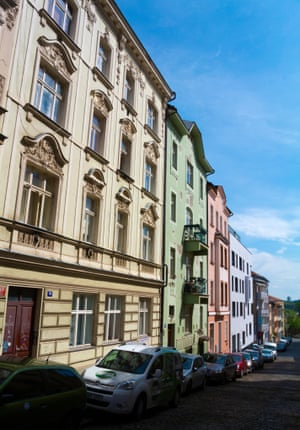
'Crammed with Art Nouveau and neo-classical buildings, some in need of love more than others':  the colourful Vršovice neighbourhood.
Pinterest
 ‘Crammed with Art Nouveau and neo-classical buildings, some in need of love more than others’: the colourful Vršovice neighbourhood. Photograph: Alamy
I began my search in Vršovice (pronounced Vir-sho-veetz-say), a neighbourhood that is a 15-minute tram ride from the centre of town. I lived here for about two years and, at the time, found little to entice me, save the bed I passed out in after a long day at work. At first sight, it looks no different from before. Set on a downward slope, Vršovice is crammed with Art Nouveau and neo-classical buildings, some in need of love more than others. The cobblestones are uneven. Many of the streets have an intriguing curve to them. And then you see a shaggy-haired 25-year-old guy in skinny jeans come around the corner and enter what appears to be a vegan restaurant called Plevel. Later, you walk into a café and hear indie bands seeping from the speakers.
My home on this visit was the Czech Inn, a quasi-industrial hotel that towers at the top of Krymská Street, maybe the hippest lane in the city. I met up with Ondrej Kobza, the owner of Café V Lese, the place that got Vršovice’s metamorphosis going. “After I opened Café V Lese five years ago,” said Kobza, who appears to be the unofficial mayor of the town, “I recruited my friends to open up places in the neighbourhood. Soon enough Plevel opened, then Družina, a creative arts studio moved in. That attracted a lot of artists. And it just kept going.”
Kobza always had his sights on more than just cafés. A couple of years ago they shut down the street to traffic and had a day-long party. He put a piano out for anyone to play. Now Kobza has placed pianos all around the city. His next project is public chess tables. “We have to reimagine the city to our liking and that’s what I’m trying to do.”
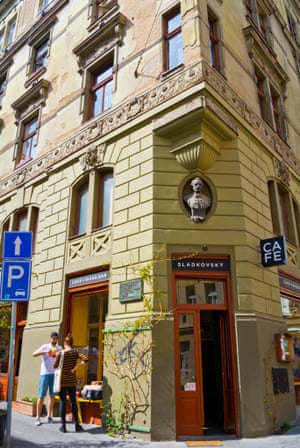
'Wes Anderson chic': Sladkovsky, bar and cafe, which does a mean goulash.
Pinterest
 ‘Wes Anderson chic’: Sladkovsky bar and cafe, which does a mean goulash. Photograph: Alamy
Later that night I popped into Café Sladkovsky – a pub/café bedecked in old photographs and kitsch wallpaper that could be described as Wes Anderson chic – and ordered goulash. This was a slightly different take on the traditional Czech dish, with boar instead of beef, and a potato pancake in place of the usual dumplings. It was a delicious twist on the original.
The next day, I walked across the Vinohrady and Žižkov neighbourhoods, a pleasant 25-minute stroll, to get to Karlín. Many of my Czech friends in their 30s and 40s had told me they had been hanging out here a lot lately. And so I came to Muj šálek kávy, the coffee spot that frowns upon the marriage of milk and coffee, to meet up with Jan Valenta and Zuzi Danková. They run Taste of Prague, a popular food-themed walking tour.
“The first time I noticed something going on in this neighbourhood was five years ago when this café opened up,” said Jan. But Zuzi pointed out that the area’s regeneration really goes back to the 2002 when the nearby Vltava river flooded, taking out centuries-old buildings and leaving the place practically abandoned. “That made property values very affordable and quickly there were a lot of new investments along the river.”
The office buildings make Karlín feel like an adult version of Vršovice: during the day, upwardly mobile office workers flood the area’s cafés and restaurants. At Garage, a diminutive eatery, I dined on the Canadian snack poutine (French fries smothered in gravy). The owner told me this used to be a rough neighbourhood, “but the floods washed away everything, even the bad parts.”
The liveliest place in the neighbourhood, Lokál, a gastropub, was packed every night; Veltlin, a bar that only serves wine made from within the old border of the Austro-Hungarian Empire, was similarly crowded. But you sensed a difference in the clientele: while the younger locals might gravitate to Vršovice, if you’re over 30, Karlín could be more your style. It certainly was for me – at least, once I’d learned to stop taking milk in my coffee.

Essentials

Flights from London Heathrow to Prague with British Airways (britishairways.com) start from £50 each way. At Czech Inn, dormitory beds start from £4, rooms with a shared bathroom start at £32, and rooms with a private bathroom start at £35 (czech-inn.com)

By David Farley


Monday, August 10, 2015

Ten Of The Best Food And Drink Secrets In Europe

With its momentous history, cutting-edge culture, and breathtaking landscapes, Europe comprises an extraordinary wealth of sights, sounds, peoples and parties. But it’s the endlessly varied cuisine that makes us reach for our passports again and again. Whether you’ve been to Europe once or 100 times, this European menu of lesser nibbled delights has plenty of places for you to sip and feast your days away. And more hidden gems await in our Secret Europe PDF.
Norcia, nestled in the Italian countryside, is famed for its cured meats, wild boar sausage and other carnivorous delights. Image by Thomas - Photography / CC BY 2.0
Norcia, nestled in the Italian countryside, is famed for its cured meats, wild boar sausage and other carnivorous delights. Image by Thomas - Photography / CC BY 2.0

Eat and drive in unexplored countryside in the Sybillini Mountains, Italy

This drive, which is also manageable by bike or horse, epitomises the best of Italy’s secret countryside, combining great, local food and jaw-dropping scenery. Straddling Umbria and the lesser-known Le Marche region, the 28km trip between the village of Norcia on the Strada Provinziale 477 (or ‘SP477’) winds its way through the tranquil Sibillini Mountains, to the tiny town of Castelluccio. In the spring and summer, the spectacular approach to the valley takes your breath away. The bright blue sky frames fields bursting with colour from thousands of bright red poppies and even brighter yellow rapeseed flowers, dotted with grazing sheep and horses. In the distance is the hilltop town of Castelluccio, famous for its world-class lentils and worth exploring for the traditional, rural feel of its cobbled walkways and rustic trattorias. Save your appetite for the drive back to Norcia, the original home of the norcinerie, or pork butchers, whose streets are littered with shops peddling and restaurants serving the town’s pork and truffle products and local specialty of wild-boar sausage.
For more about this area, check out Lonely Planet's Italy travel guide.

Follow the locals’ lead in Bergen, Norway

Potetkjelleren (‘Potato Cellar’) is one of Bergen’s finest restaurants, the sort of place that food critics rave about but attracts more locals than tourists. The dining area has a classy wine-cellar ambience, the service is faultless, and the menu (which changes monthly) is based around the freshest ingredients, Norwegian traditions and often subtly surprising flavour combinations. The wine list is also impeccable. Save this one for a special occasion and prepare to leave with a whole new respect for Norwegian cuisine.
Start planning your trip with Lonely Planet Scandinavia travel guide.
The sunkissed vineyards of Switzerland's Lavaux region, in the day's last light. Yves Marcoux / Design Pics / Perspectives / Getty Images
The sun-kissed vineyards of Switzerland's Lavaux region, in the day's last light. Image by Yves Marcoux / Design Pics / Perspectives / Getty Images

A quietly coveted wine region in Lavaux, Switzerland

With pristine waters, cute local beaches and an impressive network of walking trails, the picturesque wine-growing region of Lavaux is one of Europe’s best-kept secrets. Situated in French-speaking western Switzerland on the northern shores of Lake Geneva, Lavaux has all the beauty of the Italian lakes but a low-key sense of chic. Its microclimate gives it an almost Mediterranean feel in the summer months, when locals don swimmers, shades and sandals to revel in the best backyard in central Europe. To sample the region’s best wines, don’t miss the villages' many caveaux (wine cellars). The Caveau des vignerons de Lutry, in the lakefront town of Lutry, is popular, and Rivaz’s Lavaux Vinorama offers the region’s largest selection of local wines for tasting and sale.
Start planning your trip with Lonely Planet's Switzerland travel guide.

Savour a unique macaron in Amiens, France

With a cathedral twice the size of Paris’ Notre Dame, it’s sacrilege that this town is seldom visited. Amiens’ cathedral is a marvel of engineering, with intricate stonework that will leave you goggle-eyed, as well as some of the goriest carvings around (the severed head of John the Baptist is a recurring theme). And the local delicacy, the macaron d’Amiens, will please even the sweetest of teeth: try one at Jean Trogneux (trogneux.fr), where five generations of artisan baking have left the simple recipe of honey, almonds, sugar and egg whites unchanged. These succulent cakes are best served with an impossibly thick chocolat chaud.
Start planning your trip with Lonely Planet's France travel guide.
Morinj in Montenegro: heaven for fish lovers. Image by Witold Skrypczak / Lonely Planet Images / Getty Images

Dine in style in Morinj, Montenegro

A crystalline stream flows around and under Konoba Ćatovića Mlini, a rustic former mill that masquerades as a humble konoba (a simple, family- run establishment) but in reality is one of Montenegro’s best restaurants. Watch the geese idle by as you sample the magical bread and olive oil, which appears unbidden at the table. Fish is the focus but traditional specialities from the heartland village of Njeguši are also offered.
Start planning your trip with Lonely Planet's Montenegro travel guide.

Secret crustacean capital in Vila do Bispo, Portugal

Seafood lovers won’t want to miss a journey to the sun-drenched town of Vila do Bispo in southern Portugal. This tiny settlement is one of the finest spots on the planet to sample those tender, unusual crustaceans known as percebes. A percebe, with its juicy snap, mouth-watering flavour and faintly salty finish is like a kiss from the sea. You’ll either love or hate its extraordinary taste. Though percebes are known throughout Iberia, it’s here in Vila do Bispo that fishermen still harvest by hand the small barnacles that attach themselves to the wave-beaten cliffs outside of town. This is one of the few places in Iberia where this is still done – a sustainable practice that goes back many generations. Two Vila do Bispo restaurants are dedicated to percebes: Solar do Perceve (Rua Comandante Matoso 4) and O Palheiro (Rua Carlos Luís Correia Matos 3).
For more on this area, see Lonely Planet's Portugal travel guide.
Curious-looking but lip-smacking crustaceans, percebes, await their fate. Image by Trishhh / CC BY 2.0
Curious-looking but lip-smacking crustaceans, percebes, await their fate. Image by Trishhh / CC BY 2.0

The perfect picnic in Paris, France

Parisian foodie favourite, Claus, on rue Jean-Jacques Rousseau, is part cafe, part gourmet grocery, and has everything you need for a picnic. It’s also about a five-minute walk from one of Paris’ loveliest lounging spots. Hidden beneath the arches on the western side of the courtyard gardens of Palais Royal, you’ll find benches overlooking box-hedged flowerbeds, crunchy gravel paths and Daniel Bruen’s distinctive zebra-striped columns at one end. Pick a spot and settle in for the perfect Parisian picnic. 
Start planning your trip with Lonely Planet's Paris city guide.
A spoon-defyingly thick hot chocolate in Prague's Cafe Louvre. Image by LWYang / CC BY 2.0
A spoon-defyingly thick hot chocolate in Prague's Cafe Louvre. Image by LWYang / CC BY 2.0

Sip in secret cafés, Prague, Czech Republic

Prague is well known for its grand cafés, but raise your sights: the city’s most refined and atmospheric downtown cafés are all on the first floor, wondrously ignored by the visiting masses. The period interiors are stunning, the coffee unfailingly perfect. Try the Grand Café Orient above the Cubist Museum, decorated in such detailed sympathy even the cakes come garnished with an oddly angled wafer. Or the fin de siècle Café Louvre (cafelouvre.cz), perched over an entirely forgettable modern rival, which was a favourite with Kafka and Einstein, and serves a fabled hot chocolate you can stand a spoon up in.
Start planning your trip with Lonely Planet's Prague & the Czech Republic travel guide.
A cascade of sun-ripened grapes in Georgia, one of Europe's lesser known producers of excellent wine. Image by jb / CC BY 2.0
A cascade of sun-ripened grapes in Georgia, one of Europe's lesser known producers of excellent wine. Image by jb / CC BY 2.0

Tap into a hidden world of wine, Kakheti province, Georgia

In Georgia, where wine has been made for 8000 years, the grape has sacred significance, and the heart of wine-making here lies in the eastern province of Kakheti. Here, the Alazani River waters a fertile valley between two dramatic ranges of the Caucasus. At the northern end, a distinctive turret-shaped 50m spire belongs to the 11th-century Alaverdi Cathedral, part of a monastery complex where wine has been made for 1500 years. After a hiatus during Communist rule, wine is once more being produced at Alaverdi. Come sip.
Start planning your trip with Lonely Planet's Georgia, Armenia & Azerbaijan travel guide.

Sip, stare and shop in secret in Berlin, Germany

Some of Berlin’s finest bars, restaurants, shops and venues are hidden from view behind unmarked doors, in nondescript buildings and in other clandestine spaces. For one, beyond an anonymous steel door lies Tausend, a cosmopolitan drinking den tucked into a railway bridge. At Sammlung Boros, a Nazi-era bunker has been turned into a shining beacon of art. Entry is by guided tour only; book online as early as possible. And you’d be forgiven for walking right past the empty white cube with only a staircase spiralling down to Apartment, one of Berlin’s best-edited fashion emporiums.
Start planning your trip with Lonely Planet's Berlin city guide.
The grey exterior of the Sammlung Boros hides a decadent world of modern art and cocktail sipping. Image by Lian Chang / CC BY 2.0
The grey exterior of the Sammlung Boros hides a decadent world of modern art and cocktail sipping. Image by Lian Chang / CC BY 2.0


Read more: http://www.lonelyplanet.com/europe/travel-tips-and-articles/ten-of-the-best-food-and-drink-secrets-in-europe#ixzz3iQCFBg94

Tuesday, July 14, 2015

If You Are Seeking A New Adventure, Here Are 5 Cool Caves Around The World To Explore

Looking for an underground adventure? Then you’ll want to check out these 5 Cool Caves” compiled by members of travel website VirtualTourist.com . If you’re afraid of the dark or small places, you may have to think twice!
Waitomo Glowworm Caves, North Island, New Zealand
The Waitomo Glowworm Caves have been in existence for more than 100 years and attract people from all over the world due to its high concentration of glowworms which produce an amazing sight to see. Take a guided tour through the limestone cave and a boat ride through the Glowworm Grotto where these tiny insects glow in the dark and reflect off the water deep under the ground. The acoustics in the Cathedral cave is astounding. Stalactites, stalagmites and sculptures have formed as a result of water dripping from the roof of the caves or flowing over the exposed limestone walls. There are well laid out tracks through the native bush that surround the caves as well. Tip by keeweechic


Eisriesenwelt Ice Cave, Werfen, Austria
If you’re looking for a cool experience, pun intended, then check out the Eisriesenwelt Ice Cave in Werfen, the largest ice cavesystem in the world. The caves, which started forming about 100 million years ago, are over 24 miles (40 kilometres) long.  The oldest ice currently inside the caves is thought to be around 5,000 years old.  Intruding water eroded enormous spaces that travelers can visit today.  VirtualTourist members say this is a unique experience but not for those who don’t like the cold as it’s close to freezing inside year around.  Additionally, you should be in good shape if planning to visit as you must climb down 700 stairs and then of course, make your way back up. Tip and photo by jojes.
 
Chaak Tun Cenote, Playa Del Carmen, Mexico
Many travelers to Playa Del Carmen visit one of the nearby cenotes, a natural swimming hole underground, and VirtualTourist members say a trip to Chaak Tun Cenote, about 15 minutes from Playa Del Carmen, is a must do.  First inhabited by the Mayans centuries ago, you’ll have an opportunity to walk through these caves and swim in the underwater “pool” all while getting close encounters with some wildlife, like bats! Price begins around $25 USD. Tip and photo by blueskyjohn
Punkva Caves, Blansko (north of Brno), Czech Republic
Part of the Moravian Karst, an area with more than 1100 caverns and gorges, the Punkva Caves are one of just four caves open to the public. Here, an underground river has formed and visitors can cruise along the bottom of the famous Macocha Abyss, the biggest in Central Europe at 450 deep (138 meters), 570 feet long (174 meters), and 250 feet wide (76).  Tip and photo by Kathrin_E
Hezekiah’s Tunnel, Jerusalem, Israel
The 8th century BC brought attacks on Jerusalem by the Assyrians and Babylonians. In order to bring fresh water to the city, King Hezekiah had an aqueduct constructed which drew water from the Gihon Spring. Today, you can explore this tunnel, although you'll be wading through water nearly 3 feet deep in some places and almost completely in the dark, unless you bring a flashlight.  For those not wanting the underground, you can also continue on through an above ground tunnel which is as dry as a bone and expertly hewn by even more ancient people, the Canaanites.  Tip and photo by VeronicaG