With new fees and surcharges constantly popping up, it’s hard to imagine the word “free” associated with anything related to the airline industry. Well, the travel experts at Cheapflights.com, the online leader in finding and publishing travel deals, are once again helping you stretch your travel budget with 9 Airline Freebies You May Not Know About, a list of fun, flavorful and just plain useful items you can score on flights without breaking out your credit card. Ready for another shock? These perks are available in coach class seats.
While snacks and booze are popular and appreciated freebies on airlines, here are five other small indulgences that make our list:
·Slippers - All passengers flying with Japan Airlines get a pair of slippers – in either pink, blue or yellow – as a way to help travelers relax during the flight. Not only do you get to choose the color, you can also ask for an amenity kit with a toothbrush, set of earplugs and eye mask.
·Postcards, playing cards and writing kits - Over on Singapore Airlines, you can request free postcards, playing cards and writing kits. There is also a power outlet at every seat so you can conveniently charge your devices. And when you’re ready to grab a little shut-eye, request a free eye mask and set of earplugs from the flight attendant. Don’t forget to check out the complimentary toothbrushes, toothpaste, mouthwash, moisturizers, cologne and aftershave available in each lavatory.
·Nanny service - Need a bit of extra help getting your kids settled or keeping them occupied during the flight? If you’re flying with Etihad, you can request a nanny to come to your aid. These nannies can’t take your kids off your hands completely, but they are able to provide extra care and entertainment. Every nanny is equipped with a goody bag of games and activities.
·Amenity kits- Amenity kits aren’t just for those flying business or first class. Many airlines offer free amenity kits for long-haul flights. For example, Virgin Atlantic offers an economy amenity kit that contains eyeshades, earplugs, a toothbrush, hand wipes and a pen. On Singapore Airlines your amenity kit has a toothbrush, toothpaste and socks. If you’re flying overnight on jetBlue you can take advantage of their Snooze Kit and Eye-Opener services. The former gets you an eyeshade and earplugs, while with the latter you get a hot towel, coffee, orange juice or bottled water.
·Kids’ packs and toys - Grown-ups shouldn’t get to have all the fun when it comes to free in-flight stuff. Some airlines offer kids’ packs and toys as a way to help keep the younger set occupied during the trip. Once onboard a Virgin Atlantic flight, kids will find a KiD backpack on their seat filled with fun goodies to keep them busy while parents get settled in. On Singapore Airlines travelers younger than 12 are treated to exclusive Cartoon Network collectible items on most flights to and from Singapore. On British Airways, kids are gifted Skyflyers activity packs on all flights longer than two hours from London Heathrow and London Gatwick. For children between 3 and 5, the pack contains crayons and a “Spread your Wings” coloring book featuring Cuthbert the Cat. Kids over 6 get a pack with a pen and “Wing It” book, filled with facts about flying, together with puzzles and sudokus.
Trelawany Parish is home to the fastest man on Earth but, as Richard Moore finds, the pace of life is more leisurely
My Jamaica adventure began with Usain Bolt. Researching a book about the island’s abundance of great sprinters, I planned a visit to Trelawny Parish, where Bolt and several of his teammates come from. Most of my friends who have been to Jamaica had stayed in one of the resorts that dot the coast, particularly around Montego Bay in the north-west, but I wanted to rent a car and tour the island.
“You don’t want to hire a car,” one recent visitor told me. “You want to hire a driver.” This is what he had done and after a few days had spotted something glinting at his driver’s waist, something that wasn’t a belt buckle. It was a gun. I decide to hire a car.
In a pub in St James’s, London, I met Ian Thomson, author of The Dead Yard, a vivid, gripping account of modern Jamaica, who had promised to give me some travel tips and contacts. Over a pint of Guinness, he reassured me; well, he did. His book, which paints a fairly bleak picture, did not. And yet, travelling exclusively by bus, Ian had immersed himself in the Jamaican experience and didn’t just live to tell the tale, but actually seemed to have enjoyed himself. “You’ll love it,” he said.
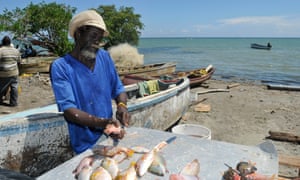
Catch of the day: Falmouth, a place with ‘charm and authenticity’. Photograph: Getty
During my first few days I explored Kingston – the city thrums with an energy that owes something to its dangerous reputation, which explains why it isn’t a mecca for tourists. It is worth visiting – it’s like plugging yourself into the mains. I take a guided tour of Trench Town, the ghetto where Bob Marley grew up, then drive out to the old city of Port Royal, and the Blue Mountains, recently designated a Unesco world heritage site. But the highlight is coming back each evening to the cooking at Neita’s Nest, a guesthouse run by Michelle, daughter of eminent Jamaican author Hartley Neita. Her housekeeper, Charmaine, lovingly prepared ackee and salt fish for breakfast; there are yams, fried bammies, boiled green bananas, cod-fish fritters with callaloo and jerked lamb burgers.
The trip to Trelawny at the other end of the island takes me through an interior which, from the air, looks lush with conical mountains and ferocious waterfalls. Up close it is even more spectacular, the roads narrow and heavily potholed as they weave through the mogul-like hills and dense forest of Cockpit Country. Driving in Jamaica is an intense experience. The roads are not dangerous per se, but some of the drivers are (“Undertakers love careless overtakers,” reads one billboard).
Entering Trelawny’s capital, Falmouth, – with its dusty roads, crumbling buildings and hand-painted signs above shops – it is as if the clock stopped in 1810, when the town was in its colonial pomp. In one direction went sugar and rum to Britain, in the other came slaves from Africa – up to 30 boats a day. The town boasted the finest Georgian architecture in the Caribbean, the pièce de résistance being the courthouse, the first building you would see on disembarking, but the buildings are now crumbling.
I am struck by another sight, one that was utterly incongruous. Sitting in the harbour, towering over the town, are two of the world’s largest cruise ships. That should mean up to 6,000 visitors, yet the streets, and the shops and market stalls, are virtually empty. The local pastor, Devere Nugent – an upbeat man who was also Bolt’s first athletics coach – explains why. The cruise company came to Falmouth, he says, with a proposal to redevelop the pier. Local people were encouraged to open shops and restaurants, but the company then built a replica of the town within the pier complex. A fence now keeps tourists in and locals out.
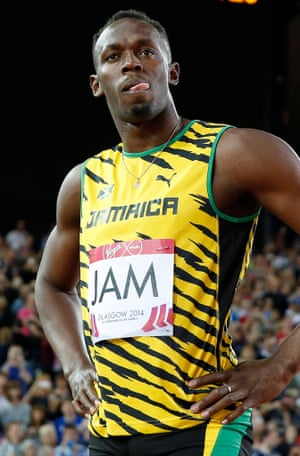
The island has an abundance of great sprinters: above, Usain Bolt. Photograph: Tom Jenkins
Which is a real shame, as Falmouth has charm and authenticity. Much of the town’s Georgian architecture has fallen into disrepair though efforts are ongoing to restore some of the grand old buildings; guided walking tours tell of the rich history of a town that was once the jewel of the Caribbean but now feels more like a rough diamond. (Falmouth had piped water before New York; these days there are villages in Trelawny, including Bolt’s, that still don’t have running water.) The area from Water Square to the old harbour has lots of stalls with the local speciality, jerk chicken, and others selling locally made arts and crafts. The businesses on Market Street are wonderfully eclectic and eccentric, among them the Miracle Medical Lab and Dr CAL Behasse, Clinical Christian Psychologist. Despite the lack of tourists, Falmouth feels safe and friendly.
The legacy of slavery is evident throughout Trelawny, though it is also the cradle of emancipation (thanks in particular to William Knibb, a 19th-century English minister who gave his name to the Falmouth Baptist church and the school attended by Bolt). Twenty minutes outside the town, perched on a hill overlooking a coast fringed by beautiful, mainly deserted beaches,, stands one of several plantation owners’ estates, Greenwood Great House. Built in 1780 by the cousin of the poet Elizabeth Barrett Browning, Greenwood is now a museum that shows how the owners lived and the slaves suffered – exhibits include the grotesque, mantraps shaped like a shark’s mouth that were used to catch runaways.
Greenwood tells one side of the story, the Maroon community of Flagstaff another. Its inhabitants are known as Maroons – from the Spanish for “fugitives”. There’s a popular theory that the Maroons hold the key to understanding Jamaica’s great sprinting success. They were the slaves who escaped to the mountaintop communities of Cockpit Country; the toughest of the tough, in other words. There’s a theory that they hold the key to understanding Jamaica’s sprinting success, though as Ian Thomson writes in The Dead Yard: “Much romantic nonsense has been written about the Maroons.”
Flagstaff is at the end of a steep zigzag road that in places is more rubble than tarmac. When I climb out of the car, I am approached by locals offering help and keen to share information. Michael Drizzle, a spry man who introduces himself as the local Maroons chief, rents his own place out on Airbnb and offers guided tours to the heritage walking trails.
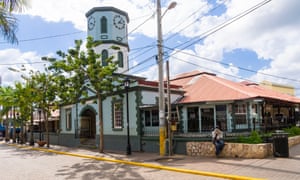
‘Despite the lack of tourists, Falmouth feels safe and friendly’: the historic square. Photograph: Alamy
It’s funny, I think, as Drizzle leads me through the village: the Maroons were slaves who escaped to inhospitable Cockpit Country to flee the Brits. Now their ancestors are slowly building the infrastructure – information boards, walks – to attract tourists. The facilities are modest but, as Grizzle explains, there is great pride in who they are and what they are trying to do.
I sense that pride in all the Maroons I meet in Flagstaff. And also, given that so many visitors to Jamaica seem to be holed up in their resorts or restricted to their cruise liners, I sense their surprise that I have made it.
Virgin Atlantic flies three times a week to Montego Bay from Gatwick from £674 return. Neita’s Nest in Kingston has doubles from £105 B&B
The Bolt Supremacy: Inside Jamaica’s Sprint Factory by Richard Moore is published by Yellow Jersey at £18.99. To order a copy for £15.19, including UK p&p, see bookshop.theguardian.com
Better food and better room in the space between business class and coach; champagne is available, but not the fancy stuff
Premium economy has matured and is a solid fixture for travelers around the world except the U.S. airlines, which simply have extra legroom rows. WSJ Middle Seat Columnist Scott McCartney joins Lunch Break. Photo: Michal Czerwonka for The Wall Street Journal
It’s time to think of premium economy as a regular class of airline service alongside coach, first and business.
Premium economy seats come with better meals and more seat width, legroom, recline and perks at a far cheaper fare than business class. The idea has taken hold everywhere but the U.S., where American, Delta and United have been focused on updating coach with slim seats and boosting business class to international standards.
Internationally, two of the last big holdouts, Singapore Airlines and Lufthansa, are now adding it for long-haul flights, citing customer demand.
ENLARGE
Along with better leg room in Lufthansa’s premium economy, the airline has installed a six-inch center console to give seats a greater feeling of width.PHOTO: LUFTHANSA
Singapore will launch premium economy on Dec. 1 with flights to Los Angeles; New York and San Francisco will follow. In addition to more space, Singapore has created new food service for premium economy—gourmet dishes such as braised short ribs, lamb biryani or dim sum from a Los Angeles restaurant—and engineered them to fit into economy trays rather than served on plates like first-class and business-class meals.
Lufthansa will complete installation of premium economy in all its long-haul airplanes in October. Since Lufthansa’s premium economy launch earlier this year, bookings have run 10% higher than the airline expected, according to Annette Mann, Lufthansa’s director of customer experience. About half of premium economy passengers are people paying their own way and half are corporate travelers.
“It’s designed for people who say economy is not comfortable enough but they, or their company, are not willing to pay for business class,” Ms. Mann says.
Typical premium economy has flight attendants and bathrooms reserved for that cabin. Seats usually have bigger entertainment screens than economy, plus 6 inches more legroom, 4 to 5 inches more recline and often an extra inch or two of seat width. Perks such as early boarding and more generous baggage allowances come with the higher fares. In a sign of how cramped regular coach seats have become, fliers have shown themselves willing to pay $600 to $900 round trip for these add-ons.
Lufthansa and Singapore had been reluctant to install premium economy for many years. They worried coach passengers wouldn’t pay up and business-class customers would trade down. But Singapore and Lufthansa say they heard more from frequent fliers, travel agents and corporations that don’t pay for business class who wanted something better than coach and were willing to pay 50% more.
Now 15 of the 20 largest airlines that offer long international flights have installed premium economy cabins. Many smaller airlines offer premium economy as well. And several airlines have said that premium economy is their most-profitable cabin per square inch of airplane floor space.
ENLARGE
Lufthansa’s premium economy seats will have some elements of business class, though meals will be more similar to those in economy seats.PHOTO: LUFTHANSA
“It seems now that it’s an accepted product category instead of just an ancillary add-on,” says Chris Rossi, senior vice president at Virgin Atlantic Airways, which was one of the first airlines to launch premium economy back in 1992. Recently Virgin added a new water fountain, snack and lounge area to the premium economy cabins on its Boeing 787 Dreamliners called the Wander Wall.
American, Delta and United, the biggest U.S. carriers, count among the last major airlines resisting this trend. They offer extra legroom seats in their coach cabins for a smaller add-on fee, but not a separate class of service with its own fares, seats and enhancements. (The other two top 20 airlines offering nothing between coach and business class are Persian Gulf carriers.)
U.S. airlines say they are content to offer extra legroom, which travelers increasingly pay for, and don’t have immediate plans for full premium economy offerings. United says it is constantly evaluating whether to add elements beyond extra legroom. American says sales of it extra legroom seats, which cost $112 to $177 each way on long international flights, are “doing well.” Delta recently said revenue from extra-legroom seats was up 30% in the second quarter compared with a year earlier.
“We’re aware of the competitive international landscape and we’re exploring options, but no decisions have been made,” Delta spokesman Anthony Black says.
ENLARGE
Virgin Atlantic has what it calls a Wander Wall, a snack/lounge area in its premium economy cabin on Boeing 787 Dreamliners.PHOTO: VIRGIN ATLANTIC
But other airlines have found fliers want more than just extra legroom. In Singapore’s case, the new premium economy cabin will have some elements of business class, such as free-flowing champagne. (It’s Ernest Rapeneau, about $25 a bottle, instead of the $50 Taittinger offered in business class.)
Instead of just puffing up economy meals with extra cheese and crackers, Singapore decided to create a new class of meal. At the airline’s Los Angeles in-flight caterer, Hacor Inc., much work went into refining recipes for taste and appearance and engineering them to fit in 5-inch-by-2.5-inch casserole dishes on economy trays.
Here, executive chef Christophe Cosnierworked through many tastings with airline officials to tailor recipes for the rigors of air travel, where food gets cooked, shipped and reheated before being served in a desert-dry environment. Even more important to Singapore was appearance—dishes must have visual flair.
“They will taste better if they look good,” says Mr. Cosnier, a Frenchman.
Mr. Cosnier borrowed some favorites from business class, such as braised short ribs, which are seasoned overnight, seared and braised for more than four hours. Lamb biryani, a new entree for Singapore, added more comfort food to the premium economy menu. The tasty rice dish is seasoned with cardamom, cinnamon, cashews and shallots.
Spicy foods work well because the arid cabin deadens taste buds, Mr. Cosnier says. He uses tricks such as covering dim sum and rice with a wet cabbage leaf to keep them moist during reheating. (Flight attendants remove the leaf before serving.)
ENLARGE
Brian Huang of Hacor examines new premium economy meals to be served on Singapore Airlines.PHOTO:MICHAL CZERWONKA FOR THE WALL STREET JOURNAL
Singapore says it is taking 66 economy seats out of its A380s to install 36 premium economy seats. Premium economy will cost 40% to 70% more than coach, says Alastair Hay-Campbell, vice president of Singapore’s southwest division.
So the premium economy cabin has to stand out with a lot more than just extra legroom. The airline decided to offer its popular Book the Cook service, where passengers preorder meals from a broad menu for each cabin, to premium economy as well as business and first.
“We want to encourage people to trade up,” he says.
British Airways recently began letting its premium economy passengers, as well as business and first, preorder meals on certain flights. British Airways also has been refreshing premium economy cabins on some of its older planes with new entertainment systems and better seat cushions.
Lufthansa says its research showed customers were willing to trade up at a fixed price of $600 to $700 more than coach, rather than a percentage of the fare. Its focus groups also found that seat width was just as important as legroom, so the airline’s premium economy seats have a six-inch center console between them. “Customers said it has to be wide enough so I don’t touch the person next to me,” Ms. Mann says.
Lufthansa’s premium economy has some elements of business class: a welcome drink at boarding, an amenity kit and bottled water at the seat. For meals, though, premium economy passengers get the same two choices as in coach. But they get a bit more food, like an extra chocolate, plus a better salad and nicer bread. And they get a bigger baggage allowance.
One driver of recent sales: global Wi-Fi and in-seat power. That means more travelers want space to open laptops and work, which can be difficult, if not impossible, in a coach row of 31 or 32 inches.
“It’s a comfortable work area now,” says Mr. Rossi, Virgin Atlantic’s head in North America.