Showing posts with label Metropolitan Museum of Art. Show all posts

Sunday, August 30, 2020

Face Masks Amid The Art: New York City’s Museums To Reopen

A man walks past a banner by artist Yoko Ono at the Metropolitan Museum of Art, Thursday, Aug. 20, 2020, in New York. Ono's two banners on the front of the museum say "Dream Together." The museum will reopen to the public on Aug. 29, 2020. (AP Photo/Mark Lennihan)
NEW YORK (AP) — When the iconic T. Rex at the American Museum of Natural History again welcomes visitors, it will gaze down at humans acting a bit differently.
They will still gape up at its massive skeleton, but there will be fewer of them. They’ll stand farther apart and wear masks. Other pandemic precautions will include hand sanitizer stations and one-way signs guiding guests through exhibits.
The museum is like many cultural institutions in the city gingerly reopening their doors, weighing the safety of visitors and staff with the need to educate, inspire and support New York’s recovery.
“We have to re-imagine and re-engineer the museum visit,” says museum President Ellen Futter. “We want to fulfill our civic mission. And we think that our mission has never been more important.”
New York City was by far the hardest-hit U.S. city by the pandemic. It’s also home to world-class cultural institutions that have for decades — and city leaders hope will once again — draw millions.
The Museum of Modern Art opens Thursday, and The Metropolitan Museum of Art reopens its Upper East Side home on Saturday. The American Museum of Natural History plans to reopen to the public Sept. 9.
City museums will institute a range of precautions, including reduced hours, reserved tickets, mandating masks, limiting attendance to a quarter of capacity, and closing movie theaters, coat rooms and food courts.
Youtube video thumbnail
Some of the new rules might make future trips to a museum less spontaneous and escapist, but there are some benefits.
“It’s true that it will be less crowded. It also will be more intimate and it may give people a different view of things. I don’t think that will diminish in the least the sense of the visit,” said Futter.
Other institutions need a bit more time. The Guggenheim will reopen on Oct. 3, while the 9/11 Memorial Museum will reopen on the anniversary of the terrorist attacks.
Whether anyone will come is the big question.
“There are a lot of unknowns out there. We don’t know whether people will feel comfortable coming back. We don’t know whether they’ll feel comfortable being with several hundred people indoors, even if we’re a very large space,” said Glenn Lowry, MoMA’s director.
“We ardently believe that people will want to come back to museums and to see the things that are both familiar and unfamiliar — see the things that animate their mind, that make them feel alive.”
Welcoming back visitors is also a chance to end months of lost ticket sales. Each facility has different financial models but for those that rely heavily on attendance, the pandemic has been crippling. The Natural History Museum alone has lost as much as $120 million.
While MoMA is looking at “significant losses” for up to three years, it has decided not to charge visitors for the first month. “It just felt like the right gesture,” said Lowry. “I think once you’ve lost a lot of money, losing a little bit more isn’t really the big issue.”
To add to the financial burden, most museums have been forced to pay for safety upgrades, like more staff, touchless bathrooms and costly air filtration systems.
“Every institution is having to look long and hard at their financial model and scale back, postponing and canceling programs and events while simultaneously pushing forward on all fundraising cylinders,” said Regan Grusy, vice president of strategic partnerships at the New Museum.
The pandemic hit only a few months after MoMA reopened in October following a $450 million expansion. Back then, visitors were greeted in the lobby with an enormous Haim Steinbach banner that read: “Hello. Again.” It’s been replaced: Now they’ll see a Milton Glaser piece that reads “I (HEART) NY.”
“This is a moment to assert the resurgence of New York,” said Lowry. “New York has gone from this huge magnet of tourism to being a city that’s just about itself because the tourists aren’t around. So with all of that, we felt this was a more powerful welcome.”
The Metropolitan Museum of Art was one of the first in the city to close and, with no federal guidance, stepped up to help lead a working group of about 25 museums in the city sharing information and creating protocols.
“The question we all face is, ‘How long will we have to limit the numbers of visitors?’ If the answer is ‘Five years,’ it would be devastating,” said Met President and CEO Daniel Weiss.
His institution has even taken on COVID-19 with art: The Met sells face masks with floral details from paintings in its collection by Claude Monet and Vincent van Gogh. “We’re trying to make the best of it,” said Weiss.
The Corona neighborhood in Queens was one the hardest-hit sections of the hardest-hit city. Yet it is home to a museum not built for pandemics — the hands-on, highly interactive New York Hall of Science.
The Hall prides itself on being a place where children engage with the exhibits — controlling mock space rovers, exploring digital environments and experimenting with circuits. It is not willing to change its goals and go touchless or remove exhibitions. It hopes to reopen next spring.
“We’re not going to back off of our core approach and core methodology,” said Margaret Honey, president and CEO. “We believe that the world will return to doing those kinds of activities when it’s safe to do so. And when it’s safe to do so is really going to depend on vaccines and treatments. And, of course, a willing public.”
Though the doors are closed, the Hall hasn’t been silent. It’s helped donate thousands of meals, turned a parking lot into a drive-in movie theater, encouraged research and hosted a mobile testing site on campus.
Like many museums, it has put many new resources and access to its offerings online, accelerating a pre-pandemic trend.
“This is the time to think about the limitless possibilities when time and space mean something completely different,” said Grusy.
When the Hall of Science does open, it will have a new exhibit exploring the different ways cultures experience happiness.
It will be called The Happiness Experiment, and Honey is tickled by the notion. “I love the idea of reopening with an exhibit that’s focusing on happiness.”
Over in Manhattan, the silent T. Rex at the Natural History museum may actually put the pandemic into perspective. It reminds visitors they are part of a churning evolution.
“We’ve seen great challenges and really deeply disturbing times before, but we’ll get through this,” said Futter. “And the museum reopening is part of that for us, for our visitors and for the city. And we’re very excited about it.”
___
Mark Kennedy is at http://twitter.com/KennedyTwits

Wednesday, April 10, 2019

Exuberant Met Exhibit Explores The Art Of Rock ‘N’ Roll

Image result for Exuberant Met exhibit explores the art of rock 'n' roll
By KATHERINE ROTH
NEW YORK (AP) — Museum exhibits tend to be quiet. Not this one.
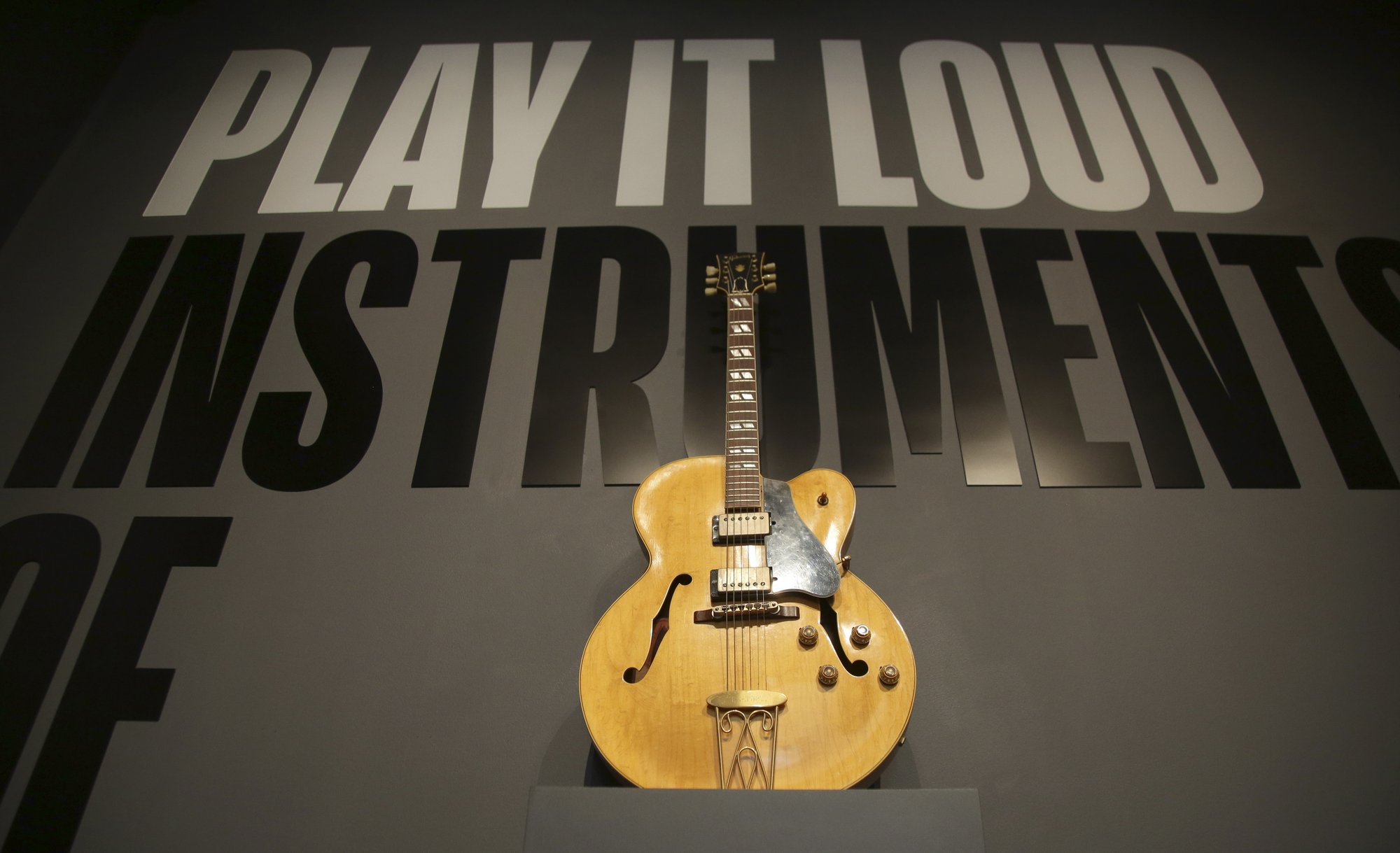
In “Play It Loud,” an exuberant show that can be heard as well as seen, the Metropolitan Museum of Art takes on the history of rock ‘n’ roll through iconic instruments on loan from some of rock’s biggest names. There are flamboyant costumes worn by Prince and Jimmy Page, videotaped interviews with “guitar gods,” even shattered guitars.
The show runs here from April 8 through Oct. 1 before traveling to the Rock and Roll Hall of Fame, in Cleveland, where it will be on view from Nov. 20, 2019 through Sept. 13, 2020.
“We’re looking at rock ‘n’ roll instruments as an art. They serve as muses, tools and visual icons, and many of them are hand-painted and lovingly designed,” says Jayson Kerr Dobney, curator in charge of the department of musical instruments at the Met. He organized “Play It Loud: Instruments of Rock and Roll,” with Craig J. Inciardi, curator and director of acquisitions at the Rock and Roll Hall of Fame.
For anyone who ever dreamed of climbing onstage at a rock concert for a closer look, this may be your best shot.
“Instruments are some of the most personal objects connected to musicians, but as audience members we are primarily used to seeing them from far away, up on a stage in performance. This exhibition will provide a rare opportunity to examine some of rock ‘n’ roll’s most iconic objects up close,” says Dobney.
The Metropolitan Museum of Art is about to make history with a major exhibition showcasing rock-and-roll instruments.  The collection consists of more than 130 pieces on loan from the genre's biggest names. (April 2)
Tap to unmute
Highlights include Chuck Berry’s ES-350T guitar (at the entrance to the exhibit), John Lennon’s 12-string Rickenbacker 325, an electric 500/1 “violin” bass on loan from Paul McCartney, Keith Moon’s drum set, and the white Stratocaster played at Woodstock by Jimi Hendrix.
Interviewed by The Associated Press on Monday, Page, the guitarist and founder of Led Zeppelin, said that when curators approached him and explained their vision of the exhibit — you approach it through the Greco-Roman art galleries and then suddenly come upon Berry’s guitar — he was all in.
“My guitar was confiscated if I took it to the school field to play,” he says. “That’s the kind of respect given to guitars in those days.
“So to see guitars from people I listen to . it’s absolutely phenomenal. It’s humbling.”
Over 130 instruments are featured in the show, including ones played and beloved by the Beatles, Elvis Presley, Bruce Springsteen, The Rolling Stones, The Grateful Dead, Lady Gaga, Joan Jett, Metallica, Steve Miller, Page and other rock ‘n’ roll greats. The collection spans 1939 to 2017. All the instruments are on loan, most by the musicians themselves, although Miller has promised to donate to the Met his 1961 Les Paul TV Special guitar, painted by surfboard artist Bob Cantrell.
The show features its own rock ‘n’ roll soundtrack and is organized in thematic sections.
“Setting the Stage” explores rock’s early days in the American South of the late 1940s and early 1950s, when pianos, saxophones and acoustic guitars were among the instruments of choice. Soon, Berry helped revolutionize the sound, establishing the electric guitar as the genre’s primary voice and visual icon.
Also featured is a setup like that used by the Beatles on “The Ed Sullivan Show” in 1964. After that performance, “thousands of rock bands were formed using that same lineup: two guitars, a bass and a drum set,” says Dobney.
The “Guitar Gods” section traces that phrase to Eric Clapton’s stardom and a piece of 1966 graffiti in London proclaiming, “Clapton is God.” Others dubbed guitar gods included Page, Jeff Beck, Pete Townsend and Hendrix. All exemplified virtuoso musicianship and awe-inspiring swagger. By the 1970s, women, too, were fronting bands and finding platforms for their own personae and skills, Dobney says.
“The Rhythm Section” explores the sources of the genre’s powerful rhythms, with accented backbeats created using a drum set and electric bass guitar.
Even as guitars were lovingly painted, and sometimes even built by the musicians who played them (like Eddie Van Halen’s red and white “Frankenstein” guitar, featuring a Fender-style body and neck with Gibson electronics), instruments were also famously destroyed by rock stars as part of their act.
“It may be the only musical genre where destruction of instruments became a part of the performance,” Dobney says.
Featured is a fragment of a Hendrix guitar that he set on fire and smashed onstage at the Monterey Pop Festival in 1967; a Gibson SG Special guitar destroyed by Townsend during a photo shoot with Annie Leibovitz for Rolling Stone (and preserved in Lucite); and a modified Hammond L-100 organ used by Keith Emerson as a “stunt instrument,” which he would jump on, pull on top of himself, stick knives in and — in this instrument’s case — set ablaze during performances.
“Expanding the Band” explores the way the classic four-piece rock band was augmented by instruments like dulcimers, sitars and a range of experimental keyboards to expand the sound.
“Creating an Image” opens with an enormous, jagged electric piano housed in acrylic with built-in lights, owned by Lady Gaga. That section also includes Prince’s “Love Symbol” guitar and a dragon-embroidered outfit once worn by Page.
A wall image of Springsteen taken from behind with his guitar over his shoulder illustrates how for some stars, the guitar became almost an extension of their body.
“Creating a Sound” explores the technical side of rock music, with the amps, guitars and rigs used by Page, Keith Richards, Van Halen and Tom Morello. Each of the four rigs is accompanied by a videotaped interview with the artist explaining how they created their unique sound.
The show ends with footage of some of rock’s most iconic moments, along with decades of posters advertising groundbreaking concerts.
“Play It Loud: Instruments of Rock and Roll” is accompanied by a hefty and detailed catalog of the same name (The Metropolitan Museum of Art, distributed by Yale University Press, 2019).

Tuesday, March 1, 2016

New York's Metropolitan Museum of Art To 'Suggest' $25 ticket, Rather Than 'Recommend'


By KAREN MATTHEWS


FILE - In this March 19, 2013 file photo patrons stand in the rain by the front doors of the Metropolitan Museum of Art in New York. Confusion over the museum’s $25 ticket price will be cleared up under a settlement for a class action suit reached on Friday, Feb. 26, 2016. The $25 “recommended” ticket price will become the $25 “suggested” ticket price under the terms of the settlement. (AP Photo/Mary Altaffer, File)
NEW YORK (AP) - The pay-what-you-like policy at New York's Metropolitan Museum of Art will be spelled out more clearly under a settlement of a class-action lawsuit that challenged the museum's $25 "recommended" admission.

Under the settlement reached Friday, the $25 ticket price will be "suggested" instead of "recommended." In addition, signs will advise visitors that "The amount you pay is up to you."

Andrew Celli Jr., a lawyer for the plaintiffs, said Saturday that the new signage "really opens up the museum to people of all economic levels."
Museum officials said they were refining the Met's admissions policies to coincide with next month's opening of a new outpost, the Met Breuer, at the former Madison Avenue home of the Whitney Museum of American Art.

"All of our recent branding and marketing work has been aimed at simplifying our message of welcome to the public and emphasizing that we are accessible to the widest possible audience," Met CEO Thomas P. Campbell said in a statement.
The Met draws more than 6 million visitors a year and recommends an admission fee of $25 for adults, $17 for seniors and $12 for students.

The 2013 lawsuit accused the Met of misleading visitors by implying that they had to pay the full amount. Museum officials denied the allegation.

The lawsuit charged that under the museum's 19th-century lease with the city it had no authority to charge any suggested admission. That portion of the suit was thrown out.
Under the settlement announced Friday, which is subject to court approval, the museum's website as well as signs at admissions desks will use the new language.

Celli, with the firm Emery Celli Brinckerhoff & Abady LLP, said the settlement affects the font size and placement of the words rather than just replacing "recommended" with "suggested."
"Suggested" is now the same size as the word "admission," he said. "I think it really brings the museum back to where it should have been, and where it was historically."

Thursday, January 21, 2016

Travelore Tips: 5 Ways To Save Time And Money At Top Museums

statue-of-david-fb
A museum can be a serene, uplifting escape from the everyday—or it can be an obstacle course of lines, crowds, and exorbitant cafeteria prices.  TripAdvisor’s list of the top 25 museums in the world just came out and, while some are well-known tourist magnets and others are lesser-known gems, there’s no doubt that all of them, now that they’ve made the list, will attract even more travelers. To help ease your visits to these museums, I thought I’d share a few hard-earned tips:

1.  Suss out in advance how to avoid the line.
Sometimes your strategy may be to make a reservation. Sometimes it might be to buy a city pass that provides entry to many attractions and allows you to skip the line. Sometimes you can book a Viator skip-the-line tour. The last time I visited the Louvre in Paris, I skipped the one-hour line at the main entrance simply by using a side door that had no line at all—the Porte des Lions, just a three-minute walk away.  At the jam-packed Hermitage in St. Petersburg, Russia—the #6 top museum in the world—I got in early in the morning, before the museum opens to the public, because I booked through a local travel firm with insider connections.  For line-skipping intel, peruse the TripAdvisor forum for the destination you’re headed to—or ask your question there.

2.  Arrive before opening hour so you’re first in the door.
The first hour or so is when most museums are relatively empty. It’s particularly important to arrive this early if the forecast calls for rain: For families with kids especially, museums are where you go when it’s raining.

3.  Go at night.
Most world-class museums have at least one night per week when they are open to the public, and those are usually peaceful times to visit.  New York City’s  Metropolitan Museum of Art, for instance—the world’s #1 museum—is open on Friday and Saturday nights till 9:00 pm, and it’s a lovely time to visit.

4. Look into free entry times and free tours.
Some museums have a certain day or night of the week or month when admission is free.  Some offer complimentary tours and talks. The #3 top museum in the world, Art Institute of Chicago, offers a variety of free guided tours, and you don’t even need to make a reservation.

5. Consider a city pass that includes entry to the museum.
Museum entry can be pricey, especially in Europe’s cultural capitals and especially for a family. When you’ve got only three or four days to sightsee in a big city, look into passes that provide entry to a number of landmarks, including the museum, at a price much lower than if you pay at each site. As mentioned earlier, often such passes—the Paris Museum Pass, for instance—allow you to skip the lines. Sometimes they even provide free entry for children.
- See more at: http://blog.tripadvisor.com/2014/09/25/5-ways-save-time-money-top-museums/?adbsc=social456661&adbid=647788202699264000&adbpl=tw&adbpr=16365636#sthash.YPGwnQAf.dpuf

Tuesday, March 17, 2015

New York’s Metropolitan Museum Announces Lord Vishnu Exhibition

New York’s Metropolitan Museum announces Lord Vishnu exhibition


The Metropolitan Museum of Art (Met) in New York will organize “Encountering Vishnu: The Lion Avatar in Indian Temple Drama” exhibition from December 19, 2015 to June five, 2016.
“Dramas presented during religious festivals in southern India are an important aspect of popular Hindu celebration. This exhibition highlights five rare wooden sculptural masks that represent a largely unrecorded category of late medieval Indian devotional art. The masks depict the protagonists in a deadly battle between Vishnu in his man-lion avatar, Narasimha, and an evil king whose destruction was essential for the restoration of order in the universe,” a Met announcement says.
Applauding Met for showcasing Hinduism focused exhibition, Hindu statesman Rajan Zed, in a statement in Nevada today, said that art had a long and rich tradition in Hinduism and ancient Sanskrit literature talked about religious paintings of deities on wood or cloth.
Rajan Zed, who is President of Universal Society of Hinduism, urged major art museums of the world, including Musee du Louvre and Musee d'Orsay of Paris, Los Angeles Getty Center, Uffizi Gallery of Florence (Italy), Art Institute of Chicago, Tate Modern of London, Prado Museum of Madrid, National Gallery of Art in Washington DC, etc., besides Met, to frequently organize Hindu art focused exhibitions, thus sharing the rich Hindu art heritage with the rest of the world.
Founded in 1870, Met, one of the top art museums of the world, has large collections of ancient art; including Greek, Roman and Near Eastern. The Met’s mission includes art that “collectively represent the broadest spectrum of human achievement”. Thomas P. Campbell is Met’s Director and CEO, while Daniel Brodsky is Trustees Chairman.
Hinduism, oldest and third largest religion of the world, has about one billion adherents and moksh (liberation) is its ultimate goal. There are about three million Hindus in USA.

Wednesday, March 27, 2013

NYC's Met Museum Accused Of Duping On Fees


Contributed by Ula Ilnytzky, AP.


In this Tuesday, March 19, 2013 photo the exterior of the Metropolitan Museum of Art in New York is photographed. (AP Photo/Mary Altaffer)
Before visitors to the Metropolitan Museum of Art can stroll past the Picassos, Renoirs, Rembrandts and other priceless works, they must first deal with the ticket line, the posted $25 adult admission and the meaning of the word in smaller type just beneath it: "recommended."
Many people, especially foreign tourists, don't see it, don't understand it or don't question it. If they ask, they are told the fee is merely a suggested donation: You can pay what you wish, but you must pay something.
Confusion over what's required to enter one of the world's great museums, which draws more than 6 million visitors a year, is at the heart of a class-action lawsuit this month accusing the Met of scheming to defraud the public into believing the fees are required.
The suit seeks compensation for museum members and visitors who paid by credit card over the past few years, though some who choose to pay less than the full price pull out a $10 or $5 bill. Some fork over a buck or loose change. Those who balk at paying anything at all are told they won't be allowed in unless they pay something, even a penny.
"I just asked for one adult general admissions and he just said, '$25,'" says Richard Johns, a high school math teacher from Little Rock, Ark., who paid the full price at the museum this past week. "It should be made clear that it is a donation you are required to make. Especially for foreign tourists who don't understand. Most people don't know it."
Met spokesman Harold Holzer denied any deception and said a policy of requiring visitors to pay at least something has been in place for more than four decades. "We are confident that the courts will see through this insupportable nuisance lawsuit," he said.
"The museum was designed to be open to everyone, without regard to their financial circumstances," said Arnold Weiss, one of two attorneys who filed the lawsuit on behalf of three museum-goers, a New Yorker and two tourists from the Czech Republic. "But instead, the museum has been converted into an elite tourist attraction."
Among the allegations are that third-party websites do not mention the recommended fee, and that the museum sells memberships that carry the benefit of free admission, even though the public is already entitled to free admission.
Lined up to testify is a former museum supervisor who oversaw and trained the Met's admissions cashiers from 2007 to 2011, said Michael Hiller, the other attorney representing the plaintiffs.
The supervisor is expected to testify that the term on the sign was changed in recent years from "suggested" to "recommended" because administrators believed it was a stronger word that would encourage people to pay more, Hiller said.
The Met's Holzer denied the former employee's allegations. He also said the basis for the lawsuit - that admission is intended to be free - is wrong because the state law the plaintiffs cited has been superseded many times and the city approved pay-what-you-wish admissions in 1970.
"The idea that the museum is free to everyone who doesn't wish to pay has not been in force for nearly 40 years," Holzer said, adding, "Yes, you do have to pay something."
As to the wording change on the sign, he said the museum "actually thought at the time, and still thinks, that 'recommended' is softer than 'suggested,' so the former employee is quite wrong here."
New York City's Department of Cultural Affairs agreed to the museum's request in 1970 for a general admission as long as the amount was left up to individuals and that the signage reflected that. Similar arrangements are in place for other cultural institutions that operate on city-owned land and property and receive support from the city, such as the American Museum of Natural History and the Brooklyn Museum. It's also a model that's been replicated in other cities.
The Metropolitan Museum is one of the world's richest cultural institutions, with a $2.58 billion investment portfolio, and isn't reliant on admissions fees to pay the majority of its bills. Sixteen percent of its $239 million budget in fiscal 2012 came from admissions. That same year, the city paid 11 percent of its operating budget. As a nonprofit organization, the museum pays no income taxes.
Holzer also noted that in the past fiscal year, 41 percent of visitors to the Met paid the full recommended admission price - $25 for adults, $17 for seniors and $12 for students.
A random sampling of visitors leaving the museum found that there was a general awareness that "recommended" implied you could pay less than the posted price.
But Dan Larson and his son Jake, visiting the museum last week from Duluth, Minn., were unaware there was any room to negotiate the admission price. They paid the full $25 each for adult tickets, with a credit card.
"My understanding was you pay the recommended price," said Larson, 50. "That's clearly not displayed."
Alexander Kulessa, a 23-year-old university student from Germany, said friends who had previously visited New York tipped him off about the admission fee.
"They said, 'Don't pay $25,'" said Kulessa. "They said it will be written everywhere to pay $25 but you don't have to pay that. You don't even have to pay the student price."
For Colette Leger, a tourist from Toronto who visited the museum with her teenage daughter, paying the full $25 was worth every penny.
"It's a beautiful museum, and I was happy to pay," she said.
___
Associated Press writer Jake Pearson contributed to this report.