Showing posts with label Fall 2020 in New York. Show all posts

Sunday, August 30, 2020

Face Masks Amid The Art: New York City’s Museums To Reopen

A man walks past a banner by artist Yoko Ono at the Metropolitan Museum of Art, Thursday, Aug. 20, 2020, in New York. Ono's two banners on the front of the museum say "Dream Together." The museum will reopen to the public on Aug. 29, 2020. (AP Photo/Mark Lennihan)
NEW YORK (AP) — When the iconic T. Rex at the American Museum of Natural History again welcomes visitors, it will gaze down at humans acting a bit differently.
They will still gape up at its massive skeleton, but there will be fewer of them. They’ll stand farther apart and wear masks. Other pandemic precautions will include hand sanitizer stations and one-way signs guiding guests through exhibits.
The museum is like many cultural institutions in the city gingerly reopening their doors, weighing the safety of visitors and staff with the need to educate, inspire and support New York’s recovery.
“We have to re-imagine and re-engineer the museum visit,” says museum President Ellen Futter. “We want to fulfill our civic mission. And we think that our mission has never been more important.”
New York City was by far the hardest-hit U.S. city by the pandemic. It’s also home to world-class cultural institutions that have for decades — and city leaders hope will once again — draw millions.
The Museum of Modern Art opens Thursday, and The Metropolitan Museum of Art reopens its Upper East Side home on Saturday. The American Museum of Natural History plans to reopen to the public Sept. 9.
City museums will institute a range of precautions, including reduced hours, reserved tickets, mandating masks, limiting attendance to a quarter of capacity, and closing movie theaters, coat rooms and food courts.
Youtube video thumbnail
Some of the new rules might make future trips to a museum less spontaneous and escapist, but there are some benefits.
“It’s true that it will be less crowded. It also will be more intimate and it may give people a different view of things. I don’t think that will diminish in the least the sense of the visit,” said Futter.
Other institutions need a bit more time. The Guggenheim will reopen on Oct. 3, while the 9/11 Memorial Museum will reopen on the anniversary of the terrorist attacks.
Whether anyone will come is the big question.
“There are a lot of unknowns out there. We don’t know whether people will feel comfortable coming back. We don’t know whether they’ll feel comfortable being with several hundred people indoors, even if we’re a very large space,” said Glenn Lowry, MoMA’s director.
“We ardently believe that people will want to come back to museums and to see the things that are both familiar and unfamiliar — see the things that animate their mind, that make them feel alive.”
Welcoming back visitors is also a chance to end months of lost ticket sales. Each facility has different financial models but for those that rely heavily on attendance, the pandemic has been crippling. The Natural History Museum alone has lost as much as $120 million.
While MoMA is looking at “significant losses” for up to three years, it has decided not to charge visitors for the first month. “It just felt like the right gesture,” said Lowry. “I think once you’ve lost a lot of money, losing a little bit more isn’t really the big issue.”
To add to the financial burden, most museums have been forced to pay for safety upgrades, like more staff, touchless bathrooms and costly air filtration systems.
“Every institution is having to look long and hard at their financial model and scale back, postponing and canceling programs and events while simultaneously pushing forward on all fundraising cylinders,” said Regan Grusy, vice president of strategic partnerships at the New Museum.
The pandemic hit only a few months after MoMA reopened in October following a $450 million expansion. Back then, visitors were greeted in the lobby with an enormous Haim Steinbach banner that read: “Hello. Again.” It’s been replaced: Now they’ll see a Milton Glaser piece that reads “I (HEART) NY.”
“This is a moment to assert the resurgence of New York,” said Lowry. “New York has gone from this huge magnet of tourism to being a city that’s just about itself because the tourists aren’t around. So with all of that, we felt this was a more powerful welcome.”
The Metropolitan Museum of Art was one of the first in the city to close and, with no federal guidance, stepped up to help lead a working group of about 25 museums in the city sharing information and creating protocols.
“The question we all face is, ‘How long will we have to limit the numbers of visitors?’ If the answer is ‘Five years,’ it would be devastating,” said Met President and CEO Daniel Weiss.
His institution has even taken on COVID-19 with art: The Met sells face masks with floral details from paintings in its collection by Claude Monet and Vincent van Gogh. “We’re trying to make the best of it,” said Weiss.
The Corona neighborhood in Queens was one the hardest-hit sections of the hardest-hit city. Yet it is home to a museum not built for pandemics — the hands-on, highly interactive New York Hall of Science.
The Hall prides itself on being a place where children engage with the exhibits — controlling mock space rovers, exploring digital environments and experimenting with circuits. It is not willing to change its goals and go touchless or remove exhibitions. It hopes to reopen next spring.
“We’re not going to back off of our core approach and core methodology,” said Margaret Honey, president and CEO. “We believe that the world will return to doing those kinds of activities when it’s safe to do so. And when it’s safe to do so is really going to depend on vaccines and treatments. And, of course, a willing public.”
Though the doors are closed, the Hall hasn’t been silent. It’s helped donate thousands of meals, turned a parking lot into a drive-in movie theater, encouraged research and hosted a mobile testing site on campus.
Like many museums, it has put many new resources and access to its offerings online, accelerating a pre-pandemic trend.
“This is the time to think about the limitless possibilities when time and space mean something completely different,” said Grusy.
When the Hall of Science does open, it will have a new exhibit exploring the different ways cultures experience happiness.
It will be called The Happiness Experiment, and Honey is tickled by the notion. “I love the idea of reopening with an exhibit that’s focusing on happiness.”
Over in Manhattan, the silent T. Rex at the Natural History museum may actually put the pandemic into perspective. It reminds visitors they are part of a churning evolution.
“We’ve seen great challenges and really deeply disturbing times before, but we’ll get through this,” said Futter. “And the museum reopening is part of that for us, for our visitors and for the city. And we’re very excited about it.”
___
Mark Kennedy is at http://twitter.com/KennedyTwits

Sunday, August 23, 2020

Sept. 11 Museum To Re-Open On 9/11 Anniversary


NEW YORK (AP) — Nearly six months after the coronavirus forced its closure, the 9/11 Memorial Museum will be reopening on the anniversary of the terrorist attacks next month, first to those who lost loved ones and then to the general public, museum officials announced Thursday.
The memorial plaza had been open to the public with social distancing restrictions since early July, but the museum remained closed, as did other cultural institutions. New York Gov. Andrew Cuomo said last week that museums would be allowed to reopen with restrictions starting later this month.
“We are extremely pleased to announce the reopening of the 9/11 Memorial Museum, a physical testament to the triumph of hope and our potential for resilience in the face of adversity and unfathomable loss,” said Alice Greenwald, the 9/11 museum’s president and CEO.
Meanwhile, the National Park Service announced Thursday that the museums on Liberty and Ellis islands will reopen Monday at 25% of their normal crowd capacity, though the Statue of Liberty’s interior and some parts of the museums will remain closed.
At the 9/11 museum, the anniversary day reopening will be reserved for families of those killed in the 2001 attack and the 1993 World Trade Center attack. The public will be able to visit starting Sept. 12.
Pandemic restrictions will be in effect, such as a limit of 25% of capacity, and a requirement to wear masks. The museum had always mandated visitors to get timed entry tickets in advance, which will continue now.
The museum said other measures had been implemented, such as Plexiglas dividers and hand-sanitizing stations, as well as temperature screenings for all, and a one-direction path through the facility.
Hours at the museum are being restricted to five days a week, from the seven days it had been opened before its shutdown in mid-March. The museum will now be closed on Tuesday and Wednesday.
Some exhibition spaces will remain closed to the public, and some services like coat check will not be available.

Wednesday, February 26, 2020

Dazzling Redesign Of The Allison And Roberto Mignone Halls Of Gems And Minerals At The American Museum Of Natural History Will Open In Fall 2020

150th Logo.png
February 25, 2020
_________________________________________________________________________________
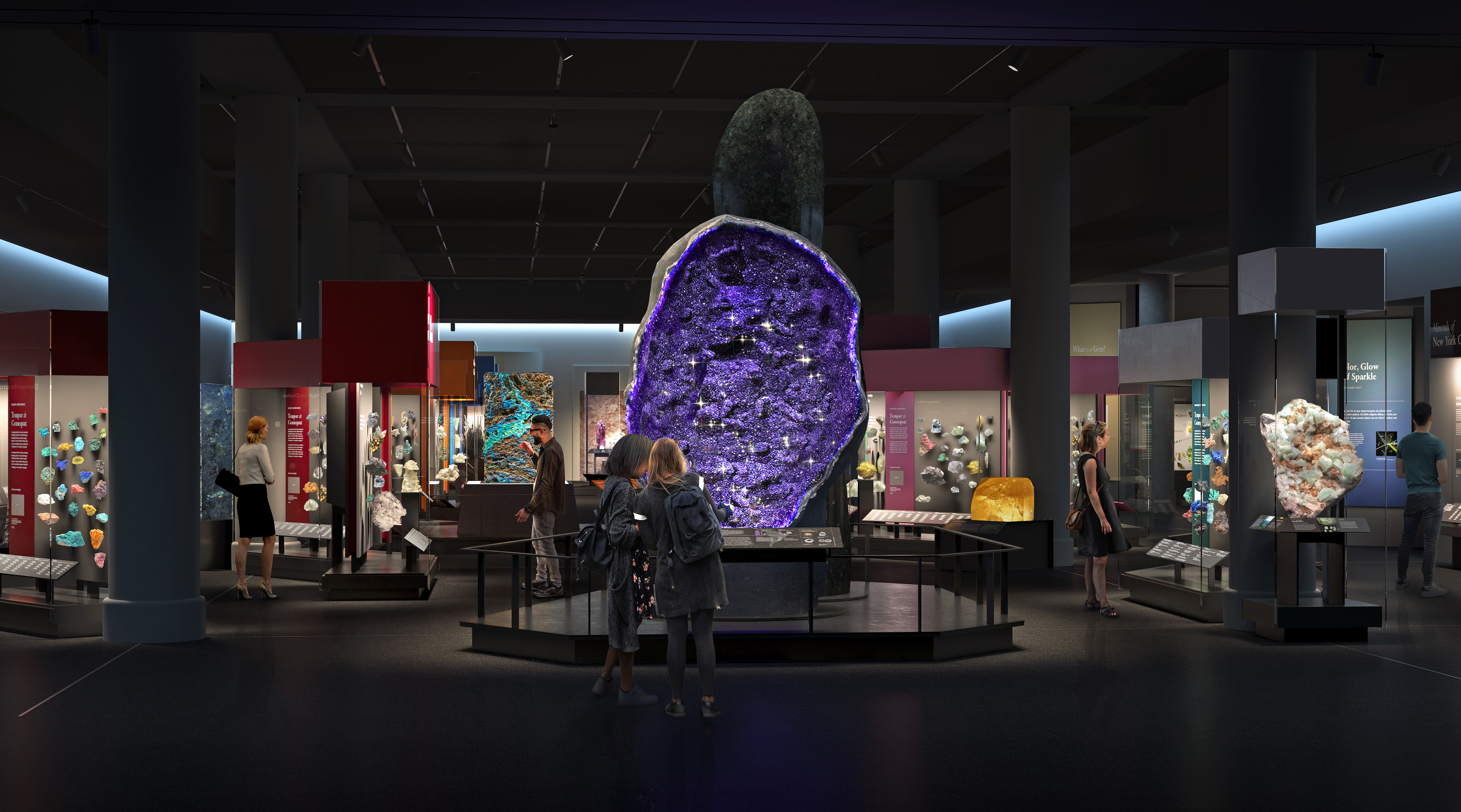
MHGM - looking north - amethyst geode.jpg


Re-Envisioned Halls Will Present the Current Science of Mineral Formation and

Showcase Spectacular New Specimens and World-Renowned Collection


A New Temporary Exhibition Gallery to Open with Beautiful Creatures,

A Celebration of Vintage and Contemporary Jewelry Inspired by Animals


The American Museum of Natural History today announced that it will open the completely redesigned Allison and Roberto Mignone Halls of Gems and Minerals in fall 2020. A brilliant showcase for one of the greatest collections of its kind and an engaging guide to recent science about our dynamic planet, the 11,000-square-foot halls will feature:
  • recently acquired specimens, including two remarkable amethyst geodes that are among the world’s largest on public display
  • a gallery of gems re-presenting treasures such as the legendary 563-carat “Star of India” sapphire and 632-carat Patricia emerald
  • and the halls’ first temporary exhibition gallery, opening with Beautiful Creatures, a celebration of exquisite historic and contemporary jewelry inspired by animals.
With interactive displays, touchable specimens, and media, the halls’ redesigned exhibits will tell the fascinating story of how the vast diversity of mineral types—which, similarly to biological organisms, are grouped into species—arose on Earth, how scientists classify them, and how humans have used them throughout the millennia for personal adornment, tools, and technology.

Highlights will include a luminous gallery featuring a wall-sized panel of rock glowing fluorescently in shades of orange and green; a pair of exquisite amethyst geodes from Uruguay that tower to a height of 12 feet and 9 feet; and the 9-pound almandine “subway” garnet discovered under Manhattan’s 35th Street in 1885. Jewelry in animal forms featured in the temporary exhibition gallery will include pieces by Cartier, Bulgari, and Tiffany & Co., as well as by contemporary designers such as Bina Goenka. The halls are curated by George E. Harlow, curator in the Museum’s Division of Physical Sciences. Marion Fasel is guest curator for the Beautiful Creatures temporary exhibition.

The halls of gems and minerals are named for Roberto and Allison Mignone, long-time Museum supporters and volunteers. Roberto Mignone is a Museum Trustee and Allison Mignone is vice chair of the Museum’s Campaign.

The halls are undergoing renovation as part of the physical and programmatic initiatives undertaken in conjunction with the 150th anniversary celebration of the Museum, which was founded in 1869. These projects will culminate in the opening of the Richard Gilder Center for Science, Education, and Innovation, a major new facility that will house exhibition galleries, education spaces, and collections.

“The opening of the Mignone Halls of Gems and Minerals will be a milestone in a wide range of capital and programmatic enhancements commemorating the Museum’s 150th anniversary,” said Ellen V. Futter, President of the American Museum of Natural History. “By telling the fascinating stories of the complex processes that gave rise to the extraordinary diversity of minerals on our dynamic planet and describing how people have used them throughout history for personal adornment, tools, and technology, the Halls will not just be glittering but also intellectually engaging. The new Mignone galleries will also be a major gateway, directly linking visitors to the new Richard Gilder Center for Science, Education, and Innovation. We are indebted to Allison and Roberto Mignone for making this important project possible.”

“When I first started as a curator at the Museum over 40 years ago, the most recent version of these galleries had just opened. Science has progressed significantly in that time, such as with the concept of mineral evolution,” said George E. Harlow, curator of the new halls. “These new exhibits will present our current scientific understanding of gems and minerals, present the environments in which they form, and focus on the intimate relationship between minerals and life.”

“Halls like these are crucial and tangible teaching tools that communicate an understanding of humanity’s place in the universe,” said Allison Mignone. “Our family’s experiences at the Museum have helped us see the discoveries and sparks that take place when spectacular exhibits such as this one are on view, and remarkable stories, such as those that will be featured in these renovated galleries, are told.”

Exhibits in the Mignone Halls of Gems and Minerals will explore the conditions on our planet that have made possible the extraordinary variety of mineral species found on Earth. In addition to the role of plate tectonics and fluids responsible for the formation of crystals, exhibits will reveal how the introduction of free oxygen into the Earth’s atmosphere more than 2 billion years ago triggered an explosion not only in biological life but also in mineral diversity. The oxygenated atmosphere—produced by cyanobacteria, a group of photosynthetic organisms—made it possible for oxygen to combine into many more vividly colorful minerals on Earth, now numbering approximately 5,500 species.

The section of the Museum that will house the Mignone Halls of Gems and Minerals had long been a cul-de-sac, which could be entered and exited only from the south end. In the future, the Mignone Halls of Gems and Minerals will be linked to the new Gilder Center, allowing visitors to circulate with greater ease and less congestion.

The Mignone Halls of Gems and Minerals will be a striking complement to the David S. and Ruth L. Gottesman Hall of Planet Earth and Hayden Planetarium in the Rose Center for Earth and Space, and the Arthur Ross Hall of Meteorites. The Gottesman Hall of Planet Earth illustrates the evolution and inner workings of our dynamic planet with outstanding geological specimens and interactive exhibits on climate change, while the Hayden Planetarium educates visitors about the latest space science through immersive presentations such as the Museum’s newest Space Show Worlds Beyond Earth. The Ross Hall of Meteorites—which is immediately adjacent to the Mignone galleries—explores the origins of our solar system through holdings from the Museum’s world-class collection of meteorites, which contain some of the same minerals found on Earth.

With exhibits that support New York State and national science education standards, these halls serve as a vital resource for school and camp groups, educators, and graduate students in the Museum’s Master of Arts in Teaching program, which provides a specialization in Earth science for teachers of grades 7 through 12.
The Mignone Halls of Gems and Minerals is designed by Ralph Appelbaum Associates together with the American Museum of Natural History’s award-winning Exhibition Department under the direction of Lauri Halderman, vice president for exhibition.
The Museum gratefully acknowledges Allison and Roberto Mignone for their leadership support of the redesigned Halls of Gems and Minerals.
Generous support has been provided by the Arthur Ross Foundation.
Worlds Beyond Earth is dedicated to the memory of Charles Hayden in celebration of the 150th anniversary of his birth and made possible by the generous support of the Charles Hayden Foundation.
Proudly sponsored by Bank of America.
Generously sponsored in loving memory of Wallace Gilroy.

About the American Museum of Natural History (amnh.org)
The American Museum of Natural History, founded in 1869 and currently celebrating its 150th anniversary, is one of the world’s preeminent scientific, educational, and cultural institutions. The Museum encompasses 45 permanent exhibition halls, including those in the Rose Center for Earth and Space plus the Hayden Planetarium, as well as galleries for temporary exhibitions. It is home to New York State’s official memorial to Theodore Roosevelt, a tribute to Roosevelt’s enduring legacy of environmental conservation. The Museum’s approximately 200 scientists draw on a world-class research collection of more than 34 million artifacts and specimens, some of which are billions of years old, and on one of the largest natural history libraries in the world. Through its Richard Gilder Graduate School, the Museum grants the Ph.D. degree in Comparative Biology and the Master of Arts in Teaching (MAT) degree, the only such free-standing, degree-granting programs at any museum in the United States. Annual on-site attendance has grown to approximately 5 million, and the Museum’s exhibitions and Space Shows can be seen in venues on six continents. The Museum’s website, digital videos, and apps for mobile devices bring its collections, exhibitions, and educational programs to millions more around the world. Visit amnh.org for more information.

Hours
The Museum is open daily, 10 am–5:45 pm. The Museum is closed on Thanksgiving and Christmas.
Admission
Museum admission is free to all New York City school and camp groups.
Pay-what-you-wish admission is available only at ticket counters, where the amount you pay is up to you.
General Admission, which includes admission to all 45 Museum halls and the Rose Center for Earth and Space but does not include special exhibitions, giant-screen 2D or 3D film, or Space Show, is $23 (adults), $18 (students/seniors), and $13 (children ages 2–12). All prices are subject to change.
General Admission Plus One includes general admission plus one special exhibition, giant-screen 2D or 3D film, or Space Show: $28 (adults), $22.50 (students/seniors), $16.50 (children ages 2–12).
General Admission Plus All includes general admission plus all special exhibitions, giant-screen 2D or 3D film, and Space Show: $33 (adults), $27 (students/seniors), $20 (children ages 2–12).
Public Information
For additional information, the public may call 212-769-5100 or visit the Museum’s website at amnh.org.

Follow
Become a fan of the American Museum of Natural History on Facebook at facebook.com/naturalhistory, follow us on Instagram at @AMNH, Tumblr at amnhnyc, or Twitter at twitter.com/AMNH