Showing posts with label North Africa. Show all posts

Tuesday, August 23, 2016

North Africa’s Largest Crystal Lagoons’ Project To Be Built In Egypt


North Africa’s largest Crystal Lagoons’ project to be built in Egypt

Crystal Lagoons, the multinational innovation company and developer of the world’s top amenity patented technology that makes giant crystal-clear lagoons a reality, has announced two new project wins in Egypt, bringing its total portfolio of active and under development projects in the Middle East and India to 15.
Showcasing a range of projects at this year’s Cityscape Global real estate showcase, which will take place at Dubai International Convention & Exhibition Centre from 6-8 September 2016, the company will highlight its latest project in Egypt located within the US$400 million phase two of the 210-hectare Stella Di Mare project in the increasingly popular western Red Sea coastal resort of Ain Sokhna.
A flagship development for Cairo-headquartered REMCO Group, the second phase of this upscale community is designed around a clutch of private islands surrounded by crystalline lagoons and connected by bridges.
“Once completed, the 38-hectare lagoon will be the largest in North Africa and will also encircle the entire development, thus creating a truly unique residential and leisure environment and further underscoring our ability to bring waterfront living to anywhere in the world, even the desert,” said Carlos Salas, Middle East Regional Director, Crystal Lagoons.
The company has also partnered with Misr Italia Group, one of Egypt’s most prominent real estate developers, to deliver two lagoons with a total size of 2.7-hectares within its US$1 billion second home Mousa Coast community located on the Red Sea, just 90 minutes from Cairo.
“Misr Italia’s reputation for developing highly attractive communities with a broad range of leisure amenities, brought us together; and now the two lagoons will be the focal point of this exciting new Red Sea development,” said Carlos Salas,
“With 2,500 units delivered and plans for 16,000 chalets and five luxury hotels, Mousa Coast is positioning itself as a secure, attractive and versatile location, and Crystal Lagoons’ expertise will add further value and a major USP for prospective investors,” he added.
Crystal Lagoons’ technology can use any type of water. When using fresh water up to 30 time less water is used. Crystal Lagoons can also use salt and brackish water, the latter has no alternative use and it can be obtained from underground aquifers, creating a crystal-clear oasis in the middle of the desert.
“Both of these projects will enjoy an idyllic beach lifestyle enabling residents to practice a wide variety of water sports - such as swimming, kayaking, paddle boarding and to enjoy luxurious resort facilities like chalets and standalone villa homes with their own private stretch of beach accessible by boat as well as car,” added Salas.
Crystal Lagoons’ sustainable technology and proven green credentials provide a low cost, low maintenance leisure amenity solution with its ultrasonic filtration system using just 2% of the energy required by conventional filtration systems, positively impacting running costs and dramatically reducing consumption.

Thursday, January 7, 2016

An Insider's Cultural Guide To Beirut: 'A Beautiful, Rowdy, Intoxicated Mess'

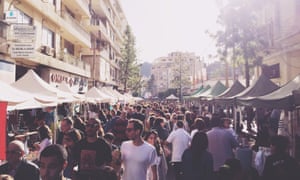
A street market in Mar Mikhael, Beirut …
A street market in Mar Mikhael, Beirut … Photograph: Nasri Atallah

Instagram stories of Syrian refugees, Arabic rap and Armenian food – Nasri Atallah shows us there’s more to the capital of Lebanon than its glamorous clubs, or its troubled politics


In five words
A beautiful, rowdy, intoxicated mess.

Sound of the city

The car horn. Everyone in the city has their hand poised just above it ready to communicate all sorts of emotions. We’ve actually developed an entire non-verbal lexicon. A long beep expresses anger, two short ones are a hello to the local greengrocer, and so on. You can even express political allegiances by playing a tune. I wish they’d have every car horn removed when cars are imported. I think it would make the place friendlier and save everyone a lot of money on whisky and Xanax.

Everyone’s tuning into …

Lebanon’s mainstream TV landscape looks alarming similar to that of most countries around the world at this point, ie some combination of X Factor and Dancing With The Stars. The latest show to capture the imagination is Celebrity Duets, the local variant of a very short lived American franchise – it lasted all of one short season – which pairs celebrities with pop singers for duets. It’s pretty self-explanatory. I think the show is working really well in Lebanon because everyone loves a good singalong, and the celebrity element makes it feel like you’re hanging out with friends.
In this clip, a TV chef who has been on screen for about as long as I can remember performs a culinary-themed duet with pop star Fares Karam.

Best venue

Badguer
Pinterest
 A corner in the lovely Armenian area of Beirut, Bourj Hammoud. Photograph: Badguer
I recently discovered Badguer, an Armenian cultural centre in the area of Bourj Hammoud. They host workshops promoting traditional trades, showrooms for budding artisans, galleries for Armenian artists. Armenians are traditionally recognised as artisans in Lebanon, and many live in Bourj Hammoud. It’s odd, this Central Asian community is very well integrated into national life, but we don’t actually know much about their culture beyond cliches. So this centre is a great place for the transmission of that culture. Oh, and there’s a restaurant with delicious food, which always helps. 

Who’s top of the playlist?

I recently saw a great set – Love and Revenge by Rayess Bek and Randa Mirza. I’ve been aware of Bek for a while as a pioneer of Lebanese rap, but here he’s doing something completely different and utterly compelling. It’s a great mashup of electro, traditional Arabic music and images from Egyptian cinema. And they’ve both spent time living in France, so it’s a way of processing their identity as well, I guess.
The independent music scene in Lebanon has gone through a real renaissance over the last few years, with great promoters like Beirut Jam Sessions and festivals like Wickerpark.

What’s the look on the street?

I’m not a reference on style whatsoever, but my wife – Nour Hage – is a fashion designer, so I guess that gives me legitimacy by association to have some sort of opinion. I honestly don’t think there’s an inherently Lebanese street style. Like much else in Beirut it’s a mashup of things people pick up along the way. It can be preppy, normcore or hipster. Depends what street you’re on. However, I’d say the overwhelming aesthetic is glam. People even dress up to go to the grocery store.

Best local artist

My favourite artist – and incidentally one of my favourite people – is Hamed Sinno, lead singer of Mashrou Leila. Even though he’s primarily a musician, and his band have had massive success touring in Europe and North America, I think his artistry goes far beyond the fresh voice he’s bringing to Arabic pop and folk music.
First of all, he’s openly gay. A lot has been already made of that in the international press because it’s a neat headline – and it is undoubtedly brave to live in Lebanon and go on the cover of one of the leading gay magazine in Europe – but he’s about far more than that. He’s very active and vocal about social issues, and incorporates his thinking about the world into meta-narratives that feed back into his music.
There’s something almost academic to his art, an intense desire to understand the root causes of injustice and intolerance, coupled with a drive to do something about it through art.

Best cultural Instagram account

Natalie Naccache is a British-Lebanese photojournalist. She’s represented by Getty, and her work is really impactful. She has documented people in limbo, like Syrian refugees trying to build a life in Lebanon and migrant workers from Africa and south-east Asia.

What does Beirut do better than anywhere else?

Design seems to be the artform we export most successfully, primarily fashion design. The top couture designers – Elie SaabRabih Keyrouz – from Lebanon are pretty much household names internationally for anyone who follows red carpet pre-award show banter. I also think it’s not accidental that a lot of visual art, graphic design, filmmaking and advertising comes from Lebanon (or at least from Lebanese people). There’s something about the aesthetic of the place that pushes you to add your touch to it.

Comedy gold

There are a bunch of long-running political satires on television, some old school and some ripping off formats like The Daily Show. But they tend to be on the racist, misogynistic side. Even though they’re pretty popular, I’d rather not mention them. Something much more fun is what’s going on on Facebook. Besides Lebanese takes on various international internet memes, and some hilarious Viners (like Hass Julien), a few guys have gone viral just posting videos of themselves bitching about the situation in the country. I like this one guy Farid Hobeiche. He’s got this massively deadpan delivery, and he’s completely absurd. But then you think about what he’s saying; it’s just a reflection of how absurd everything is here. And he’s getting hundreds of thousands of views, so he’s clearly hitting a chord.

Moment in history

Fairuz at the Baalbeck Festival in 1957. She needs no introduction. But what people might not know about her is that she sang the story of a Lebanon that never really existed. A figment of all of our collective imaginations. Of village life and innocence. She essentially helped build the identity of Lebanon, just 14 years after it became an independent country. She infused a voice and stories into the place.
There’s no YouTube footage of it (that I can find) but here’s an extract from a musical film she made that has the same theme of village life.

What’s the big talking point?

It’s not exactly pleasant, but it would be disingenuous to not mention it: the trash crisis. The country’s rubbish has been piling up untreated since 21 July. Even by the government’s own dismal standards, this was a pretty bad thing to mess up. There were widespread protests all summer, accompanied by police violence and inertia on the government side.
It’s really a symbol of everything that’s wrong here. The system is broken, and even our trash is polarised and politicised. Now everyone is terrified about disease. In a kind of perverse way we were secretly relieved that our biggest problem was now trash (something solvable through protest and better governance) rather than car bombs. That’s until we had the worst terrorist attack since the end of the civil war on 12 November. Then the conversation shifted to why we’re not worthy of the same attention Paris was the following day.

Best street art

Sabah street art
Pinterest
 Looming large over the neighbourhood of Hamra … Photograph: Yazan Halwani
Yazan Halwani. He’s already had a tonne of attention for it, but I think it merits mentioning again. He created a mural of Sabah along the side of a building in Hamra. The legendary singer and actor passed away last year – she was equally legendary for her personal life (she did pretty much anything she wanted) in a place with a very codified moral order.

From me

Nasri Atallah
Pinterest
 This is me … Photograph: Yann Traboulsi
By Nasri Atallah; a British-Lebanese author, publisher and media entrepreneur. You can follow him on Twitter here, Instagram here and Facebook here.

Five to follow


#Mid

Saturday, July 18, 2015

Tourism To Iran Set To Rise Sharply

The Siosepol bridge, whose name means bridge of 33 arches, in Isfahan, Iran's top tourist destination. It crosses Zayandeh Rud, the “life-giving river”, connecting two halves of the city build during the Safavid dynasty.The Siosepol bridge, whose name means bridge of 33 arches, in Isfahan, is one of Iran’s top tourist destinations. Photograph: Alamy
Iran is hoping that the nuclear agreement struck in Vienna will create a further boost to a tourist industry that has already relaxed visa requirements and is planning to build new hotels to attract visitors to its ancient sights
Iran, host to many unique cultural treasures largely unseen by western eyes, is expecting a significant rise in the number of tourists visiting the country in the wake of this historic nuclear deal. 
President Hassan Rouhani’s government is taking fresh measures to ease or abolish visa requirements for most foreign visitors and build as many as 200 new hotels, as existing accommodation is insufficient to cater for the spike in tourism that has occurred since his election in 2013.
Iran’s vice-president for tourism, Masoud Soltanifar, said that “bright days” lie ahead for the country’s tourism industry following the nuclear agreement struck in Vienna.
“No other industry in Iran will see a bigger boost than tourism as the result of this deal,” he said. “The news about the nuclear agreement and lifting of economic sanctions has delighted our tourism industry.” Soltanifar announced earlier in July that Iran was increasing the length of tourist visas from 15 days to one month, and from as early as next year tourist visas could be issued electronically. 

Tourists at the Tachara Palace in Persepolis.
Pinterest
 Tourists at the Tachara Palace in Persepolis. Photograph: Behrouz Mehri/AFP/Getty Images

Earlier this month, Unesco added two more ancient sites – Susa archaeological mounds and the stunning Meymand village – the 18th and 19th sites on Iran’s world heritage list. The country was a popular destination for visitors until the 1979 Islamic revolution, and hosted world luminaries such as Andy Warhol, violinist Yehudi Menuhin and choreographer Maurice Béjart.
Iran, which was a Zoroastrian country before Islam arrived, is home to some of the world’s most magnificent historical and archaeological sites with ancient ruins, glittering mosques and spectacular landscapes. Relics of a proud ancient civilisation include: Persepolis, the capital of the largest empire that the world has ever seen; the city of Isfahan; Shiraz, the city of love and poetry; and Hamadan, where Avicenna, the father of early modern medicine, is buried. The capital Tehran is famous for having ski resorts on its doorstep.


Michael Pullman, marketing manager of UK-based tour operator Wild Frontiers, which has been taking western tourists to Iran for the past 10 years, said demands for Iran tours have soared since the nuclear deal was reached earlier this week. He also said that since 2013 demand to visit Iran has increased significantly, and last year the tour operator, which specialises in small, tailor-made group tours, took 150 people. He expects that number to increase by 30% this year. 
“When relations started to thaw between Iran and the west, suddenly people felt safe to go,” said Pullman. “It had been branded as part of the ‘axis of evil’ by George Bush, which didn’t help things, and it’s taken time for Iran to rid itself of the label.”
The reactions from westerners visiting Iran is remarkable, he added: “They all come back unanimously saying it’s their ‘new’ country. The sites are one thing – there’s just stunning Islamic architecture and ancient sites, such as Persopolis – but everyone seems to agree that it’s the people that are the biggest surprise.”

Milad Tower, Tehran.
Pinterest
 Milad Tower, Tehran. Photograph: Gallo Images/Getty Images

David McGuinness from Travel The Unknown, echoed Pullman: “When Rouhani got elected, it made a sea-change difference in terms of bookings. Immediately we saw a rise in bookings for Iran, it suddenly became one of our most popular destinations.” His company, which took 100 people to Iran last year, has already planned several other tours – two classic and archeology tours in September and four more in October, including off-the-beaten-track tours. 
But is Iran safe to visit? McGuinness said: “The country is very safe, I have travelled there myself five or six times over the last two years and we have never had any problems with anybody. Iran is probably the most friendly, most welcoming country I’ve ever been in.”
Pullman agreed: “I felt very safe. With what’s going on at the moment with Isis, if you look at the countries surrounding Iran, such as Syria and Iraq, they are unsafe but Iran is quite a strictly-controlled country, it’s 90% Shia and there’s no kind of Sunni-Shia friction. You feel safe walking in the streets, I felt safer there than I do in most places in London.”
One big disappointment is that the British foreign office (FCO) still advises against all but essential travel to Iran. “FCO still advises against travelling to Iran but we feel it’s perfectly safe and that seems to be more of an issue with the fact that there’s no British embassy in Tehran, rather than any particular threat,” said Pullman. Wild Frontiers works with an insurer who provides cover for its clients as standard insurance policies are not valid while FCO advice against travel is in place.
The FCO announced on 15 July that it was planning to reopen its embassy in Tehran by the end of this year. “When that happens and the FCO lifts its advice, the demand will increase further, in fact it will go to the roof,” said Pullman.
Pullman visited Iran last year and noted that: “Iran has an incredibly young population, I think over 60% is under 35; it has a history of being a cultured nation, and very well-educated. It also has one of the highest female university rates anywhere in the world.” 
The UAE-based Rotana hotels is planning to open a number of hotels in Iran, and France’s leading hotelier, Accor, is involved in at least two four-star hotels in the country. Iranian officials, looking at neighbouring Turkey with envy, have expressed hope that the country could attract as many as 20 million visitors a year by 2025.
 Iran correspondent, www.theguardian.com

Saturday, June 27, 2015

Travelore News: Thousands Of European Tourists Being Evacuated From Tunisia

Thousands of European tourists being evacuated from Tunisia

A Jetairfly aircraft flying yesterday from Germany to Tunis turned around midair after news emerged on the terror attack.
The UK Foreign Office has warned travelers that some attackers may still be at large in Tunisia and has urged people to stay indoors and not disclose information on social media.
Ten bodies have been identified out of 38 -- eight Britons, a Belgian and a German, said senior ministry official Naoufel Somrani.
Another 39 people were wounded including British, German and Belgian nationals.
The Tunisian ministry said more time was needed to identify the other victims because most of them were in beachwear at the time of the attack and were not carrying identification.
Ten Thomson Airways flights are travelling to Tunisia from Britaomto bring approximately 2,500 Thomson and First Choice customers home.
All Thomson and First Choice packages to Tunisia will be cancelled for the next week. Amendments can be made to bookings on holidays to Tunisia until 24th July. Instead passengers booked on a holiday to Tunisia can will be offered trips to Cape Verde, Rhodes and Gran Canaria. Additional flights are already scheduled.
Also German tour operators allow free cancellation and are sending planes to Tunisia to pick up travelers.
Tourism is a key component of Tunisia's economy, generating around 15 per cent of its GDP.
TUI joint chief executive Peter Long said: "Our whole organisation is reeling with pain to see the suffering that is taking place in Tunisia with our customers...We are doing our very, very best to look after our guests who are still in Tunisia."
Thomson had hundreds of customers at hotels in the Sousse area, and confirmed several of the victims were its customers, but was unable to confirm how many had been killed or injured.
Itaka Polska, a Polish tour operator is also cancelling all trips to this North African country.

Monday, July 28, 2014

What To Do In Marrakech: 10 Amazing Attractions


(CNN) -- While many visits to Marrakech revolve around the imposing Koutoubia mosque or Jemaa el Fna, the bustling central square filled with snake charmers and storytellers, there's plenty to do beyond these landmarks.
For those willing to delve deep into the narrow streets around the square or into the desert and mountains outside the city, Marrakech rewards with stunning scenery, unforgettable flavors and luxurious indulgences.
Here are some of the city's highlights.
1. Getting lost in the backstreets
Exploring the old medina can be pleasurable and expensive in equal measures thanks to the small boutiques selling almost everything.
Among classic local souvenirs are djellaba robes, spices, babouches (Moroccan slippers), old carpets and colorful ceramics.
Bargaining is part of the attraction here.
Taking time over a purchase will not only save money but generally prompt an enjoyable discussion with the vendor.
Recommended: La Porte d'Or -- an ancient two-level bazaar rammed with rugs and antiques.
La Porte d'Or 115 Souk Semmarine, Marrakech; +212 24445454

2. Wandering through the Jardin Majorelle
Here, the simple joy of a peaceful garden meets the complicated world of high couture.
This 12-acre botanical creation was bequeathed to Marrakech by French painter Jacques Majorelle and later saved from development by fashion designer Yves Saint Laurent, who bought it in the 1980s and, following his death, had his ashes scattered among its plants.
The garden, which blends Moorish and art deco features, is filled with rare flowers. A startling electric blue villa looks down upon the scene.
Jardin Majorelle, Rue Yves Saint Laurent, Marrakech; +212 5243-01894
Marrakech\'s answer to the mall.
Marrakech's answer to the mall.
3. Eating a sheep's head
There are plenty of places to eat Moroccan food in Marrakech.
Cooked snails, tajines, couscous and sheep heads -- there are different levels of exoticism to match the adventurousness of the diner.
Tanjia is a staple here. It's a meat dish cooked for six or more hours in a ceramic pot.
It's not commonly enjoyed by tourists but has such a terrific reputation among Moroccans that some come to Marrakech with the sole purpose of eating it.
Recommended: Dar Rhizlane Bejgueni, Jamaa el Fna square. This 40-year-old restaurant is a Marrakech institution. It's open until 2 a.m. and is famous for its sandwiches.
Dar Rhizlane Bejgueni, Jamaa el Fna square, Marrakech
4. Getting pummeled by a stranger
Steaming in a traditional Hammam or public bath is an important part of Moroccan life and culture.
Being scrubbed by a perfect stranger may not sound like everyone's idea of relaxation, but there's no better way to escape the buzzing Medina and revitalize weary skin and muscles.
Recommended: Les bains de Marrakech, a luxury spa close to the medina that offers individual massage rooms.
Les Bains de Marrakech, 2 Derb Sedra, Bab Agnaou, Kasbah, Marrakech; +212 5 24 38 14 28
5. Visiting or staying in a palace
El Badi Palace: It may be in ruins, but it's still possible to get an idea of the former glory of this sprawling 16th-century sultan's home.
There are subterranean rooms and a labyrinth to explore, plus a museum of objects recovered from an old Minbar (pulpit) at the Koutoubia mosque.
Mamounia Palace: This five-star hotel has been a Marrakech institution for the best part of a century, receiving famous guests such as Winston Churchill and Charlie Chaplin.
Green space: Jardin Majorelle.
The Mamounia still attracts celebrities. Russian President Vladimir Putin's daughter was reportedly married here in 2013.
Namaskar Palace: Another luxury hotel, this one on the way from Marrakech to the Atlas Mountains.
Stylish with traditional influences, the oasis-style spa retreat regularly tops best-in-Africa lists.
El Badi Palace: Ksibat Nhass, Marrakech; +212 661 350878
Mamounia Palace, Arset el Maach, Marrakech; +212 5243 88600
Namaskar Palace, Route de Bab Atlas, 88/69, Province Syba, Marrakech; + 212 5 24 29 98 00
6. Relaxing in a riad
Whether for drinking tea or staying the night, riads are a great part of the Marrakech experience.
These traditional Moroccan houses built around a central garden or courtyard are as much a part of the city as the snake charmers of the main square -- although many have had a modern makeover.
Regardless of whether they've been kitted out with the latest fixtures or remain faithful to their old fashioned Moroccan decor, they all seem to evoke the myths of "One Thousand and One Nights."
Recommended: El fenn, a maze-like, 22-room luxury boutique hotel based around three central courtyards.
El Fenn, Derb Moullay Abdullah Ben Hezzian, Bab el Ksour Medina, Marrakech; +212 524 44 1210
7. Checking out the Atlas Mountains
One of Marrakech's key attractions is that it lies within easy reach of the Atlas Mountains, meaning that cool retreats from the heat and dust of the city are close at hand.
The town of Lalla Takerkoust, 43 kilometers (27 miles) to the southwest, is chiefly known for its nearby dam and lake and is a great place for quad biking, camel riding or simply admiring view of the peaks.
Slow food: A Marrakech snail vendor.
The valley of Ourika, in the Atlas foothills 60 kilometers to the south of Marrakech, is a popular escape to see Berber villages surrounded by waterfalls and rivers.
The village of Armed, 64 kilometers due south, is the last stop before Toubkal, Morocco's highest mountain, the peak of which affords views over the Sahara.
It's a great base for hiking or for simply breathing pure air, contemplating nature or enjoying a lunch on the terrace at the Roches Hotel (+212 667 64 49 15)
8. Grabbing a bargain in Bab El Khemis
It's off the main tourist trail, but Bab el Khemis is worth a visit.
The souk here is open every day, but on Thursdays ("Khemis" translates as "Thursday") it becomes a truly Moroccan experience.
This is when it transforms into a crowded flea market selling secondhand goods and treasures such as vintage carpets, doors and more than a few things that customers probably don't know exist until they stumble across them here.
9. Hot air ballooning
When people visit the city and talk of getting high, it doesn't necessarily mean they're hunting for the Crosby, Stills and Nash "Marrakech Express" vibe of the 1960s hippie trail.
Over the past 20 years, the city has emerged as a destination for balloon trips -- clear Moroccan skies that rarely see clouds or rain are a huge plus.
Taking in what is undoubtedly the best view of the Atlas Mountains doesn't come cheap, but few deny it's money well spent.
Recommended: Ciel d'Afrique, an organzied and professional operation with decades of ballooning experience.
Ciel d'Afrique; +212 524 43 28 43
10. Thrill seeking
A 30-minute drive south of Marrakech leads to Terres d'Amanar, a 173-acre adult playground filled with adrenaline-boosting outdoor activities.
For those with no fear of heights there are climbing routes, high wires and zip lines, while on the ground there's horse and camel riding.
Berber bread making courses are also offered.
Terres d'Amanar; +212 524 438 103
Contributed by Ali Berrada; a Moroccan photographer, writer and director. 
Follow us on Twitter: @TraveloreReport