Showing posts with label #MiddleEast. Show all posts

Saturday, January 13, 2018

Female Tourists 25 And Over Can Now Visit Saudi Arabia Without Male Escort


Women aged 25 and over will now be allowed to travel to Saudi Arabia without a chaperone, the country’s tourism commission has announced. It’s the latest reform in the easing of restrictions in the ultra-conservative Gulf kingdom.
As long as they meet the age requirement, women will now be able to receive a tourist visa to visit the country by themselves, Saudi Commission for Tourism and National Heritage (SCTH) spokesman Omar al-Mubarak told the Saudi daily Arab News. The move is part of the country’s wider decision to officially allow tourist visas for both men and women after running a trial period from 2008 to 2010.
“The tourist visa will be a single-entry visa, and valid for 30 days maximum. This visa is added to those currently available in the Kingdom. It is independent of work, visit, Hajj and Umrah visas,” Mubarak said.
He said the commission’s IT department is “currently building an electronic system for the issuance of tourist visas, coordinating with representatives of the National Information Center and the Foreign Ministry.”
Saudi Arabia experienced an influx of more than 32,000 people during its trial period of implementing tourist visas. Those visas were facilitated by various tour operators licensed by the SCTH.
The SCTH announcement was not unexpected, as Prince Sultan bin Salman bin Abdul Aziz, head of Saudi Arabia’s tourism authority, said in November that “tourist visas will be introduced soon.”
Riyadh seems intent on boosting the country’s image as a tourist destination, with Crown Prince Mohammed bin Salman announcing in August a project to turn 50 islands and a string of sites on the Red Sea into luxury resorts.
The visa decision comes less than four months after King Salman issued a decree ordering that women finally be allowed to drive. The new policy is set to come into effect on June 24, 2018, officially abolishing the world’s only female driving ban.
The country is also easing restrictions on women in other ways. In September, women were allowed into the King Fahd International Stadium in Riyadh for the first time to witness the 87th anniversary celebrations of the country’s foundation.
In October, stadiums across the country were ordered to begin making preparations for women to be allowed inside from early 2018. As a result, women will be allowed into Prince Abdullah al-Faisal Stadium in Jeddah on Friday to watch a Saudi Premier League football match for the very first time. Cinemas, which have been banned in the ultra-conservative country for 35 years, are also set to open in March. The country plans to have more than 2,000 movie screens operating by 2030.

Sunday, December 10, 2017

Egypt Hopes Discovery Of Ancient Tombs Will Spark Tourism Revival

The tombs, located on the west bank of the river Nile in a cemetery for noblemen and top officials, are the latest discovery in the city famed for its temples and tombs spanning different dynasties of ancient Egyptian history.
“It’s truly an exceptional day,” said Antiquities Minister Khaled al-Anani.
“The 18th dynasty private tombs were already known. But it’s the first time to enter inside the two tombs.”
Al-Anani said the discoveries are part of the ministry’s efforts to promote Egypt’s vital tourism industry, partially driven by antiquities sightseeing, that was hit hard by extremist attacks and political turmoil following the 2011 uprising.
The ministry said one tomb has a courtyard lined with mud-brick and stone walls and contains a six-metre burial shaft leading to four side chambers.
The artefacts found inside were mostly fragments of wooden coffins. Wall inscriptions and paintings suggest it belongs to era between the reigns of King Amenhotep II and King Thutmose IV, both pharaohs of the 18th dynasty.
The other tomb has five entrances leading to a rectangular hall and contains two burial shafts located in the northern and southern sides of the tomb.
Among the artefacts found inside are funerary cones, painted wooden funerary masks, clay vessels, a collection of some 450 statues and a mummy wrapped in linen who was likely a top official.
A cartouche carved on the ceiling bears the name of King Thutmose I of the early 18th dynasty, the ministry said.
Afterward, al-Anani headed to a nearby site where the famous Mortuary Temple of Hatshepsut is located to open for the first time the temple’s main sanctuary known as the “Holy of Holies”.
Since the beginning of 2017, the Antiquities Ministry has made a string of discoveries in several provinces across Egypt – including the tomb of a royal goldsmith, in the same area and belonging to the same dynasty, whose work was dedicated to the ancient Egyptian god Amun.
In November, scientists announced that they had found a hidden chamber in Egypt’s Great Pyramid of Giza, in what would be the first such discovery in the structure since the 19th century, sparking a surge of interest in the pharaohs.
© Associated Press

Wednesday, April 19, 2017

Emirates Trims U.S. Flights After Trump Administration Curbs


DUBAI, United Arab Emirates (AP) — Emirates, the Middle East's biggest
 airline, said on Wednesday it is cutting flights to the United States because of 
a drop in demand caused by tougher U.S. security measures and Trump 
administration attempts to ban travelers from Muslim-majority nations.

The decision by the Dubai government-owned carrier is the strongest sign
 yet that the new measures imposed on U.S.-bound travelers from the
 Mideast are taking a financial toll on fast-growing Gulf carriers that have
 expanded rapidly in the United States.

Dubai was one of 10 cities in Muslim-majority countries affected by a 
ban on laptops and other personal electronics in carry-on luggage 
aboard U.S.-bound flights.

Emirates' hub at Dubai International Airport, the world's third 
busiest, is a major transit point for travelers who were affected by
 President Donald Trump's executive orders temporarily halting
 entry to citizens of six countries.

The latest travel ban suspended new visas for people from Iran, Libya, Somalia,
 Sudan, Syria and Yemen, and froze the nation's refugee program. Like an earlier
 ban that also included Iraqi citizens, it has been blocked from taking effect by the courts.

Emirates said the reductions will affect five of its 12 U.S. destinations, starting
 next month. It called the move "a commercial decision in response to
 weakened travel demand" in the three months since Trump took office.

"The recent actions taken by the U.S. government relating to the issuance of
 entry visas, heightened security vetting, and restrictions on electronic devices
 in aircraft cabins, have had a direct impact on consumer interest and demand
 for air travel into the U.S.," the carrier said in a statement.

Emirates did not provide financial data for its U.S. operations but said it had
 seen "healthy growth and performance" there until the start of the year.

In the three months Trump has been in office, however, there has been what it
 called "a significant deterioration in the booking profiles on all our U.S. routes, 
across all travel segments."

"Emirates has therefore responded as any profit-oriented enterprise would,
 and we will redeploy capacity to serve demand on other routes on our global
 network," it said.

The cuts will reduce the number of U.S.-bound flights from Dubai to 101, down 
from 126 currently.

Twice daily Emirates flights to Boston, Los Angles and Seattle will be reduced
 to once a day. Daily flights to Fort Lauderdale and Orlando will be pared down
 to five per week.

Like its smaller Gulf rivals Qatar Airways and Abu Dhabi-based Etihad Airways,
 Emirates has ramped up its U.S. presence in recent years and recently
 launched a new service to Newark via Athens.

Several big U.S. carriers have bristled at the Gulf airlines' U.S. push, accusing
 them of flooding the market with capacity while receiving billions of dollars
 of unfair government subsidies. The Gulf airlines deny the allegations.

Delta Air Lines and United Airlines both stopped flying to Dubai last year,
 leaving Emirates the only carrier to offer direct U.S. flights to what has
 become the world's busiest airport for international traffic.

By ADAM SCHRECK. AP.

Monday, April 4, 2016

Hilton Worldwide Unveils Brand New Hotel In Egypt

Hilton Worldwide


The hotel offers 199 modern rooms, including 20 suites and 21 executive rooms, all designed with comfort and convenience in mind to provide a place to relax and unwind or to catch up on work. Credit: Hilton Hotels & Resorts.
Hilton Hotels & Resorts today announces the official opening of Hilton Alexandria King’s Ranch. The hotel marks Hilton Worldwide’s (NYSE: HLT) 18th in Egypt, showcasing the company’s commitment to expanding its operations and further strengthening its presence in the country.

Thursday, January 21, 2016

Travelore News: Bomb Attack Kills Six In Cairo


CAIRO (Reuters) - A bomb attack killed six people, including three policemen, on Thursday near a road leading to the pyramids in the Cairo suburb of Giza, security sources said.
The bomb exploded as the police arrived in their vehicles in front of a building where suspected militants were hiding, the sources said. Thirteen people were wounded.
The Interior Ministry issued a statement saying the bomb had been planted by Muslim Brotherhood militants and went off when security forces tried to raid the building.
Islamist militants have stepped up attacks on Egyptian soldiers and police since the army toppled president Mohammed Mursi of the Muslim Brotherhood in 2013 after mass protests against his rule. Civilians have also been killed.
(Reporting by Cairo bureau; Writing by Michael Georgy; Editing by Andrew Roche)

Thursday, January 7, 2016

An Insider's Cultural Guide To Beirut: 'A Beautiful, Rowdy, Intoxicated Mess'

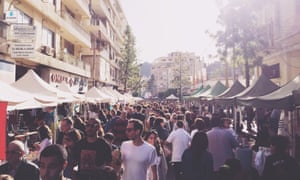
A street market in Mar Mikhael, Beirut …
A street market in Mar Mikhael, Beirut … Photograph: Nasri Atallah

Instagram stories of Syrian refugees, Arabic rap and Armenian food – Nasri Atallah shows us there’s more to the capital of Lebanon than its glamorous clubs, or its troubled politics


In five words
A beautiful, rowdy, intoxicated mess.

Sound of the city

The car horn. Everyone in the city has their hand poised just above it ready to communicate all sorts of emotions. We’ve actually developed an entire non-verbal lexicon. A long beep expresses anger, two short ones are a hello to the local greengrocer, and so on. You can even express political allegiances by playing a tune. I wish they’d have every car horn removed when cars are imported. I think it would make the place friendlier and save everyone a lot of money on whisky and Xanax.

Everyone’s tuning into …

Lebanon’s mainstream TV landscape looks alarming similar to that of most countries around the world at this point, ie some combination of X Factor and Dancing With The Stars. The latest show to capture the imagination is Celebrity Duets, the local variant of a very short lived American franchise – it lasted all of one short season – which pairs celebrities with pop singers for duets. It’s pretty self-explanatory. I think the show is working really well in Lebanon because everyone loves a good singalong, and the celebrity element makes it feel like you’re hanging out with friends.
In this clip, a TV chef who has been on screen for about as long as I can remember performs a culinary-themed duet with pop star Fares Karam.

Best venue

Badguer
Pinterest
 A corner in the lovely Armenian area of Beirut, Bourj Hammoud. Photograph: Badguer
I recently discovered Badguer, an Armenian cultural centre in the area of Bourj Hammoud. They host workshops promoting traditional trades, showrooms for budding artisans, galleries for Armenian artists. Armenians are traditionally recognised as artisans in Lebanon, and many live in Bourj Hammoud. It’s odd, this Central Asian community is very well integrated into national life, but we don’t actually know much about their culture beyond cliches. So this centre is a great place for the transmission of that culture. Oh, and there’s a restaurant with delicious food, which always helps. 

Who’s top of the playlist?

I recently saw a great set – Love and Revenge by Rayess Bek and Randa Mirza. I’ve been aware of Bek for a while as a pioneer of Lebanese rap, but here he’s doing something completely different and utterly compelling. It’s a great mashup of electro, traditional Arabic music and images from Egyptian cinema. And they’ve both spent time living in France, so it’s a way of processing their identity as well, I guess.
The independent music scene in Lebanon has gone through a real renaissance over the last few years, with great promoters like Beirut Jam Sessions and festivals like Wickerpark.

What’s the look on the street?

I’m not a reference on style whatsoever, but my wife – Nour Hage – is a fashion designer, so I guess that gives me legitimacy by association to have some sort of opinion. I honestly don’t think there’s an inherently Lebanese street style. Like much else in Beirut it’s a mashup of things people pick up along the way. It can be preppy, normcore or hipster. Depends what street you’re on. However, I’d say the overwhelming aesthetic is glam. People even dress up to go to the grocery store.

Best local artist

My favourite artist – and incidentally one of my favourite people – is Hamed Sinno, lead singer of Mashrou Leila. Even though he’s primarily a musician, and his band have had massive success touring in Europe and North America, I think his artistry goes far beyond the fresh voice he’s bringing to Arabic pop and folk music.
First of all, he’s openly gay. A lot has been already made of that in the international press because it’s a neat headline – and it is undoubtedly brave to live in Lebanon and go on the cover of one of the leading gay magazine in Europe – but he’s about far more than that. He’s very active and vocal about social issues, and incorporates his thinking about the world into meta-narratives that feed back into his music.
There’s something almost academic to his art, an intense desire to understand the root causes of injustice and intolerance, coupled with a drive to do something about it through art.

Best cultural Instagram account

Natalie Naccache is a British-Lebanese photojournalist. She’s represented by Getty, and her work is really impactful. She has documented people in limbo, like Syrian refugees trying to build a life in Lebanon and migrant workers from Africa and south-east Asia.

What does Beirut do better than anywhere else?

Design seems to be the artform we export most successfully, primarily fashion design. The top couture designers – Elie Saab, Rabih Keyrouz – from Lebanon are pretty much household names internationally for anyone who follows red carpet pre-award show banter. I also think it’s not accidental that a lot of visual art, graphic design, filmmaking and advertising comes from Lebanon (or at least from Lebanese people). There’s something about the aesthetic of the place that pushes you to add your touch to it.

Comedy gold

There are a bunch of long-running political satires on television, some old school and some ripping off formats like The Daily Show. But they tend to be on the racist, misogynistic side. Even though they’re pretty popular, I’d rather not mention them. Something much more fun is what’s going on on Facebook. Besides Lebanese takes on various international internet memes, and some hilarious Viners (like Hass Julien), a few guys have gone viral just posting videos of themselves bitching about the situation in the country. I like this one guy Farid Hobeiche. He’s got this massively deadpan delivery, and he’s completely absurd. But then you think about what he’s saying; it’s just a reflection of how absurd everything is here. And he’s getting hundreds of thousands of views, so he’s clearly hitting a chord.

Moment in history

Fairuz at the Baalbeck Festival in 1957. She needs no introduction. But what people might not know about her is that she sang the story of a Lebanon that never really existed. A figment of all of our collective imaginations. Of village life and innocence. She essentially helped build the identity of Lebanon, just 14 years after it became an independent country. She infused a voice and stories into the place.
There’s no YouTube footage of it (that I can find) but here’s an extract from a musical film she made that has the same theme of village life.

What’s the big talking point?

It’s not exactly pleasant, but it would be disingenuous to not mention it: the trash crisis. The country’s rubbish has been piling up untreated since 21 July. Even by the government’s own dismal standards, this was a pretty bad thing to mess up. There were widespread protests all summer, accompanied by police violence and inertia on the government side.
It’s really a symbol of everything that’s wrong here. The system is broken, and even our trash is polarised and politicised. Now everyone is terrified about disease. In a kind of perverse way we were secretly relieved that our biggest problem was now trash (something solvable through protest and better governance) rather than car bombs. That’s until we had the worst terrorist attack since the end of the civil war on 12 November. Then the conversation shifted to why we’re not worthy of the same attention Paris was the following day.

Best street art

Sabah street art
Pinterest
 Looming large over the neighbourhood of Hamra … Photograph: Yazan Halwani
Yazan Halwani. He’s already had a tonne of attention for it, but I think it merits mentioning again. He created a mural of Sabah along the side of a building in Hamra. The legendary singer and actor passed away last year – she was equally legendary for her personal life (she did pretty much anything she wanted) in a place with a very codified moral order.

From me

Nasri Atallah
Pinterest
 This is me … Photograph: Yann Traboulsi
By Nasri Atallah; a British-Lebanese author, publisher and media entrepreneur. You can follow him on Twitter here, Instagram here and Facebook here.

Five to follow


#Mid

Wednesday, May 8, 2013

An Appreciation For Israel's Determined Pioneers


Contributed by Rick Steves.

During my visit, Israel was celebrating 65 years as a nation. There were flags everywhere. For me, a highlight of my Israel visit was gaining an appreciation for the Zionist pioneers who built the country--slowly early in the 20th century, then very quickly after its modern founding in 1948--and seeing how far the nation has come.
2013-05-02-p5telaviv.jpg
In 1908 Tel Aviv was just a big sand dune. Born in 1909, the city today feels like San Diego. Of the almost eight million people in the country, more than three million live in the greater Tel Aviv area. The relative prosperity among Israel and its neighbors is striking. Waking up on my first morning here, I looked out my hotel window at the wonderful sandy beach (which is made of sediment from the Nile River). Pondering the joggers and kayakers getting in their morning exercise, I kept thinking it's as if someone put California in the middle of Mexico.
2013-05-02-p6wheelbarrows.jpg
When you look at a photo of the early Zionist pioneers who came here and mixed sand, sweat, brain power, and a determined vision into a powerful nation, you can understand the passion Israelis have for their homeland.
2013-05-02-p7concentrationcampsurvivors.jpg
After WWII, a generation of Holocaust orphans--many still wearing the striped uniforms issued to them in concentration camps like Dachau--helped end a 1,900-year-long Jewish diaspora.

Follow Rick Steves on Twitter: www.twitter.com/@RickSteves