Showing posts with label St Kilda. Show all posts

Saturday, October 15, 2016

A Hebridean Cliffhanger: In Search Of St Kilda


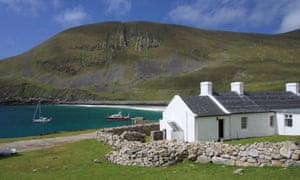
Island life: the Factor’s House on the island of Hirta, St Kilda, Scotland.
Island life: the Factor’s House on the island of Hirta, St Kilda, Scotland. Photograph: Alamy Stock Photo

From its golden sands and its towering cliffs, nothing prepares you for the drama of the Outer Hebrides. Madeleine Bunting pays tribute to the islanders’ indomitable spirit of endurance

The Butty Bus in Leverburgh, on the isle of Harris, serves a welcome egg and chips. There’s only space inside the bus for half a dozen customers and in summer the conversation swiftly turns to St Kilda, the remote group of islands 50 miles to the west. This harbour town is one of the main points from which to catch a boat for a day trip to St Kilda, but Hebridean weather being unpredictable and often stormy, boats can be cancelled, and visitors end up kicking their heels in Leverburgh.
Still, that’s not such a hardship with the exquisite 15th-century St Clement’s church and its carvings a few miles down the coast at Rodel. Or you can head north along the west coast’s stunning beaches and sip a cappuccino in the Temple CafĂ© as you watch eagles soar overhead.

An unforgiving place: the island of Boreray has the largest gannet colony in the world.
Pinterest
 An unforgiving place: the island of Boreray has the largest gannet colony in the world. Photograph: Alamy Stock Photo

I’d booked two trips, to be safe: one was cancelled but the other went ahead in choppy water and driving rain, a total of five hours, there and back, of exhilarating Atlantic. Most of my fellow passengers turned a ghastly shade of grey.
None of the extensive photography and filming of St Kilda can quite capture the drama of its topography. The group of islands and stacks includes some of the highest cliffs in the British Isles and is home to one of the biggest seabird colonies. Circling round the stacks, I craned my neck to look up at the sheer slabs of rock which towered over our boat with the screech of guillemots and gannets, the smell of ammonia and salt, and the roar of the surf. It’s astonishing to imagine that the St Kildans harvested these cliffs for the birds and eggs on which they survived.

A mile of sand: Uig Beach on the Isle of Lewis.
Pinterest
 A mile of sand: Uig Beach on the Isle of Lewis. Photograph: Alamy Stock Photo

The last inhabitants left in 1930, evacuated at their request, bringing to an end a remarkable story of human resilience. It’s the appreciation of this as much as the dramatic landscape which makes visiting St Kilda, a Unesco World Heritage Site, so memorable. I wandered through the poignant ruined cottages on the main island of Hiort, visited the old schoolroom and then headed for the main peak of Conachair, and along the cliffs. It was tough walking, but stunning even in a thick drizzle.
Back on Lewis, I came across one of the most inspiring and beautiful coastlines of all the islands I have visited in the Outer Hebrides. An hour or so by car from Stornoway I reached Uig, a sweep of golden sand with the mountains of Harris in the distance. If you continue along the single track road to Mangursta and Mealasta, you will stumble across a series of smaller bays. The machair [low-lying grassy plain] here is perfect for wild camping and we breakfasted on the cliffs in brilliant sunshine, watching gannets dive dramatically into the sea.

Bird brained: a group of puffins resting on a lichen-covered rock on St Kilda. For generations the local St Kildans harvested bird eggs as part of their diet.
Pinterest
 Bird brained: a group of puffins resting on a lichen-covered rock on St Kilda. For generations the local St Kildans harvested bird eggs as part of their diet. Photograph: Alamy Stock Photo

Jagged stacks rear spectacularly out of the Atlantic along the battered coastline. This dramatic spot on Lewis has been chosen as a site for the ambitious proposal to build a St Kilda Centre, dedicated to its history, wildlife and geology. It’s an unlikely location – building on St Kilda isn’t possible as bad weather would restrict access – so this would offer the best chance of seeing the islands, 44 miles to the west.
On my way home, I stopped by Uig Lodge, with its stunning view of the bay, for the essential souvenir to bring home: the most delicate smoked salmon, guaranteed to bring back memories of the bracing salty breeze and sound of Atlantic surf as it hits the palate.

Essentials

Trips to St Kilda are available from Harris on kildacruises.co.uk and from Lewis on Seatrek (seatrek.co.uk)
Love of Country: A Hebridean Journey by Madeleine Bunting is published by Granta on 6 October at £18.99. Order a copy for £15.57 atbookshop.theguardian.com

By

Friday, July 11, 2014

10 Of The Best Destinations For Eco-Travel

Eco Travel_Header Image_KarryOn

With the World Responsible Tourism Awards in their 11th year, leading ethical agent Responsible Travel rounds up 10 award-winning destinations.

These go-to spots will not only give you the holiday of a lifetime, but where your travels will also make a real, positive difference to local people and conservation efforts. Here are our top 10 best destinations for eco-travel.

10. The Lake District National Park, UK

Eco Travel_Inside Image8_KarryOn
Jaw dropping scenery, crystal lakes and enough outdoor activities to keep adventurers of all ages happy, the Lake District National Park offers a real retreat into nature. And with so many of its tourism businesses partnering with conservation organisations, a stay here really does contribute to keeping the Lakes as beautiful as they are now, for years to come.

9. Aspen, Colorado, USA

Eco Travel_Inside Image7_KarryOn
Leading the field in environmentally-friendly skiing, this mountain resort has a whole host of green accolades to its name. Be stunned by its towering mountains and summer hiking trails, and in winter know that the snow here is about as green as it gets.

8. St Kilda, Outer Hebrides, UK

Eco Travel_Inside Image6_KarryOn
Isolated St Kilda, in the remotest part of Scotland’s Outer Hebrides may not be the top of everyone’s travel bucket list, but these tiny islands are the UK’s only Dual UNESCO World Heritage Site, recognised for both its natural and unique cultural significance. This 7 day wildlife cruise costs £1390 per person and will get you up close and personal with the islands’ sea-birds and marine life. http://www.responsibletravel.com/holiday/15754/st-kilda-wildlife-cruise-in-scotland

7. Tobago

Eco Travel_Inside Image4_KarryOn
A world away from the all inclusive resorts, feel the rhythm of the real Caribbean in Tobago. And nowhere else in the Caribbean offers such a diversity of wildlife and habitats in such a compact area.  Try this 16 day nature tour for forest forays, snorkelling, turtles and birdlife, from £2,095 including flights.http://www.responsibletravel.com/holiday/6833/trinidad-and-tobago-nature-tours

6. The New Forest National Park, UK 

Eco Travel_Inside Image2_KarryOn
Tucked away on the South Coast of the UK, this family friendly area of 900 year old woodland, walking trails, quaint villages and ubiquitous New Forest ponies won the award for Best Destination in the 2007 World Responsible Tourism Awards. Excellent bus connections and gentle cycling routes makes it easy to go car-free. http://www.responsibletravel.com/holidays/new-forest

5. Cape Town, South Africa

Eco Travel_Inside Image10_KarryOn
Vibrant and diverse, South Africa’s culture is often an afterthought to its animals. Cape Town offers a unique, complex combination of history and modernity, culture and scenery as well as innovative, informative township tourism projects. Find a holiday which immerses you in this cultural melting pot at http://www.responsibletravel.com/holidays/south-africa.

4. The North York Moors, UK

Eco Travel_Inside Image3_KarryOn
Conjuring up images of wild, remote landscapes and atmospheric adaptations of Bronte novels, Winner of the best Protected Area in 2004, the North York Moors are a spectacular mixture of coastline, open moorland and quaint, Georgian spa towns. Take the waters in Harrogate, or take to two wheels to explore the open, heather-filled expanses.

3. Roros, Norway

Eco Travel_Inside Image9_KarryOn
Take a step back in time in this unique former mining town and UNESCO World Heritage Site, which has been using tourism to preserve local heritage for over 85 years. Come here for culture and wilderness, cycling, hiking and canoeing in summer, and snowshoeing, husky-sledding and to see traditional reindeer herders in winter.

2. New Zealand

Eco Travel_Inside Image1_KarryOn
Overall winner of the World Responsible Tourism Awards 2008 for its nationwide efforts to use tourism to make better places to live and visit, New Zealand is an adrenalin-fuelled outdoor playground. Mountains, trimmed by glaciers roll into staggering coastlines and lush forests offer walking and hiking trails galore. Try this 3 week taste of active adventuring including hiking, glacier walking and jet boating from £5,999 per person including flights. http://www.responsibletravel.com/holiday/10908/new-zealand-adventure-holiday

1. Bonito, Brazil

Eco Travel_Inside Image11_KarryOn
This wonderland of caves, crystal clear water, mountains and forests is little known outside Brazil, but has an enterprising and innovative approach to sustainable tourism which won it the Best Destination in the 2013 World Responsible Tourism Awards. So while you are snorkelling through its kaleidoscopic caverns, and marvelling at its wildlife, you’ll also be helping protect them for generations to come.http://www.responsibletravel.com/holidays/brazil
Contributed by 
Follow us on Twitter: @TraveloreReport