Showing posts with label Traveling with Animals. Show all posts

Wednesday, February 24, 2016

Travelore News: Delta Changes Policy To Prevent Pet Deaths On Flights


88d066bcd7ce438d824f6222e50cf850
IMAGE: GETTY IMAGES
In an effort to make itself more pet-friendly, Delta is stopping one of the most dangerous methods of flying for pets: As checked baggage.
According to the Department of Transportation, a total of 76 animals died aboard Delta flights over the past 10 years — the highest of any U.S. airline.
The last reported death happened on Nov. 28. Somewhere between Atlanta and Pittsburgh, a Mini Dalmatian puppy died in the cargo hold of a Delta flight. The puppy was flying from Albany, Georgia: After a three-hour layover in Atlanta, it was loaded onto the Pittsburgh-bound flight. When gate crew unloaded the plane, they found the puppy was unresponsive.
This most recent death of a checked pet on a Delta flight will be the last, if the airline can help it. Delta will no longer carry pets as checked baggage starting March 1.
The airline will still allow pets to be transported in the cabin, if they are small enough to fit in a carrier under a seat, or shipped via Delta Cargo's pet shipping Variation Live program. 
The Humane Society recommends that pet owners "do not transport your pet by airplane unless absolutely necessary," and to choose keeping the pet in the cabin if possible.
"We want consumers to be well-informed about the risks of flying," KC Theisen, director of pet care issues at The Humane Society of the United States, told Mashable. "Cargo hold is not the passenger cabin, just a floor down."

"Cargo hold is not the passenger cabin, just a floor down."
Cargo is where the majority of animal incidents happen, usually on long distance flights or flights with several different legs, Theisen said.
Brachycephalic, or short-snouted, animals, like bulldogs, pugs or Persian cats should never be shipped in cargo, according to the Humane Society. These animals can easily overheat or have difficulty breathing in environments that are not temperature controlled. For this reason, many airlines will only allow these breeds as carry-ons. 
The steps that pet owners should take before travel:
  1. Crate train: It's important to crate train pets well before travel, Theisen said. By mimicking travel conditions and building up the amount of time a pet stays crated, owners normalize the experience and help pets understand that they will eventually be let out. 
  2. Talk to the airline: For those about to fly with a pet, the best thing to do is get "in serious contact with the airline well in advance," according to Theisen. Because every airline has different regulations, it's important to find out well in advance what options are available:
  • American Airlines permits pets as carry-ons, cargo or checked luggage — excluding brachycephalic dogs and cats, which are not allowed as checked luggage. 
  • Both JetBlue and Southwest Airlines will accept cats and dogs as carry-ons only, for a $95 to $100 fee. 
  • United allows cats, dogs, rabbits and household birds in the cabin, in addition to carry-on luggage, for $125. Certain United aircraft come equipped with special "PetSafe" compartments that are pressurized like the passenger cabin, for transporting pets in cargo.
  • Alaska Airlines will transport pets as cargo or as a carry-on for $100. Brachycephalic are not allowed for cargo travel.

  • Talk to your vet: Theisen recommends talking to a veterinarian as soon as travel plans are made to get recommendations for a food and water schedule. A veterinarian can tailor advice to specific breeds and help make the experience low-stress, important for both pets and their owners.

  • "The vast majority of pets arrive safely and in good health, but it's important that pet owners are aware of the risks," Theisen said. "The best thing you can do is just protect against risk and take preventative measures."
    Have something to add to this story? Share it in the comments.

    Tuesday, July 21, 2015

    JFK Airport Building World’s Only Private Animal Terminal

    JFK airport building world’s only private animal terminal
    New York’s JFK international airport is building a state-of-the-art facility for animals. Dubbed the “Ark,” the world’s only privately owned animal terminal will replace the aging and much smaller facility by 2016 for a price tag of $48 million.
    The 178,000-square-foot facility will occupy the place of the former Cargo Building 78, on the northern edge of the airport complex. It is named after Noah’s vessel from the Bible, and intended to replace the 10,000-square-foot kennel called the Vetport, built in the 1950s.
    New York-based Racebrook Capital, the terminal’s developer, calls it the “world's only privately owned animal terminal and USDA-approved, full-service, 24-hour, airport quarantine facility for import and export of horses, pets, birds and livestock.”
    Animal facilities exist at airports in Chicago, Los Angeles and Miami, but JFK handles most animal arrivals into the US. Government regulations require many animals to spend some time in quarantine to guard from infectious diseases. Currently, animals arriving at the Vetport need to be trucked to a federal facility in Newburgh, two hours’ drive north. The Ark will spare the animals and their owners the hassle and the expense of that second trip.
    Designed by the architecture firm Gensler, led by experienced airport architect Cliff Bollman, the Ark will offer stalls for up to 70 horses and 180 head of cattle, plus a holding pen for goats, pigs and sheep, an aviary, and kennels for dogs and cats. All animals will have access to round-the-clock clinic services provided by Cornell University's veterinary college.
    Cats will be able to enjoy custom-made climbing trees with a view of the aquarium at the Cat Adventure Jungle, while horses and cows will be housed in climate-controlled stalls, with tilted floors to facilitate waste disposal. Dogs will be offered a 20,000 square foot “luxury resort” run by the company Paradise 4 Paws, with splashing pools, massage therapists and “pawdicure” services.
    "It will be a place for people who love their pets like they love their kids," Bollmann, the architect, told Crain’s magazine. "Maybe more."
    The Port Authority of New York and New Jersey, which operates JFK, signed a 30-year lease deal in January with Ark Development, an affiliate of Racebrook Capital. The project is supposed to create 180 jobs and generate $108 million in revenue over the term of the lease.
    Between the airplane ticket, the crate, veterinary certifications, airport fees and driver commissions, a private company may charge up to $2500 to fly a dog to London. By some estimates, sending a horse overseas may cost up to $10,000.
    The terminal “will set new international airport standards for comprehensive veterinary, kenneling and quarantine services,” said Racebrook chairman John Cuticelli, adding the concept would address “unmet needs” of companion, sporting and agricultural animals.

    Sunday, December 8, 2013

    Cunard Line's Queen Mary 2, The Only Cruise Ship That Lets You Bring Fido

    2013-12-03-cunardkennelqm2bulldog610.jpg
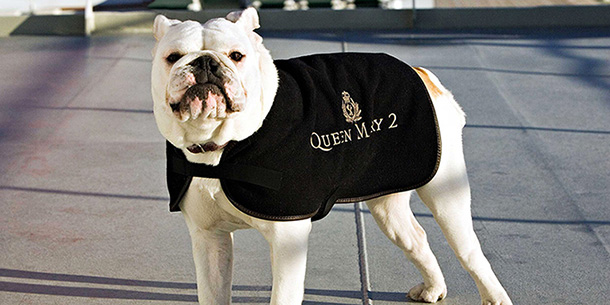
    A bulldog poses for a picture on the deck of the Queen Mary 2. Photo by Cunard Cruise Line.

    For true animal lovers, the hardest part of traveling is leaving your four-legged friend behind. When Gemma Whitehouse, director of the philanthropic organization, Amanzi Travel, had the opportunity to live in Vancouver for a year, leaving her black labs, Boo and Manzi, home in England was simply out of the question. Not wanting to deal with the hassles of flying, she took advantage of a unique program offered on Cunard Line's Queen Mary 2, the only cruise ship to allow pets onboard.
    Cunard has a long history of being a pet-friendly line, having hosted canine celebrities from Rin Tin Tin to Elizabeth Taylor’s puppies. QM2 features a fully equipped onboard kennel, with space for 12 dogs, a playroom and designated outdoor walking areas. The line doesn't allow pets free rein on the ship, but it does offer owners four visiting sessions a day, including a long one in the afternoon, during which dogs can play with their owners on deck.
    Kennel fees range from $500 for dogs under 25 pounds, to $700 for larger dogs. Fees for cats, which need two kennels, cost $1,000. Weight restrictions apply, and mastiffs, greyhounds, Great Danes and other large breeds are not allowed. Cunard also requires rabies vaccination paperwork, a recent tapeworm treatment and a U.S. Department of Agriculture-approved pet certificate.
    Though thrilled to be able to travel with Boo and Manzi, Whitehouse was also anxious, since her dogs had never been in kennels before. Cunard provides everything a pet would need, including: beds, food, blankets and even scratching posts for cats. Still, Whitehouse found herself nervous. She packed her dogs' beds and some toys, along with a thunder shirt -- a compression vest used to calm high-anxiety dogs during storms -- for nervous Boo, in order to give them familiar smells.
    Once Whitehouse boarded, any lingering doubts she had were quickly put to rest by Jojo, the kennel master.
    According to Whitehouse: "Boo and Manzi made friends with all the other dogs onboard, and were super friendly to the other passengers. But, to be honest, I think their best friend on the cruise was Jojo, since he fed them. Typical Labradors!"
    When Whitehouse arrived in New York with Boo and Manzi a year later for her return cruise, Jojo greeted them on the dock with a big smile. Too excited to behave, Boo and Manzi pulled their leashes right out of Whitehouses' hands to rush over and greet their old friend.


    Cunard QM2 Kennel Gemma Whitehouse
    Whitehouse with Boo and Manzi.
    Contributed By Thomas Faddegon
    BonVoyageMag.com
    A publication of Cruiseline.com

    Friday, July 5, 2013

    For Animal Lovers Traveling To Germany: Lufthansa's Frankfurt Animal Lounge - An Exclusive Domain For Animals


     The world's most modern animal station is the Frankfurt Animal Lounge and its "hotel rooms" for all kinds of animals. In their animal facility, handling, animal co-ordination and veterinary examinations work together under one roof in a 4,000 m2 area. The facility is fitted with non-slip asphalt floors which are more pleasant and comfortable for animals than traditional concrete. The loading area is protected against the weather. Their experts will provide the best possible care for your animal shipment.

    The export, import, and transit areas are separated from each other by built-in partitions. Thanks to this separation, all contact between animals being exported and those being imported can be avoided. These individual areas can be further sub-divided into different sections to ensure that animals can be shielded from the sight and sound of others. In addition, live ornamental fish can be examined under black light and in case of emergency, supplied with oxygen. A total of 42 large animal stalls with up to 28 square metres, 39 small animal boxes, special aviaries and 18 individual, temperature-adjustable climatic chambers provide space for a variety of species. Some stalls can be divided flexibly if required - for mares with foals, for example. And for attendants accompanying animals, we have built an additional bathroom.

    The Frankfurt Animal Lounge meets the latest safety requirements, too - because for us safety is the quality benchmark of a thorough transport process and a key part of our company philosophy. The whole facility is therefore protected by surveillance cameras, entry is permitted to authorized personnel only.