Dubai, UAE based airline Emirates announced it will launch a new daily service from Dubai to Newark Liberty International Airport, via the Greek capital city of Athens, starting on 12 March 2017.
The new route complements Emirates’ existing four daily flights between Dubai and New York’s JFK airport, by offering global travellers with another convenient access point to the popular New York Metropolitan area.
Emirates’ new Dubai-Athens-Newark flight will also provide a year-round non-stop daily service between the United States and Greece – a service that does not exist today and has not existed since 2012. The airline will operate a wide-body Boeing 777-300ER powered by General Electric GE90 engines on the route, offering 8 seats in First, 42 seats in Business and 304 seats in Economy class, as well as 19 tonnes of belly-hold cargo capacity.
Sir Tim Clark, President of Emirates Airline said: “The Greek Government and Athens International Airport approached Emirates some time ago to consider serving the route between Athens and New York. After careful review, Emirates concluded that extending one of our Dubai-Athens flights to Newark would be commercially and operationally feasible. We are pleased to be able to help meet a strong consumer need long neglected by other airlines, and we would like to thank the authorities and our partners in both the US and Greece for their support of the new route.”
Sir Tim added: “The availability of high quality, daily international air services is essential for the development of business and cultural ties. Trade, especially in high-value and time-sensitive products, will be facilitated by the ample cargo capacity on Emirates’ Boeing 777 aircraft. We also expect tourism to receive a major boost from the availability of daily flights year-round.”
Elena Kountoura, Minister of Tourism of the Hellenic Republic said: “Within the framework of our excellent cooperation, and in line with our common goal for the growth of tourism between our two countries as well as the expansion to long-haul markets, I would like to thank Emirates for having positively considered our request to launch a new Emirates itinerary connecting Dubai with New York via Athens all year round. This strategic choice substantially supports our efforts at the Ministry of Tourism to enhance the already increasing flow of visitors to Greece from the United States and the UAE on a yearly basis, travelling either for leisure or business purposes.”
Endy Zemenides, Executive Director of the Hellenic American Leadership Council said: “The Greek-American community has long been anticipating the reestablishment of year round direct travel between Greece and the United States. For this moment to arrive thanks to Emirates – the world’s top airline – is special indeed. Greece’s economic comeback is going to have to include year round tourism and easier business travel. The new Emirates route makes this possible. The Greek-American community will be thrilled with this new itinerary, and we thank Emirates Airline for establishing its route and for its endorsement of travel to Greece.”
The United States and Greece have long maintained close economic relations as well as a strong national security alliance. For decades, the United States has advocated policies that promote and foster economic growth and further opportunities for U.S. investment in Greece. The United States is also home to the largest overseas Greek community in the world, numbering approximately 1.3 million, and the New York City metropolitan area has the largest community of Greek Americans in the country.
In addition to serving the large Greek-American population in the New York City metropolitan area, the availability of one-stop same-plane service to Dubai will offer a convenient alternative to travellers headed towards the Middle East, West Asia, and Africa.
Santorini is the
supermodel of the Greek islands, a head-turner whose face is instantly recognizable around the world: multicoloured cliffs soar out of a
sea-drowned caldera, topped by drifts of whitewashed buildings. With
its reputation for dazzling panoramas, romantic sunsets and
volcanic-sand beaches, it’s hardly surprising the island features on so
many travellers’ bucket lists.
There’s no denying the uniqueness of this destination or its huge allure – Santorini hosts 1.5 million tourists annually. Here’s all you need to know if you’re planning to join that crowd.
Church of Anastasis in Imerovigli village. Image by De Agostini / Getty Images
Volcanic history
Part of the Cyclades island group, Santorini (officially known as Thira, a name that encompasses the volcanic islets within Santorini’s orbit) sits in the Aegean Sea, roughly halfway between Athens and Crete.
The island is shaped like a wonky croissant, and the neighbouring
islets hint at the fact that Santorini was once circular; it was known
as Strongili (the Round One). Thousands of years ago a colossal volcanic
eruption caused the centre of Strongili to sink, leaving a caldera (or
crater) with towering cliffs along the east side – now Santorini’s
trademark landscape.
Restaurants in Ammoudi port. Image by Hackenberg / ullstein bild / Getty Images
Caldera-edge settlements
Santorini’s commercial development is focused on the caldera-edge
clifftops in the island’s west, with large clusters of whitewashed
buildings nesting at dizzying heights, spilling down cliffsides and
offering gasp-inducing views from land or sea. Fira,
the island’s busy capital, sprawls north into villages called
Firostefani (about a 15-minute walk from Fira) and Imerovigli (the
highest point of the caldera edge, about a half-hour walk from Fira). A
path running through these villages is lined with upmarket hotels,
restaurant terraces and endless photo opportunities.
These three conjoined settlements draw most visitors, together with the stunning and quite exclusive village of Oia
in Santorini’s north. There’s a growing number of hotels in the
island’s south, offering caldera views to the north and northeast.
Akrotiri’s views come cheaper than Oia’s, but it’s a fair way from the
action of Fira.
Windmills in Oia village. Image by Hackenberg / ullstein bild / Getty Images
Away from the caldera edge
Santorini’s east coast is lesser known than the celebrated, elevated
west coast. Here, the caldera-edge heights have sloped down to sea
level, and volcanic-sand beaches and resorts offer a very different
drawcard. East-coast resorts such as Kamari and Perissa have a more
traditional (and more affordable) island-holiday appeal:
sunlounger-filled beaches, water sports, bars and taverna-lined
promenades.
The east coast’s beaches are lined with black sand; on the south
coast, there’s a string of beaches famed for their multicoloured
sand – dramatic Red Beach is a traveller favourite.
The island’s interior is dotted with vineyards and traditional
villages that let you see beyond the tourist hustle. Make a stop in
Pyrgos for great eats and a wander through charming backstreets.
Red Beach on Santorini's south coast. Image by Loop Images / UIG / Getty Images
What to do
Walks The obvious
activity is to walk the caldera edge and admire the views. Walks in and
around Fira are spectacular, particularly heading north to Firostefani
and Imerovigli along the caldera-edge pathway. Keep walking and you’ll
eventually reach Oia, but be aware that this is no small undertaking and
the trail beyond Imerovigli can be rough. It’s about 9km in all, and a
good three- to four-hours’ walk in one direction. Wine-tasting Santorini’s
lauded wines are its crisp dry whites and the amber-coloured,
unfortified dessert wine known as Vinsanto. Both are made from the
indigenous grape variety, assyrtiko. About a dozen local
vineyards host tastings (usually with a small charge) and some offer
food, with scenery and local produce combining to great effect. Start
your investigations at the large, slick SantoWines. History Santorini’s intrigue reaches deep into the past, with the fascinating site of Akrotiri displaying a Minoan city destroyed by the volcanic eruption of 1613 BC. In Fira, the impressive Museum of Prehistoric Thera helps piece together the story of ancient Akrotiri. Sunsets Nature’s
handiwork is on display from any waterfront seat come sundown, but prime
sunset-viewing is in Oia, where thousands of tourists flock to admire
(and applaud) nightfall. Swimming Take the plunge:
at your hotel’s infinity pool or your suite’s private plunge pool, from
the edge of a boat on a caldera cruise or on a black-sand beach on the
east coast. Tours Any tour your heart
desires can be organised – there are dozens of agencies ready to help
with winery visits, archaeology tours, sunset-watching and more. The
most popular option is a cruise, and the classic itinerary takes in the
caldera’s volcanic islands of Nea Kameni and Palia Kameni, including a
stop at the former’s crater and the latter’s hot springs. Surprises Sure, there are
views that stop you in your tracks and great glimpses into how
A-listers travel. But away from Santorini travel headlines there’s
plenty to explore, from a gorgeous open-air cinema to a cool microbrewery, wine caverns adorned with artworks, and cooking demonstrations and classes which celebrate Santorini’s growing foodie culture.
Picturesque alleys of Oia village. Image by Athanasios Gioumpasis / Getty Images
Where to stay
If they can afford it, first-timers to Santorini should stay on the
caldera edge to experience the full ‘wow’ factor. Fira, Firostefani,
Imerovigli and Oia have hotels and villas with whitewashed interiors,
terraces and infinity pools that have inspired marriage proposals,
high-fashion photo shoots and many an Instagram post. Sadly, there’s not
a lot in these view-blessed locales for budget-conscious travellers:
caldera-view accommodation comes at a premium and it’s in hot demand
(book ahead).
There are decent midrange options in Fira and Firostefani (less so in
Imerovigli and Oia), away from the front-row panoramas. There’s also a
great hostel and a budget-friendly campground (with rooms) on the outskirts of Fira.
If you’re more interested in a beach break or activities, stay in
Perissa or Kamari (and catch the bus into Fira). The advantage of this
is some respite from the camera-toting caldera crowds, and more
reasonable prices.
Pool with caldera views in Imerovigli village. Image by Athanasios Gioumpasis / Getty Images
When to go
Peak travel time is July and August, when prices soar and hotels,
viewpoints and beaches are packed with tourists. The shoulder-season
months of April, May, early June, late September and October are good
times to visit – things are marginally quieter at the caldera edge, and
considerably quieter on the east coast (where accommodation bargains are
plentiful).
Don’t discount a winter break, when crowds are scarce (and prices
low) while the scenery is still breathtaking. Santorini is working on
positioning itself as a year-round destination.
The famous Santorini sunset. Image by JTB Photo / UIG / Getty Images
Practicalities
Frequent ferries and high-speed catamarans link Santorini with Athens’ main port of Piraeus, Crete and various Cycladic islands. Your best bet for ferry timetables is OpenSeas (openseas.gr).
Santorini Airport (santoriniairport.com) has year-round flight connections with Athens, and summertime European connections.
On the island, bus services are decent (if crowded in summer); loads
of companies offer cars, mopeds and ATV four-wheeler bikes for rent.
Although Crete
hosts one-quarter of Greece’s annual visitors, it’s still possible to
escape the crowds by heading south. Thanks to the rugged mountains that
stretch across much of the island’s spine, southern Crete remains a
place apart.
Known for their hospitality, traditional music and healthy home-cooking, Cretans
are also fiercely independent. They frequently rebelled under Venetian
and later Ottoman occupation, with southern strongholds such as Sfakia (a rocky, barren territory centred on the port village of Hora Sfakion) remaining unconquered.
Due to the towering cliffs overhanging the sea, the Sfakia area remains peacefully isolated; nearby settlements such as Loutro,
a fishing village shimmering with white houses, or Sweetwater and
Marmara (Marble) beaches are accessible by boat (the intrepid can hike
there instead). Boat trips hug the coast westward from Hora Sfakion to Paleohora, via Loutro and Agia Roumeli; the latter is where throngs of tired hikers stumble out of the Samaria Gorge – at 16km, Europe’s longest.
Hiking in the Samaria Gorge. Image by Gareth Mccormack / Lonely Planet Images / Getty Images
A boat trip is ideal for traversing the south coast. It concludes
at Paleohora – a small town which has preserved its laid-back
character, despite being the jumping-off point for popular Elafonisi Beach
on Crete’s southwestern tip. The soft pink sands and islet here are
undeniably enticing and, except in high summer, serene. Palaeohora also
offers great live traditional music; the songs, known as mantinades (15-syllable folk verse accompanied by the Cretan lyra, or violin), fully express the island’s powerful and melancholy spirit.
Crete is big enough to be its own country, and its people love
distinguishing themselves from other Greeks. Lakkis Koukoutsakis, a tour
guide and restaurant owner in Azogires, a placid hamlet 7km north of
Paleohora, sums it up: ‘among us here live about 13 Cretans, eight
Greeks, two English and one Dutch’, he quips. It is this sense of
otherness that makes the Cretans, especially those from the south, such
good company. They can entertain with eccentricity or anecdotes, vex
with their stubbornness, seduce with hospitality and amaze with feats of
strength. It goes without saying that being among them is rarely dull.
The southern mountains are dotted with tiny traditional villages,
fantastic spots to buy hearty local olive oil and thyme honey, though
Azogires has a freshwater lagoon where the itinerant nereids –
those beguiling sea-nymphs of ancient Greek myth – can allegedly steal a
man’s soul on one sacred night each year. More otherworldly characters –
the so-called drosoulites, or ghosts of fighters killed by the Turks in 1828 – can apparently be seen marching around dawn each year in late May, over at Frangokastello. This magnificent 13th-century Venetian fortress stands above a tranquil beach east of Hora Sfakion.
Occasional yoga groups visit Azogires, though unruffled Agios Pavlos, further east on the south coast, is more established. Just 3km west, the outpost of Triopetra comprises barely one set of domatia (rooms
for rent) complemented by a seafront terrace restaurant. Here, all
sense of time quickly recedes, and the menu varies according to the
catch of the day. Keenly aware of the irreplaceable value of Triopetra
(where some regular visitors book rooms three years ahead), locals
protested vociferously when a Chinese consortium sought to build a huge
container ship port – as ever through the centuries, the Cretans
stubbornly resisted a much bigger foreign intruder.
Frangokastello near Sfakia, Crete. Image by Maria Toutoudaki / Getty Images
Triopetra’s relative inaccessibility and tiny size have kept it
blissfully quiet. Yet even the places that attract more visitors, such
as lazy Plakias west of Preveli,
stand apart from the north and its resorts. Having one of the south’s
longest beaches, Plakias has attracted some smallish hotels and
restaurants, though the truly extraordinary Youth Hostel Plakias (open from Greek Easter through October) also attracts devotees of all ages.
One of the reasons why Plakias and other southern getaways have
remained relatively immune from mass tourism is the terrific summer wind
which roars through everything, pelting beach-goers with sand and
whipping up whitecaps on the sea. But the winds also drive away the
mosquitoes and break through that solid wall of summer heat. Channelled
up and down Crete’s mountain canyons – veritable wind tunnels – these
stiff breezes are known to locals by individual names, depending on
where they come from, how long they stay, and what gifts they bring with
them.
Good but winding paved roads connect the south-coast towns,
where the terrain allows. Regular buses run from the north-coast hubs of
Hania and Rethymno to Paleohora, Hora Sfakion and Plakias. This article was first published in August 2010 and last updated in April 2015.
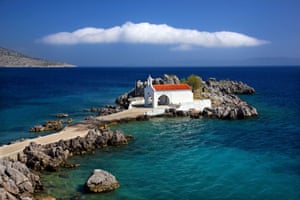
The church of Agios Isidoros on an islet close to Langada, Chios. Photograph: Hercules Milas/Alamy
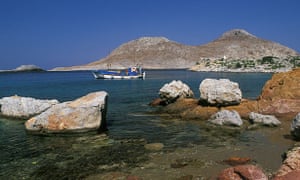
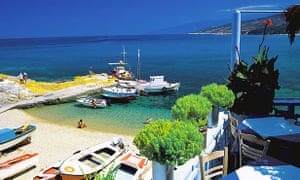
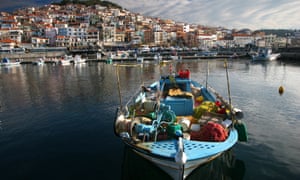
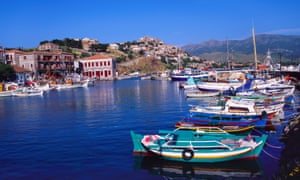
This disparate group of islands stretches from the Greek mainland across the Aegean to the coast of Turkey. Many remain off the beaten track to foreign visitors but reward them with deserted beaches and excellent seafood tavernas
Some islands fall easily into groups, others are left hanging and are gathered into more arbitrary designations. The latter is true of the north-east Aegean, which includes a hodgepodge of islands stretching from lush Samos in the south – just off the coast of Turkey – up to Thassos, 400km to the north and closer to Bulgaria than it is to Athens.
In between are an isolated stretch of islands, often far apart from each other and not well connected. Perhaps because of this, and the difficulty of labelling them easily together, these islands are often overlooked. For those prepared to travel a bit further afield, this is a bonus as, apart from midsummer, they tend to be uncrowded and unspoilt.
Samos is the nearest thing this group gets to “well-known destination”, but it is still more easily reached from Turkey than most of the rest of Greece. It does have its resorts but is big and diverse enough to still reward visitors. It is probably the most instantly attractive of the group.
Heading west, little Fourni is getting increasing recognition as an “unspoilt” gem, and still deserves the reputation. Larger Ikaria is a different kettle of fish and, while not immediately pretty, is worth exploring: the locals have an independent and proud streak that sets them apart.
Chios and Lesbos also hug the Turkish coast. The former has a long and often tragic history but hides many beautiful places away from its couple of beach resorts. Lesbos is one of the biggest of all the Greek islands, and a long visit and exploration will reveal why it is still beloved by artists, historians and modernSapphos.
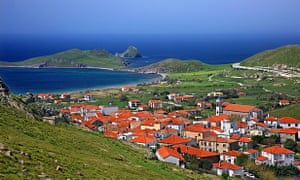
In the north is a scattering of volcanic islands that remain off-the-beaten track. Limnos has become trendy, especially among mainland Greeks, but remains beautiful and authentic. Samothrace is one of the most dramatic of the Greek islands and is home to a stunning and world-class ancient site. And if you want to see how Greeks party, Thassos is your place.
All prices are for one week’s accommodation for two in August, and include breakfast unless otherwise stated. Prices outside of this month can be considerably cheaper. Greek taverna prices are remarkably similar and, if anything, have gone down in the last few years. You can usually expect to eat well for €15-€20 per head. If places are cheaper or more expensive than this, it is stated in the text.
Samos
Armonia Bay Hotel
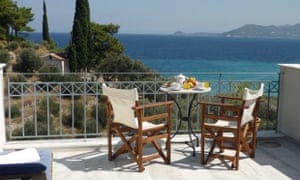
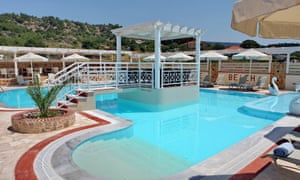
Where to stay Armonia Bay This is exactly what you hope for from a Greek island hotel. The simple rooms are large and tastefully done, and most have balconies with great views down to the beach, which is a five-minute stroll away – although there’s a pool if you can’t manage that. The hospitality is relaxed and friendly. •£560, +30 22730 92279, armoniabay.com; family-friendly
Where to eat Pnaka For the best food you should head up to the hillside villages above. This meze place has a great terrace in the village of the same name, and serves a great mixture of small dishes and salads to mix and match. Do as the Greeks do and order a little at a time and keep going for as long as you can. •+30 22730 93297
One to muse on … Vathy’s Archaelogical Museum makes a pleasant break from the summer heat. Photograph: Peter Forsberg/Alamy
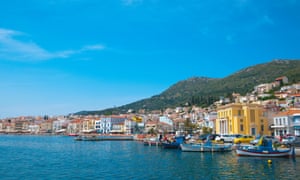
Don’t miss Most museums on the islands are only for the real enthusiast. The one in Vathy (the Archaeological Museum), the capital of Samos, is an exception, and has one of Greece’s largest statues as its prize exhibit. The old upper town of Vathy is also worth a stroll. •+30 2273 027469
Fourni
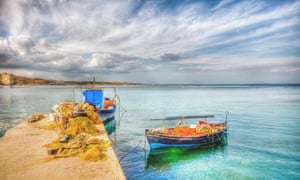
A fishing boat at Thymena Island, Fourni. Photograph: Alamy
Where to stay ArchipelagosAs the ferry pulls into isolated Fourni you will be greeted by plenty of locals willing to offer you rooms, some of which are very nice indeed. If you want a bit more certainty in your life, book this port-side hotel that has all the views and facilities you would expect. •£470, +30 69734 94967, archipelagoshotel.gr
Where to eat Nikos For a little island, Fourni has a surprisingly large permanent population (which gives it a more dynamic atmosphere than some). The key to this is its large fishing fleet, which means the island’s seafood tavernas are first class. There are a couple of prominent ones by the port, and Nikos is perhaps the best choice. Lobster pasta is an island speciality. •+30 22750 51207
Don’t miss A short boat ride from Fourni is the even smaller island of Thymena. The population of barely 100 lives mainly in the little port. A short hike takes you over to an isolated beach and taverna – bliss.
Ikaria
Restaurant overlooking fisherman’s bay, Ikaria. Photograph: Alamy
Where to stay The Ikarian Winery Eccentric Ikaria takes a little getting to know, and there is no better place to do that than at this agri-tourism-themed vineyard near the island’s north coast. It has a cluster of traditionally-decorated cottages and is still producing its own wines –offering the opportunity to get involved with production, as well as sample the product. •£490, +30 22750 31151, ikarianwine.gr; family-friendly
Artemis Studios These simple studios are all about location, with superb sunset views down to one of the prettiest coves in Greece. It comes at a bargain price as well. • £195, +30 22750 71485, artemis-studio-ikaria.blogspot.gr; family-friendly
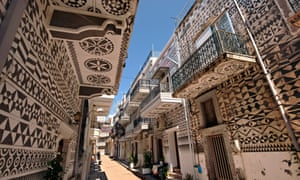
Don’t miss Chios made its fortune from the harvesting of mastic, a tree resin once chewed in the harems of Ottoman Istanbul. The product is just a curiosity now, but the villages that were based around the industry still make worthwhile visit. The houses of striking Pyrgi are decorated with whitewash patterns on top of the black, volcanic rock underneath.
Where to stay Aphrodite Lesbos, with its artistic associations has plenty of boutique getaways; the Aphrodite, on a long stretch of isolated beach, is something a bit more old-school: a classic seaside Greek hotel, down to the two-ring electric hobs in the studios. Don’t expect sophistication, but enjoy the friendly welcome from the Hahathakis family and the relaxed atmosphere. • £280, +30 22520 61288, aphroditehotel.gr; family-friendly
Where to eat Akrotiri At the west end of Vatera beach is the little port of Ayios Fokas, where this seafood taverna is by the sparse ruins of a temple to Dionysus. This is the real deal with freshly caught fish washed down with plentiful local wine. Try the lakerda, a dish of raw, pickled tuna. •+30 22520 61465
Molyvos Harbour Photograph: Robert Harding/Getty Images
Molyvos is the prettiest village of Lesbos, even with many of its shops now given over to the tourist trade. It is topped by an impressive Byzantine castle that has superb views.
Limnos
Photograph: Alamy
Where to stay Ethaleia This is a lovely little hotel with a warm heart. Dina, one of the couple who have put their souls into this establishment, is a local, and her love of the land and its culture shines through. The 10 rooms are often booked up by return visitors, and given the views and hospitality you can see why. • £400, +30 69443 55755, ethaleia.gr
Surf Club Keros
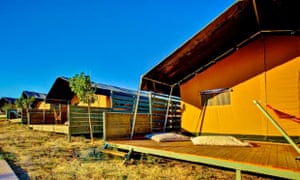
Glamping arrives in Greece! The Surf Club provides luxury safari tents right by the beautiful beach of Keros Bay. The tents have air-con, comfy beds and even a TV and coffee machine, so you’re really not slumming it. •£465, +30 69441 56679, surfclubkeros.com; family-friendly
Where to eat Mamas Kitchen (as above) You are rather in the middle of nature at the Surf Club, but don’t be alarmed as Mamas Kitchen will provide all your needs, from a fresh breakfast to a chill-out area, and then Greek taverna classics in the evening.
Surf Club Keros Photograph: Pantelis Ladas/Panteliz Photography
Mantella This is a traditional taverna in the little village of Sardes, the highest of Limnos. Apparently named after Nelson Mandela, everything else about this place is very Greek: hearty portions of local food are served with a smile. •+30 22540 61349
Don’t miss What else to do at the Surf Club Keros but try the waves? Lessons and equipment are available in surfing, kite-surfing and windsurfing for adults and children. The surrounding nature area is also well worth an explore, or just a gentle stroll. One of the best things to do on Limnos is to explore its villages and dramatic landscapes. The latter can be seen by visiting the cave chapel of Panagía Kakaviótissa. It’s a stiff, if short, climb, but the views are well worth it.
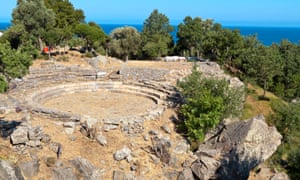
Ancient hellenistic theatre at the Sanctuary of Great Gods, Samothrace. Photograph: Alamy
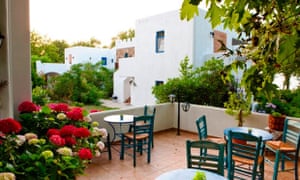
Where to stay Archondissa Set in its own, lovely, gardens, and right by the beach on the edge of the village of Therma, these apartments are spacious and well furnished. Terraces offer views either to the crystal clear sea or up to Mount Fengari, the highest in the Aegean (you can climb it from here, but it’s a good six hours each way). •£280, +30 25510 98098, archondissa.gr; family-friendly
Where to eat Perivoli T’Ouranou This nearby taverna sells all the standards to a good quality, with the added bonus of having regular, and sometimes spontaneous, live music performances. •+30 25510 98313
Archondissa apartment
Don’t miss Samothrace is a visually stunning island and there is nowhere better to appreciate this than the Sanctuary of the Great Gods. This cult was worshipped here for over 1,000 years, and the site still evokes awe in the visitor.
Thassos
Where to stay Thassos Inn Thassos can be on the lively side, so it can be nice to get away from it all. This hotel dominates the quiet and attractive hilltop village of Panayia. It’s bright yellow buildings are set round a terrace of plane trees and a carp-filled pools, while inside the simple rooms have terraces with great views. • £320, +30 25930 61612, thassosinn.gr
Where to eat Ilias If you can find them, meze tavernas are often the best places to eat in Greece, giving you the opportunity to try lots of different dishes. This one is just above the small village of Avlaki, serves 40 different dishes, and does an interesting sideline in Moroccan tagines. •+30 22750 71009, ilias.com.gr
Nas If anything this taverna’s terrace has even better views, and the hearty meals carry on the theme of value for money. Also, you can’t help but be tempted to follow the river canyon below to the sheltered cove itself, which is surrounded by wind and wave sculpted rock. It’s a beautiful place, but be careful not to swim too far out as the currents can be deceptively strong. •+30 22750 71486
Don’t miss The Ikarians like to do things differently. The four villages of Raches are linked by a well-mapped hiking trail, something that is becoming more common in Greece. They also run on “Ikarian time”. The villagers sleep for much of the day, then open up their shops and tavernas for most of the night.
Where to stay Perleas Estate In the interior of this popular island is this superbly-restored old mansion set in four acres of land now given over to organic fruit, olives and vegetables. Attention to detail is the key here, with the gorgeous rooms mixing traditional styles with a nod to the Genoan history of the estate. • £585, +30 22710 32217, perleas.gr
Where to eat Fabrika In an old olive press in the market town of Volissos, this taverna specialises in grilled meat (done properly over charcoal). For the carnivore this is heaven (in particular try kokoretsi if it’s on the day’s menu – just don’t ask what it is first) but don’t worry if that’s not your thing as there are plenty of other dishes. . •+30 22740 22045
Where to eat
Drosia Also in Panayia, this is another reliable standard taverna, specialising in grilled meat, but also offering good sardines and mussels. •+30 25930 61340
Don’t miss Thassos is a destination for Greeks (especially those from Thessaloniki) who are looking for entertainment. The island is overpopulated with bouzouki bars, and it’s worth giving them a go, even if only for one night. Ideally go with Greek friends and don’t expect to be home before dawn and without a fair amount of whisky inside you.
Getting to the north-east Aegean
The larger, southern islands of the chain can be reached by ferry from Athens, and plane from Athens and other places in Greece. In summer, charter flights run from abroad. Limnos can be reached from Thessaloniki by ferry. The two northern islands of Thassos and Samothrace are a more difficult prospect. Ferries run from the northern mainland ports of Kavala and Alexandropouli respectively.