Showing posts with label #MexicoCity. Show all posts

Thursday, December 10, 2015

Sealed Chambers At Ancient Aztec Site In Mexico City Could Hold Rulers' Tombs

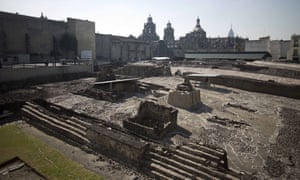
The Templo Mayor (Great Temple) in the heart of modern Mexico City, where archaeologists have discovered a long tunnel leading into a circular platform where Aztec rulers were believed to be cremated.
 The Templo Mayor (Great Temple) in the heart of modern Mexico City, where archaeologists found a tunnel into a circular platform where Aztec rulers are believed to have been cremated. Photograph: Eduardo Verdugo/AP

The answer to the mystery of leaders’ ultimate fate could be revealed behind two doors at the end of a tunnel into a platform at Tenochtitlán’s Great Temple

Archaeologists in Mexico have found a passageway and two sealed chambers beneath one of the largest temples of the ancient Aztec capital, raising hopes that excavations will uncover a ruler’s tomb beneath the city.
The tunnel, only 18in wide and 5ft high, leads 27ft directly into a circular ceremonial platform at the Great Temple or Templo Mayor complex of Tenochtitlán, the ruined Aztec capital that overlaps with modern Mexico City. At the end of the tunnel the archaeologists found two sealed doors.
According to the Spaniards who wrote of the conquest of Mexico, the Aztecs burned their kings’ remains on the circular structure – suggesting to lead archaeologist Leonardo López Luján that the sealed portals may lead to tombs.
“Once we freed the passage from earth and stone, we knew it led directly into the heart of the Cuauhxicalco,” López Luján said, using the Aztec name for the large stone platform, meaning “eagle cup”. “At the end appear two old entrances sealed up with masonry.”
The passage is actually an extension of a tunnel unearthed in 2013, discovered when a researcher noted signs of a continuation. That year archaeologists heaved a three-ton rock away from the mouth of the tunnel, finding a large box in a hollow space beneath it. The box contained gold ornaments, stone knives and the bones of children and eagles.
The human remains included two skulls belonging to children, aged five to seven, as well as bones from a hand and two feet. The knives and three vertebrae found with the skulls suggested they were sacrificed, a ritual practice relatively common among Aztec people, in which young children were often the preferred victims.
“From what the sources say, the Cuauhxicalco was a structure of a funerary character, so we can speculate that behind these walls there might be two small rooms that contain the incinerated remains of several leaders,” López Luján said.
López Luján said he suspected any remains might be of Moctezuma I and his successors, Axáyacatl and Tízoc, given the dating of the structure, referring to three of the earliest Aztec rulers. The trio ruled sometime during the 14th and the 15th centuries.
The discovery of any Aztec ruler’s remains would stand as a historic achievement – what the civilization did after leaders died remains one of the most enduring mysteries of the Aztec people.
López Luján urged caution and patience, saying that the tomb hypothesis was only that. He noted that archaeologists’ hopes had been dashed many times before and said excavations on the doorways will begin in 2016.
Unlike the tombs of the classic-period Maya, who laid out their kings in occasionally lavish chambers, Aztec burials from after 1000AD have eluded archaeologists, said Rosemary Joyce, a professor at the University of California, Berkeley.
“They keep digging down hoping they’re going to find the big guy,” she said, “but they’re running out of places to look in Tenochtitlán.”
Aztec images show dead rulers “bundled up in cloth, seated upright, with little crowns on”, she said, and indigenous people drew pictures of cremation ceremonies, but what they did with these ashes or bundles is unknown.
The clues together present a tantalizing case for the tentative hopes of a tomb. The eagles – associated with the cremation stone and the sun god Huitzilopochtli – could also suggest a leader who wanted their own associations with the deity. Joyce noted that the dual doorways could be a reflection of how the Aztecs governed: with two rulers, a tlatoani – translated as “emperor” but more literally “speaker” – and a cihuacoatl – a word with an ambiguous meaning, possibly “woman twin” or “skirt serpent”.
And while the Aztecs may have dispersed ashes or simply not buried them, Joyce agreed that the early rulers of Tenochtitlán may have constituted a special case for a people who, unlike the Maya, did not have a cult of their ancestors or necessarily inherit power through family lines.
“The remains of the first or founding generations of the Aztec rulers” may have deserved their own tomb, she said, comparing to the symbolism Americans use to venerate George Washington. “He’s not Barack Obama’s great-great-great-grandfather, but he is the father of the nation.”
Susan Gillespie, an archaeologist at the University of Florida, agreed with Joyce that researchers are not sure whether the Aztecs dispersed ashes or made any special arrangements for their leaders at all.
“It is not surprising that these cremains have not yet been found or identified,” Gillespie told the AP. “Archaeologists don’t quite know what they’re looking for.”


Wednesday, October 14, 2015

The Ritz-Carlton Set To Debut In Mexico City In 2019


Legendary luxury hotel brand to introduce stunning new hotel on Avenida Reforma
The Ritz-Carlton Hotel Company, L.L.C. today announced plans to open its first hotel in Mexico
 City in 2019. Upon completion, the 153-room Ritz-Carlton, Mexico City will operate under a long
 term management agreement with Thor Urbana Capital and Heldan Hotels & Resorts. The hotel 
marks a significant milestone for Ritz-Carlton development in the Caribbean and Latin America,
 representing its entree into one of the region's most prominent capital cities.  
The Ritz-Carlton Set to Debut in Mexico City in 2019; legendary luxury hotel brand to introduce stunning new hotel on Avenida Reforma
"We are thrilled to collaborate with Thor Urbana Capital and Heldan Hotels & Resorts to expand our
 presence in the Caribbean and Latin America, particularly in Mexico City - an epicenter of commerce
 and culture," said Herve Humler, president and chief operations officer for The Ritz-Carlton. "Mexico
 remains one of the largest and most important international markets for our company, and we are
 confident that our legendary Ritz-Carlton service and culture is a perfect match for this vibrant,
 exciting destination."

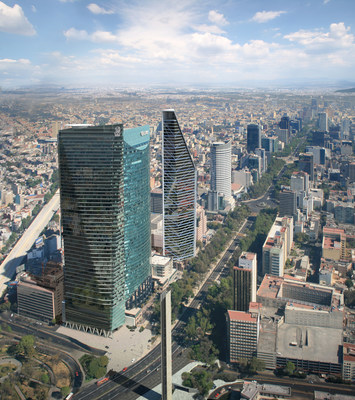
The hotel will be part of the Chapultepec Uno mixed use project, prominently located at the
 intersection of Avenida Reforma and Circuito Interior in the heart of the city's financial center.
 Once completed, the stunning structure will include 58 floors and 1.1 million square feet of space,
 rendering it one of the tallest buildings in the city. KMD Architects and Taller GLOBAL are leading
 the design and architectural efforts for the project.

The Ritz-Carlton, Mexico City will occupy floors 36-47 of the building, featuring unobstructed views
 of Chapultepec Park. The hotel will include signature Ritz-Carlton luxury services and amenities
 including a Club Lounge and spa.

"Mexico City is the country's economic, industrial and cultural center," said Jaime Fasja, chief 
executive officer of Thor Urbana Capital. "We are so proud to be a part of this extraordinary project
 that we know will bring a new level of luxury hospitality to the city."

"Travel to Mexico continues to grow for both business and leisure travel throughout the Caribbean 
and Latin America region and for inbound travel to the United States," said Gabriel Helfon, chief 
executive officer of Heldan Hotels & Resorts.  "This project will play a helpful role in the continued
 emergence and success of Mexico City as a leading international destination."

Recently named by highly reputed London-based consultancy, Luxury Branding, as the world's
 most popular luxury hotel brand, The Ritz-Carlton currently offers a collection of seven luxury
 hotels throughout the Caribbean and Latin America including The Ritz-Carton, Santiago, The
 Ritz-Carlton, Aruba, The Ritz-Carlton, Grand Cayman, The Ritz-Carlton, St. Thomas, The Ritz-
Carlton, Cancun, The Ritz-Carlton, San Juan, and Dorado Beach, a Ritz-Carlton Reserve (Puerto Rico).
  In addition to The Ritz-Carlton, Mexico City, future locations in the region include Panama City,
 Panama (2016) and Los Cabos, Mexico (2017). The Ritz-Carlton portfolio currently includes 90
 hotels around the world, with expectations for the brand to reach 100 hotels by the end of 2016.

Note on forward-looking statements : The Ritz-Carlton expectations for future hotel openings in
 the Caribbean and Latin America region and reaching 100 hotels by the end of 2016 are "forward-
looking statements" within the meaning of U.S. federal securities laws and are subject to numerous
 risks and uncertainties, including changes in market conditions, supply and demand changes for
 hotel rooms, the availability of capital to finance hotel growth, and other applicable "Risk Factors"
 that Marriott International discloses in its most recent quarterly report on Form 10-Q, any of which
 could delay or prevent hotel openings or otherwise cause growth to be different than we anticipate. 
 We make these forward-looking statements as of the date of this news release, and undertake no
 obligation to publicly update or revise any forward-looking statement, whether as a result of new
 information, future events or otherwise.

About The Ritz-Carlton Hotel Company, L.L.C.
The Ritz-Carlton Hotel Company, L.L.C., of Chevy Chase, Md., currently operates 90 hotels
 in the Americas, Europe, Asia, the Middle East, Africa, and the Caribbean.  More than 40 
hotel and residential projects are under development around the globe. For more information 
or reservations, visit the company web site at www.ritzcarlton.com, and for the latest company
 updates, visit news.ritzcarlton.com.  The Ritz-Carlton Hotel Company, L.L.C. is a wholly-owned
 subsidiary of Marriott International, Inc. (NASDAQ:MAR).