Showing posts with label Archaeology. Show all posts

Tuesday, April 26, 2022

Egypt: Ruins Of Ancient Temple For Zeus Unearthed In Sinai

CAIRO (AP) — Egyptian archaeologists unearthed the ruins of a temple for the ancient Greek god Zeus in the Sinai Peninsula, antiquities authorities said Monday.

The Tourism and Antiquities Ministry said in a statement the temple ruins were found in the Tell el-Farma archaeological site in northwestern Sinai.

Tell el-Farma, also known by its ancient name Pelusium, dates back to the late Pharaonic period and was also used during Greco-Roman and Byzantine times. There are also remains dating to the Christian and early Islamic periods.

Mostafa Waziri, secretary-general of Egypt’s Supreme Council of Antiquities, said archaeologists excavated the temple ruins through its entrance gate, where two huge fallen granite columns were visible. The gate was destroyed in a powerful earthquake in ancient times, he said.

Waziri said the ruins were found between the Pelusium Fort and a memorial church at the site. Archaeologists found a set of granite blocks probably used to build a staircase for worshipers to reach the temple.

Excavations at the area date back to early 1900 when French Egyptologist Jean Clédat found ancient Greek inscriptions that showed the existence of the Zeus-Kasios temple but he didn’t unearth it, according to the ministry.

Zeus-Kasios is a conflation of Zeus, the God of the sky in ancient Greek mythology, and Mount Kasios in Syria, where Zeus once worshipped.

Hisham Hussein, the director of Sinai archaeological sites, said inscriptions found in the area show that Roman Emperor Hadrian (117-138) renovated the temple.

He said experts will study the unearthed blocks and do a photogrammetry survey to help determine the architectural design of the temple.

The temple ruins are the latest in a series of ancient discoveries Egypt has touted in the past couple of years in the hope of attracting more tourists.

The tourism industry has been reeling from the political turmoil following the 2011 popular uprising that toppled longtime autocrat Hosni Mubarak. The sector was also dealt further blows by the coronavirus pandemic and most recently Russia’s invasion of Ukraine.

Sunday, December 6, 2020

New Lift, Pathways To Open Acropolis To Disabled Visitors

ATHENS, Greece (AP) — Greece’s prime minister has inaugurated new facilities at the Acropolis in Athens designed to make the historic site fully accessible to disabled visitors.
Kyriakos Mitsotakis chose Thursday, designated International Day of People with Disabilities, to visit the ancient citadel. The World Heritage site is closed to the public due to pandemic restrictions, but it’s expected to reopen when a national lockdown lifts on Dec.14. A new lift for people using wheelchairs has been built on the north face of the hill, while a badly eroded network of existing concrete walkways has been replaced with smooth artificial stone paths leading among the ruined 5th Century B.C. temples on the summit.
Mitsotakis said the project, which was funded by the private Onassis Foundation, will “make the Acropolis accessible to everyone ... without the difficulties associated with the classic route up to the Hill of Acropolis.” Some in Greece had criticized the new 500-meter (yard) network of 4-meter wide (13-foot) pathways, saying they made excessive use of concrete. The Culture Ministry countered that the previous network, which dates from the 1960s and had been worn down by the shoes of millions of visitors, made heavier use of concrete and was in such bad shape it endangered visitors. “I was saddened to realize that over the past months there has been cheap opposition rhetoric, even about this project,” Mitsotakis said. “This is a project for the whole world and, under normal circumstances, it should unite us all.” First inhabited about 6,000 years ago, the Acropolis hill was fortified from Mycenaean times and in the 5th century B.C. was heavily rebuilt with marble temples, including the Parthenon and the Erechtheion, and the monumental Propylaea gates. Until the early 19th century it served as a fortress.

Wednesday, June 3, 2020

Well-Preserved Roman Mosaic Unearthed In Italian Vineyard

\Gianni De Zuccato a well-preserved colorful mosaic floor of an ancient Roman villa archaeologists have revealed among vineyards near the northern city of Verona, Italy. The official in charge of archaeology Verona province, Gianni De Zuccato, on Friday, May 29,2020, said the mosaics appeared to be ‘’in a good state of conservation,’’ from what they are able to observe after gingerly digging a trench between vineyards in the hills of Valpolicella, known for its full-bodied red wine. (Soprintendenza ABAP Verona via AP)
SOAVE, Italy (AP) — Archaeologists have briefly revealed a well-preserved mosaic floor of an ancient Roman villa first discovered almost a century ago near the northern Italian city of Verona.
The mosaic in bright shades of red, pink, orange, purple and yellow appeared to be ’’in a good state of conservation,” from what archaeologists observed after gingerly digging a trench between vineyards in the hills of Valpolicella, Gianni de Zuccato, the official in charge of archaeology in Verona province, said Friday.
Mosaics revealing the site of an ancient villa were first discovered in 1922. Archaeologists have been doing partial digs to determine the scale of the original villa and in preparation to transform the area into a museum. The recent discovery of two nearby mosaic floors confirmed the villa extended north and south of the original site.
The dig from May 18-22 was the fourth since July and went ahead only after restrictions imposed as part of Italy’s coronavirus lockdown were lifted. The unearthed mosaic from the villa’s servants’ quarters dates from the 3rd century and has since been covered back up.
’’After numerous failed attempts, finally a part of the flooring and foundation of the Roman villa discovered a century ago has been brought to light,” the city administration of Negrar, the town where the site is located, said in a Facebook post.
The city said archaeological officials would decide with landowners and Negrar officials the best way to make the site accessible to the public.
The original excavation in 1922 revealed the remains of a villa of some 270 square meters that had intricate mosaics covering set into the floors of multiple rooms. The ongoing project aims to continue study of the site to fully reveal its story while protecting the dig and eventually putting a protective covering over it ‘’with the goal of creating a museum that can be visited by the public.,’ officials said.

Sunday, December 10, 2017

Egypt Hopes Discovery Of Ancient Tombs Will Spark Tourism Revival

The tombs, located on the west bank of the river Nile in a cemetery for noblemen and top officials, are the latest discovery in the city famed for its temples and tombs spanning different dynasties of ancient Egyptian history.
“It’s truly an exceptional day,” said Antiquities Minister Khaled al-Anani.
“The 18th dynasty private tombs were already known. But it’s the first time to enter inside the two tombs.”
Al-Anani said the discoveries are part of the ministry’s efforts to promote Egypt’s vital tourism industry, partially driven by antiquities sightseeing, that was hit hard by extremist attacks and political turmoil following the 2011 uprising.
The ministry said one tomb has a courtyard lined with mud-brick and stone walls and contains a six-metre burial shaft leading to four side chambers.
The artefacts found inside were mostly fragments of wooden coffins. Wall inscriptions and paintings suggest it belongs to era between the reigns of King Amenhotep II and King Thutmose IV, both pharaohs of the 18th dynasty.
The other tomb has five entrances leading to a rectangular hall and contains two burial shafts located in the northern and southern sides of the tomb.
Among the artefacts found inside are funerary cones, painted wooden funerary masks, clay vessels, a collection of some 450 statues and a mummy wrapped in linen who was likely a top official.
A cartouche carved on the ceiling bears the name of King Thutmose I of the early 18th dynasty, the ministry said.
Afterward, al-Anani headed to a nearby site where the famous Mortuary Temple of Hatshepsut is located to open for the first time the temple’s main sanctuary known as the “Holy of Holies”.
Since the beginning of 2017, the Antiquities Ministry has made a string of discoveries in several provinces across Egypt – including the tomb of a royal goldsmith, in the same area and belonging to the same dynasty, whose work was dedicated to the ancient Egyptian god Amun.
In November, scientists announced that they had found a hidden chamber in Egypt’s Great Pyramid of Giza, in what would be the first such discovery in the structure since the 19th century, sparking a surge of interest in the pharaohs.
© Associated Press

Thursday, December 10, 2015

Sealed Chambers At Ancient Aztec Site In Mexico City Could Hold Rulers' Tombs

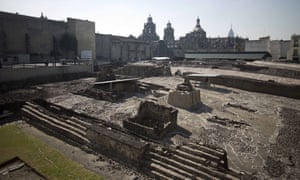
The Templo Mayor (Great Temple) in the heart of modern Mexico City, where archaeologists have discovered a long tunnel leading into a circular platform where Aztec rulers were believed to be cremated.
 The Templo Mayor (Great Temple) in the heart of modern Mexico City, where archaeologists found a tunnel into a circular platform where Aztec rulers are believed to have been cremated. Photograph: Eduardo Verdugo/AP

The answer to the mystery of leaders’ ultimate fate could be revealed behind two doors at the end of a tunnel into a platform at Tenochtitlán’s Great Temple

Archaeologists in Mexico have found a passageway and two sealed chambers beneath one of the largest temples of the ancient Aztec capital, raising hopes that excavations will uncover a ruler’s tomb beneath the city.
The tunnel, only 18in wide and 5ft high, leads 27ft directly into a circular ceremonial platform at the Great Temple or Templo Mayor complex of Tenochtitlán, the ruined Aztec capital that overlaps with modern Mexico City. At the end of the tunnel the archaeologists found two sealed doors.
According to the Spaniards who wrote of the conquest of Mexico, the Aztecs burned their kings’ remains on the circular structure – suggesting to lead archaeologist Leonardo López Luján that the sealed portals may lead to tombs.
“Once we freed the passage from earth and stone, we knew it led directly into the heart of the Cuauhxicalco,” López Luján said, using the Aztec name for the large stone platform, meaning “eagle cup”. “At the end appear two old entrances sealed up with masonry.”
The passage is actually an extension of a tunnel unearthed in 2013, discovered when a researcher noted signs of a continuation. That year archaeologists heaved a three-ton rock away from the mouth of the tunnel, finding a large box in a hollow space beneath it. The box contained gold ornaments, stone knives and the bones of children and eagles.
The human remains included two skulls belonging to children, aged five to seven, as well as bones from a hand and two feet. The knives and three vertebrae found with the skulls suggested they were sacrificed, a ritual practice relatively common among Aztec people, in which young children were often the preferred victims.
“From what the sources say, the Cuauhxicalco was a structure of a funerary character, so we can speculate that behind these walls there might be two small rooms that contain the incinerated remains of several leaders,” López Luján said.
López Luján said he suspected any remains might be of Moctezuma I and his successors, Axáyacatl and Tízoc, given the dating of the structure, referring to three of the earliest Aztec rulers. The trio ruled sometime during the 14th and the 15th centuries.
The discovery of any Aztec ruler’s remains would stand as a historic achievement – what the civilization did after leaders died remains one of the most enduring mysteries of the Aztec people.
López Luján urged caution and patience, saying that the tomb hypothesis was only that. He noted that archaeologists’ hopes had been dashed many times before and said excavations on the doorways will begin in 2016.
Unlike the tombs of the classic-period Maya, who laid out their kings in occasionally lavish chambers, Aztec burials from after 1000AD have eluded archaeologists, said Rosemary Joyce, a professor at the University of California, Berkeley.
“They keep digging down hoping they’re going to find the big guy,” she said, “but they’re running out of places to look in Tenochtitlán.”
Aztec images show dead rulers “bundled up in cloth, seated upright, with little crowns on”, she said, and indigenous people drew pictures of cremation ceremonies, but what they did with these ashes or bundles is unknown.
The clues together present a tantalizing case for the tentative hopes of a tomb. The eagles – associated with the cremation stone and the sun god Huitzilopochtli – could also suggest a leader who wanted their own associations with the deity. Joyce noted that the dual doorways could be a reflection of how the Aztecs governed: with two rulers, a tlatoani – translated as “emperor” but more literally “speaker” – and a cihuacoatl – a word with an ambiguous meaning, possibly “woman twin” or “skirt serpent”.
And while the Aztecs may have dispersed ashes or simply not buried them, Joyce agreed that the early rulers of Tenochtitlán may have constituted a special case for a people who, unlike the Maya, did not have a cult of their ancestors or necessarily inherit power through family lines.
“The remains of the first or founding generations of the Aztec rulers” may have deserved their own tomb, she said, comparing to the symbolism Americans use to venerate George Washington. “He’s not Barack Obama’s great-great-great-grandfather, but he is the father of the nation.”
Susan Gillespie, an archaeologist at the University of Florida, agreed with Joyce that researchers are not sure whether the Aztecs dispersed ashes or made any special arrangements for their leaders at all.
“It is not surprising that these cremains have not yet been found or identified,” Gillespie told the AP. “Archaeologists don’t quite know what they’re looking for.”


Saturday, October 17, 2015

10 Of The Best Ancient Ruins … That You’ve Probably Never Heard Of

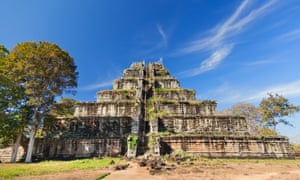
CE7J30 Ancient khmer pyramid in Koh Kher, Cambodia.
Ancient Khmer pyramid in Koh Kher, Cambodia. Photograph: Alamy


Done Pompeii, Ephesus and Angkor and still thirsting after archeological marvels? The founder of Timeless Travels magazine recommends 10 less well-known sites that can usually be savoured without the crowds


Koh Ker, Cambodia

Lost to forest and abandoned for over a thousand years, you’ll find this little-visited site in northern Cambodia. It’s less than two hours’ ride from its more famous cousin, Angkor Wat, and well worth a visit to see more than two dozen temples emerging from the jungle. A highlight is a seven-tiered pyramid, 40 metres high, which is thought to have been the state temple of Jayavarman IV and is often compared to Mayan temples. The site was the capital of the whole Khmer empire from 928-944AD.
 A new road means day trips to Koh Ker are possible from Siem Reap, but there are also now a few basic guesthouses and an ecolodge for those who want to stay longer

Choquequirao, Peru

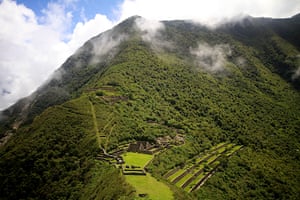
Choquequirao is a ruined Inca city in south Peru
Pinterest
 Photograph: Zachary Bennett/Corbis
Little sister to the better-known Machu Picchu, Choquequirao is one of the most-rewarding travel destinations in the Americas. Only a few hundred people visit during the dry season (May to October), compared with thousands each day at Machu Picchu. At 3,000m, the site sits on a cloud-forest ridge, 61 miles west of Cusco in the remote Vilcabamba range. The city was built by Topa Yupanqui, son of the man who built Machu Picchu, Pachacuti, some time in the 15th century. It’s a two-day trek to Choquequirao from the town of Cachora (though a cable car link is planned), and exploring it and the outlying sites of Capullyoc, Hurincancha and Casa de Cascada with a guide will take several days.
 Buses run from Cusco to Ramal, close to Cachora, where guides and pack mules can easily be hired

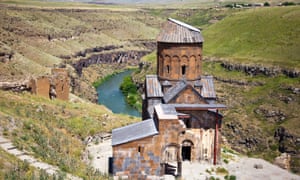
The ruined church of Saint Gregory in Ani, Turkey.Ani, Turkey

Pinterest
 The ruined church of Saint Gregory in Ani. Photograph: Alamy
There are some wonderful treasures in the far east of Turkey and one of them is the site of Ani. Capital of the Armenian Bagratid dynasty until the 11th century, and situated on key trade routes, it flourished for over 400 years and at its peak was larger than any contemporary European city, with a population of over 100,000. It was destroyed by an earthquake in 1319, and today its ruins are spread over a wide area, with the remains of spectacular churches, a Zoroastrian fire temple, palaces and city walls. Take a picnic and spend a day exploring the site.
 Ani can be reached by taxi or hire car from the town of Kars, 46km away and served by internal flights from Ankara or Istanbul

Conimbriga, Portugal

Roman ruins (House of fountains), Conimbriga
Pinterest
 Photograph: Getty Images
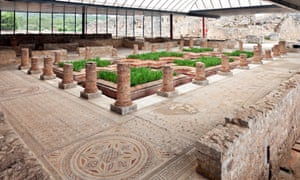
This is one of the largest Roman settlements in Portugal – roughly halfway between Lisbon and Porto, near the village of Condeixa-a-Nova. It was a prosperous town in Roman times and, while not the largest Roman city in Portugal, it is the best preserved. Although only a small section of the site has been excavated, there are baths, luxurious houses, an amphitheatre, a forum, shops, gardens with working fountains and city walls to explore, with many wonderful mosaics still in situ. In its centre is one of the largest houses discovered in the western Roman empire, the Casa de Cantaber, which is built around ornamental pools in superb colonnaded gardens and has its own bath complex and heating system. There is also a good museum, cafe and picnic site. Pick up a guidebook from the museum and have a few euro coins in your pocket to make the fountains work.
 Easyjet and Ryanair fly to Porto and Lisbon from about £50 return

Han Yangling, China

Terracotta figures at Han Yang Ling Museum.
Pinterest
 Terracotta figures in the Han Yangling museum. Photograph: Alamy
A smaller version of the Xi’an terracotta warriors, this often-overlooked site is the the tomb of E mperor Jing Di , who died in 141BC, and his Empress Wang. The site, 20km north of Xi’an, is well laid-out, with glass panels over the burial pits so you can see everything in situ, and there is also an excellent museum. The warrior figures here have individual faces; their arms were made of wood and they wore clothes. Sadly, both have disintegrated now, though examples can be seen in the museum. The pits are filled with figurines of courtiers and animals, and you can see the fossilised remains of wooden chariots.
 Han Yangling is easily reached by taxi, from Xi’an international airport (25 minutes)

Pella, Jordan

Ruins in Pella, Jordan
Pinterest
 Photograph: Corbis
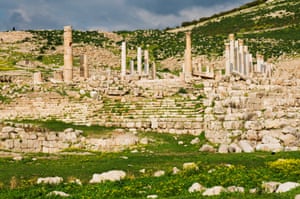
Frequently bypassed for the larger sites of Jerash and Umm Qais , Pella, in the north Jordan valley, is a multi-period site, occupied since neolithic times. It has some stunning Roman/Byzantine remains, and recent excavations have unearthed a Canaanite temple dating from 1700BC and early-bronze-age city walls dating from 3200BC. Take the time to climb to the top of Tell Husn, the southern mound overlooking the dig house, and you will be rewarded with a fantastic view across the excavations and the Jordan valley.
 The site is 45 minutes by road from the city of Irbid (two hours from Amman). Buses run from Irbid to the present-day village of Tabaqat Fahl

Vatican Necropolis, Italy

Roman necropolis in the Vatican.
Pinterest
 Photograph: AGF/Rex
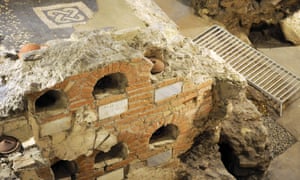
Beneath the Vatican City lie the ancient streets of Rome and an ancient burial ground, the Vatican necropolis – originally a cemetery on the southern slope of Vatican Hill. Saint Peter is said to be buried here, after he was martyred in the nearby Circus of Nero. Emperor Constantine I built a basilica above the apostle’s grave in the fourth century AD, and excavations in the 1940s did find a number of mausoleums. To walk at ancient street levels through the necropolis is an exciting experience for those who love to step back in time.
 Visits must be booked with the Vatican Excavations Office. Tours, in groups of about 12, last 90 minutes

Takht-e Soleyman, Iran

Takht Soleyman
Pinterest
 Photograph: /Getty Images
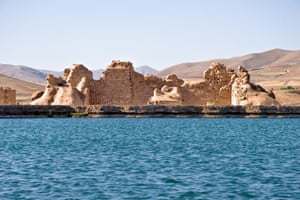
Takht-e Soleyman, meaning Throne of Solomon, is a breathtaking site built around a mineral-rich crater lake 30km north of Takab in Iran’s West Azerbaijan province. The earliest remains date from the Sasanian period, from 224 to 651AD. Set in a vast, empty landscape 2,000 metres above sea level, the site includes the remains of a Zoroastrian fire temple complex and a 13th-century Mongol palace. It is surrounded by an oval wall with 34 towers and two gates. The lake is 60 metres deep and so filled with minerals that it contains no life and is undrinkable. Don’t miss the small museum, housed in an Ilkhanid (a 13th-century building), with fine examples of tile, ceramics and stucco decoration. 
 The site is about two hours by taxi from the city of Zanjan, which is served by buses and trains from Tehran

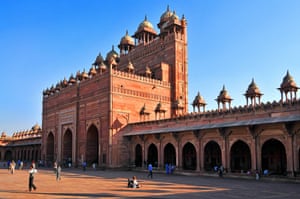
Fatehpur Sikri, India

Fatehpur Sikri, India
Pinterest
 Photograph: /Corbis
This surprisingly intact walled and fortified Mughal city is 40km west of Agra and the Taj Mahal in Uttar Pradesh. Built by Emperor Akbar in 1571, it was the Mughal capital for 14 years before being abandoned for lack of water. A stunning royal complex of pavilions and palaces include a harem, a mosque, private quarters, gardens, ornamental pools, courtyards and intricate carvings. It is the best-preserved collection of Mughal architecture in India. Don’t miss the Rumi Sultana palace, the smallest but most-elegant structure in the complex, and the secret stone safes in the corner of the Treasury, which also houses a museum opened just last year.
 The complex is an easy day trip from Agra: take a bus or train to Fatehpur station, 1km from the site

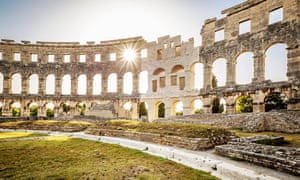
Pula, Croatia

Ancient Amphitheater Pula, Croatia
Pinterest
 Photograph: Getty Images
The amphitheatre of Pula is the only Roman amphitheatre to have four side towers and all three levels preserved. Built between in 27BC and 68AD, it is one of the six largest surviving Roman arenas in the world, and the best-preserved ancient monument in Croatia. Overlooking the harbour in the north-east of the town, it seated 20,000 spectators. In summer there are weekly re-enactments of gladiator fights, and it is also used for plays, concerts and the September Outlook festival. Look out for the slabs that used to secure the fabric canopies that sheltered spectators from the sun.
 Ryanair flies to Pula from Stansted from £117 return
by Fiona Richards