Showing posts with label #SpaceTourism. Show all posts

Sunday, April 8, 2018

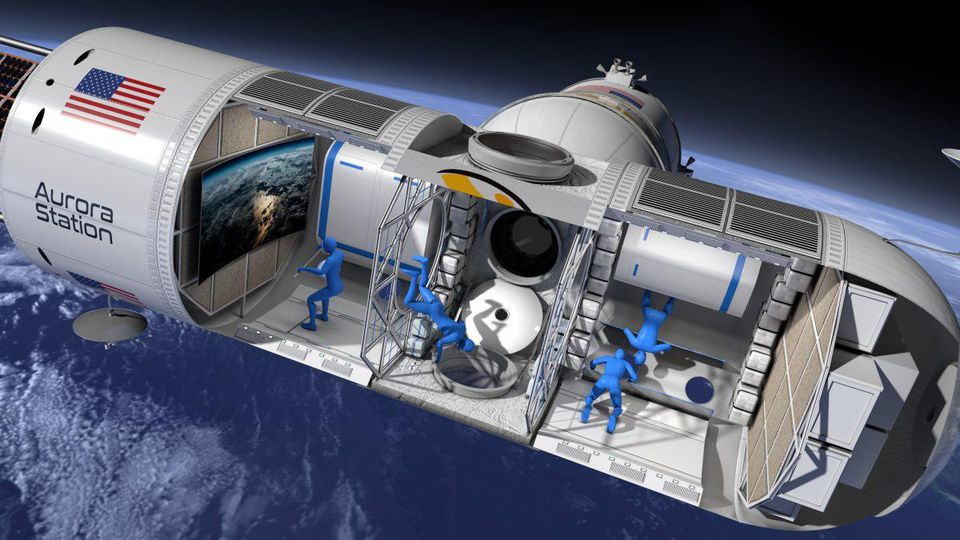
First Ever Luxury Space Hotel Begins Accepting Reservation Deposits


Image result for First-ever luxury space hotel

The first-ever luxury space hotel was introduced during the Space 2.0 Summit in San Jose, California. Named after the magical light phenomenon that illuminates the Earth’s polar skies, Aurora Station is being developed by Orion Span and the company’s team of space industry veterans, who have over 140 years of human space experience.
The first fully modular space station to ever debut, Aurora Station will operate as the first luxury hotel in space. The exclusive hotel will host six people at a time – including two crew members. Space travelers will enjoy a completely authentic, once-in-a-lifetime astronaut experience with extraordinary adventure during their 12-day journey, starting at $9.5M per person. Deposits are now being accepted for a future stay on Aurora Station, which is slated to launch in late 2021 and host its first guests in 2022. The deposit is $80,000 per person.
“We developed Aurora Station to provide a turnkey destination in space. Upon launch, Aurora Station goes into service immediately, bringing travelers into space quicker and at a lower price point than ever seen before, while still providing an unforgettable experience,” said Frank Bunger, chief executive officer and founder of Orion Span. “Orion Span has additionally taken what was historically a 24-month training regimen to prepare travelers to visit a space station and streamlined it to three months, at a fraction of the cost. Our goal is to make space accessible to all, by continuing to drive greater value at lower cost.”
During their stay on Aurora Station, travelers will enjoy the exhilaration of zero gravity and fly freely throughout Aurora Station, gaze at the northern and southern aurora through the many windows, soar over their hometowns, take part in research experiments such as growing food while in orbit (which they can take home with them as the ultimate souvenir), revel in a virtual reality experience on the holodeck, and stay in touch or live stream with their loved ones back home via high-speed wireless Internet access. While in space, Aurora Station guests will soar 200 miles above the Earth’s surface in Low Earth Orbit, or LEO, where they will find stunning views of the Earth. The hotel will orbit Earth every 90 minutes, meaning those aboard will see an average of 16 sunrises and sunsets every 24 hours. On return to Earth, guests will be treated to a hero’s welcome home.
Prior to take-off, those set to travel on Aurora Station will enjoy a three-month Orion Span Astronaut Certification (OSAC). Phase one of the certification program is done online, making space travel easier than ever. The next portion will be completed in-person at Orion Span’s state-of-the-art training facility in Houston, Texas. The final certification is completed during a traveler’s stay on Aurora Station.
“Aurora Station is incredibly versatile and has multiple uses beyond serving as a hotel,” Bunger added. “We will offer full charters to space agencies who are looking to achieve human spaceflight in orbit for a fraction of the cost – and only pay for what they use. We will support zero gravity research, as well as in space manufacturing. Our architecture is such that we can easily add capacity, enabling us to grow with market demand like a city growing skyward on Earth. We will later sell dedicated modules as the world’s first condominiums in space. Future Aurora owners can live in, visit, or sublease their space condo. This is an exciting frontier and Orion Span is proud to pave the way.”
Orion Span officially made the Aurora Station announcement this morning at the Space 2.0 Summit in San Jose, California. The company’s leadership team includes Chief Executive Officer Frank Bunger, who is a serial entrepreneur and technology start-up executive credited with multiple startups under his belt; Chief Technology Officer David Jarvis – a lifelong entrepreneur, human spaceflight engineer, and payload developer with breadth and depth in the management and operations of the International Space Station (ISS); Chief Architect Frank Eichstadt, who is an industrial designer and space architect credited with being the principal architect on the ISS Enterprise module; and Chief Operating Officer Marv LeBlanc – a former general manager and program manager with decades of executive space experience running operations and mission control.

Monday, February 27, 2017

SpaceX To Fly Two Space Tourists Around The Moon In 2018

Image result for SpaceX

Two tourists are paying SpaceX for a trip around the moon next year.

SpaceX CEO Elon Musk announced Monday afternoon that the travelers had already placed a significant deposit.
"Next year is going to be a big year for carrying people to the space station and hopefully beyond," Musk said in a conference call with reporters.
SpaceX will use the same launch pad near Cape Canaveral, Florida, that was used for the Apollo programs missions.
This story is developing and will be updated.

Monday, February 22, 2016

Virgin Galactic Unveils New Spaceship For Tourists

Virgin Galactic Unveils New Spaceship for Tourists
Photo courtesy of Thinkstock
A little more than a year after Richard Branson’s SpaceShipTwo crashed, killing a pilot, his company has revealed a new spaceship, CNNreported. 
The company, Virgin Galactic, has spent more than three years building the new spacecraft, which is located at the Mojave Air & Space Port in California.
After the vehicle undergoes extensive testing, Branson said average people, rather than astronauts, will be able to travel 50 miles above Earth’s surface, which the company said will make them “bona fide space tourists."
"Our beautiful new spaceship, VSS Unity, is the embodiment of that goal and also a great testament to what can be achieved when true teamwork, great skill and deep pride are combined with a common purpose," Branson said, according to a Virgin Galactic press release. 
More than 700 people have already signed up to fly on Virgin Galactic. In order to fly with the company, passengers must pay $250,000 per seat in advance.

Tuesday, October 6, 2015

World View's Balloon-Based Space Tourism To Lift Off In 2017

World View Enterprises Balloon Flight
Artist's illustration of World View's balloon-borne capsule cruising through the stratosphere.
Credit: World View Enterprises, Inc.
TUCSON, Arizona — A new type of space tourism is set to lift off two years from now, without the aid of a rocket.

Arizona-based World View Enterprises aims to start launching paying customers to the stratosphere in 2017 beneath a giant balloon, for $75,000 per seat. Passengers will spend two hours at an altitude of 100,000 feet (30,500 meters), where they'll be able to see the blackness of space and the curvature of Earth, company representatives say.
"I hear a lot of people say this: 'I don't want to have lived my entire life on this planet and never really seen it,'" World View chief technology officer Taber MacCallum told Space.com late last month here at the company's headquarters near Tucson International Airport. [World View's Near-Space Balloon Rides in Pictures]

"There's a really interesting psychology surrounding getting that perspective, which is why we called [the company] World View," MacCallum added.

A different kind of experience

World View passengers will ride aboard a pressurized capsule that accommodates six paying customers and two crewmembers.
A huge, helium-filled balloon will loft the 10,000-lb. (4,535 kilograms) capsule to the stratosphereduring a gentle ascent that takes 90 minutes to 2 hours. The launch site for these flights is unclear at the moment; the company is currently deciding between Florida and Arizona, MacCallum said.
The gondola, which is classified as a spacecraft by the Federal Aviation Administration, will then cruise at 100,000 feet for another two hours or so. When it's time to descend, the pilot will start venting helium from the balloon. After a while, the balloon and capsule will separate, with the latter eventually making a soft landing at a predetermined site with the aid of a steerable, parachute-like device called a parafoil. (The balloon will be recovered and recycled.)
The entire flight will last for five or six hours. The distance between launch and landing sites could be as great as 300 miles (480 kilometers), depending on winds, World View representatives say.
The balloon experience will be very different from the suborbital spaceflights that Virgin Galactic and XCOR Aerospace plan to offer with their in-development rocket planes, which are called SpaceShipTwo and Lynx, respectively.
For starters, World View is cheaper: tickets for the six-passenger SpaceShipTwo and the one-passenger Lynx are currently selling for $250,000 and $100,000, respectively (though Lynx rides will cost $150,000 starting on Jan. 1, 2016). 
In addition, World View's balloons will float gently through the atmosphere, while SpaceShipTwo and Lynx will give customers a pulse-pounding rocket ride. The two space planes will also go much higher than World View — about 62 miles (100 kilometers) above Earth, the traditionally accepted boundary where outer space begins.
People aboard SpaceShipTwo and Lynx will experience about 5 minutes of weightlessness as well, unlike World View's customers, who will never float around inside their sealed gondola. But the space planes won't stay aloft as long as the balloons: SpaceShipTwo's total flight time will be about 2.5 hours (with a chunk of it spent beneath the belly of a carrier aircraft called WhiteKnightTwo), while a typical Lynx mission will last about 30 minutes. [Now Boarding: The Top 10 Private Spaceships]

Making it happen

World View is not starting from scratch. The company is leveraging the technology developed for the StratEx (Stratospheric Exploration) program, which set the record for highest-ever skydive in October 2014 when Google executive Alan Eustace jumped from a balloon 135,908 feet (41,425 m) above the New Mexico desert.
Indeed, MacCallum was StratEx's safety officer, and Arizona-based Paragon Space Development Corp., which McCallum co-founded and where he served as CEO for more than 20 years, was the program's prime contractor. (World View CEO Jane Poynter is also a co-founder of Paragon, which is a subcontractor to World View and specializes in developing environmental-control and life-support systems.)
StratEx "was really a foundational project for World View, to run through essentially all the phases of flight that we would have with a capsule, only in a one-person version," MacCallum said. "It was essentially a scale model."
The basic pieces of World View's flight system have therefore mostly been developed, and the work left to do before commercial operations can begin involves adapting, integrating and testing them.
Such efforts are already underway. In February, for example, World View flew a parafoil to an altitude of 102,200 feet (31,150 m), two times higher than the previous record for parafoil flight. The company plans to perform a test drop from 100,000 feet with a 10 percent scale model — that is, a payload that weighs 1,000 lbs. (454 kg) — in the next week or so. A full-scale test drop should follow by the end of the year or early 2016, MacCallum said.
If everything goes well, the first crewed test flights will take place in early to mid-2017, he added, with commercial operations beginning in late 2017.
World View also conducts uncrewed balloon flights for scientific purposes; the company has already lofted payloads for NASA and other customers. The experience gained via these efforts should help the company manage its crewed operations, MacCallum said.
It's unclear when SpaceShipTwo and Lynx will be up and running. SpaceShipTwo has conducted four rocket-powered test flights, but the most recent one, in October 2014, ended in tragedy; the vehicle broke apart in mid-air, killing co-pilot Michael Alsbury and seriously injuring pilot Peter Siebold. The first Lynx test flights could come later this year, XCOR representatives have said. 

The 'entry drug' for space tourism?

World View hasn't really begun trying to sell tickets for its stratospheric tours yet, MacCallum said. But he isn't too worried about finding enough takers, citing Virgin Galactic's success in garnering hundreds of deposits for future SpaceShipTwo flights.
"We really don't think that tickets are going to be an issue at this point," MacCallum said. "We think we're going to be limited by the number of operations we safely feel like we can conduct for the first few years, not available people who want to fly."
Indeed, MacCallum believes the space tourism market is big enough for World View, Virgin Galacitc and XCOR to co-exist peacefully and profitably, especially since World View is doing something so different.
"I actually think the balloon experience is probably like the entry drug," MacCallum said. "What's nice about that is, they [customers] have already had the time to contemplate the view, so then when you go do the Virgin Galactic or the XCOR experience, you can enjoy the rocket ride."
by Mike Wall, Space.com Senior Writer Follow him on Twitter @michaeldwall and Google+. Follow us@SpacedotcomFacebook or Google+
Originally published on Space.com.

Follow us:  @TraveloreReport