PORT-AU-PRINCE, Haiti (AP) — Gunmen assassinated Haitian President Jovenel Moïse and wounded his wife in their home early Wednesday, inflicting more chaos on the unstable Caribbean country that was already enduring an escalation of gang violence, anti-government protests and a recent surge in coronavirus infections.
Claude Joseph, the interim prime minister, confirmed the killing and said the police and military were in control of security in Haiti, where a history of dictatorship and political upheaval have long stymied the consolidation of democratic rule.
While the streets of the Haitian capital, Port-au-Prince, were quiet Wednesday morning, some people ransacked businesses in one area. The country appeared to be heading for fresh uncertainty ahead of planned general elections later this year. Moïse, 53, had been ruling by decree for more than a year after the country failed to hold elections and the opposition demanded he step down in recent months.
Former President Michel Martelly, whom Moïse succeeded, said he was praying for first lady Martine Moïse, calling the assassination “a hard blow for our country and for Haitian democracy, which is struggling to find its way.”
Joseph said Martine Moïse, 47, was shot and in a hospital. He condemned the president’s killing as a “hateful, inhumane and barbaric act.”
“The country’s security situation is under the control of the National Police of Haiti and the Armed Forces of Haiti,” Joseph said in a statement from his office. “Democracy and the republic will win.”
In the statement, Joseph said some of the attackers spoke in Spanish but offered no further explanation. He later said in a radio address that they spoke Spanish or English.
A resident who lives near the president’s home said she heard the attack.
“I thought there was an earthquake, there was so much shooting,” said the woman who spoke on condition of anonymity because she fears for her life. “The president had problems with many people, but this is not how we expected him to die. This is something I wouldn’t wish on any Haitian.”
The U.S. Embassy in Haiti said it was restricting U.S. staff to its compounds and that the embassy would be closed Wednesday because of ’’an ongoing security situation.″
The White House described the attack as “horrific” and “tragic” and said it was still gathering information on what happened. U.S. President Joe Biden will be briefed later Wednesday by his national security team, spokesperson Jen Psaki said during an interview on MSNBC.
“The message to the people of Haiti is this is a tragic tragedy,” she during a previously scheduled interview on CNN. “And we stand ready and stand by them to provide any assistance that’s needed.”
Haiti’s economic, political and social woes have deepened recently, with gang violence spiking heavily in Port-au-Prince, inflation spiraling and food and fuel becoming scarcer at times in a country where 60% of the population makes less than $2 a day. These troubles come as Haiti still tries to recover from the devastating 2010 earthquake and Hurricane Matthew that struck in 2016.
Opposition leaders accused Moïse of seeking to increase his power, including by approving a decree that limited the powers of a court that audits government contracts and another that created an intelligence agency that answers only to the president.
In recent months, opposition leaders demanded the he step down, arguing that his term legally ended in February 2021. Moïse and supporters maintained that his term began when he took office in early 2017, following a chaotic election that forced the appointment of a provisional president to serve during a year-long gap.
There are no vaccines or treatments available for Zika. | File photo
The Centers for Disease Control and Prevention (CDC) recently added new countries to its travel guidelines concerning the Zika virus, warning people who travel to these regions that the virus is at large.
The countries include Barbados, Bolivia, Cape Verde, Ecuador, Guadeloupe, Guyana, Saint Martin and Samoa. These are in addition to the previously added countries: Brazil, Colombia, El Salvador, French Guiana, Guatemala,Haiti,Honduras, Martinique, Mexico, Panama, Paraguay, Puerto Rico, Surname and Venezuela.
Health officials have found it difficult to determine the exact regions where Zika is most likely to be transmitted, as these areas and likelihoods will change as the virus spreads.
The CDC will continue to update its travel alerts as more information is revealed. Travelers should be aware of the risks they are taking when they travel to certain regions, which may also have higher chances of chikungunya and dengue viruses. It is most likely that people who contract these diseases will be infected while they are traveling, only showing symptoms after they return home.
Mosquitoes that transmit these three viruses are more aggressive, biting people during daytime hours. These mosquitoes also tend to live outdoors nearby people or indoors inside people’s residences.
There are no vaccines or treatments available for Zika.
United Airlines will allow customers concerned about the Zika virus to cancel or postpone their trips if they’re ticketed to fly to areas affected by the mosquito-borne virus. American Airlines also said it would allow certain customers to do the same.
United's policy includes travel to all areas mentioned in a Centers for Disease Control alert. So far, American's covers flights to four destinations in Central America.
“We are offering customers who are traveling to the affected regions the opportunity to rebook at a later date or receive a full refund,” United spokesman Charles Hobart said in a statement to Today in the Sky on Tuesday.
United is basing its exception policy off the guidelines issued by the CDC. Hobart says customers ticketed to regions listed by the CDC should contact the carrier if they have concerns.
“For travelers who feel they’re at risk, we’ll provide them with options,” Hobart added in a follow-up call on Wednesday.
American had not yet posted its Zika policy on its website, though spokesman Ross Feinstein says the carrier decided to implement the policy Monday. To date, American's policy is specific than United's.
Feinstein says American will allow customers to receive a refund if they provide a doctor's note stating they are unable to travel to one of four cities due pregnancy. The cities included in American's waiver are San Pedro Sula and Tegucigalpa in Honduras as well as Panama City, Panama, and Guatemala City. Feinstein says American continues to review its policy.
The Zika virus has been in the news since the Centers for Disease Control (CDC) issued a travel warning alert earlier this month warning about the risk of traveling to countries in theAmericas affected by the virus. Zika has been linked to an epidemic of birth defects in Brazil and is thought to be spreading to other regions of North and South America.
The CDC's warning focused mostly on pregnant women or those seeking to become pregnant.
The World Health Organization (WHO) issued its own alert on Monday, saying it expects the Zika to eventually spread to the United States and most of the Americas.
As for United, it said its travel waivers would include countries covered in the CDC's travel advisories.
Currently, the CDC's advisories mention the following countries and territories in the Americas: Barbados, Bolivia, Brazil, Colombia, Ecuador, El Salvador, French Guiana, Guadeloupe, Guatemala, Guyana, Haiti, Honduras, Martinique, Mexico, Paraguay, Panama,Puerto Rico, Saint Martin, Suriname and Venezuela.
American, Delta and United are the three large U.S. carriers with a significant international presence. Each flies to numerous destinations in Central and South America.
For now, Delta has no such waiver in place.
“We continue to monitor the situation closely. No flight cancelations have resulted as of this time and there is currently no waiver,” Delta spokesman Morgan Durrant says to Today in the Sky.
Durant added that Delta remains "in close contact" with both the CDC and WHO on all health risks that could affect air travelers.
Outside the United States, the the largest carrier in Latin America also announced that it will waive fees or offer fees to pregnant women seeking to travel to nations affected by Zika, The Associated Press reports. LATAM, which includes both LAN and TAM airlines, says its policy will cover travel to Brazil, Colombia, El Salvador, Guatemala, French Guyana, Haiti, Honduras, Martinique, Mexico, Panama, Paraguay, Puerto Rico, Suriname and Venezuela.
(CNN)Pregnant women should not travel to Barbados, Bolivia, Ecuador, Guadeloupe, Saint Martin, Guyana, Cape Verde and Samoa because of Zika virus, the CDC said Friday.
This comes on the heels of last week's travel alert from the CDC recommending pregnant women postpone travel toBarbados, Bolivia, Ecuador, Guadeloupe, Saint Martin, Guyana, Cape Verde and Samoa Brazil, Colombia, El Salvador, French Guiana, Guatemala, Haiti, Honduras, Martinique, Mexico, Panama, Paraguay, Suriname, Venezuela and Puerto Rico. The recommendations alsocall for women who have traveled to these places during their pregnancy be screened and monitored for the virus if their visit took place while the virus was present in the country they visited.
What is the Zika virus?01:55
The decision is based on their ongoing monitoring of the Zika virus around the world and CDC say they will update as necessary in the interest of public health.
Zika virus is a mosquito borne disease. An individual becomes infected by the bite of an infected mosquito. Symptoms of the virus include fever, rash, joint pain and red eyes and can last from a few days to about a week. But 80% of individuals infected have no symptoms.
So why is there so much concern?
The virus has been linked to an increase in cases of a rare neurological condition called microcephaly in babies. Microcephaly results in babies being born with abnormally small heads, and often serious, and sometimes deadly, developmental delays.
This is what prompted the Salvadoran vice minister of health to tell women there not to get pregnant for two years. "We're recommending that women who may get pregnant plan their pregnancies and try to avoid getting pregnant this year and the next," Eduardo Espinoza told CNNEspanol Thursday.
Colombia and Jamaica issued similar recommendations for women to delay pregnancy earlier this week.
Brazil was the first nation to give this advice in November after they saw a sharp increase in the rare birth defect coinciding with an outbreak of the virus there. The Ministry of Health has recorded more than 3,700 cases of microcephaly in 2015 and so far this year. In comparison, 147 cases of microcephaly were recorded in 2014.
The CDC conducted tests on human tissue from babies in Brazil confirming a the link between Zika virus and microcephaly.
Health officials there and in El Salvador, also suspect a surge of the rare disorder Guillian Barre Syndrome, or GBS, is connected to Zika virus. GBS is a rare disorder in which an individual's immune system attacks nerve cells, resulting in muscle weakness and sometimes paralysis. The CDC is working with the Ministry of Health in Brazil and has a team on the ground conducting investigating a possible link between the two.
Dangers of Zika virus01:39
"It's a strong message to tell people to stop getting pregnant for a couple of years," said Stephen Higgs, PhD, president of the American Society of Tropical Medicine and Hygiene. He likens it to the message to promote safe sex for the prevention of HIV. "Some people will pay attention to this and realize they are at risk for something, others are obviously going to ignore it," he said.
Higgs believes a unified message could help, noting that El Salvador recommends a two-year halt on pregnancy while Jamaica, for example is recommending 6 to 12 months. This could come in the form of an overarching announcement from the World Health Organization or the Pan American Health Organization that applies to all Zika-infected countries, rather than individual countries making recommendations. The message will probably change too as more is learned about the virus.
What now?
"Zika in the Americas is in new territory and (as) we've seen with the microcephaly, it's showing different patterns of infection that hasn't been seen before. We don't fully understand what's going on," Higgs said.
He also expects the CDC to continue to expand the list of nations as the virus continues to spread.
In the U.S. there are confirmed cases of the virus among individuals who have traveled to infected countries, including in Illinois, Florida and Texas, among others. However, there are no known cases of locally transmitted illness. "These imported cases might result in local human-to-mosquito-to-human spread of the virus in limited areas of the continental Unites States that have the appropriate mosquito vectors," according to a new report on the spread of the virus issued by the CDC Friday.
There is at least one known case of a baby born with microcephaly believed to be linked to Zika in Hawaii.
There is no prevention or treatment, which is why the best course of action is for travelers to danger areas is toprevent mosquito bites by using mosquito repellant and covering exposed skin. The aedis aegyptia mosquito, which transmits the disease, bites all day long, so individuals need to reapply that repellant and not let their guard down. Aedes albopictus mosquitoes, which are found throughout the U.S. and are known for transmittingdengue fever and chikungunya, may also transmit the virus, the CDC said Friday.
However, mosquito bites and mother to unborn baby aren't the only ways this virus is transmitted. The new CDC report notes documented cases of infection from sexual transmission, blood transfusion and laboratory exposure.
The good news is, while it's not certain, scientists believe once an individual has been infected with the virus, they are immune and won't become infected again, according to Higgs.
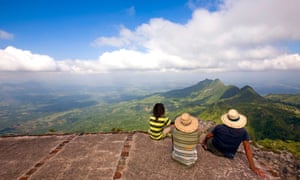
Looking down from La Citadelle Laferrière in north Haiti. Photograph: Alamy
Haiti was devastated by an earthquake, now hurricanes , we hope tourists will return soon – to find a raw and fascinating Caribbean country with a unique culture
How to Help: https://www.redcross.org/donate/donation
Long before I arrive in Haiti I get a sense of what the name itself conjures up. There are no direct flights from the UK, so I’ve flown in via the Dominican Republic, Haiti’s conjoined twin on the island of Hispaniola. The tourists on my flight cannot understand why anyone would risk Haiti: “I hope you survive!”; “Will you have armed guards?” and, perhaps the key question, “Why?” But tour operators like the one I’m travelling with, Wild Frontiers, feel that Haiti’s time has finally come, especially with Cuba looking more visitor-crowded and less adventurous than before. There is also a sense that responsible tourism to Haiti could put money where it is really needed.
Hispaniola is shaped like a large canine tooth extracted from the gob of Mexico and thrown into the centre of the Caribbean Sea. Haiti is the western third of it, and I’m arriving on a small plane from the east of the island, gazing out at the mountainous terrain and totting up reasons for Haiti’s unsavoury reputation. So far I’ve got deadly earthquakes, dire poverty, the brutal Tontons Macoutes, the tyrant Papa Doc Duvalier, plus, of course, the zombies – mustn’t forget the zombies. On the plus side, I scribble “fresh fruit”. Then, out of the aeroplane window, the verdure of the Dominican Republic is giving way abruptly to something eroded and bone-like. Over Port-au-Prince, the Haitian capital, we enter a pall of dust, and the plane bounces and sways before landing. I cross out fresh fruit.
It was not always this way. Expectations of this land were high when Columbus touched down in 1492, noting the extreme fertility, the abundance of food and clean water, the gold, and the handsome, happy people. “With 50 men,” he noted ominously, “we could subjugate them all and make them do whatever we wanted.” And that is what the conquistadores did, shipping in fresh workers from west Africa when the locals died. By 1660, the western third of Hispaniola was French, the other part Spanish, and in all but name, the two countries of Haiti and the Dominican Republic were established. They both had wars of independence, years of American occupation, and brutal dictators, but Dom Rep, as everyone now refers to it, somehow emerged as a place where you can buy a pizza 24 hours a day and visit shopping malls. But what about Haiti?
The first thing I notice in Port-au-Prince is the people: they are all out on the street. Men and women carrying their goods on their heads: bananas to sell, water, a roll of naif paintings to hang up outside a hotel. There are horses, mules and donkeys amid a tangle of good-natured, slow-moving traffic. And behind all this frenetic activity, rising above the heads, is a mixture of ruins and new buildings. It is five years since one of the most devastating earthquakes in human history razed huge areas of the city, killing up to 220,000 people. Finally, Port-au-Prince is being rebuilt, and very attractively too, judging by what’s been done already.
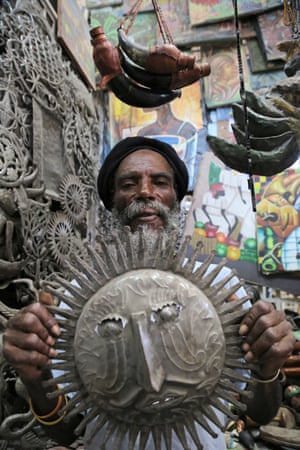
I visit the reconstructed Marché de Fer, the bustling central market, where a stately rastaman called Dominic shows me around (for $1 – this is a place where you need lots of small dollar bills). After spices, vegetables and beauty products, we enter an area selling flouncy blue dresses and sinister-looking dolls. I tackle the voodoo question head on.
Dominic – Kevin’s guide to Port-au-Prince’s central market – shows off some of his own art. Photograph: Kevin Rushby
Voodoo is a polytheistic faith that came to the island with slaves from west Africa, and took on a camouflage veneer of Roman Catholicism. Its importance to Haiti was firmly established when, in 1791, a voodoo ceremony triggered the only slave revolt which has led to the founding of a state. Ever since, the religion has prospered, often in the teeth of official disapproval. Western attitudes have sometimes been fearful, and frequently condescending: “proper” religions have gods and miracles; voodoo has spirits and mumbo jumbo. Unfortunately, Papa Doc, dictator during the 1960s, further tarnished the religion’s image by encouraging the belief that he was Baron Samedi, the spirit of the dead.
At the refurbished National Museum I get to see Papa Doc’s bowler hat, cane and evil little machine gun, plus photos of Haiti’s many other presidents. It is a wonderful little museum – from the slave torture devices to the inscribed names of early rebels (Hyacinthe and Chickenshit included); from the ostentatiously Napoleonic insignias of the first black leaders to the earlier simplicity of Taino Indian stone carvings (the Tainos were all but wiped out within a century of Columbus’s arrival). There is even an anchor that claims to be from Columbus’s ship, the Santa María, wrecked on the north coast.
After a night at the Montana Hotel, elegantly rebuilt from the ruins of the quake, I meet Serge, my local guide, who takes me to the highlands behind Port-au-Prince. He’s a fascinating character: having grown up in an orphanage, he had a successful career as a dancer, then worked as a researcher on almost every film project in Haiti for the past decade. We leave the car and walk around Wynne Farm, a project encouraging farmers to plant trees and work sustainably. Hummingbirds thrum past and we spot two nests, one with a pair of tiny chicks inside, neither of them larger than the tip of my little finger. Serge’s conversation runs through modern slavery, voodoo, cuisine, art, music and the iniquities ofMinustah, the UN stabilisation mission that still exerts a powerful influence in the country. Over the treetops we enjoy vast panoramas of green hills, heavily farmed. Haiti has a severe deforestation problem.
We head downhill, to the home of Janey Wynne, the owner of Wynne Farm, and a plant enthusiast. Her current obsession is bamboo. “It could save Haiti’s poor farmers,” she says. Some of her poor neighbours just sold a bundle of canes for US$200 – a small fortune. We drink herbal tea, eat mango cake and then tour the garden, which is magical: there’s macadamia, ginger, naranjilla, datura, and several strange fruits I’ve never seen before.
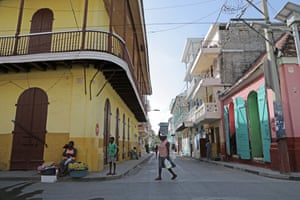
Street life in Cap Haïtien, on the north coast. Photograph: Kevin Rushby
Serge finally drags me away: he wants us to visit Croix-des-Bouquets, a village on the east side of Port-au-Prince, where a tradition of metal-working has developed. As we drive, I note that Janey’s enthusiasm has worked: Serge is clutching a handful of seeds and some cuttings for his garden.
En route, we stop at an upmarket art gallery, a chance to orientate myself. Haitian art is complex and colourful, incorporating various schools and traditions, and long since “discovered” by collectors. Top names, such as Prospere Pierre-Louis, command substantial prices, but there is always the chance of finding an emerging talent.
When we reach Croix-des-Bouquets, Serge introduces me to Jacques Eugene, who makes mask-like pieces, punctured and perforated, adorned with twisted cutlery and car parts. His inspiration comes in dreams, from a voodoo spirit called Ezili Danto.
Down the road we pass dozens of workshops and shops. At one we meet Serge Jolimeau, one of the stars of Haitian art, whose work hangs all around us: huge, textured heads surging with vitality. In Jolimeau’s hands the metal becomes fluid and magical. The trouble is, once I’ve seen what I can’t afford, I don’t want the cheap stuff.
We drive north-west along the coast, stopping at simple fishing villages such as Luly, where the people are sitting in the shade, weaving fish traps. The beach is something of a curate’s egg: gorgeous pink conch shells mixed with plastic bottles in one great fascinating mess, like the country itself. At Montrouis I tour theMuseum Ogier-Fombrun, part of the delightfully laid-back Moulin-sur-Mer beach hotel. At this former French plantation, 600 slaves eked out miserable lives to help create what was France’s richest colony. Now the place is home to a superb collection of artefacts, and tranquil gardens filled with semi-tame birds.
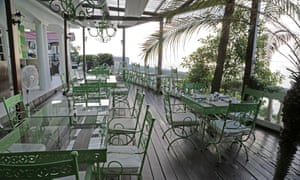
Hotel Habitacion Jouissant, in Cap Haïtien. Photograph: Kevin Rushby
The visitors here seem to be mainly Haitian emigres from the US. The few European tourists tend to head south – to Jacmel, and a few well-kept beach resorts. Haiti, however, has a lot more to offer. Up in the north is the city of Cap Haïtien, a crumbling masterpiece of colonial-era architecture: brightly painted, well-kept houses mixed with the dilapidated and ruined. Like everywhere in Haiti, I find the people friendly but not effusive: smiles are not freely given, they have to be elicited. I stay at Habitacion Jouissant, a much-extended, shady bungalow on a patio high above the sea, where at dawn, wooden sailing boats can be spotted heading off to the Turks and Caicos Islands.
Cap Haïtien has some great markets and, nearby, good beaches and a potentially world-class attraction in La Citadelle Laferrière, an imposing fortification that sits on a high ridge above the village of Milot, where it’s worth seeking out Maurice Etienne, owner of a guesthouse-cum-cultural centre. Maurice’s great-great-grandfather was a soldier in La Citadelle, and Maurice has turned himself into an expert on the place. When I arrive, two American archaeologists are picking his brains.
Built by Haiti’s first post-slavery president, Henri Christophe, between 1805-1820, La Citadelle was both a warning to France and a bold statement that the former slaves were capable of great achievements. As the latter it was a success, but sadly the French did return, blockading the ports and demanding reparations for their lost, slave-driven businesses. Haiti capitulated, embarking on a withering series of debt repayments that would sap its strength for generations to come.
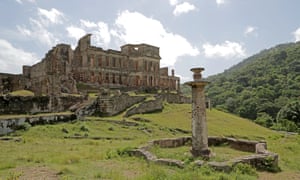
Sans-Souci Palace, the home of Haiti’s first independent ruler, near La Citadelle Laferrière. Photograph: Kevin Rushby
After our visit, Maurice and I have lunch on his patio. He’s optimistic about Haiti’s future now, and with La Citadelle, he knows Milot has a real winner. We eat fresh fruit – yes, there’s plenty of it – and he talks of Haiti’s unique culture, more strongly African than anywhere else in the Caribbean.
“Once, a government delegation came here from west Africa and we entertained them with voodoo drummers.” He laughs. “When it ended, we found the head of the group was in a deep trance.”
I’m beginning to feel a similar trance-like state coming on.
Back in Port-au-Prince, I meet up with Serge again, and ask him a question that’s been bothering me: do zombies exist? He is perfectly sure they do, but there is nothing supernatural about them. He found some when researching a film years ago. “They are people who get drugged, then buried alive and dug up at midnight. After that they are kept as drugged slaves, working in bad conditions.”
“And people are really afraid of it – being made into zombies?”
“It’s like a cultural memory of slavery, really – a fear that it could return, to you personally.”
In a few words, Serge has blown away all the nonsense that is talked about zombies, and revealed something deeper and very real. And then, a few minutes later, I’m heading into the airport to leave, and I’m thinking, I’ve barely scratched the surface here. This place deserves time, and it deserves visitors who want more than a beach.
•The trip was provided by Wild Frontiers (020-7736 3968), which offers an 11-day small-group tour to Haiti, including visits to Bassin Bleu and La Citadelle, whale- and dolphin-watching, walking in the Central Plateau, local guides and overnights in homestays, but excluding flights, from £2,450pp. The next departures are 16 March and 28 December 2016. Local excursions and tours available with Voyages Lumiere. British Airways flies from London to Punta Cana in Dominican from £303 one-way; onward flights to Port-au-Prince were provided by Sunrise Airways (US$140 one-way). Casa Sanchezhotel (double rooms from $90) is an excellent boutique hotel near the historic colonial city of Santo Domingo in Dominican Republic. Further information Experience Haiti. Transfers were provided by the Dominican Republic Tourist Board