 |
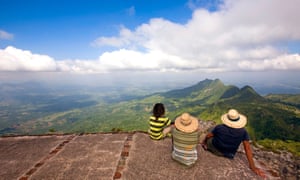
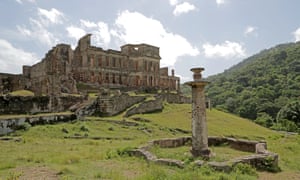
| Looking down from La Citadelle Laferrière in north Haiti. Photograph: Alamy |
Haiti was devastated by an earthquake, now hurricanes , we hope tourists will return soon – to find a raw and fascinating Caribbean country with a unique culture
How to Help: https://www.redcross.org/donate/donation
Long before I arrive in Haiti I get a sense of what the name itself conjures up. There are no direct flights from the UK, so I’ve flown in via the Dominican Republic, Haiti’s conjoined twin on the island of Hispaniola. The tourists on my flight cannot understand why anyone would risk Haiti: “I hope you survive!”; “Will you have armed guards?” and, perhaps the key question, “Why?” But tour operators like the one I’m travelling with, Wild Frontiers, feel that Haiti’s time has finally come, especially with Cuba looking more visitor-crowded and less adventurous than before. There is also a sense that responsible tourism to Haiti could put money where it is really needed.
Hispaniola is shaped like a large canine tooth extracted from the gob of Mexico and thrown into the centre of the Caribbean Sea. Haiti is the western third of it, and I’m arriving on a small plane from the east of the island, gazing out at the mountainous terrain and totting up reasons for Haiti’s unsavoury reputation. So far I’ve got deadly earthquakes, dire poverty, the brutal Tontons Macoutes, the tyrant Papa Doc Duvalier, plus, of course, the zombies – mustn’t forget the zombies. On the plus side, I scribble “fresh fruit”. Then, out of the aeroplane window, the verdure of the Dominican Republic is giving way abruptly to something eroded and bone-like. Over Port-au-Prince, the Haitian capital, we enter a pall of dust, and the plane bounces and sways before landing. I cross out fresh fruit.
It was not always this way. Expectations of this land were high when Columbus touched down in 1492, noting the extreme fertility, the abundance of food and clean water, the gold, and the handsome, happy people. “With 50 men,” he noted ominously, “we could subjugate them all and make them do whatever we wanted.” And that is what the conquistadores did, shipping in fresh workers from west Africa when the locals died. By 1660, the western third of Hispaniola was French, the other part Spanish, and in all but name, the two countries of Haiti and the Dominican Republic were established. They both had wars of independence, years of American occupation, and brutal dictators, but Dom Rep, as everyone now refers to it, somehow emerged as a place where you can buy a pizza 24 hours a day and visit shopping malls. But what about Haiti?
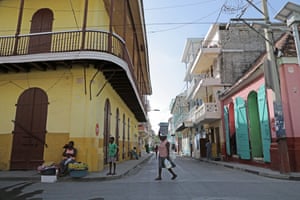
The first thing I notice in Port-au-Prince is the people: they are all out on the street. Men and women carrying their goods on their heads: bananas to sell, water, a roll of naif paintings to hang up outside a hotel. There are horses, mules and donkeys amid a tangle of good-natured, slow-moving traffic. And behind all this frenetic activity, rising above the heads, is a mixture of ruins and new buildings. It is five years since one of the most devastating earthquakes in human history razed huge areas of the city, killing up to 220,000 people. Finally, Port-au-Prince is being rebuilt, and very attractively too, judging by what’s been done already.
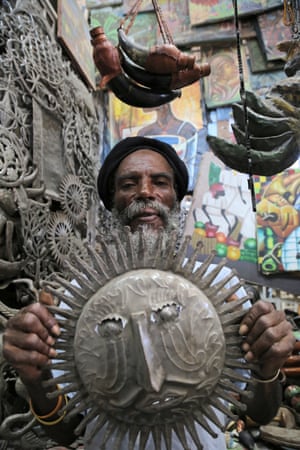
I visit the reconstructed Marché de Fer, the bustling central market, where a stately rastaman called Dominic shows me around (for $1 – this is a place where you need lots of small dollar bills). After spices, vegetables and beauty products, we enter an area selling flouncy blue dresses and sinister-looking dolls. I tackle the voodoo question head on.
“Is voodoo scary?”
Dominic chuckles gently: “No way. It’s our religion.”
He shows me some veve, intricately beaded flags that carry the symbols of certain spirits.
“This one is Ayida Weddo, the rainbow snake.”
Voodoo is a polytheistic faith that came to the island with slaves from west Africa, and took on a camouflage veneer of Roman Catholicism. Its importance to Haiti was firmly established when, in 1791, a voodoo ceremony triggered the only slave revolt which has led to the founding of a state. Ever since, the religion has prospered, often in the teeth of official disapproval. Western attitudes have sometimes been fearful, and frequently condescending: “proper” religions have gods and miracles; voodoo has spirits and mumbo jumbo. Unfortunately, Papa Doc, dictator during the 1960s, further tarnished the religion’s image by encouraging the belief that he was Baron Samedi, the spirit of the dead.
At the refurbished National Museum I get to see Papa Doc’s bowler hat, cane and evil little machine gun, plus photos of Haiti’s many other presidents. It is a wonderful little museum – from the slave torture devices to the inscribed names of early rebels (Hyacinthe and Chickenshit included); from the ostentatiously Napoleonic insignias of the first black leaders to the earlier simplicity of Taino Indian stone carvings (the Tainos were all but wiped out within a century of Columbus’s arrival). There is even an anchor that claims to be from Columbus’s ship, the Santa María, wrecked on the north coast.
After a night at the Montana Hotel, elegantly rebuilt from the ruins of the quake, I meet Serge, my local guide, who takes me to the highlands behind Port-au-Prince. He’s a fascinating character: having grown up in an orphanage, he had a successful career as a dancer, then worked as a researcher on almost every film project in Haiti for the past decade. We leave the car and walk around Wynne Farm, a project encouraging farmers to plant trees and work sustainably. Hummingbirds thrum past and we spot two nests, one with a pair of tiny chicks inside, neither of them larger than the tip of my little finger. Serge’s conversation runs through modern slavery, voodoo, cuisine, art, music and the iniquities ofMinustah, the UN stabilisation mission that still exerts a powerful influence in the country. Over the treetops we enjoy vast panoramas of green hills, heavily farmed. Haiti has a severe deforestation problem.
We head downhill, to the home of Janey Wynne, the owner of Wynne Farm, and a plant enthusiast. Her current obsession is bamboo. “It could save Haiti’s poor farmers,” she says. Some of her poor neighbours just sold a bundle of canes for US$200 – a small fortune. We drink herbal tea, eat mango cake and then tour the garden, which is magical: there’s macadamia, ginger, naranjilla, datura, and several strange fruits I’ve never seen before.
Serge finally drags me away: he wants us to visit Croix-des-Bouquets, a village on the east side of Port-au-Prince, where a tradition of metal-working has developed. As we drive, I note that Janey’s enthusiasm has worked: Serge is clutching a handful of seeds and some cuttings for his garden.
En route, we stop at an upmarket art gallery, a chance to orientate myself. Haitian art is complex and colourful, incorporating various schools and traditions, and long since “discovered” by collectors. Top names, such as Prospere Pierre-Louis, command substantial prices, but there is always the chance of finding an emerging talent.
When we reach Croix-des-Bouquets, Serge introduces me to Jacques Eugene, who makes mask-like pieces, punctured and perforated, adorned with twisted cutlery and car parts. His inspiration comes in dreams, from a voodoo spirit called Ezili Danto.
Down the road we pass dozens of workshops and shops. At one we meet Serge Jolimeau, one of the stars of Haitian art, whose work hangs all around us: huge, textured heads surging with vitality. In Jolimeau’s hands the metal becomes fluid and magical. The trouble is, once I’ve seen what I can’t afford, I don’t want the cheap stuff.
We drive north-west along the coast, stopping at simple fishing villages such as Luly, where the people are sitting in the shade, weaving fish traps. The beach is something of a curate’s egg: gorgeous pink conch shells mixed with plastic bottles in one great fascinating mess, like the country itself. At Montrouis I tour theMuseum Ogier-Fombrun, part of the delightfully laid-back Moulin-sur-Mer beach hotel. At this former French plantation, 600 slaves eked out miserable lives to help create what was France’s richest colony. Now the place is home to a superb collection of artefacts, and tranquil gardens filled with semi-tame birds.
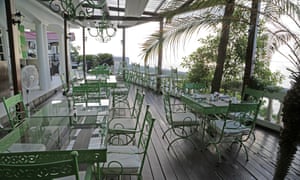
The visitors here seem to be mainly Haitian emigres from the US. The few European tourists tend to head south – to Jacmel, and a few well-kept beach resorts. Haiti, however, has a lot more to offer. Up in the north is the city of Cap Haïtien, a crumbling masterpiece of colonial-era architecture: brightly painted, well-kept houses mixed with the dilapidated and ruined. Like everywhere in Haiti, I find the people friendly but not effusive: smiles are not freely given, they have to be elicited. I stay at Habitacion Jouissant, a much-extended, shady bungalow on a patio high above the sea, where at dawn, wooden sailing boats can be spotted heading off to the Turks and Caicos Islands.
Cap Haïtien has some great markets and, nearby, good beaches and a potentially world-class attraction in La Citadelle Laferrière, an imposing fortification that sits on a high ridge above the village of Milot, where it’s worth seeking out Maurice Etienne, owner of a guesthouse-cum-cultural centre. Maurice’s great-great-grandfather was a soldier in La Citadelle, and Maurice has turned himself into an expert on the place. When I arrive, two American archaeologists are picking his brains.
Built by Haiti’s first post-slavery president, Henri Christophe, between 1805-1820, La Citadelle was both a warning to France and a bold statement that the former slaves were capable of great achievements. As the latter it was a success, but sadly the French did return, blockading the ports and demanding reparations for their lost, slave-driven businesses. Haiti capitulated, embarking on a withering series of debt repayments that would sap its strength for generations to come.
After our visit, Maurice and I have lunch on his patio. He’s optimistic about Haiti’s future now, and with La Citadelle, he knows Milot has a real winner. We eat fresh fruit – yes, there’s plenty of it – and he talks of Haiti’s unique culture, more strongly African than anywhere else in the Caribbean.
“Once, a government delegation came here from west Africa and we entertained them with voodoo drummers.” He laughs. “When it ended, we found the head of the group was in a deep trance.”
I’m beginning to feel a similar trance-like state coming on.
Back in Port-au-Prince, I meet up with Serge again, and ask him a question that’s been bothering me: do zombies exist? He is perfectly sure they do, but there is nothing supernatural about them. He found some when researching a film years ago. “They are people who get drugged, then buried alive and dug up at midnight. After that they are kept as drugged slaves, working in bad conditions.”
“And people are really afraid of it – being made into zombies?”
“It’s like a cultural memory of slavery, really – a fear that it could return, to you personally.”
In a few words, Serge has blown away all the nonsense that is talked about zombies, and revealed something deeper and very real. And then, a few minutes later, I’m heading into the airport to leave, and I’m thinking, I’ve barely scratched the surface here. This place deserves time, and it deserves visitors who want more than a beach.
• The trip was provided by Wild Frontiers (020-7736 3968), which offers an 11-day small-group tour to Haiti, including visits to Bassin Bleu and La Citadelle, whale- and dolphin-watching, walking in the Central Plateau, local guides and overnights in homestays, but excluding flights, from £2,450pp. The next departures are 16 March and 28 December 2016. Local excursions and tours available with Voyages Lumiere. British Airways flies from London to Punta Cana in Dominican from £303 one-way; onward flights to Port-au-Prince were provided by Sunrise Airways (US$140 one-way). Casa Sanchezhotel (double rooms from $90) is an excellent boutique hotel near the historic colonial city of Santo Domingo in Dominican Republic. Further information Experience Haiti. Transfers were provided by the Dominican Republic Tourist Board
By Kevin Rushby
