Showing posts with label Pandemic airline travel. Show all posts

Tuesday, August 18, 2020

Virus Pandemic Reshaping Air Travel As Carriers Struggle

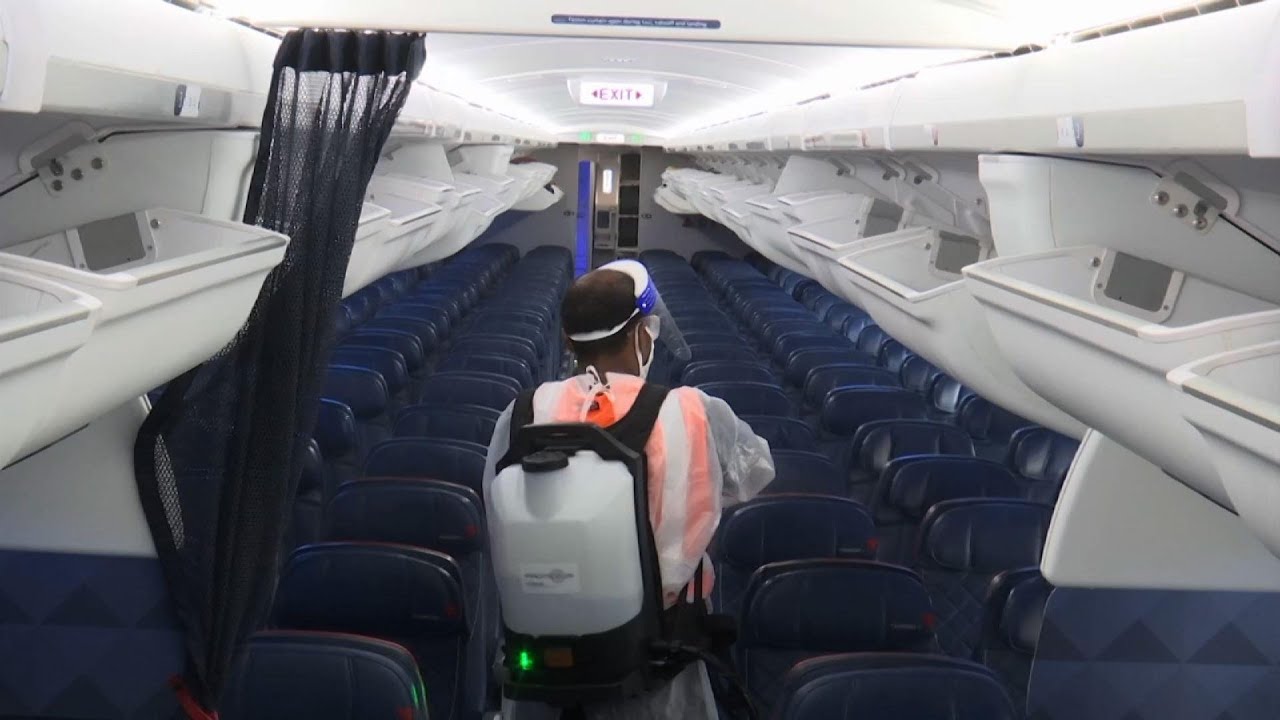
Melaku Gebermariam uses an electrostatic sprayer to disinfect the inside of a Delta Airplane between flights on July 22, at the Ronald Reagan Washington National Airport in Arlington, Va. U.S. airlines have scrambled to reassure travelers that planes are safe. They require passengers to wear face masks and are cleaning cabins more thoroughly, even spraying seats with anti-microbial mist. (AP Photo/Nathan Ellgren)

In a bid to survive, airlines are desperately trying to convince a wary public that measures like mandatory face masks and hospital-grade air filters make sitting in a plane safer than many other indoor settings during the coronavirus pandemic.
It isn’t working.
Surveys indicate that instead of growing comfortable with air travel, more people are becoming skeptical about it. In the United States, airline bookings have stalled in the past month after slowly rising — a reaction to a new surge of reported virus infections.
Globally, air travel is down more than 85% from a year ago, according to industry figures.
The implications for the airline industry are grave. Several leading carriers already have filed for bankruptcy protection, and if the hoped-for recovery is delayed much longer, the list will grow.
The four largest U.S. airlines lost a combined $10 billion from April through June. Their CEOs say they will survive, but they have lowered their expectations for a rebound.
“We were all hoping that by the fall the virus might run its course,” said Southwest Airlines CEO Gary Kelly. “Obviously, that has proven to be dead wrong.”
When Consumer Reports surveyed more than 1,000 people in June about their comfort with various activities during the pandemic, 70% said flying was very or somewhat unsafe. They rated going to a hospital emergency room or standing in line to vote as safer.
Youtube video thumbnail
In a survey commissioned by an airline trade group, the biggest concern of travelers was the possibility of sitting next to an infected person.
John Kontak, a schoolteacher from Phoenix, said that was his fear as soon as he stepped onto a crowded American Airlines flight this summer to visit his parents in Ohio.
“I don’t know anything about this person who is sitting a foot away from me,” Kontak said. “They took the bottom line or the dollar over the safety of passengers. Next time, I’d rather drive back to Ohio than fly — it’s safer because I can control it.”
The U.S. Centers for Disease Control and Prevention says sitting within 6 feet (2 meters) of other passengers, often for hours, may increase the risk of getting COVID-19. But CDC also notes that most viruses and other germs don’t spread easily on flights because of how air circulates on planes.
Standard & Poor’s said this week that the industry’s prospects have gone “from bad to worse,” with global air traffic dropping by up to 70% this year. In May, S&P said a 55% drop was a worst-case scenario.
“It’s going to be a slower and more uneven recovery than one might have expected,” S&P analyst Philip Baggaley said.
An airline trade group, the International Air Transport Association, predicts carriers will lose $84 billion this year, making it the worst year in the industry’s history. The group says traffic won’t fully recover until 2024.
Asia, where outbreaks were brought under control earlier, is doing better than the U.S. and Europe. Domestic travel inside China has recovered to about two-thirds its year-ago level. In the U.S., traffic is less than one-third of 2019 levels.
Air traffic at Europe’s more than 500 airports has tumbled, down 94% in June compared with the same month last year. There were about 4 million passengers, compared with 217 million a year earlier.
Travel ticked up when more than two dozen European countries opened borders to one another in early July, but virus cases are rising in several countries, leading to reimposed restrictions. This week, the U.K. imposed a 14-day quarantine requirement on travelers — even Britons returning home — from France and the Netherlands. Travel from outside Europe, including the United States, is still restricted.
In the United States, traffic picked up after collapsing by 95% in April but has stalled — down 74% in July, 72% in August.
Airlines came into this crisis in the best shape ever financially, thanks to rising demand for travel, reduced competition through mergers, and billions raised by extra fees.
Among international carriers, the big state-backed airlines are almost certain to survive. In Asia and the Middle East, they are often seen as vital contributors to the overall economy. Similarly, big European carriers including Lufthansa, Air France-KLM and British Airways may be too important to let fail.
It’s too late for U.K.-based Flybe; it shut down in March. Latin America’s two biggest airlines, Avianca and Latam, filed for bankruptcy protection. So did Aeromexico. Virgin Atlantic and Virgin Australia, both part of British mogul Richard Branson’s galaxy of companies, are using the courts to reset debts.
In the U.S., Trans States and Compass, which flew smaller planes for the major airlines, and Alaska-based Ravn Air shut down, but the big airlines have survived with billions in government aid and billions more in private borrowing.
U.S. airlines have scrambled to reassure travelers that planes are safe. They require passengers to wear face masks and are cleaning cabins more thoroughly, even spraying seats with anti-microbial mist.
“You can smell the cleaning fog that’s been done, and everything is wiped down basically top to bottom – chairs, window shades, even the light switches and overhead bins,” said Jason Bounds, a veteran flight attendant at Delta Air Lines.
The airlines split in one regard. Delta, Southwest, JetBlue and Alaska leave some seats empty to create room between passengers. United, American and Spirit do not, arguing that social distancing is impossible on a plane.
Most flights have plenty of empty seats, but scenes of full planes alarm travelers.
Carol Braddick, a business coach and consultant who splits her time between Phoenix and England, was so worried about the American Airlines leg of her journey to the U.K. that she sought out a COVID-19 test after arriving.
“The person I was sitting next to was drinking nonstop, shouting to his friend a row behind him; they were shouting back and forth,” Braddick said. “The combination of alcohol, shouting and no mask is unacceptable, and the flight attendant did nothing.”
Braddick put off plans for a couple of short holiday trips within Europe this summer.
“The new reality for us is fewer trips, longer stays, and being much more selective about which airline we’ll fly,” she said.
Even frequent flyers like Seth Miller, who writes about travel at his PaxEx.aero website, are grounding themselves.
“Much as I love and miss travel, it just doesn’t seem worth the risk to me,” he said.
By DAVID KOENIG and DAVID McHUGH___
Nathan Ellgren in Washington, D.C., contributed to this report.
___
David Koenig can be reached at www.twitter.com/airlinewriter.
@TraveloreReport on Twitter

Saturday, August 8, 2020

Travelore Opinion: The Odds Of Catching Covid On A Flight Are Slim

Planes have not been the sites of superspreading events, at least so far.

Tray tables up.
 
Photographer: Andrew Matthews/PA Images
If you decide to fly, the odds that you will pick up Covid-19 are low, according to one expert analysis. Despite the known dangers of crowded, enclosed spaces, planes have not been the sites of so-called superspreading events, at least so far.
That’s not to say flying is perfectly safe — safety is relative and subjective. But as restrictions continue to change, the only way to move forward through this long pandemic is to start thinking in terms of risk-benefit ratios. Very little is without risk, but perhaps some risks — such as flying — are small enough to warrant taking.
Arnold Barnett, a professor of management science at the Massachusetts Institute of Technology, has been trying to quantify the odds of catching Covid-19 from flying. He’s factored in a bunch of variables, including the odds of being seated near someone in the infectious stage of the disease, and the odds that the protection of masks (now required on most flights) will fail. He’s accounted for the way air is constantly renewed in airplane cabins, which experts say makes it very unlikely you’ll contract the disease from people who aren’t in your immediate vicinity — your row, or, to a lesser extent, the person across the aisle, the people ahead of you or the people behind you.
What Barnett came up with was that we have about a 1/4300 chance of getting Covid-19 on a full 2-hour flight — that is, about 1 in 4300 passengers will pick up the virus, on average. The odds of getting the virus are about half that, 1/7700, if airlines leave the middle seat empty. He’s posted his results as a not-yet-peer-reviewed preprint.
The odds of dying of a case contracted in flight, he found, are even lower — between 1 in 400,000 and 1 in 600,000 — depending on your age and other risk factors. To put that in perspective, those odds are comparable to the average risk of getting a fatal case in a typical two hours on the ground.
The numbers all sound low enough, though Barnett says they are still high compared to the 1 in 34 million odds your flight will end in a deadly crash. He told me he wouldn’t fly right now because his age, 72, puts him at higher risk than the average American, and he says you have to consider the risk of adding to the problem by getting the virus and unknowingly passing it on to

The Chances Of Getting Covid-19 on a Plane is Slim

Arnold Barnett estimates that you have a 1/4300 chance of picking up the virus on a full, 2-hour flight
Source: Covid-19 Risk Among Airline Passengers, medRxiv, 2020
Other experts have been mixed on whether they, personally, would fly. The Boston Globe recently reported that of 15 epidemiologists and infectious disease experts surveyed, 13 said they would not fly at this time — however it wasn’t clear whether they had any reason to get on a plane.
University of Massachusetts biology professor Erin Bromage says he is flying every week, as he advises federal, state and district courts on how to reopen while minimizing risks. Whereas many experts are taking a zero-tolerance for risk approach, he’s trying to find a middle ground — and helping others do it in a rational way.
Drawing on a background in industrial mechanics and pilot training (an injury forced him to switch career paths into biology), Bromage says that the air exchange system in planes is better than in hospitals, with the air in the cabin being completely replaced 30 times every hour. He agrees with MIT’s Barnett, though, that it’s possible to transmit the disease to or from your close neighbors.
He and Barnett both suggested that customers should, if possible, choose an airline, such as Jet Blue, that promises to keep the middle seat open. That cuts way back on the odds of getting or giving the virus. JetBlue also promises that solo travelers won’t have a neighbor in a two-seat row.
Real-world data bodes well for flying, too. Australia has been using contact tracing to investigate Covid transmission on hundreds of flights, and has found that while infected people got on planes, nobody got infected on a plane. Worldwide, there have been a couple of individual transmissions possibly linked to flights, but no superspreading-type events.
Assuming we’ll be living with this disease for months to come, we will need ways to separate low-risk activities from high-risk ones. Keeping informed of relative risks can help us do that. By worrying less about the relatively safer part of a trip — the actual flight — we can pay more attention to the potentially riskier parts, such as crowds and tightly packed lines at the airport.
Of course, we’re all obligated to avoid adding to the spread of the disease, and this means taking precautions in the air, such as wearing a mask and staying home if sick, and keeping a distance from others at the airport. 
What happens at your destination matters too. Traveling around and mingling with distant contacts can increase the risk of spreading the virus more than mingling with a comparable number of people closer to home. So people can help themselves and others by driving their own cars to the airport and renting cars wherever they arrive, rather than taking taxis or ride-shares.
In the old normal, Bromage would wrap up his advisory duties and have dinner with the people he’s working with. Now, he just goes back to his hotel room. “It’s quite lonely,” he says. Like so much this year, it’s a compromise.
    This column does not necessarily reflect the opinion of the editorial board or Bloomberg LP and its owners.
    To contact the author of this story:
    Faye Flam at fflam1@bloomberg.net
    To contact the editor responsible for this story:
    Nicole Torres at ntorres51@bloomberg.net

    Tuesday, July 28, 2020

    Star Alliance And Its Member Airlines Helping Consumers Navigate The Ever-Changing International Travel Landscape During Covid-19


    Star Alliance Travel Information Hub offers greatly expanded utility

    FRANKFURT, Germany  – Building upon the successful launch of its Travel Information Hub at the end of June, Star Alliance, the world’s largest global airline alliance, has unveiled a series of useful upgrades to now help passengers plan multi-stop itineraries.

    Star Alliance Travel Information Hub
    This unique alliance service was created by Star Alliance and its member airlines to help customers navigate the ever-changing international travel landscape that has resulted from measures taken by governments, regulators, and other stakeholders to help contain the spread of COVID-19. The tool provides information on specific health and hygiene measures presented across all elements of the customer journey.

    Key Features
    In its most recent iteration, the Star Alliance Travel Information Hub provides customers travelling with Star Alliance member airlines a broader and more personalized user experience. Customers may now: 

    1. Enter two-segment journey details (two airlines, three airports)
    • Previously allowing only a query of a single airport, and a single airline, the Travel Information Hub now permits the user to configure a complete itinerary, including the origin airport, a transfer point, and a connecting airline.
    • Country information, both at origin and destination, previously a separate search query, is now integrated into a customer-friendly visual representation of the entire journey.
    2. Utilize the Travel Information Hub in four additional languages
    • In addition to English, customers can use the website tool in Chinese (Simplified), French, German and Spanish, though query results will be returned to the user in the language offered by the source data.
    ​​​​​​​3. Avail themselves of an email function to share their findings with others
    • This is a particularly helpful feature for friends, colleagues and travel professionals to assist customers by researching on their behalf.
    ​​​​​​​
    "The Star Alliance Travel Information Hub initiative grew out of the need to reduce complexity in air travel in these times of COVID-19," says Christian Draeger, VP Customer Experience of the Alliance. "It combines the input of all 26 of our member airlines, and the many key airports in our global network, to provide our customers specific health and hygiene safety guidance for an ever-expanding array of destinations and transfer points."

    More features, and more airports are being added continuously, with the Alliance pledged to continue to offer the most digitally advanced premium travel experience to customers wherever they may be.

    With the aviation industry facing the greatest challenge in its history, Star Alliance and its member airlines continue their work with other travel industry stakeholders to help make travel more accessible and to help restore and maintain confidence in air travel, once again connecting people and cultures.
    #WeWillReconnect
    #FlyWithConfidence


    The Star Alliance network was established in 1997 as the first truly global airline alliance to offer worldwide reach, recognition and seamless service to the international traveller. Its acceptance by the market has been recognized by numerous awards, including the Air Transport World Market Leadership Award and Best Airline Alliance by both Business Traveller Magazine and Skytrax. The member airlines are: Aegean Airlines, Air Canada, Air China, Air India, Air New Zealand, ANA, Asiana Airlines, Austrian, Avianca, Brussels Airlines, Copa Airlines, Croatia Airlines, EGYPTAIR, Ethiopian Airlines, EVA Air, LOT Polish Airlines, Lufthansa, Scandinavian Airlines, Shenzhen Airlines, Singapore Airlines, South African Airways, SWISS, TAP Air Portugal, THAI, Turkish Airlines, and United. The Star Alliance network offers more than 19,000 daily flights to more than 1,300 airports in 195 countries. Further connecting flights are offered by Star Alliance Connecting Partner, Juneyao Airlines and Thai Smile Airways.