
Showing posts with label Travel during the coronavirus. Show all posts
Showing posts with label Travel during the coronavirus. Show all posts
Friday, October 16, 2020
Europe, US Reel As Virus Infections Surge At Record Pace

Thursday, October 15, 2020
London Faces New Restrictions As City Sees Higher Virus Risk

Saturday, September 12, 2020
The Latest Travel Updates From The Frankfurt-Rhine Main Region Of Germany Including First “Safe From Covid-19” Airport And A New Hotel On The Rhine

First “Safe from Covid-19” airport, a new hotel on the Rhine and more news from Germany. Dream your way to Europe!

With the advent of autumn comes new hope for the time ahead – hope that we will soon be able to welcome international guests with our arms wide open. Until then, let’s dream on! However, when the time comes, FrankfurtRhineMain region is a great way to start any trip to Europe. TÜV Hessen, the technical inspection services association of the state of Hesse, recently awarded Frankfurt International Airport the “Safe from Covid-19” quality seal, the first German airport to receive it. Read more about this and the brand-new visitor center at the airport. This press release will also tell you all about a new hotel on the Rhine, the latest exhibitions, intense flavors due to volcanic soils, and highlights, virtual offers and detailed travel suggestions in this unique area in Germany. Let your readers know about all these opportunities when travel is again permitted, and let them dream their way right to the heart of Germany!
The first official “Safe from Covid-19” airport in Germany
Frankfurt International Airport is one of the major gateways to Germany and all of Europe. The importance of this airport for international travel is undisputed. We are proud to announce that Frankfurt International Airport is the very first German airport to receive the “Safe from Covid-19” quality seal from TÜV Hessen, the technical inspection services association of the state of Hesse, which is valid for six months. This means that the airport has rigorously implemented government guidelines for safe travel (safety and hygiene guidelines) and passed all official tests and checks conducted by the association. It has its own medical center and special Covid-19 testing stations, and will be opening a brand new visitor center in Terminal 1 (between areas B and C) at the end of the year. Read more about the latest developments at Frankfurt International Airport here.
Frankfurt awarded quality seal for accessible travel
Frankfurt is the first city in the Hessen region and only the fifth in Germany to receive the all-important “Travel for All” quality seal for accessible travel. More than 20 tourist facilities (hotels, museums, restaurants and more) have been verified as excellent facilities for disabled visitors. This has been a major project for the city over many years, and will continue to be central when it comes to future developments. The “Barrier-free Frankfurt” brochure contains important information about accessible tourist amenities, including details like door width, the location of public toilets for wheelchair users and so on. The brochure is available for download here.
The Sound of Disney – a new exhibition in Frankfurt
Wallow in childhood memories of great animations, particularly those of Walt Disney, that will take you back to magical times. “The Sound of Disney”, a special exhibition at the DFF (the Deutsches Filminstitut & Filmmuseum, an international film heritage organization) revolves around the sounds of classic Disney animated films between 1928 and 1967. Walt Disney (1901–1966) was a perfectionist. His masterpieces produced while he was still alive include Snow White and the Seven Dwarfs (US 1937) and The Jungle Book (US 1967). Not only is he renowned for these and the invention of Mickey Mouse, but also for his unique fusion of sound and film. The exhibition, which opened on August 7 and can be visited until January 10, 2021, highlights this, providing an interactive experience that makes the meaning of voice, music and sound in animated films understandable to everyone. It delivers a cross section of the artistic work of Walt Disney’s studio, inviting you to reminisce and “Forget about your worries and your strife”.
The Jewish Museum Frankfurt is reopening
It is near impossible to visit Frankfurt and not stumble upon a museum, the city being one of the major museum locations in Germany. The Jewish Museum, a veritable jewel in Frankfurt’s crown, has been refurbished and is now approaching its reopening on October 21, 2020. “Frankfurt's Jewish history since 1800”, a new permanent exhibition opening in the Rothschild-Palais, a historic residential house, is spread over an area of approximately 1,500 square meters on three floors. Each floor will present a different perspective of Jewish history and culture. The location is well chosen: Frankfurt is one of the centers of Jewish culture in Europe. The exhibition recounts how Jews influenced the city’s cultural, economic and social development, and also focuses on Jewish experiences of discrimination and violence, featuring Anne Frank and displaying family artifacts and documents for the first time. This interactive museum is a must when visiting Frankfurt.
Papa Rhein – a new hotel and spa in Bingen am Rhein
What could be more romantic than visiting a city that sprawls along the Rhine, one of the longest rivers in Central and Western Europe? Regarded as the gateway to the “Upper Middle Rhine Valley” UNESCO World Heritage Site,  Bingen is situated at the intersection of four winegrowing areas. The Papa Rhein, a hotel that had its soft opening on July 31 and will have its much-awaited grand opening on September 15, presents a whole new take on accommodation: The rooms are inspired by the Rhine, river life and ports, and the history of the Middle Rhine Valley; range from a cozy bunk to amazing suites; and boast views of the river, the surrounding vineyards and the nearby “Niederwalddenkmal”, a monument commemorating the founding of the German Empire following the Franco-Prussian War. There’s nothing better than relaxing in the spa or watching a spectacular sunset from the rooftop lounge. But the Papa Rhein offers much more, so be sure to visit its website (German only).
Exceptional flavors in the Vogelsberg
Who would have thought that anything growing in the volcanic soils of the Vogelsberg in Central Hesse could have more intense and tangy flavors! This is all due to the erosion of basalt. The first season of “Der Vulkan kocht” (literally: the volcano cooks), a new culinary experience based on regional specialties including game, lamb, potatoes and apples, runs from September 1 to November 8, 2020. The second season, which features strawberries, lamb and trout, is planned for spring 2021. It will be exciting to see what the 17 participating catering establishments will create from the seasonal, sustainable, regional and animal-friendly products. What we do know is that it will be an unforgettable and highly enjoyable experience. To read more about the event in the Vogelsberg region, be sure to visit its website (German only).
The best of art nouveau at Museum Wiesbaden
The beautiful city of Wiesbaden lies on the banks of the Rhine and borders the famous Rheingau region. Museum Wiesbaden, an art and natural history museum, has been home to one of the most significant European private collections of art nouveau and symbolism since June 29, 2019. The Ferdinand Wolfgang Neess collection was donated to the museum on March 23, 2017, transforming it into one of the most important centers for art nouveau in Germany. The international collection comprises some 700 German, French and Austrian works of art including furniture, glass, ceramics, lamps and paintings of exceptional quality, attracting both history lovers and people who would like to simply broaden their horizons. If you would like to find out what else you could do in this city and all it has to offer, click here to watch “That’s why we love it” and, perhaps, fall in love with Wiesbaden yourself.
The current coronavirus situation and traveling safely in Germany
We have put together a few sources for you to keep updated on the current coronavirus situation in Germany and how to travel as safely as possible. The latest updates on the COVID-19 pandemic in Germany, include daily reports and recommendations, are available on the Robert Koch Institute website. To read more about how Frankfurt International Airport is dealing with the pandemic and what to consider when flying, please click here to visit the airport’s website. Exploring the region by train is easy and practical: Please visit the Deutsche Bahn website for more information and guidelines for safe rail travel.
Thursday, September 3, 2020
Travelore News: Cuba Closes Off Havana To Stamp Out Spread Of Coronavirus
 |
| A street vendor wearing a mask as a precaution against the spread of the new coronavirus pushes his cart down a street in Havana, Cuba, Monday, Aug. 31, 2020. Cuban authorities will introduce new measures starting tomorrow Tuesday aimed at containing the spread of the coronavirus in Havana among others a curfew from 7 pm until 5 am and no one without special permission will be able to enter or leave the province. The new measures will last at least 15 days. (AP Photo/Ramon Espinosa) |
HAVANA (AP) — Cuban authorities ordered a strict 15-day lockdown of Havana on Tuesday seeking to stamp out the low-level but persistent spread of the novel coronavirus in the capital.
Aggressive anti-virus measures including closing down air travel have virtually eliminated COVID-19 in Cuba with the exception of Havana, where cases have surged from a handful a day to dozens daily over the last month.
Starting September 2nd, Havana is under a 7 p.m. to 5 a.m. curfew. Most stores are barred from selling to shoppers from outside the immediate neighborhood in order to discourage people from moving around the city.
Some Havana residents complained that the measures were complicating the already difficult task of buying food in a city stricken by constant shortages and endless lines for a limited supply of basic goods.
“It’s a good cause, getting rid of all of this (coronavirus), but in the end they aren’t going to get rid of the lines,″ said Josuel Suárez, a 26-year-old engineer. “The situation is already difficult, and on top of that these restrictive measures, and people have to eat, to resolve their problems.″
Others welcomed the tighter control.
“Many people don’t pay attention to medical advice. This is how we’re going to resolve this situation, which isn’t easy,″ said Rosa Rojas, an 80-year-old homemaker. ’’I go out because I need to, but there are people in the street with no reason, drinking rum and hanging out in parks without a face mask.″
Police stationed on every road leaving Havana are supposed to stop everyone who doesn’t have a special permit to travel, meant to be issued only in extraordinary circumstances. Some provinces that saw no new cases for weeks have begun detecting them in recent days, often linked to travelers from Havana.
The start of in-person classes was also indefinitely delayed in Havana, even as schools open normally in the rest of Cuba.
The island of 11 million people has reported slightly more than 4,000 confirmed coronavirus cases, with fewer than 100 deaths, one of the lowest rates in the region during the pandemic.
The government made face masks obligatory in the early stages of its pandemic response and in the first months of the crisis police aggressively fined and even jailed people for violations.
That stance slackened somewhat as Havana moved out of the first, strictest phase of lockdown in July, public transportation restarted and people returned to work. Cases began to climb, and the capital province returned to phase zero last month.
But the measures failed to brake the rise of coronavirus infections, as authorities bemoaned widespread violations of requirements including wearing face masks, avoiding large gatherings and maintaining social distance.
The government announced last week that for at least 15 days the capital would be placed under the strictest measures to date. They include fines of up to $125 per violation, more than triple the average monthly wage.
“We are going to demand people follow the rules with a lot of rigor so that our country sees the results it deserves,″ Dr. Francisco Durán, the country’s head of epidemiology, said Tuesday morning.
A
Wednesday, September 2, 2020
Uber To Require That Passengers Provide Face-Mask Selfies

SAN FRANCISCO (AP) — Mask slackers will now have to provide photographic proof they’re wearing a face covering before boarding an Uber.
The San Francisco-based company unveiled a new policy Tuesday stipulating that if a driver reports to Uber that a rider wasn’t wearing a mask, the rider will have to provide Uber with a selfie with one strapped on the next time they summon a car on the world’s largest ride-hailing service.
The requirement will roll out in the U.S. and Canada later this month before coming to other parts of the world.
The additional safety measures are part of Uber’s ongoing efforts to rebuild a service that has seen ridership plunge this year. People have been seeking to minimize the chances of becoming sick and and also have had fewer reasons to go anywhere, with offices, bars, restaurants and nightclubs closed through much of the U.S. and other parts of the world.
The adverse conditions caused the number of trips on Uber during its most recent quarter to plunge by 56% from the previous year.
The mask verification rule expands upon a similar requirement that Uber imposed on its drivers in May to help reassure passengers worried about being exposed to the novel coronavirus that has upended society. Now, Uber believes it’s time to help make its drivers feel safer, too.
Tuesday, August 25, 2020
Six Philadelphia Hotels Offering Free Nights And Discounted Rates Perfect for Long Weekends & Mid-Week Escapes To Recharge, Reconnect, Disconnect And Celebrate
PHILADELPHIA – Philadelphia hotels are offering free nights and discounted rates to help locals and visitors explore the region safely and responsibly once again. Those looking to recharge, reconnect, disconnect and celebrate have plenty of options to do just that at several popular Center City hotels. These deals are perfect for enjoying the city as major attractions reopen and indoor dining in Philadelphia returns on September 8th (Reservations are suggested for dining and cultural activities). Take a look at six enticing offers available right now:
Package Name: Suite Life
 Hotel: Four Seasons Philadelphia Hotel at Comcast Center
Package Overview: Guests who book a suite 14 days in advance enjoy 20% off their stay.
Available: Through December 30, 2020
Book: fourseasons.com/philadelphia

Package Name: Half-off Offer
Hotel: Renaissance Philadelphia Downtown
Package Overview: Those who book one night, get a second night at 50% off.
Available: Through December 30, 2020
Hotel: Renaissance Philadelphia Downtown
Package Overview: Those who book one night, get a second night at 50% off.
Available: Through December 30, 2020
Book: marriott.com

Package Name: Half-off Offer
Hotel: Marriott Philadelphia Old City
Package Overview: Book one night, get a second night at 50% off.
Available: Through December 30, 2020
Hotel: Marriott Philadelphia Old City
Package Overview: Book one night, get a second night at 50% off.
Available: Through December 30, 2020
Book: marriott.com

Package Name: More Space for Less
Hotel: Loews Philadelphia Hotel
Package Overview: This deal offers a second room (of equal or lesser value) at 50% off.
Available: Through December 31, 2020
Book: loewshotels.com/philadelphia-hotel
Hotel: Loews Philadelphia Hotel
Package Overview: This deal offers a second room (of equal or lesser value) at 50% off.
Available: Through December 31, 2020
Book: loewshotels.com/philadelphia-hotel

Package Name: Stay Close
Hotel: Sofitel Philadelphia Rittenhouse Square
Package Overview: Visitors who stay one night get a second night free. Those who stay two nights, get two nights free. And on and on.
Available: Through 2020
Book: sofitel-philadelphia.com
Hotel: Sofitel Philadelphia Rittenhouse Square
Package Overview: Visitors who stay one night get a second night free. Those who stay two nights, get two nights free. And on and on.
Available: Through 2020
Book: sofitel-philadelphia.com

Package Name: Rediscover Philadelphia
Hotel: The Study at University City
Package Overview: Guests who book two nights score a third night free, plus free parking.
Available: Through March 31, 2021
Book: thestudy@universitycity.com
Hotel: The Study at University City
Package Overview: Guests who book two nights score a third night free, plus free parking.
Available: Through March 31, 2021
Book: thestudy@universitycity.com
About VISIT PHILADELPHIA:
VISIT PHILADELPHIA is our name and our mission. As the region’s official tourism marketing agency, we build Greater Philadelphia’s image, drive visitation and boost the economy.
On Greater Philadelphia’s official visitor website and blog, visitphilly.com and uwishunu.com, visitors can explore things to do, upcoming events, themed itineraries and hotel packages. Compelling photography and videos, interactive maps and detailed visitor information make the sites effective trip-planning tools. Along with Visit Philly social media channels, the online platforms communicate directly with consumers. Travelers can also call and stop into the Independence Visitor Center for additional information and tickets. 6th & Market Streets, (800) 537-7676
Monday, August 24, 2020
Explore Fairbanks Announces The Arrival Of Aurora Season

Since natural phenomena are unscathed by viruses, locals are still chasing the aurora and have developed ways to safely assist visitors in this pursuit. Find five brand new real time and time lapse aurora videos on the Explore Fairbanks website and virtually engage in northern lights viewing or embark on a trip to Fairbanks following current travel restrictions and travel responsibly protocols and make all your aurora viewing wishes come true.
FAIRBANKS, Ala. Fairbanks' world-famous northern lights lure aurora chasers from around the world. Such is the case with University of Alaska Fairbanks (UAF) physics student Andy Witteman. Andy is so passionate about the aurora that he lives to study, photograph and chase the northern lights. When he discovered UAF's Geophysical Institute was the foremost research center for auroral studies in North America he knew that Fairbanks, Alaska, was where he wanted to follow his dreams. This Aurora Season we are partnering with Andy to showcase a few of his brilliant real time and time lapse aurora videos for those who choose to armchair travel until the time is right. Andy says, "For anyone with an adventurous spirit, the northern lights can become an obsession bringing you to the edges of the world! Big auroras can happen on nights which are seemingly quiet, and cloudy nights can break up just enough to let the purples and greens rain down from the stars!" View Andy Witteman's five brand new videos on the Explore Fairbanks website.
Explore Fairbanks has built the Aurora Tracker to assist visiting aurora chasers. The Aurora Tracker correlates three individual streams of data to predict northern lights viewing opportunities for six locations in the Fairbanks region. Data streams include: aurora forecast data from the Geophysical Institute, weather forecast data for specific northern lights viewing locations and the amount of daylight hours. The aurora will be visible in Fairbanks an average of four out of five nights when the sky is clear and dark enough. Visitors who stay a minimum of three nights and are actively out during the late evening hours increase their chance of seeing the aurora to more than 90 percent.
Spanning all four seasons and nine months of the year Aurora Season, August 21 through April 21, has arrived. Due to the fact that natural phenomena are unscathed by viruses, locals are out chasing the aurora and have developed ways to safely assist visitors in this pursuit. Whether you want to virtually engage in northern lights viewing or you want to plan to see them in person, Explore Fairbanks is at your service. On Explore Fairbanks website you will find a current downloadable PDF list of local accommodations, attractions and tours as well as eating and drinking establishments that are "Open for Business."
As you make your travel plans to Fairbanks, find up-to-date information about Alaska's COVID-19 travel restrictions, including testing requirements, pinned to the top of Explore Fairbanks home page. With careful planning and precautions, including mask wearing, social distancing and hand sanitation, we invite you to come "Explore Fairbanks Responsibly" and make your aurora viewing wishes come true.
Find out about the above and more at http://www.explorefairbanks.com. For specific questions, email info@explorefairbanks.com.
About Explore Fairbanks
Explore Fairbanks is a non-profit marketing and management organization whose mission is to be an economic driver in the Fairbanks region by marketing to potential visitors and optimizing the visitor experience. Explore Fairbanks markets Fairbanks as a year-round destination by promoting local events, attractions and activities to independent travelers, group tour operators, travel agents, meeting planners and the media as well as by developing public policy and infrastructure to achieve marketing objectives. Explore Fairbanks encourages travelers to "Explore Fairbanks Responsibly." Find out more at explorefairbanks.com.
Explore Fairbanks is a non-profit marketing and management organization whose mission is to be an economic driver in the Fairbanks region by marketing to potential visitors and optimizing the visitor experience. Explore Fairbanks markets Fairbanks as a year-round destination by promoting local events, attractions and activities to independent travelers, group tour operators, travel agents, meeting planners and the media as well as by developing public policy and infrastructure to achieve marketing objectives. Explore Fairbanks encourages travelers to "Explore Fairbanks Responsibly." Find out more at explorefairbanks.com.
SOURCE Explore Fairbanks
Tuesday, August 18, 2020
Virus Pandemic Reshaping Air Travel As Carriers Struggle
 |
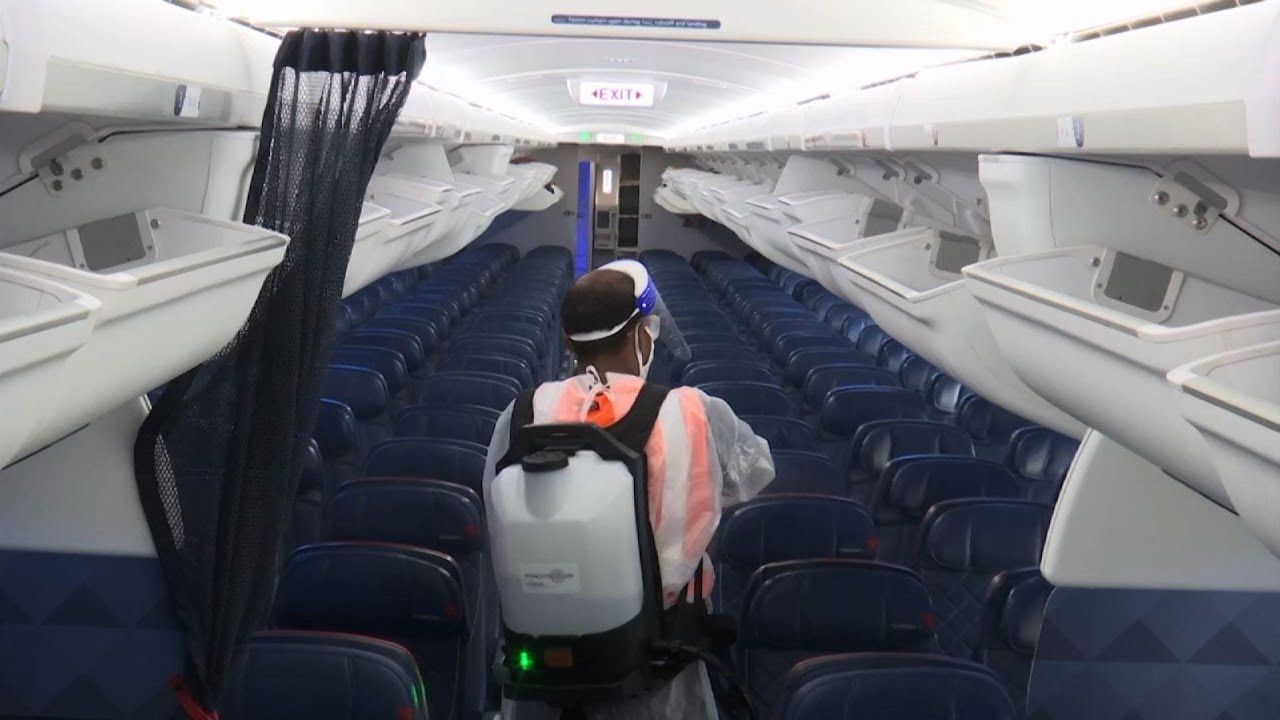
| Melaku Gebermariam uses an electrostatic sprayer to disinfect the inside of a Delta Airplane between flights on July 22, at the Ronald Reagan Washington National Airport in Arlington, Va. U.S. airlines have scrambled to reassure travelers that planes are safe. They require passengers to wear face masks and are cleaning cabins more thoroughly, even spraying seats with anti-microbial mist. (AP Photo/Nathan Ellgren) |
In a bid to survive, airlines are desperately trying to convince a wary public that measures like mandatory face masks and hospital-grade air filters make sitting in a plane safer than many other indoor settings during the coronavirus pandemic.
It isn’t working.
Surveys indicate that instead of growing comfortable with air travel, more people are becoming skeptical about it. In the United States, airline bookings have stalled in the past month after slowly rising — a reaction to a new surge of reported virus infections.
Globally, air travel is down more than 85% from a year ago, according to industry figures.
The implications for the airline industry are grave. Several leading carriers already have filed for bankruptcy protection, and if the hoped-for recovery is delayed much longer, the list will grow.
The four largest U.S. airlines lost a combined $10 billion from April through June. Their CEOs say they will survive, but they have lowered their expectations for a rebound.
“We were all hoping that by the fall the virus might run its course,” said Southwest Airlines CEO Gary Kelly. “Obviously, that has proven to be dead wrong.”
When Consumer Reports surveyed more than 1,000 people in June about their comfort with various activities during the pandemic, 70% said flying was very or somewhat unsafe. They rated going to a hospital emergency room or standing in line to vote as safer.

In a survey commissioned by an airline trade group, the biggest concern of travelers was the possibility of sitting next to an infected person.
John Kontak, a schoolteacher from Phoenix, said that was his fear as soon as he stepped onto a crowded American Airlines flight this summer to visit his parents in Ohio.
“I don’t know anything about this person who is sitting a foot away from me,” Kontak said. “They took the bottom line or the dollar over the safety of passengers. Next time, I’d rather drive back to Ohio than fly — it’s safer because I can control it.”
The U.S. Centers for Disease Control and Prevention says sitting within 6 feet (2 meters) of other passengers, often for hours, may increase the risk of getting COVID-19. But CDC also notes that most viruses and other germs don’t spread easily on flights because of how air circulates on planes.
Standard & Poor’s said this week that the industry’s prospects have gone “from bad to worse,” with global air traffic dropping by up to 70% this year. In May, S&P said a 55% drop was a worst-case scenario.
“It’s going to be a slower and more uneven recovery than one might have expected,” S&P analyst Philip Baggaley said.
An airline trade group, the International Air Transport Association, predicts carriers will lose $84 billion this year, making it the worst year in the industry’s history. The group says traffic won’t fully recover until 2024.
Full Coverage: Virus Outbreak
Asia, where outbreaks were brought under control earlier, is doing better than the U.S. and Europe. Domestic travel inside China has recovered to about two-thirds its year-ago level. In the U.S., traffic is less than one-third of 2019 levels.
Air traffic at Europe’s more than 500 airports has tumbled, down 94% in June compared with the same month last year. There were about 4 million passengers, compared with 217 million a year earlier.
Travel ticked up when more than two dozen European countries opened borders to one another in early July, but virus cases are rising in several countries, leading to reimposed restrictions. This week, the U.K. imposed a 14-day quarantine requirement on travelers — even Britons returning home — from France and the Netherlands. Travel from outside Europe, including the United States, is still restricted.
In the United States, traffic picked up after collapsing by 95% in April but has stalled — down 74% in July, 72% in August.
Airlines came into this crisis in the best shape ever financially, thanks to rising demand for travel, reduced competition through mergers, and billions raised by extra fees.
Among international carriers, the big state-backed airlines are almost certain to survive. In Asia and the Middle East, they are often seen as vital contributors to the overall economy. Similarly, big European carriers including Lufthansa, Air France-KLM and British Airways may be too important to let fail.
It’s too late for U.K.-based Flybe; it shut down in March. Latin America’s two biggest airlines, Avianca and Latam, filed for bankruptcy protection. So did Aeromexico. Virgin Atlantic and Virgin Australia, both part of British mogul Richard Branson’s galaxy of companies, are using the courts to reset debts.
In the U.S., Trans States and Compass, which flew smaller planes for the major airlines, and Alaska-based Ravn Air shut down, but the big airlines have survived with billions in government aid and billions more in private borrowing.
U.S. airlines have scrambled to reassure travelers that planes are safe. They require passengers to wear face masks and are cleaning cabins more thoroughly, even spraying seats with anti-microbial mist.
“You can smell the cleaning fog that’s been done, and everything is wiped down basically top to bottom – chairs, window shades, even the light switches and overhead bins,” said Jason Bounds, a veteran flight attendant at Delta Air Lines.
The airlines split in one regard. Delta, Southwest, JetBlue and Alaska leave some seats empty to create room between passengers. United, American and Spirit do not, arguing that social distancing is impossible on a plane.
Most flights have plenty of empty seats, but scenes of full planes alarm travelers.
Carol Braddick, a business coach and consultant who splits her time between Phoenix and England, was so worried about the American Airlines leg of her journey to the U.K. that she sought out a COVID-19 test after arriving.
“The person I was sitting next to was drinking nonstop, shouting to his friend a row behind him; they were shouting back and forth,” Braddick said. “The combination of alcohol, shouting and no mask is unacceptable, and the flight attendant did nothing.”
Braddick put off plans for a couple of short holiday trips within Europe this summer.
“The new reality for us is fewer trips, longer stays, and being much more selective about which airline we’ll fly,” she said.
Even frequent flyers like Seth Miller, who writes about travel at his PaxEx.aero website, are grounding themselves.
“Much as I love and miss travel, it just doesn’t seem worth the risk to me,” he said.
By DAVID KOENIG and DAVID McHUGH___
Nathan Ellgren in Washington, D.C., contributed to this report.
___
David Koenig can be reached at www.twitter.com/airlinewriter.
@TraveloreReport on Twitter
Subscribe to:
Posts (Atom)