Showing posts with label Airline travel during the Coronavirus. Show all posts

Friday, March 26, 2021

Airlines Return To Old Ways; Southwest Drops Boarding Change

As Americans slowly return to flying, airlines are dropping some of the changes they made early in the pandemic.

Southwest Airlines has gone back to boarding passengers in lots of 30. During the pandemic, it restricted boarding to 10 passengers at a time to create more space between them.

Airline spokeswoman Brandy King said that the change went into effect on March 15. She said that when Southwest started boarding in smaller groups last May, face masks weren’t as common, and people were just getting accustomed to social distancing in public places.

Southwest and several other airlines that once blocked middle seats now sell out flights if they can. The last holdout is Delta Air Lines, which has extended empty middle seats through April 30.

A search of Delta flights in May showed middle seats for sale. A Delta spokesman said the airline hasn’t decided whether to extend the middle-seat ban, and if it does, passengers in middle seats can be moved to window and aisle seats.

Many airlines are also bringing back snacks and drinks after halting service last year to limit contact between flight attendants and passengers. Some, but not all, have resumed selling alcohol —Southwest is still dry; other airlines vary service by flight length and whether passengers are in first-class.

Tuesday marked the 13th straight day that more than 1 million passengers went through U.S. airport checkpoints, according to the Transportation Security Administration. Traffic is still down about half from the same period in 2019, however.

Friday, August 21, 2020

Travelore News: American Airlines Will Drop Flights To 15 Cities In October


American Airlines will drop flights to 15 smaller U.S. cities in October when a federal requirement to serve those communities ends.
The airline blamed low demand during the coronavirus pandemic, which has triggered a massive slump in air travel and huge losses for the carriers. Airlines and their labor unions are seeking billions in new taxpayer relief.
American said its schedule covering Oct. 7 through Nov. 3 will drop flights to cities including Sioux City, Iowa; New Haven, Connecticut; and Springfield, Illinois.
“This is the first step as American continues to evaluate its network and plans for additional schedule changes in the coming weeks,” the airline said in a prepared statement.
More than half of the cities that American is dropping have no other airline service. It will be a major blow to Tweed-New Haven Airport, but the airport’s executive director, Sean Scanlon, held out hope that the loss will be temporary.
“I’m confident that we will see other carriers here once the industry bounces back from COVID regardless of what happens with American,” Scanlon said.
A massive pandemic-relief measure approved in March set aside up to $50 billion in cash and low-interest loans for the nation’s passenger airlines. American was the largest recipient — $10.7 billion if a pending loan wins final approval from the U.S. Treasury Department.
In return for taxpayer dollars, airlines were barred from furloughing workers and were required, in most cases, to continue serving destinations they had before the pandemic. Both of those conditions expire Sept. 30.
Passenger airlines and their labor unions are lobbying for an additional $25 billion to keep paying workers and avoid furloughs through next March. Cargo airlines and contractors would get $7 billion.
The push by airlines and labor has received significant support in Washington. A majority of the Democratic-controlled House endorsed the additional money, so did 16 Senate Republicans. President Donald Trump spoke favorably about helping the airlines when asked about the proposal.
However, the provision is wrapped up in discussions over a larger virus-relief package that would include extended unemployment benefits and, Democrats hope, aid to cities and state governments. The fate of that measure is unclear after negotiations between congressional Democrats and the White House broke down more than a week ago.
An American Airlines executive cited the stalemate in Washington for the airline’s decision to cut service to some destinations.
“We have been holding off, hoping that we would come to some sort of agreement that would extend (the payroll money) and would extend the service requirement. That broader negotiation does seem to be stalled, and this is an unfortunate casualty of that,” said the executive, who spoke on condition of anonymity to explain private discussions about the decision.
Without more federal money, airlines may lay off or furlough tens of thousands of workers as early as Oct. 1. American has warned 25,000 workers they could lose their jobs. United Airlines has sent notices covering 36,000 employees. The final number of cuts will depend on how many employees take offers of buyouts, early retirement or long-term leave.
The requirement to preserve most routes that airlines flew before the pandemic has been unpopular with airlines because many of them carry few passengers. The Transportation Department agreed to let airlines drop a few cities if other carriers continued flying there, but many other requests were denied.
American Airlines lost more than $2 billion in its most recent quarter.
Other airlines declined to comment on their plans.
Industry analysts believe American did not simply ax cities with the fewest flights or seats. The airline likely considered other factors, such as competition and important customers, they said.
“It’s a network planner’s nightmare to pull out of a city,” said Jim Ogden, a product director at aviation data firm Cirium and a former network planner for American. “When you close down a city, you’re cutting those customers off to your entire network.”
American could continue to serve the smaller cities in a limited capacity, through flights at nearby airports or by selling tickets to flights operated there by another carrier, a practice called code-sharing.
Other cities that American dropped from the October schedule are Del Rio, Texas; Dubuque, Iowa; Florence, South Carolina; Greenville, North Carolina; Huntington, West Virginia; Joplin, Missouri; Kalamazoo-Battle Creek, Michigan; Lake Charles, Louisiana; New Windsor, New York; Roswell, New Mexico; Stillwater, Oklahoma; and Williamsport, Pennsylvania.
___
Dave Collins in Hartford, Connecticut, contributed to this report.
David Koenig can be reached at www.twitter.com/airlinewriter

Tuesday, August 18, 2020

Virus Pandemic Reshaping Air Travel As Carriers Struggle

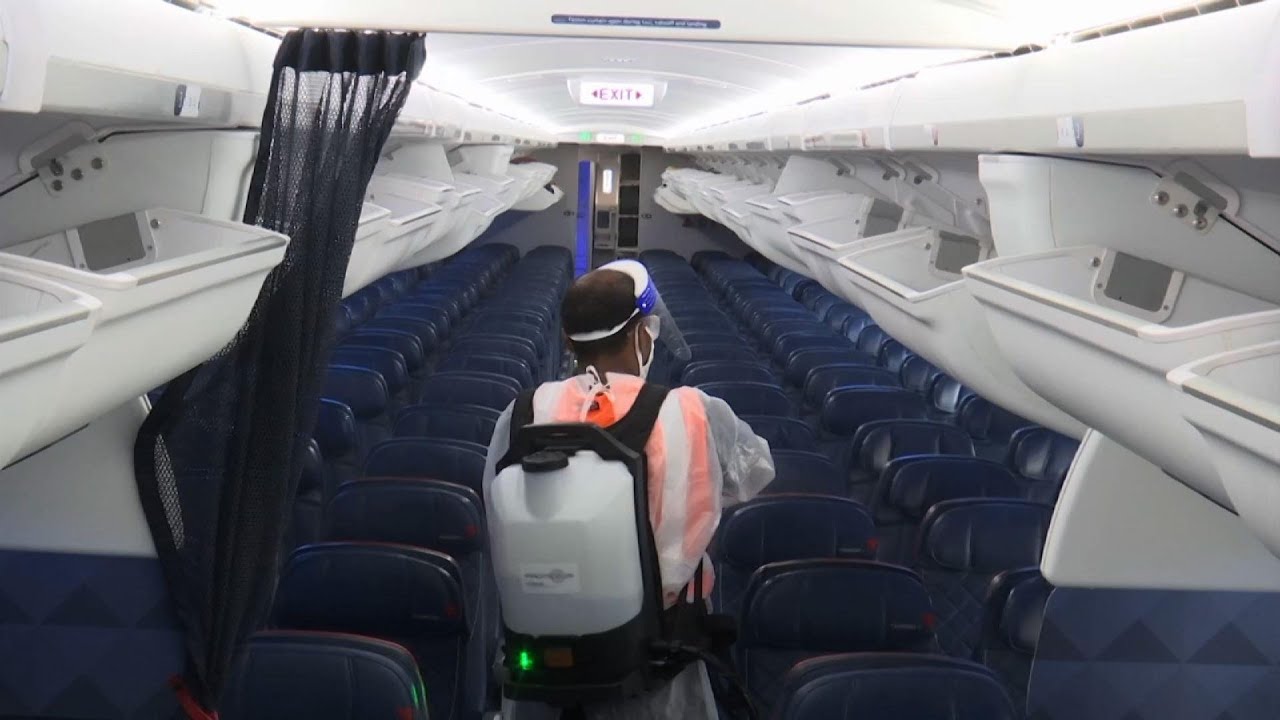
Melaku Gebermariam uses an electrostatic sprayer to disinfect the inside of a Delta Airplane between flights on July 22, at the Ronald Reagan Washington National Airport in Arlington, Va. U.S. airlines have scrambled to reassure travelers that planes are safe. They require passengers to wear face masks and are cleaning cabins more thoroughly, even spraying seats with anti-microbial mist. (AP Photo/Nathan Ellgren)

In a bid to survive, airlines are desperately trying to convince a wary public that measures like mandatory face masks and hospital-grade air filters make sitting in a plane safer than many other indoor settings during the coronavirus pandemic.
It isn’t working.
Surveys indicate that instead of growing comfortable with air travel, more people are becoming skeptical about it. In the United States, airline bookings have stalled in the past month after slowly rising — a reaction to a new surge of reported virus infections.
Globally, air travel is down more than 85% from a year ago, according to industry figures.
The implications for the airline industry are grave. Several leading carriers already have filed for bankruptcy protection, and if the hoped-for recovery is delayed much longer, the list will grow.
The four largest U.S. airlines lost a combined $10 billion from April through June. Their CEOs say they will survive, but they have lowered their expectations for a rebound.
“We were all hoping that by the fall the virus might run its course,” said Southwest Airlines CEO Gary Kelly. “Obviously, that has proven to be dead wrong.”
When Consumer Reports surveyed more than 1,000 people in June about their comfort with various activities during the pandemic, 70% said flying was very or somewhat unsafe. They rated going to a hospital emergency room or standing in line to vote as safer.
Youtube video thumbnail
In a survey commissioned by an airline trade group, the biggest concern of travelers was the possibility of sitting next to an infected person.
John Kontak, a schoolteacher from Phoenix, said that was his fear as soon as he stepped onto a crowded American Airlines flight this summer to visit his parents in Ohio.
“I don’t know anything about this person who is sitting a foot away from me,” Kontak said. “They took the bottom line or the dollar over the safety of passengers. Next time, I’d rather drive back to Ohio than fly — it’s safer because I can control it.”
The U.S. Centers for Disease Control and Prevention says sitting within 6 feet (2 meters) of other passengers, often for hours, may increase the risk of getting COVID-19. But CDC also notes that most viruses and other germs don’t spread easily on flights because of how air circulates on planes.
Standard & Poor’s said this week that the industry’s prospects have gone “from bad to worse,” with global air traffic dropping by up to 70% this year. In May, S&P said a 55% drop was a worst-case scenario.
“It’s going to be a slower and more uneven recovery than one might have expected,” S&P analyst Philip Baggaley said.
An airline trade group, the International Air Transport Association, predicts carriers will lose $84 billion this year, making it the worst year in the industry’s history. The group says traffic won’t fully recover until 2024.
Asia, where outbreaks were brought under control earlier, is doing better than the U.S. and Europe. Domestic travel inside China has recovered to about two-thirds its year-ago level. In the U.S., traffic is less than one-third of 2019 levels.
Air traffic at Europe’s more than 500 airports has tumbled, down 94% in June compared with the same month last year. There were about 4 million passengers, compared with 217 million a year earlier.
Travel ticked up when more than two dozen European countries opened borders to one another in early July, but virus cases are rising in several countries, leading to reimposed restrictions. This week, the U.K. imposed a 14-day quarantine requirement on travelers — even Britons returning home — from France and the Netherlands. Travel from outside Europe, including the United States, is still restricted.
In the United States, traffic picked up after collapsing by 95% in April but has stalled — down 74% in July, 72% in August.
Airlines came into this crisis in the best shape ever financially, thanks to rising demand for travel, reduced competition through mergers, and billions raised by extra fees.
Among international carriers, the big state-backed airlines are almost certain to survive. In Asia and the Middle East, they are often seen as vital contributors to the overall economy. Similarly, big European carriers including Lufthansa, Air France-KLM and British Airways may be too important to let fail.
It’s too late for U.K.-based Flybe; it shut down in March. Latin America’s two biggest airlines, Avianca and Latam, filed for bankruptcy protection. So did Aeromexico. Virgin Atlantic and Virgin Australia, both part of British mogul Richard Branson’s galaxy of companies, are using the courts to reset debts.
In the U.S., Trans States and Compass, which flew smaller planes for the major airlines, and Alaska-based Ravn Air shut down, but the big airlines have survived with billions in government aid and billions more in private borrowing.
U.S. airlines have scrambled to reassure travelers that planes are safe. They require passengers to wear face masks and are cleaning cabins more thoroughly, even spraying seats with anti-microbial mist.
“You can smell the cleaning fog that’s been done, and everything is wiped down basically top to bottom – chairs, window shades, even the light switches and overhead bins,” said Jason Bounds, a veteran flight attendant at Delta Air Lines.
The airlines split in one regard. Delta, Southwest, JetBlue and Alaska leave some seats empty to create room between passengers. United, American and Spirit do not, arguing that social distancing is impossible on a plane.
Most flights have plenty of empty seats, but scenes of full planes alarm travelers.
Carol Braddick, a business coach and consultant who splits her time between Phoenix and England, was so worried about the American Airlines leg of her journey to the U.K. that she sought out a COVID-19 test after arriving.
“The person I was sitting next to was drinking nonstop, shouting to his friend a row behind him; they were shouting back and forth,” Braddick said. “The combination of alcohol, shouting and no mask is unacceptable, and the flight attendant did nothing.”
Braddick put off plans for a couple of short holiday trips within Europe this summer.
“The new reality for us is fewer trips, longer stays, and being much more selective about which airline we’ll fly,” she said.
Even frequent flyers like Seth Miller, who writes about travel at his PaxEx.aero website, are grounding themselves.
“Much as I love and miss travel, it just doesn’t seem worth the risk to me,” he said.
By DAVID KOENIG and DAVID McHUGH___
Nathan Ellgren in Washington, D.C., contributed to this report.
___
David Koenig can be reached at www.twitter.com/airlinewriter.
@TraveloreReport on Twitter

Monday, August 3, 2020

Covid-19 And Hurricanes Puts Spotlight On Cancel For Any Reason Travel Insurance


InsureMyTrip recommends that summer travelers consider "cancel for any reason" travel insurance coverage. This specific coverage guards against covid-19 related travel concerns as well as storm threats this hurricane season.

"As travel restrictions wane, travelers want maximum flexibility when it comes to trip cancellations," says InsureMyTrip Director of Marketing & eCommerce Cheryl Golden. "We highly recommend that all travelers — including those booking domestic trips —  consider the cancel for any reason upgrade."

How Cancel For Any Reason Travel Insurance Works
Example: A traveler is having second thoughts about going on vacation, after a new hot spot for covid-19 emerges. Her family vacation costs $4,000.
Q: Can she back out of the trip and still get her money back? The traveler has travel insurance that includes a cancel for any reason benefit.
A: Yes, if the traveler met all requirements and submitted the proper paperwork, she can expect to be reimbursed 50-75 percent of the non-refundable trip cost (the exact amount depends on the plan).
Example: A traveler wants to cancel his tropical vacation, after a hurricane caused some mild damage to the area. He no longer wants to go.
Q: Can he back out of the trip and still get his money back? He paid over $2,500 for a flight, hotel stay, and excursion. This traveler has standard trip cancellation coverage. No cancel for any reason coverage.
A:  No. Standard trip cancellation wouldn't apply. His resort was still open and flights were running as scheduled. The only opportunity to cancel a trip for reasons other than those listed as "covered reasons" on a policy is cancel for any reason coverage.

Here's some other important considerations when considering cancel for any reason coverage:
  • It's usually optional. Think of it as an upgrade to a standard comprehensive travel insurance plan.
  • Entire trip must be insured. That means the traveler must add up all prepaid, non-refundable trip expenses and provide an accurate trip cost.
  • Yes, you'll pay more. Generally, plans that include a cancel for any reason benefit do tend to cost more. It may run an additional 40-60 percent more than a standard plan.
  • You still must file a claim. Any time reimbursement is requested from a travel insurance company, paperwork must be filed.
  • Procrastinators miss out. That's because travelers must purchase this coverage within 14-21 days of making an initial trip payment or deposit.
  • No last minute cancellations. The trip must be canceled no less than two days prior to departure.
  • Don't expect all your money back. Reimbursement is usually 50-75 percent of the entire prepaid, non-refundable trip cost. The exact reimbursement percentage depends on the plan purchased.
  • Not available in all states.
Bottom line: Travel insurance plans with the optional "cancel for any reason" coverage offers the most protection for travelers who may want to cancel a trip due to covid-19.
While some standard trip cancellation policies may cover a physician-ordered quarantine or contracting the virus (unless pandemics are specifically excluded), it will not cover covid-19 related cancellations due to fear of travel or any government-ordered border shutdowns.
Travelers can visit the Travel Insurance & Coronavirus resource hub for more information on cancel for any reason coverage.

Sunday, August 2, 2020

France Starts Testing Travelers From 16 Nations For Virus


PARIS (AP) — Travelers entering France from 16 countries where the coronavirus is circulating widely now must undergo virus tests upon arrival at French airports and ports.
French Prime Minister Jean Castex announced last month that the tests would be required starting Aug. 1 for passengers France is allowing in from a list of approved countries unless they present proof of a negative test done within 72 hours of their departure.
Those who test positive in France as of Saturday must quarantine for 14 days.
France is not permitting general travel to and from the 16 countries, which include the United States and Brazil. The testing requirement therefore only applies to people entering under limited circumstances: French citizens who live in these countries or citizens of these countries with an established residence in France.
Daniel Court was tested at Paris-Charles de Gaulle Airport after coming in from the French Riviera city of Nice. He acknowledged not loving the experience.
“It’s very fast, but I have to say that it’s not very pleasant,″ he said. “But we have to do it.″
Another passenger who got tested after landing at Paris’ main airport, Nadia Vusik of Belarus, said she thought the new policy made sense.
“It is definitely necessary, and I am happy that in France it is possible to do right here. It’s very convenient,” she said.
French health authorities say the number of daily confirmed COVID-19 cases has jumped on the French mainland in recent weeks. The government has already made mask-wearing mandatory in all indoor public spaces.
France has had over 225,000 confirmed infections and over 30,200 virus-related deaths, according to a tally by Johns Hopkins University, but experts say all numbers in the pandemic are too low for various reasons, including limited testing and missed cases.
The French government has so far ruled out imposing another nationwide lockdown after the one that brought the country to a standstill for nearly two months between March and May.
___

Tuesday, July 28, 2020

Star Alliance And Its Member Airlines Helping Consumers Navigate The Ever-Changing International Travel Landscape During Covid-19


Star Alliance Travel Information Hub offers greatly expanded utility

FRANKFURT, Germany  – Building upon the successful launch of its Travel Information Hub at the end of June, Star Alliance, the world’s largest global airline alliance, has unveiled a series of useful upgrades to now help passengers plan multi-stop itineraries.

Star Alliance Travel Information Hub
This unique alliance service was created by Star Alliance and its member airlines to help customers navigate the ever-changing international travel landscape that has resulted from measures taken by governments, regulators, and other stakeholders to help contain the spread of COVID-19. The tool provides information on specific health and hygiene measures presented across all elements of the customer journey.

Key Features
In its most recent iteration, the Star Alliance Travel Information Hub provides customers travelling with Star Alliance member airlines a broader and more personalized user experience. Customers may now: 

1. Enter two-segment journey details (two airlines, three airports)
  • Previously allowing only a query of a single airport, and a single airline, the Travel Information Hub now permits the user to configure a complete itinerary, including the origin airport, a transfer point, and a connecting airline.
  • Country information, both at origin and destination, previously a separate search query, is now integrated into a customer-friendly visual representation of the entire journey.
2. Utilize the Travel Information Hub in four additional languages
  • In addition to English, customers can use the website tool in Chinese (Simplified), French, German and Spanish, though query results will be returned to the user in the language offered by the source data.
​​​​​​​3. Avail themselves of an email function to share their findings with others
  • This is a particularly helpful feature for friends, colleagues and travel professionals to assist customers by researching on their behalf.
​​​​​​​
"The Star Alliance Travel Information Hub initiative grew out of the need to reduce complexity in air travel in these times of COVID-19," says Christian Draeger, VP Customer Experience of the Alliance. "It combines the input of all 26 of our member airlines, and the many key airports in our global network, to provide our customers specific health and hygiene safety guidance for an ever-expanding array of destinations and transfer points."

More features, and more airports are being added continuously, with the Alliance pledged to continue to offer the most digitally advanced premium travel experience to customers wherever they may be.

With the aviation industry facing the greatest challenge in its history, Star Alliance and its member airlines continue their work with other travel industry stakeholders to help make travel more accessible and to help restore and maintain confidence in air travel, once again connecting people and cultures.
#WeWillReconnect
#FlyWithConfidence


The Star Alliance network was established in 1997 as the first truly global airline alliance to offer worldwide reach, recognition and seamless service to the international traveller. Its acceptance by the market has been recognized by numerous awards, including the Air Transport World Market Leadership Award and Best Airline Alliance by both Business Traveller Magazine and Skytrax. The member airlines are: Aegean Airlines, Air Canada, Air China, Air India, Air New Zealand, ANA, Asiana Airlines, Austrian, Avianca, Brussels Airlines, Copa Airlines, Croatia Airlines, EGYPTAIR, Ethiopian Airlines, EVA Air, LOT Polish Airlines, Lufthansa, Scandinavian Airlines, Shenzhen Airlines, Singapore Airlines, South African Airways, SWISS, TAP Air Portugal, THAI, Turkish Airlines, and United. The Star Alliance network offers more than 19,000 daily flights to more than 1,300 airports in 195 countries. Further connecting flights are offered by Star Alliance Connecting Partner, Juneyao Airlines and Thai Smile Airways.

Sunday, May 3, 2020

Southwest Airlines Changes Boarding Process: What You Need To Know


Southwest Airlines has announced some changes to its usual boarding process in order to better help keep proper social distancing practices during the COVID-19 pandemic.
Travelers will now be boarding the airplanes in groups of 10, with people only lining up on one side of the Southwest’s boarding poles. This will help customers “spread out,” according to the airline.
That’s a big difference than what we’ve seen in the past with as many as 60 people — 30 on each side of the boarding pole — huddled together and waiting to board.
The airline is also asking passengers to download their mobile boarding pass prior to leaving home in order to limit the amount of exchanges they make with others and to plan on arriving at the airport earlier than usual to allow for new check-in and security processes

.Southwest recommends eating before traveling, since drinks and snacks will no longer be served onboard in order to limit contact with others.
These are just a few of the measures that the airline has implemented in response to the coronavirus pandemic.
Others include “using electrostatic anti-microbial spray treatments, cleaning aircraft between each flight using a disinfectant with the same grade that’s used in hospitals and restaurants, implementing physical-distancing measures, limiting the number of passengers onboard,” according to the Southwest website.

Thursday, April 30, 2020

JetBlue Begins Requiring All Customers To Wear Face Coverings During Travel


JetBlue  has announced that starting May 4 all customers will be required to wear a face covering during travel. The policy comes after the airline began requiring all crew members to wear face coverings while working. JetBlue has modeled its policy on the Centers for Disease Control (CDC) guidelines that indicate all individuals should wear a face covering in public to help slow the spread of the coronavirus (COVID-19).
“Wearing a face covering isn’t about protecting yourself it’s about protecting those around you”
“Wearing a face covering isn’t about protecting yourself it’s about protecting those around you,” said Joanna Geraghty, president and chief operating officer, JetBlue. “This is the new flying etiquette. Onboard, cabin air is well circulated and cleaned through filters every few minutes but this is a shared space where we have to be considerate of others. We are also asking our customers to follow these CDC guidelines in the airport as well.”
This new policy will require customers to wear a face covering over their nose and mouth throughout their journey, including during check-in, boarding, while in flight and deplaning. Customers will be reminded of this requirement before their flight via email and at the airport by both terminal signage and announcements. Small children who are not able to maintain a face covering are exempt from this requirement.
CDC guidance defines a suitable face covering as an item of cloth that should fit snugly against the side of the face, be secured with ties or ear loops, include multiple layers of fabric and allow for unrestricted breathing. The CDC recommends surgical masks and N-95 respirators be reserved for healthcare workers and other medical first responders.
Maintaining distance onboard whenever possible
Beyond face covering requirements for crew members and customers, since late March, JetBlue has limited the number of seats available for sale on most flights, allowing the airline to provide additional space between individuals who are not traveling together. Before each flight, JetBlue reviews seat assignments to ensure as much personal space as possible. In addition, rows near crew member jump seats have been blocked off to create buffer zones for added crewmember and customer safety.
Safety enhancements throughout the journey
All of JetBlue’s aircraft are equipped with hospital grade high-efficiency air particulate (HEPA) filters. All recirculated air is passed through these HEPA filters before re-entering the cabin and being mixed with fresh air. All of the air in the cabin is, on average, completely changed every three minutes. HEPA filters are capable of removing 99.97 percent of particles, bacteria and viruses. To learn about how air circulates onboard JetBlue’s fleet, view this JetBlue video at https://youtu.be/Q2_C2iN-tEs.
Since the coronavirus began spreading in the United States, JetBlue has increased the rigor of its aircraft cleanings at night and between flights, using disinfectant approved to kill the coronavirus. Cleanings have been focused on the places customers and crew members touch the most, including seat covers, seatbelts, tray tables and armrests. Traditional food and beverage service have been adjusted onboard to limit touchpoints between crewmembers and customers. To learn about all the additional measures JetBlue has implemented visit http://blog.jetblue.com/coronavirus.
About JetBlue Airways
JetBlue is New York's Hometown Airline®, and a leading carrier in Boston, Fort Lauderdale-Hollywood, Los Angeles (Long Beach), Orlando, and San Juan. JetBlue carries more than 42 million customers a year to nearly 100 cities in the U.S., Caribbean, and Latin America with an average of more than 1,000 daily flights. For more information please visit jetblue.com.