MEXICO CITY (Reuters) - A strong earthquake shook various Central American countries on Thursday, just as a hurricane barreled through the region, according to a Reuters witness and local media reports.
The 7.2 magnitude quake struck at a depth of 33 kilometers, some 154 kilometers (96 miles) south-southwest of Puerto Triunfo in El Salvador, according to the U.S. Geological Survey.
(Reporting by Gabriel Stargardter)
Thursday, November 24, 2016

Travel Law: Theft Of Guest’s Property In Milan Hotel – Who Is Liable For The Loss?

We examine the case of Eckhart v. Starwood Hotels & Resorts Worldwide, Inc., 53425/2013 (West. Sup.) TJR, Decision dated September 26, 2016, in which a United States citizen sought damages arising from the theft of her personal property from her hotel room at the Sheraton Milan Malpensa Hotel in Milan, Italy. The Decision is instructive on such issues as what law applies, New York or Italian, and the application of the doctrine of forum non conveniens.
Terror Targets Update
In 650% Increase in Deaths from Terrorism Amongst OECD Member Countries, eturbonews.com (11/16/2016) it was noted that “The total number of deaths caused by terrorism decreased by 10% to 29,276 in 2015 according to the Global Terrorism Index 2016, reversing a four-year upward trend. The military interventions against ISIL and Boko Haram have resulted in a 32% reduction of deaths in Iraq and Nigeria, which contributed to an overall reduction in the global figure. However, while ISIL and Boko Haram were weakened at home, these organizations spread to other countries, increasing the impact of terrorism in the rest of the world and contributing to a 6% deterioration in this year’s overall (Global Terrorism Index)”
.Jordan
In Baker, Mazzetti and Schmitt, U.S. Investigates Deaths of 3 Soldiers in Jordan as Possible Terrorism, nytimes.com (11/16/2016) it was noted that “American officials said Wednesday that they were investigating the killing of three United States soldiers at a Jordanian air base this month as a possible terrorist attack and dismissed suggestions that the three had done anything to provoke the shooting…The three soldiers, all with Special Forces, were in Jordan on a training mission and were returning to the air base in the southern desert when a Jordanian soldier fired on them”.
Berlin, Germany
In Eddy, Germany Bans ‘True Religion’ Muslin Group and Raids Mosques, nytimes.com (11/15/2016) it was noted that “A German organization that calls itself the True Religion and that is known for distributing German-language copies of the Quran was outlawed on Tuesday, after authorities accused it of recruiting jihadists to fight in Iraq and Syria. Thomas de Maiziere, the German interior minister, said the government had banned the True Religion organization, which is also known as Read (as in the instruction to read the Quran), because it acted as a ‘collecting pool’ for would-be Islamist fighters”.
Khuzdar, Pakistan
In Famous shrine in Pakistan bombed, killing at least 47, eturbonews.com (11/12/2016) it was noted that “A suicide bomber killed over 47 believers of Sufi Sant Baba Shah Nurani (Noorani) in a remote district of Khuzdar, the capital city of Balochistan in Pakistan”.
Moscow, Russia
In Russia foils planned terror attacks in Moscow and St. Petersburg, eturbonews.com (11/12/2016) it was noted that “Russian Federal Security Service (FSB) announced that it had foiled a terror plot to blow up targets in Moscow and St. Petersburg. ‘An operation conducted on November 12 in Moscow and St. Petersburg resulted in the arrests of 10 terrorists. They had a total of four powerful IEDs in their arsenals, which were seized’, the FSB said in a statement.
Small Print In Travel Brochures
In Elliott, On travel brochures, the small print makes a big difference, randolphcountyheraldtribue.com (10/26/2016) it was noted that “The National Trust Tours brochure for its upcoming Odyssey of Ancient Civilizations-a seven-night cruise through Italy, Croatia, Montenegro, Albania and Greece-advertises an ‘all-inclusive’ itinerary. And, indeed, the $4,195 price for an ocean-view stateroom covers meals, tours and ‘enhanced’ services, such as a flight insurance policy. But a closer look at its catalogue suggests that one or two items are left out of the prominently displayed price. Taxes are an additional $440 per person ‘and are subject to change’, the brochure notes next to an asterisk below the rates. Purchasing the package also requires a $20 National Trust for Historic Preservation membership fee. And the $4,195 price, the most prominently displayed rate, is technically unreservable if you want to sign up now, since you missed a summer deadline to quality for a $1,000 per person early booking discount….An informal survey of tour brochures and interviews with tour operators indicates that National Trust Tours’ pricing is not out of the ordinary. Yet complaints about ‘gotha’ rates for similar packages are few…The federal government clamped down on airfare pricing with a 2012 ‘full fare’ price rule for airline tickets and it’s considering similar rules for hotel rates. But what about tours advertised through brochures? Turns out there’s little, if any, regulation”.
Airline Disclosure Rules
In Jansen, DOT: airlines must tell passengers more about punctuality, lost bags, usatoday.com (10/18/2016) it was noted that “Airline travelers will earn a lot more about which carriers are the most punctual, which mishandle the most luggage and which damage the most wheelchairs, under final rules that the Transportation Department unveiled Tuesday. The reporting rules are final, but take effect Jan. 1, 2016, to give airlines time to comply. In addition, the new rule will require online travel agents to disclose if they have any bias favoring one airline over another when travelers shop for tickets. The rule goes into effect 30 days after it is published in the Federal Register. ‘The goal is to have a more robust consumer marketplace and create a more competitive environment and better outcomes for fliers’, Transportation Secretary Anthony Foxx said. ‘Today’s actions are a win for grovelers’. A dozen major airline, which each carry at least 1% of the 700 million annual travelers, now report flights that arrive at least 15 minutes later than scheduled. The goal of the new rule is to clarify the tardiness of more regional airlines that fly half of the flights…The larger airlines now report many bags are mishandled for total passengers. The new rule will change the standard of mishandled bags out of the total number of checked bags, to be more precise as travelers carry on more bags”.
Marriott-Starwood Loyalty Programs
In Glusac, How Loyalty Programs Will Work After Marriott-Starwood Deal, nytimes.com (10/12/2016) it was noted that “In late September (Marriott’s portfolio of hotels) grew to 30 hotel brands from 19 when Marriott acquired Starwood Hotels & Resorts in a $13 billion deal that makes Marriott the largest hotel company in the world, managing over 5,700 hotels and 1.1 million rooms…For travelers, the biggest issue posed by the deal is the marriage of two different loyalty programs…Q. What does the acquisition mean for travelers who have Starwood Preferred Guest (SPG) points? Will the loyalty programs be merged? A. Minutes after closing this deal we announced this site, members.marriott.com. It will allow members of each respective program to link their accounts. If you have gold status in SPG, you are automatically matched with gold status in Marriott Rewards and all the benefits that come along with being an elite. You’ll be able to transfer points from Marriott Rewards to SPG and vice versa”.
Latest Developments In Drone Law
In Raysman & Brown, Latest Developments in the Law of Unmanned Aerial Vehicles, New York Law Journal, October 7, 2016 it was noted that “Pursuant to the FAA Modernization and Reform Act of 2012, on Aug. 29, 2016, the Federal Aviation Administration (FAA) rules authorizing the operators of commercial unmanned aircraft systems-commonly known as drones-took final effect. See 14 C.F.R. Part 107 et seq. In a related development, on Sept. 20, 2016, the U.S. Department of Transportation (DOT) unveiled a new federal policy designed to accelerate the development and utilization of drones. The FAA Part 107 Rules are similarly designed to expand drone use, as the agency concluded that it could generate more than $82 billion for the U.S. economy and create more than 100,000 jobs in the next decade. Another estimation has the commercial drone market reaching $120 billion by 2020. The Part 107 Rules institute wide-ranging reforms, including (1) eliminating the case-by-case waiver approval for the use of drones for commercial purposes; (2) requiring drones to fly below 400 feet and be operated by a pilot at least 16 years old who has passed a written test; (3) forbidding drones from flying over people and (4) banning drones from fling at night. Notably, the Part 107 Rules functionally eliminate any business opportunities for drone package delivery service, as the drones must remain within the pilot’s visual line of sight. That being said, Virginia Tech University will soon be delivering burritos on campus. Interest in use of drones is rampant, as more than 3,000 would-be drone pilots signed up on the first day of the licensing test became available”.
The Bermuda Triangle
In Mercante, Bermuda Triangle: Trick or Trap?, New York Law Journal, October 28, 2016, it was noted that “Admiralty law recognizes that seafaring is a dangerous occupation, and thus creates legal obligations of ship owners to safeguard the lives of seamen. Pursuant to the doctrine of ‘seaworthiness’,’[a] ship owner has a duty, at the commencement of a voyage, to furnish his employees with a vessel that is seaworthy in itself, and seaworthy as respects its appurtenances and appliances’. It to be ‘seaworthy, a vessel must not only be fit for the intended voyage, but also be properly equipped and under the control of a competent master. Admiralty law also recognizes the mysteries of the sea and that ships may be lost with no evidentiary trace. As a result, maritime law has developed a rule that if a vessel is lost in calm seas it is presumed to be unseaworthy/But can a vessel be found ‘unseaworthy’ if it sins under mysterious circumstances and is never found? Perhaps no seafaring route has produced more theory, speculation and mystery than the Bermuda Triangle, a triangle shaped like a line drawn from Bermuda to Miami to Puerto Rico, considered a haunted part of the sea claiming ships without a trace…One of the most recent losses in the triangle was that of the cargo ship the EL FARO, which sank as it encountered Hurricane Joaquin en route from Florida to Puerto Rico, one year ago this month. Instead of being gone forever, ships that go down in the Bermuda Triangle are not forgotten. Federal court, in admiralty, is where the mysterious disappearances and sinkings surface to eerily re-create the voyage and the cause of loss”.
Fishy Travel Search Results
In Klugel, here’s why your travel search results look fishy, startribune.com (95/2016) it was noted that “Famished after a two-leg, cross-country flight rife with delays and scarce on nutrition, I tapped open Google Maps on my phone ad scanned the area around by Los Angeles International Airport hotel for someplace interesting to eat. At the get-go, two white circles with fork-and-knife symbols appeared: McDonald’s and Denny’s/ Not for me. I typed in ‘restaurants’ and a few red circles with similar symbols appeared-like Carl’s Jr. and a hotel cocktail bar.
Pass…Ok, I wasn’t in Koreatown or Silver Lake, but was this best Los Angeles could do? Only after zooming in, block by block, did some tiny red dots appear, representing Thai, Somali and Greek spots. And the Melo Burger, an ‘old-school, 24/7 burger stand’. Bingo. But why had the chains popped up first? Isn’t mu smartphone supposed to know me better than that? Could they have paid for exposure? Had an algorithm gone awry? As travelers, we’re ever more dependent on apps and online services that show us what to eat or where to sleep. Yet we (or at least I) often forget those sites are public utilities that exist to male us happy but for-profit businesses trying to make a buck…Google doesn’t share many details about its search results, but it shares enough. ‘Local results are based primarily on relevance, distance and prominence’, reads a support page called ‘Improve your local ranking on Google’. Review scores play a role, but brands ‘that are familiar to many people are also likely to be prominent in, local search results’. Congratulations, McDonalds. Sorry, Banadir Somali Restaurant…But restaurants can influence their success with customers indirectly but paying for what Yelp calls an ‘enhanced profile’ and TripAdvisor a ‘business listing’. Such companies don’t appear higher; they appear better. In Yelps case, improvements include a photo slide show, the elimination of competitor ads from their profile page and the capacity to insert ‘call-to-action’ buttons-to print a coupon, for example”.”
Travel Law Article: The Eckhart Case
In the Eckhart case Court noted that “The complaint alleges that the defendants were negligent in failing to maintain their surveillance system and in providing an improperly secured safe. Sheraton Overseas Management Corporation, a wholly owned subsidiary of Starwood Hotels & Resorts Worldwide, Inc., operated the hotel under a management agreement prior to the assignment of that agreement to a non-party Belgian corporation, Starwood E.A.M.E. License and Services Company, BVBA”.
Checking In
“Plaintiff and her traveling companion, non-party Carlos Kenda, check-in at the Sheraton Milan on August 17, 2011. They were provided with electronic key cards to Room 3170. Plaintiff left the room to make rental car arrangements. In her absence, the desk clerk who had checked them in arrived at the room and explained to Kenda that the keys previously given to them did not permit entry to the Executive Lounge. The clerk exchanged the original keys with new ones”.
The Disappearing Room Safe
“Plaintiff returned to the room, and placed her jewelry and other valuable property in the room safe, which was bolted to a shelf in the closet. Then she and Kenda left to dine in the hotel restaurant. When they returned to the room, they discovered that the luggage had been stolen and the entire safe had been removed. The hotel manager advised plaintiff that the hotel’s liability was limited under Italian law to 100 times the room rental rate. She was subsequently offered that amount (17,589 Euros) as a settlement, which she declined. No suspect was ever identified, and no arrest was made”.
Defendants’ Arguments
“Defendants argue that their liability is limited under either Italian (Civil Code 1783) or New York law (G.B.L. 200); that the in-room safe was adequate, as it was bolted to the shelf; and that there is no evidence that the surveillance system was not functioning-only that it did not record the incident. Defendants further maintain that there is no proof that the theft was perpetrated by an intruder, as opposed to a ‘fellow guest’ and that they provided reasonable security measures at the hotel. Lastly, they seek dismissal on the ground of forum non conveniens”.
Plaintiff’s Arguments
“Plaintiff does not dispute that Italian law applies, but contends that the defendants have failed to provide meaningful information regarding Italian law, and that under certain circumstances Italian law subjects the defendants to unlimited liability. Plaintiff asserts that there is overwhelming circumstantial evidence that the perpetrator was an employee of the hotel. The further argue that a forum non conveniens dismissal has been waived”.
The Court’s Analysis
“While defendants cite the so-called New York ‘Innkeeper Statute’ (G.B.L. 200) they nevertheless request that the court apply Italian law. The defendants assert that under Italian Civil Code 1783, their liability is limited to 100 times the amount charged for the hotel room. The plaintiff agrees that Italian law applies, but argues that Italian Civil Code 1785 expands liability when the innkeeper is ‘responsible’. Neither side, however, has submitted to the court the text of Italian Civil Code 1783 et seq…or a certified translation of the ext of that legislative scheme”.
Establishing Applicable Law
“The construction of foreign law is a legal question that may be summarily determined when sufficient information based on documentary and other evidence is presented…Copies of statutes are therefore prima facie evidence of the law when contained in publications generally admitted as evidence of the existing law of the jurisdiction where it is in force. Expert affidavits interpreting the relevant legal provisions may also be considered in construing foreign law, if accompanied by sufficient documentary evidence…Under the present circumstances, defendants have failed to provide the court with ‘sufficient information’ to discern Italian law as it pertains to this case…It is not possible…absent competent proof of the foreign law to determine whether the defendants are liable for the loss”.
Forum Non Conveniens
“Dismissal of an action for forum non conveniens (another forum, typically, where the accident occurred is more convenient for the parties) (see Travel Law at Chapter 1 and Litigating International Torts in United States Courts at Chapter 10) may be precluded by laches and inexcusable delay…Here extensive discovery was completed, and a note of issue was filed on September 4, 2015. The action has been pending since March 3, 2013. No motion was made to dismiss on the basis of forum non conveniens under December 2, 2015, long after a note of issue had been filed”.
Justice Dickerson has been writing about travel law for 39 years including his annually updated law books, Travel Law, Law Journal Press (2016) and Litigating International Torts in U.S. Courts, Thomson Reuters WestLaw (2016), and over 400 legal articles many of which are available at nycourts.gov/courts/9jd/taxcertatd.shtml. Justice Dickerson is also the author of Class Actions: The Law of 50 States, Law Journal Press (2016). For additional travel law news and developments, especially in the member states of the EU, see IFTTA.org.
This article may not be reproduced without the permission of Thomas A. Dickerson.
Read many of Justice Dickerson’s articles here.
Saturday, November 19, 2016
Iran Tourism For Women: Safe Or Not Safe?

With sanctions on Iran being relaxed and airlines including British Airways reintroducing direct flights to Tehran, Iran is once again attracting foreign businesses and travellers. Having just returned from a one-month self-drive tour of the country, I can assure you the destination has much to offer.
Justine Oliver is an independent travel security specialist with extensive global expertise, who specialises in solo female travel. For the last 16 years she has advised multi-nationals, NGO’s, media organisations, educational establishments, companies and individuals how to operate safely abroad. From 2001 to 2015 Justine worked for Control Risks and then a joint venture between Control Risks and International SOS in London, providing all elements of travel security, incident and crisis management, business continuity and security solutions to clients around the globe. During this time, Justine delivered regular training to clients operating abroad or sending new travellers and ex-pats into foreign environments. She conducts training, both via webinar and faceto – face, to individuals and groups across Europe. Before specialising in travel security, Justine lived in Hong Kong for four years where she worked in development for the Hong Kong Cancer Fund. On leaving South East Asia, instead of flying home, Justine decided to spend 10 months sailing a 30-footsailing boat back to London with her future husband. During this time, Justine honed her writingskills by documenting her trip and her resulting articles were serialised in Yachting Monthly. Justine has travelled to and worked in more than 58 countries and has just returned from a five-month trip with her husband and two children, self-driving a 1957 Land Rover to Iran and back. Justine holds a degree in Combined Studies from Newcastle University. She currently lives in South West France.
Business, culture, history, landscape, food and the people are just some of the compelling reasons to travel to Iran, but one of the main barriers to visiting the country for many people is often their colleagues and friends asking ‘is it really safe to travel there?’
Western media often portrays Iran negatively. There is a widespread misunderstanding about the true nature and safety of the country, which is tainted by the reputation of some of its more politically unstable neighbours.
That’s why people are often stunned when they are told Iran, with the exception of a few locations, is considered a low-risk country and a safe destination to visit.
As a travel security consultant, specialising in women travellers, here are my top 10 tips to ensure visitors have a safe and fascinating trip to Iran.
CRIME
Crime rates are low in Iran and many women travel to the country alone without facing any issues. As with travel to any destination, you should always take basic, common-sense precautions, such as not visiting isolated places after dark or finding yourself alone with men you don’t know. The rates of petty crime such as bag snatching and pick-pocketing are far lower than in western countries and serious crime against foreigners is even more rare.
CULTURAL DIFFERENCES
The main danger for women travellers is falling foul of cultural sensibilities. The country is Islamic and as a woman you are restricted in terms of your dress and behaviour. The risks to women are two-fold; the religious authorities and attracting male attention unintentionally. The latter is much less likely than in other Muslim countries such as Egypt and Pakistan, where it is not unusual to feel harassed by unwanted male attention. Iranians are incredibly friendly and welcoming, but are also very respectful of your personal space. You are extremely unlikely to be groped in Iran.
It is considered very rude to approach a woman without being invited to do so. You may well be stared at by both men and women, but this is likely to be from genuine curiosity and excitement that you are visiting their country. When making friends in Iran, which you surely will as Iranians are some of the friendliest people on earth, you need to be careful of making western-style eye contact with men in the group as you will cause them to feel uncomfortable or worse, they may take your eye contact as an invitation. Wearing sunglasses can help avoid inadvertently making eye contact with people you are not engaged in conversation with. Touching, patting on the back, shaking hands with males and other physical contact is not advisable.
CLOTHING
The religious authorities do pose a threat to women travellers and it is very important to adhere to the strict dress code by wearing the ‘Hijab.’ The word hijab can mean both ‘headscarf’ and ‘modest dress’, but in Iran it means that your hair and body should be totally covered and your upper body covering should not be too tight fitting and should hang low enough to cover your bottom.
Iranian women are roughly divided into two groups with more religious women tending to wear the ‘chador’ meaning ‘tent,’ a shapeless black gown that covers their entire body. The other group wears bright colours, and usually a ‘manteau,’ or thigh-length, lightweight coat over jeans. Testing the limits of what is allowed seems to be an Iranian sport, particularly in Tehran, but the Islamic police do patrol the streets and pull people in for inappropriate dress. Each city seems to have different standards and in more religious cities like Qom you will not feel comfortable in your brightly-coloured manteau and will want to wear neck-toankle loose-fitting black garments, as well as socks if you are wearing sandals.
Follow the guidance of local people. It is better to be more conservative and for locals to tell you that you can shed layers rather than for them to signal for you to cover up.
COVERING YOUR HAIR
No one veils their face Iran, but every woman past puberty must cover their hair and décolletage. In reality, every town and city follows these rules to a greater or lesser degree. In Tehran you will see some women with most of their hair uncovered and their head-scarves just pinned to the back of their heads, whereas in Tabriz, no one will have any hair showing at all. Take some hairpins to help keep your veil in place and be sure to remember it every time you leave your hotel room and leave your hotel room for breakfast.
EATING AND DRINKING
One of the things women dislike about travelling on their own is eating alone. Iranians are so friendly and joyful that it is unlikely that you will have to endure much solitary dining. Due to social constraints, men are unlikely to approach you but it is very likely that Iranian women, in groups or with their family, will invite you to dine with them. Don’t be surprised if they pay for your meal even if you have declined to join them!
ALCOHOL
Alcohol is illegal in Iran, but if you are invited to an Iranian family’s house, you may well be offered it. Be prudent in your assessment of the situation. There are harsh penalties for drinking alcohol and there is always the possibility that your guide or another guest may report the fact you drank alcohol to the authorities.
PUBLIC TRANSPORT AND GENDER SEPARATION
Public transport is safe to use but aside from the Tehran Metro, it is probably not the ideal mode of transport for a business traveller.
The Tehran metro is cheap, clean, air-conditioned and easy to navigate. At the front and rear of each train are women-only carriages. These were implemented for gentlemanly reasons rather than being sexist or discriminatory and can provide a less crowded and more comfortable experience, particularly during the rush-hour crush in the central carriages. Women may enter other carriages alone or with male colleagues.
Other modes of public transport also feature women-only sections and separation may be enforced on some buses.
TOILETS
Toilets are definitely a low point in what is otherwise a highly sophisticated society. Surprisingly, they are not always segregated. It is not uncommon to visit the bathroom in a restaurant to find that you have to walk through the men’s toilets to get to the women’s section. There is however always soap for which one is most grateful!
SWIMMING
The majority of hotel pools are not segregated, so unfortunately women cannot use them or even sit by them even if wearing the hijab. There are some segregated beaches, where the female swimming section is screened off, but these are few and far between.
ROAD TRAFFIC INCIDENTS
The main roads in Iran are very good quality, but driving standards are poor. Always check that your vehicle has working seat belts and sit in the back. Drivers will attempt to drive as quickly as they can; ask them to slow down if you are concerned and feign motion sickness if you are making no headway.
Cities are safe to walk around and often you will be in the shade of trees, even in cities, however crossing roads can be daunting, even at official crossings. Always look both ways even on one-way streets, especially when you near the pavement again. You may find it easier to ‘tag’ onto a local and cross in time with them. Even while safely sticking to the pavement, be aware of scooters travelling from both directions.
CONCLUSION
Iran is a fantastic country to visit. Certain nationalities still have visa complications and journalists or those involved in human rights can face greater risks, but for the average traveller, a wonderful trip awaits.
Thursday, November 17, 2016
National Geographic Travel: National Geographic Travel Announces Best Of The World List #BestTrips2017
National Geographic Travel Announces Best of the World List
Annual list features 21 must-see destinations for 2017
National Geographic Traveler magazine announced its annual Best of the World list,
which highlights 21 must-see places to visit in 2017. The destinations were all chosen by the
Traveler editors and fall into one of three categories- Cities, Nature, or Culture. The full list can
be found in the December/January 2017 issue of Traveler magazine, available on newsstands
nationwide starting November 29, and online now at NatGeoTravel.com/BestTrips2017.
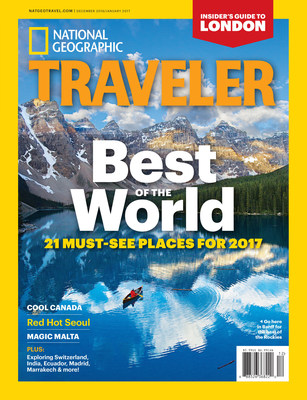
"This special issue takes readers on a globe-spinning journey to 21 of the world's best destinations,"
said George Stone, National Geographic Traveler editor in chief. "We think this year's list represents a
carefully curated selection of forward-leaning places that reveal the bright future of travel. This list
is all about exploration and discovery. It's not just about where to go, but why to go now and how
to make 2017 a year of enlightenment through travel."
The 2017 Best of the World destinations are (in alphabetical order):
- Anchorage, Alaska, USA
- Baja California National Marine Parks, Mexico
- Banff, Alberta, Canada
- Canton Uri, Switzerland
- Cartagena, Colombia
- Central India's National Parks
- Chengdu, China
- Cradle of Humankind, South Africa
- Ecuador's Cloud Forests
- Finland
- Georgia, USA
- Guadeloupe Islands
- Hamburg, Germany
- Kauai, Hawaii, USA
- Madrid, Spain
- Malta
- Marrakech, Morocco
- Moscow, Russia
- Papua New Guinea
- Seoul, Korea
- Via Dinarica, Western Balkans
The online hub includes an immersive visual experience with 360 videos along with helpful tips
and facts for planning trips to each locale. Visitors will also find inspiring illustrations to download
and share. National Geographic Travel will be hosting a Best of the World-themed Twitter chat on
Friday, November 18, from 2-3:00 PM EST. Join the conversation with @NatGeoTravel and #BestTrips2017.
National Geographic Traveler (six issues per year) is the world's most widely read travel magazine and
has 15 international editions. The National Geographic Travel digital group shares its inspiring
and authoritative digital content such as trip ideas, photo galleries, blogs and apps with
its @NatGeoTravel community of over 20 million.
To learn more about each destination, visit: NatGeoTravel.com/BestTrips2017
National Geographic Partners LLCNational Geographic Partners LLC, a joint venture between National Geographic Society and
21st Century Fox, combines National Geographic television channels with National Geographic's
media and consumer-oriented assets, including National Geographic magazines; National
Geographic Studios; related digital and social media platforms; books; maps; children's media;
and ancillary activities that include travel, global experiences and events, archival sales, catalog,
licensing and e-commerce businesses. A portion of the proceeds from National Geographic Partners
LLC will be used to fund science, exploration, conservation and education through significant ongoing
contributions to the work of the National Geographic Society. For more information,
United Will Not Allow Lowest-Fare Passengers To Use Overhead Bins
Charging passengers more to use the overhead bin is one step too far.

ROBERT ALEXANDER VIA GETTY IMAGES

United will become the first big U.S. airline to limit low-fare customers to one carry-on bag that fits under a seat.
The announcement on Tuesday could frustrate flyers who already feel burdened with airline travel restrictions and fees.
United, the No. 3 U.S. airline by passengers carried, said customers who bought its cheapest fares would not be assigned seats until the day of departure, meaning people on the same ticket may be split apart.
United will also prohibit these travelers from carrying on bags that can only fit in overhead bins, and they will not accrue miles toward elite status.

IMAGE SOURCE VIA GETTY IMAGES
The company expects the moves to add $4.8 billion to its annual operating income by 2020, although the figure does not include rising wages.
Fare initiatives such as “basic economy” will account for $1 billion of this, as more customers pay to check bags or select higher fares that give them two “free” carry-ons.
United’s announcement follows Delta Air Lines’ decision to sell cheap tickets that prohibit itinerary changes and seat selection.
“This action clearly shows how airline consolidation is eliminating choice,” Charlie Leocha, chairman of consumer advocacy group Travelers United, said in an email. “Simply stated, this is an example of airline consolidation gone too far, with choice and transparency being wrung out of the system.”

KLAUS LAHNSTEIN VIA GETTY IMAGES
Delta and United hope to lure customers with cheap fares and upsell them once they reveal the conditions of the ticket. It’s a practice they are using to compete with low-cost carriers Spirit Airlines and Frontier Airlines, which charge for add-ons including carry-on bags.
“Customers have told us that they want more choice and Basic Economy delivers just that,” Julia Haywood, United’s chief commercial officer, said in a news release.
The boarding process will also be faster because fewer customers will be searching for overhead bin space, United said.
Chicago-based United said it would begin selling the no-frills fares in the first quarter of 2017 for travel starting in the second quarter. Prices will be comparable to low fares it now charges for the economy cabin, but with more restrictions.
The initiative is part of United’s long-promised plan to rival Delta, which is more profitable and cancels fewer flights.
(Reporting by Jeffrey Dastin in New York, additional reporting by Ankit Ajmera in Bengaluru; Editing by Lisa Shumaker, Sai Sachin Ravikumar and Ted Kerr)
Subscribe to:
Posts (Atom)