Showing posts with label Central America. Show all posts

Thursday, July 2, 2026

Safe & Welcoming: The Best Global Destinations For Jewish Travelers

Navigating global travel today requires a careful blend of wanderlust and situational awareness. For Jewish travelers, the desire to explore the world is increasingly weighed against a crucial question: Where can I travel safely and openly? While global dynamics shift, several incredible destinations across East Asia, the Americas, and Europe continue to stand out for their low levels of antisemitism, robust local security, or deeply welcoming cultures.


Here is a curated guide to some of the safest destinations for Jewish travelers this year.


1. Israel: The Ultimate Cultural Comfort and Security

While the geopolitical landscape requires staying informed, Israel remains a primary, deeply meaningful destination where Jewish travelers can experience something found nowhere else on earth: the ability to live and travel completely in the cultural majority.


  • The Vibe: There is a unique emotional safety in walking down the street where Hebrew is the default language, Shabbat is a national day of rest, and Jewish identity is celebrated openly everywhere you turn.

  • Unmatched Infrastructure: From world-class security protocols at every public venue to an entire country built around kosher dining and Jewish traditions, the logistics of travel here are entirely seamless.

  • Smart Travel Note: While major cultural and tourism hubs like Tel Aviv, Jerusalem, and the Dead Sea feature highly sophisticated security networks and are welcoming international visitors, travelers should always check real-time regional advisories and stick to established tourist corridors.

2. Japan: The Global Gold Standard for Safety

If you are looking for a destination where you can travel with complete peace of mind, Japan tops the list. According to safety data and specialized travel agencies, Japan remains one of the safest countries in the world for Jewish families.


  • The Vibe: Antisemitism is practically non-existent in Japanese culture. Locals generally view Jewish travelers simply as Western tourists and treat them with the country's legendary omotenashi (hospitality).

  • Jewish Heritage & Life: You can explore the rich history of Chiune Sugihara—the Japanese diplomat who saved thousands of European Jews during WWII—at his memorial hall in Yaotsu.

  • Logistics: Tokyo and Kobe boast active Chabad houses and Jewish community centers, making it seamless to secure kosher meals and find a welcoming place for Shabbat.

3. Buenos Aires, Argentina: Vibrant Community & Kosher Hub

For those craving South American culture, Argentina offers a fantastic, deeply rooted Jewish experience. Buenos Aires is home to the largest Jewish population in Latin America, creating a confident and highly visible community.


  • The Vibe: Because the Jewish community is an integral fabric of the city, walking through Jewish neighborhoods feels comfortable and familiar.

  • The Kosher Scene: Buenos Aires is famous for its incredible Jewish culinary layout. The neighborhoods of Once and Villa Crespo offer a wealth of kosher delis, steakhouses, and even kosher fast-food options.

  • Safety Note: While normal urban precautions against petty theft apply to anyone visiting a major metropolis, targeted hostility toward Jewish travelers is incredibly rare.

4. Central European Gems: Czech Republic and Hungary

While parts of Western Europe have seen a noticeable spike in tensions, Central European capitals like Prague and Budapest remain highly rated for Jewish tourism.


  • Prague, Czech Republic: The Czech Republic continually maintains excellent security and a welcoming stance toward Jewish visitors. The city’s historic Jewish Quarter (Josefov) is one of the most well-preserved in Europe, heavily guarded, and deeply respected.

  • Budapest, Hungary: Budapest features a thriving, visible Jewish district (the 7th District). It’s common to see religious Jews walking openly to the Dohány Street Synagogue, and the neighborhood is packed with kosher bakeries, ruin bars, and rich history.

5. Panama: The Kosher Haven of Central America

Panama has quietly become one of the premier destinations for Orthodox and kosher travelers in the Western Hemisphere, thanks to its flourishing Sephardic community.


  • The Vibe: Panama City features a tight-knit, highly successful Jewish community that is incredibly welcoming to tourists.

  • Convenience Factor: The sheer volume of kosher infrastructure here is staggering. From high-end kosher sushi spots and supermarkets to beachfront kosher villas in destinations like Playa Venao, you can travel here without ever compromising on your lifestyle.

6. East Asia Safari: Thailand and Singapore

Beyond Japan, Southeast Asia has proven to be a remarkably warm region for Jewish globetrotters.


  • Singapore: Routinely ranking at the absolute top of global safety indexes, Singapore offers an impeccably secure urban environment. Its historic Jewish community, though small, is highly respected and supported by the local government.

  • Thailand: Whether you’re backpacking through Chiang Mai or relaxing on the beaches of Phuket, Thailand’s Chabad houses are legendary. They act as massive safety and cultural hubs, serving thousands of Jewish travelers every week with security, community, and warm kosher meals.


Quick Travel Safety Tips


Connect Locally: Before you fly, check in with the local Chabad house or synagogue of your destination. They have their finger on the pulse of the city and can give you real-time advice on neighborhoods and security protocols (some European synagogues require pre-registration for security reasons).


Pack Smart: If you keep strictly kosher and are heading off the beaten path, pack high-protein, non-perishable kosher snacks just in case.


Situational Awareness: Regardless of where you go, staying aware of your surroundings and respecting local travel advisories ensures your trip remains memorable for all the right reasons.

Tuesday, December 25, 2018

It’s A Jungle Out There: Costa Rica With Kids

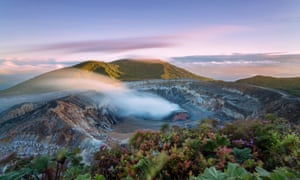
High angle view of Poas volcano crater emitting smoke at sunset, Costa Rica.

 Crater expectations … Poás, one of six active volcanoes in Costa Rica. Photograph: Matteo Colombo/Getty Images

Contributed by 
Full of exotic animals and rainforests but also child-friendly, Costa Rica is the perfect natural playground for a family adventure


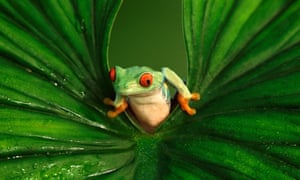
It’s dark in the rainforest, the air thick with strange croaks and chirps, and our group moves slowly, following José’s torchlight. As he gestures for us to stop, we gather around in silence, the adults as keen as the children to see what he’s spotted. There on a leaf, with its bulging orange eyes, neat green body and comically big tangerine feet, sits a Costa Rican tree frog. Cue delighted squeals all round.
“It’s so cute!” whispers my niece, Georgia, and I nod, partly relieved it’s not a boa constrictor or tarantula.
We’re halfway through a night safari at Maquenque Ecolodge in the far north of the country and the jungle feels tangibly alive. Caiman eyes shine at the edge of the lagoon and frogs and toads of all colours and sizes add to the howler monkeys, turtles and toucans we’d seen earlier in the day.
For somewhere the size of Denmark, Costa Rica packs a powerful punch when it comes to wildlife. A quarter of its land is protected and, with half a million species, it’s one of the world’s most biodiverse countries.
A wild natural playground with decent tourist infrastructure, it seemed the perfect choice for an adventure to remember with a 12-year-old. It is our first trip together, my first time alone in charge of a child (I don’t have kids) and the longest Georgia has been away from her parents. My plan is to show her a world away from life at home – and get her back in one piece.
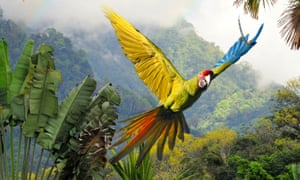
Close up of great green macaw flying through the rainforest in Costa Rica, showing the yellow underside of one wing, the blue top of the other, a red head and green and red tail
Pinterest
 Flight of fancy … great green macaw. Photograph: Getty Images

After a night in the capital, San José, we hit the road. The landscape quickly changes as we snake up into the hills, swathes of mist hanging in the cloud forest. Road signs warn of fauna crossing: monkeys, anteaters and a badger-shaped creature with a long, raised tail that we don’t recognise, though one soon scurries across our path (we later find out it’s a raccoon-like coati).
It’s an easy three-hour drive to La Fortuna, our base for the next couple of nights. The small mountain town is the gateway to Arenal Volcano national park and a hub for activities from zip-wire tours to white-water rafting.
Our first foray is a safari on Rio Blanco (its waters more of a muddy brown than white), floating on rafts through a landscape Georgia deems “just like The Jungle Book”.
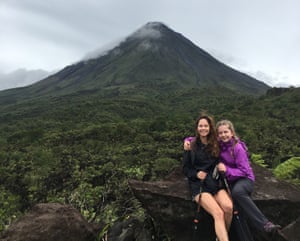
Jane and Georgia walking in the foothills of Arenal Volcano
Pinterest
 Jane and Georgia walking in the foothills of Arenal Volcano
We pass monkeys swinging through the canopy, a sloth hanging motionless in a tree and an iguana high up on branches, silhouetted against the sky. Bright blue morpho butterflies flit alongside us and there’s nervous excitement as we come surprisingly close to a caiman and spot crocodiles on the riverbank. A torrential downpour – our school summer holidays fall during Costa Rica’s rainy season – just adds to the fun.
The rain stops in time for an afternoon trek in the national park, dense mist clearing to reveal the looming volcano. Arenal last erupted in 1968, and we hike over a black lava landscape, already thick with rainforest, climbing higher for phenomenal views across lakes and mountains.

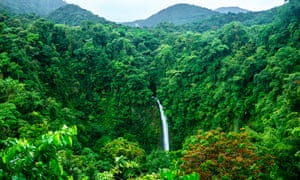
A distant shot of the waterfall of La Fortuna in the verdant Arenal Volcano National Park, Costa Rica,
Pinterest
 Green giant … La Fortuna waterfall. Photograph: Getty Images

Hot springs go hand in hand with volcanoes and there are several to visit in the area. It’s almost dark when we arrive at Ecotermales, a magical place with naturally warm waterfalls and various-sized thermal pools – perfect for an after-hike soak.
La Fortuna is fully geared up for tourists (restaurant tips include Snapper House for delicious ceviche) but our next stop, a homestay in Juanilama, a rural community three hours north, takes us well off the beaten tourist track. The women who founded it aim to give visitors an authentic taste of village life and bring in a bit of extra cash.

Red-eyed tree frog emerging from between the folds of a wet leaf
Pinterest
 Now you see me … red-eyed tree frog. Photograph: David Tipling/Getty Images
Our host is Eli, who lives with her three children and three-year-old granddaughter Victoria, and we stay in a simple wooden cabin in her garden. Georgia practises her Year 7 Spanish, bonding with Victoria as they play with kitten Blancanieves (Snow White). We eat fried plantain and gallo pinto(Costa Rican rice and beans) and on a tour of a smallholding learn about everything from pineapples – which each take a year and half to grow – to cassava, and press our own fresh sugarcane juice.
The next day, our drive to Maquenque takes us farther north again, over bright green hills and along bumpy unpaved roads lined with pineapple plantations. The lodge is part of the Maquenque Wildlife Refuge – a remote area of lowland tropical rainforest and wetlands to the south of the Nicaragua border. It’s exciting just getting there: cars are abandoned for a boat to take us across the river.
Accommodation is in 15 wooden bungalows with terraces overlooking a lagoon, or high up in treehouses. You don’t need to leave the 68-acre grounds to see incredible wildlife. There are 8km of marked trails through the forest. With more than 400 species of birdlife (including the rare great green macaw), there’s constantly something to gawp at: we see huge scarlet parrots, iridescent green ibises and a chestnut-bellied heron, wings outstretched in the sun.

On our last morning I sign us up for a kayaking trip on the San Juan river. Monkeys, iguanas and crocodiles are among wildlife we’re likely to spot, says Cristian, our guide.
Not the best place then to capsize – and we’re reassured that no one ever has. So it’s a bit of a shock when somehow we do just that and end up in the water, clinging to our kayak, drifting downstream. We’re soon safely back on and Georgia’s laughing – but it’s a while before I can fully focus again on the lush jungle scenery and the kingfishers and giant lizards Cristian points out.
It’s another memory-bank moment from an action-packed week – a proper adventure and one I doubt either of us will ever forget.

Way to go

Rickshaw Travel offers tailor-made itineraries to Costa Rica. The three-day Lava Flows of Arenal Volcano costs £235pp; the two-day At Home with the Tico costs £98pp and the three-day Nature Calls costs £245pp. Transport (either transfers or car hire) and flights extra. British Airways flies direct to Costa Rica from London Gatwick
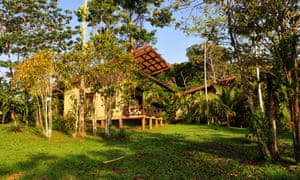
A wooden bungalow on stilts on bright green lowland tropical rainforest
FacebookPinterest
 ‘A little slice of Eden’ … Maquenque Eco-Lodge
It’s a little slice of Eden, untamed but very comfortable, and great for children, with a pool hidden in the jungle and a restaurant right on the water. Most produce served comes from the gardens and we drink straight from coconuts and dine on plantain and baked fish.

On our last morning I sign us up for a kayaking trip on the San Juan river. Monkeys, iguanas and crocodiles are among wildlife we’re likely to spot, says Cristian, our guide.
Not the best place then to capsize – and we’re reassured that no one ever has. So it’s a bit of a shock when somehow we do just that and end up in the water, clinging to our kayak, drifting downstream. We’re soon safely back on and Georgia’s laughing – but it’s a while before I can fully focus again on the lush jungle scenery and the kingfishers and giant lizards Cristian points out.
It’s another memory-bank moment from an action-packed week – a proper adventure and one I doubt either of us will ever forget.

Way to go

Rickshaw Travel offers tailor-made itineraries to Costa Rica. The three-day Lava Flows of Arenal Volcano costs £235pp; the two-day At Home with the Tico costs £98pp and the three-day Nature Calls costs £245pp. Transport (either transfers or car hire) and flights extra. British Airways flies direct to Costa Rica from London Gatwick


Thursday, November 24, 2016

Travelore Breaking News: Magnitude 7.2 Quake Strikes Off Pacific Coast Of Central America

MEXICO CITY (Reuters) - A strong earthquake shook various Central American countries on Thursday, just as a hurricane barreled through the region, according to a Reuters witness and local media reports.
The 7.2 magnitude quake struck at a depth of 33 kilometers, some 154 kilometers (96 miles) south-southwest of Puerto Triunfo in El Salvador, according to the U.S. Geological Survey.


 (Reporting by Gabriel Stargardter)

Sunday, November 13, 2016

Curio – A Collection By Hilton Debuts Five-Star Beach & Golf Resort In Honduras


"Indura" is the Garifuna word for Honduras and the resort strives to incorporate the culture of the Garifuna people – descendants of Caribe, Arawak and West African people – into its offerings, with local Honduran products and sustainable materials used in its construction. Credit: Curio - A Collection by Hilton

TELA, Honduras   - Steps from the crystal-blue Caribbean Sea in Honduras, Indura Beach & Golf Resort today joined Curio - A Collection by Hilton. As Hilton's (NYSE: HLT) rapidly-expanding global collection of distinctive upscale hotels, Curio caters to passionate travelers seeking local discovery and authentic experiences. Owned by Desarrollo Turistico Bahía de Tela S.A de C.V (DTBT) and managed by Trust Hospitality, the 60-suite Indura Beach & Golf Resort marks Curio's first property in Central America.

Monday, May 23, 2016

Costa Rica Welcomes Visitors With New Hotels, Tours And Festivities

Image result for costa rica


Travelers now have access to new accommodations, activities and options to get around

Costa Rica, which closed 2015 with a new record of 2.6 million visitors, is full of surprises for those looking to explore the Central American nation this year. From new accommodations to city tours, activities and festivals, the country has no shortage of choices for those seeking to experience the Pura Vida lifestyle.

Below are some of the highlights for those looking to explore the Central American nation soon: 

Where to stay: new hotel and resort openings
Whether traveling for business or for pleasure, solo or with a group, visitors now have new lodging options to suit their travel preferences and budgets. Several hotels and resorts have opened their doors throughout the country including Hacienda Altagracia, a luxury property in the mountains of Perez Zeledon region, as well as the Esplendor Hotel, overlooking the Pacific Ocean in Tamarindo region.

Others are slated to open their doors to travelers throughout the country, starting as early as this summer; among these are:

·         Casa Chameleon Las Cantinas (Mal Pais, opening in December 2016 – will feature 21 rooms)
·         Green Residence Hotel and Suites (San José, opening in June 2016 – will feature 100 rooms)
·         Manglar de Osa (Puntarenas, opening in July 2016 – will feature 10 rooms)
·         Nantipa: A Tico Beach Resort (Puntarenas, opening in June 2016 – will feature 44 rooms)
·         Residence Flamingo by Marriott (Guanacaste, opening in November 2016 – will feature 124 rooms)

What to do: From new bus tours in San Jose to nightlife shuttles and extreme adventure activities

Those looking to explore San Jose’s rich history and culture with a certified guide can now enjoy the ease and convenience of the new hop-on, hop-off tours. Visitors have the option of hopping on or off at more than 12 stops as many times as they like throughout the day. The buses provide travelers with access to more than 50 attractions including the National Theater, the Jade Museum, the Gastronomic Road in Escalante, the Children’s Museum, the Costa Rican Art Museum, the Central Market and Plaza Tempo, among others. The service is provided daily from 8:40 a.m. to 5 p.m. For more information or to purchase tickets, please visit www.costaricacitysquaretour.com.

When the sun sets, those looking to explore the city by night can take advantage of the new La Carreta by Carpe Chepe nightlife shuttle. Travelers have the opportunity to visit up to 30 of San Jose’s most vibrant bars as selected by a group of locals who live in – and love – the region. La Carreta runs continuously from 8:30 p.m. to 2:30 a.m. For more information on routes or to track the shuttle in real time, please visitwww.carpechepe.com. 

Those who want to get their adrenaline pumping can venture into the new Gravity Falls Waterfall Jumping tour in La Fortuna; the multi-sport canyon adventure combines hiking, rappelling, cliff jumping and swimming all in one. Thrill seekers can jump off 10- to 30-foot waterfalls and cliffs, and rappel along the edge of a thundering 140-foot waterfall, dropping into a deep pool of crystalline water. For more information, visitwww.desafiocostarica.com.

Where to go: From Guanacaste’s biggest fiesta to one of the country’s largest arts festivals and everything in between   

EXPOMARIMBA 2016 – July 15-17
Costa Rica’s national instrument, the marimba, a percussion instrument similar to the xylophone, will take the center stage at this year’s EXPOMARIMBA. The event will attract locals and visitors alike to the Guanacaste region for three days filled with music, dance, religious and cultural celebrations, as well as delicious local fare. EXPOMARIMBA’s ultimate goal is to preserve and showcase the country’s local heritage, allowing visitors the opportunity to truly experience the Tico culture.

Festival de la Tortilla Palmeada al Aire  (Tortilla Festival) – July 22-24
The town of Corralillo located in the province of Guanacaste will be celebrating its 10th annual Festival de la Tortilla Palmeada al Aire with live music, dance shows, contests, cultural exhibits and authentic Tico cuisine. Attendees will, of course, have the opportunity to enjoy delicious handmade tortillas, a staple in the Costa Rican cuisine. Visitors should also not miss the competition for the best tortilla maker; the corn delicacies are judged by their taste, texture and presentation.

Día de la Anexión del Partido de Nicoya – July 25
Recently selected as one of Top 26 Places to Go in 2016 by About.com, the Province of Guanacaste, in Costa Rica’s Pacific coast, is known for its breathtaking beaches, optimal surfing conditions and lush national parks. Travelers headed to the region should not miss the festivities surrounding the Día de la Anexión del Partido de Nicoya, also known as Guanacaste’s Annexation Day, in celebration of the region’s annexation to Costa Rica, July 25; festivities include parades, concerts, folk dances, handicrafts, fireworks and authentic Tico cuisine. Bullfights are also a common part of the celebration. However, as opposed to the typical Spanish bullfighting, bullfighting in Costa Rica does not aim to hurt the bull, but rather to dodge it.

Festival Nacional de las Artes de Costa Rica – August 5-14
Costa Rican culture is in many ways a reflection of its ethnic diversity with Spanish, Caribbean and indigenous influences. Those looking to explore the country’s cultural arts scene can head over to the Festival Nacional de las Artes de Costa Rica  (Costa Rica’s National Arts Festival), a biennial arts festival presented by the Costa Rica’s Ministry of Culture. The event brings together the country’s best artists, providing attendees with an opportunity to enjoy artwork, live theater, dance shows and musical performances.  This year’s festivities will be held in the cities of Neily and Golfito, in the country’s southern region – an ideal destination for those in search of unspoiled natural beauty, away from the hustle-and-bustle of life. For more information, visit www.festivaldelasartes.go.cr.

Fiestas Patronales de San Ramon and Entrada de los Santos – August 25 - September 1
Every year, the region of San Ramon in the Alajuela Province enjoys several days of live music, dance, cultural and religious festivities and traditional festival food in celebration of its patron saint, San Ramon Nonato. One of the most symbolic of these celebrations is the Entrada de los Santos, August 30, where more than two dozen statues of saints from various towns are brought to San Ramon and paraded through the streets.

To obtain a complete list of cultural events happening in San Jose’s Greater Metropolitan Area, please visit GAM Cultural,www.gamcultural.com. The interactive website provides travelers planning a trip to the country with information on all the latest exhibits, concerts, workshops and literary events, among others.

For more information on visiting Costa Rica, please visit www.VisitCostaRica.com.