Showing posts with label #FrenchFoodAndDrink. Show all posts

Sunday, August 27, 2017

Alsatian Wines Strike A Balance Of Dry And Sweet #Wine #FrenchWine


Photo

André Ostertag of Domaine Ostertag in the Alsace wine region of France.CreditPascal Bastien for The New York Times
EPFIG, France — The Muenchberg vineyard outside this small town is considered one of the best in Alsace. It’s among several dozen in the region that have earned the status of grand cru, vineyards from which the wines have the potential to transcend the qualities of the grapes to express the character of the place.
While the notion of grand cru in Alsace reaches back only a few decades, the individuality of Muenchberg has been recognized for centuries.
Cistercian monks first planted vines in a natural amphitheater in the foothills of the Vosges Mountains in the 12th century. Perhaps for them the potential greatness of Muenchberg was evident in its complexity: diverse exposures angled in all directions and wide-ranging soils including red sandstone with lots of iron and quartz, volcanic sediment and limestone.
From any angle, however, the vineyard is gorgeous. The light is pure, and the breeze fresh.
“Grand crus are always beautiful places where you feel the force and energy,” said André Ostertag, proprietor of Domaine Ostertag, which has holdings in Muenchberg as well as numerous other plots in the middle and northern parts of the Alsace growing region. “In any strong terroir, you have the feeling of the place.”


Olivier Humbrecht of Zind Humbrecht in his cellar. CreditPascal Bastien for The New York Times

The Alsace wine region, from Mulhouse on the south to Strasbourg on the north, is full of beautiful places and great terroirs. This long, narrow slash of rolling hills and pretty half-timbered towns between the Vosges on the west and the Rhine to the east has its share of great growers and winemakers, both older masters and young up-and-comers.
Alsace also has an image problem. Or, to be more precise, in the United States it faces the absence of one. Ask a young person about the wines of Alsace, and chances are you will be met with a blank stare. The best wine lists in New York may have only a handful of Alsatian bottles, and the hipper lists none at all.
Yet no region in France has a higher percentage of organic or biodynamic growers than Alsace, which theoretically should attract the keepers of natural wine lists.
It is time for a deeper look at Alsace, where I spent a few days this year visiting a range of producers. I tasted many wonderful wines, like Mr. Ostertag’s 2015 riesling from the Muenchberg vineyard, savory and saline, full of power and finesse. And, for a wine of less grandeur, his 2015 sylvaner, a grape practically unknown in the United States, is floral and zesty.


Bottles of Domaine Ostertag wines before labeling. CreditPascal Bastien for The New York Times
Alsace did not always draw a blank in America. In the 1980s, when I was first learning about wine, the slender bottles from Alsace were known as delicious high-quality values, dry contrasts to the generally sweet wines from Germany made from a similar set of grapes.
It helped that André Soltner, the superstar chef and owner of Lutèce, New York’s leading restaurant back then, was Alsatian. His list was full of the top names of Bordeaux and Burgundy, but the wines of Alsace were his favored selections with the cuisine.
In the ’90s, estates like Zind Humbrecht became critical darlings. But the wines also seemed to ebb from the general consciousness and slowly slip away.
The problem was that over time, too many of the historically dry wines of Alsace were sold with residual sugar in them. These wines were sweet, heavy and out of balance, with no indication of sweetness on the label. The problem is not new, and much has been done to rectify it. But the perception appears to linger.


Bottles of Domaine Ostertag wines before labeling. CreditPascal Bastien for The New York Times
Alsace did not always draw a blank in America. In the 1980s, when I was first learning about wine, the slender bottles from Alsace were known as delicious high-quality values, dry contrasts to the generally sweet wines from Germany made from a similar set of grapes.
It helped that André Soltner, the superstar chef and owner of Lutèce, New York’s leading restaurant back then, was Alsatian. His list was full of the top names of Bordeaux and Burgundy, but the wines of Alsace were his favored selections with the cuisine.
In the ’90s, estates like Zind Humbrecht became critical darlings. But the wines also seemed to ebb from the general consciousness and slowly slip away.
The problem was that over time, too many of the historically dry wines of Alsace were sold with residual sugar in them. These wines were sweet, heavy and out of balance, with no indication of sweetness on the label. The problem is not new, and much has been done to rectify it. But the perception appears to linger.


A glass of Zind Humbrecht wine in the tasting cellar.CreditPascal Bastien for The New York Times

Mr. Ostertag attributed the increasing sweetness to American critics who favorably rewarded those wines. “The sweeter the wine, the higher the score,” he said. “More and more wine appeared with sweetness and nothing more.”
Winemakers in Alsace have been working on solutions to the sweetness issue for years now. Partly, the problem was the result of idealism. Producers like Zind Humbrecht and Domaine Marcel Deiss, who work organically and biodynamically, were loath to pick grapes before they achieved absolute ripeness. They refused to add powerful store-bought yeast to complete fermentations that the indigenous yeast had not finished, which left residual sugar in the wine.
Over time, Olivier Humbrecht, whose family owns Zind Humbrecht, adjusted his viticulture so that ripeness could be achieved with less sugar in the grapes. You can taste the difference. Bottles that I used to find almost syrupy are now sharp and focused, even when they do have some residual sugar.
For years, Zind Humbrecht has put a code on its label to show the level of sweetness consumers can expect. The numbers, or indices, run from 1 (dry) to 5 (rich and sweet). I tasted a 2015 riesling from the Clos Häuserer vineyard, marked Indice 3, that was clearly sweet, yet it was vibrant and refreshing, with a balancing zing of acidity that I would not have found a decade ago.


The Zind Humbrecht estate in Turckheim, France. CreditPascal Bastien for The New York Times

Zind Humbrecht’s dry 2015s are lovely, including a fragrant gentle muscat from the grand cru Goldert vineyard and a deeply mineral, concentrated riesling from the grand cru Brand vineyard. I was especially impressed with their pinot gris, a grape that seems particularly susceptible in Alsace to cloying heaviness.
“There’s a lot of work done in the vineyard getting the precision right in pinot gris,” said Jolene Hunter, Zind Humbrecht’s export manager. “If you hesitate for a day, the acidity drops massively and alcohol shoots up.”
The 2014 pinot gris from the Rotenberg vineyard was beautifully balanced, fruity and saline, deliciously refreshing.
At Domaine Marcel Deiss, Jean-Michel Deiss and his son, Mathieu, have also been working in the vineyard to achieve riper grapes with less sugar. Mathieu Deiss’s side project, Vignoble du Rêveur, allows him to experiment with techniques popularized in natural wines: macerating white wines with their skins in the manner used for making red wines, fermenting and aging in amphoras, and working without sulfur dioxide, the stabilizer used in most wines.


Photo


From left, Jean-Michel and Mathieu Deiss of Domaine Marcel Deiss. CreditPascal Bastien for The New York Times

The 2015 Vignoble du Rêveur Singulier Sec is, like many of the Deiss wines, a blend of different grapes, in this case riesling, pinot gris, pinot blanc and pinot noir. It’s a beautiful amber, textured and tannic, bone-dry, fresh and energetic. It reminded me of the wines of Radikon, the great producer from Friuli-Venezia Giulia.
Residual sugar does have an important place in Alsace, as long as the wines are balanced and consumers know what to expect. But Deiss leaves this responsibility to the wine trade and to consumers themselves rather than indicating on its bottles the characteristics of its various bottles.
For example, the Engelgarten wines — from a gravelly terroir where muscat, pinot gris, pinot noir and riesling grow together — are generally dry, earthy and savory. But wines from the limestone Grasberg vineyard — combining riesling, pinot gris and gewürztraminer — are invariably floral, spicy and sweet, though balanced by excellent acidity.
“The nature of this vineyard is the expression of residual sugar,” said Marie-Hélène Cristofaro, commercial director and enologist for Deiss. “The wine never completes fermentation. This balance comes from nature.”


Sampling a pinot noir at Domaine Valentin Zusslin. CreditPascal Bastien for The New York Times

She said, though, that Mathieu Deiss’s experiments indicate that fermentation can go more smoothly with skin maceration, and suggested a future application in wines like the Grasberg.
“It raises new questions,” she said.
At Domaine Valentin Zusslin, where Marie Zusslin and her brother, Jean-Paul, have managed the estate since 2008, there is no question about which wines are dry and which is not.
“In Alsace, heavier, sweeter wines were understood,” she said, noting that that is not the case internationally. To eliminate confusion, the Zusslin wines are dry unless clearly indicated.
From the Clos Liebenberg, a southeast-facing vineyard outside Orschwihr in the southern part of the region, you can see the Swiss Alps on a clear day. Riesling is planted in rows and on terraces. Beehives are nearby for honey and pear trees for making eau de vie. Like all of the Zusslin estate, it has been farmed biodynamically for almost 20 years. Each element of the undulating terrain is different, with varying microclimates, exposures and soils.


Marie and Jean-Paul Zusslin of Domaine Valentin Zusslin in Orschwihr, France.CreditPascal Bastien for The New York Times
“To observe is paramount,” Ms. Zusslin said, a key tenet of biodynamic viticulture.
The Zusslin wines reflect this precision. They are characterized by acidity, energy and a savory quality that I can only describe as saltiness. I especially liked the lively 2014 sylvaner and the gentle 2014 riesling, both from the Bollenberg vineyard, along with the mineral 2013 riesling from the grand cru Pfingstberg vineyard and the linear 2013 riesling from Clos Liebenberg.
Alone among the estates that I visited, the venerable Maison Trimbach did not acknowledge any confusion in the marketplace about its wines.
The United States is its biggest market, said Pierre Trimbach, who oversees the winemaking, and Trimbach continues to do well there.
Perhaps that is because Trimbach has never deviated from its policy of clarity in its labeling. Consumers know that its wines, like the great riesling Clos Ste.-Hune and the more affordable Cuvée Frédéric Émile, are going to be dry. But when I said this to Mr. Trimbach, he grimaced.
Balanced. I can live with that.
Follow NYT Food on FacebookInstagramTwitter and PinterestGet regular updates from NYT Cooking, with recipe suggestions, cooking tips and shopping advice.

Saturday, January 16, 2016

How To Find The Best Sauvignon Blanc From The Loire Valley

Sauvignon blancs from the Loire Valley are bracingly fresh and taste great with healthy food - just don't serve them too cold.


Sauvignon blanc wines
Wines from Pouilly-Fumé and Sancerre are great matches for herby risottos and salads


Like many, I have a bouncy relationship with New World (especially New Zealand) sauvignon blanc – sometimes that perfumed, juicy blast of gooseberry, passion fruit and tomato leaf is exactly what’s needed to wake up the taste buds with a zap, yet at others it seems altogether too loud, too strong, too relentlessly bright.
So I found myself in the pretty French town of Sancerre recently, marvelling at the elegance and poise of the classic sauvignon blancs of the Loire Valley. My tasting notes from the trip include “tangerines, pears, roses, melon, peach and greengage”, but these are subtle hints; at the heart is always whistle-clean lemon juice, precise and clear, sometimes with minty or smoky whiffs but almost always with a bracingly fresh mineral streak.
The top wines of Sancerre and nearby Pouilly-Fumé can be expensive, but in the same general area sauvignons from less famous Quincy, Reuilly and Menetou-Salon can also deliver at lower prices, and, sauv blanc lovers, do look out for the affordable, simpler but moreish versions from the Côteaux du Giennois appellation.
This is exactly the right time of year to sip them with healthy new-season food – salad leaves and fresh asparagus, baby broad beans and newly sprouted green herb risottos. Oh, and goat’s cheese, and of course white fish and seafood.
On my last night in Sancerre I was the guest of a Japanese chef who paired the wines with her own exquisite, delicate dishes made using nori, radish, miso. Sushi too – all worked beautifully with these restrained and refined white wines.
TRY THESE...
Finest Pouilly-Fumé 2013 Loire, France (Tesco, £10.99)
This has a riper, creamier texture and long finish but the flavours are crystal clear: zesty lemon and grapefruit with a grassy hint – just made for white fish.
Domaine de Villargeau 2013 Côteaux du Giennois Loire, France (Majestic, £8.99)
Lemon and clementine mingle to make a mouthwatering, light and dry citrus cocktail, and there’s a faint hint of mint on the scent. Properly refreshing sauvignon blanc.
Domaine Vacheron Sancerre 2013 Loire, France (selected Waitrose, £19.99)
A brilliant organic producer whose whites have strikingly pure flavours and clean acidity; here’s lemon again, and very light peach. Dry, crisp finish – a seriously good match for lobster.

TIPPLE TIP keep yours cool...

Though it’s tempting in summer, never serve fine whites like these sauvignon blancs too cold, or their delicate flavours and aromas will be hard to detect through the chill. Aim for a cool 8C, which should be just right to make the wine more refreshing without masking its subtle character.

Sunday, September 20, 2015

The Hidden Charms Of Languedoc-Roussillon

Unrelenting rain and an April chill greeted us as we navigated the cobbled streets and narrow roads in the hamlet of Gattigues, a petite village in France’s Languedoc-Roussillon. Several twists, turns and reverses later, we discovered our inn. Huddling under a coat, we dashed through the pastel blue door of Les Sardines aux Yeux Bleus (www.les-sardines.com) to its foyer, where the smell of just-cooked strawberry jam and cinnamon muffins immediately erased memories of the rain. Charming, rustic, intimate and authentic, Les Sardines aux Yeux Bleus captures the essence of Languedoc-Roussillon.

Welcome to Languedoc-Roussillon

The tiled rooftops of Uzès. Image by Dave Mitchell / Flickr Open / Getty Images.
The tiled rooftops of Uzès. Image by Dave Mitchell / Flickr Open / Getty Images.
Like its famous neighbour Provence, Languedoc-Roussillon boasts lyrical landscapes and rich scenery, from the western Mediterranean coastline to its sun-soaked valleys, peaks and vineyards. Its tucked-away villages and small hilltop towns are still largely untouched by tourists; the charm of French country life is alive and well. Off-the-beaten-path inns sit beside rustic restaurants frequented by locals, seducing travellers with a peek into the France of 20 years ago.

On the mountainside

With its cluster of Renaissance architecture bounded by countryside dotted with renovated 16th-century farmhouses – like the notable L'Artémise (www.chambresdelartemise.com) – Uzès is one of Languedoc-Roussillon’s most charming towns. Wine shops, chic boutiques and inventive restaurants have sprouted along its medieval streets, though Uzès has maintained an authentic and low-key vibe. Its celebrated Saturday market, flanked by the vaulted archways at the Place aux Herbes, is not to be missed. For dinner, make a beeline for the smart Les Trois Salons, where Swedish-born chef Petter Nilsson developed a devoted following. Though Nilsson now sits at the helm of a Parisian bistro, Les Trois Salons remains one of Uzès’ finest culinary experiences.
For a taste of Uzès’ grapes, travel 10 minutes by car to the north where the artisanal estate of La Gramière (www.lagramiere.com) occupies just five hectares of vineyards. Founded in 2005, La Gramière is one of the region’s most interesting garage wineries, producing less than 10,000 bottles a year of grenache-based wines. These organic wines are all farmed by hand, from the planting to the picking, by a two-person team. Thanks to a successful Kickstarter campaign, La Gramière recently restored an old Citroën van that serves as a roving wine bar. Check out their summer events in the vineyards, or look out for La Gramière’s green camion around Uzès. Be sure to taste their blend of syrah and rose, sold exclusively in France.
Vineyards in Languedoc-Rousillon. Image by Danita Delimont / Gallo Images / Getty Images.
Vineyards in Languedoc-Roussillon. Image by Danita Delimont / Gallo Images / Getty Images.
North of Uzès by 30km, La-Roque-sur-Cèze (www.laroquesurceze.fr/index.php) dramatically juts out of a rock peak above the Cèze. This petite gem is officially one of France’s most beautiful villages – a quick stroll through its winding streets to the former castle and its chapel shows why. Grey residences and creamy alleyways lead to the village’s summit where expansive views of the river valley below will steal your breath. Less than an hour is all you need to explore the village, including copious time for oohing, aahing and taking pictures.
Walk towards the bottom of the village and across the Cèze River to the striking waterfall Cascades du Sautadet. Limestone cliffs, dips and edges in a variety of peculiar shapes are saturated with rushing water and pools of bubbling river. Tread carefully on the limestone’s flat, dry surfaces to get an up-close-and-personal glimpse of the river whooshing through in a scene that looks more like Iceland than France.
Head to the east to find St Siffret – another minuscule medieval village with stone walls, vaulted archways and beige steps. Here, two chateaux take centre stage, including one that was a Commanderie of the Knights Templars. Sadly, neither is open for visits and there are scarce spots for lingering with a coffee and croissants. There is, however, a worthwhile restaurant, L’Authentic (Place de L’Ecole, 30700 Uzès, St Siffret), housed in the village’s old school. A changing weekly menu inspired by local and seasonal ingredients is all that is offered, but the quality will not leave you wanting. Tourists are scarce, especially in the off-season.

Beside the seaside

The picturesque port city of Banyuls-sur-Mer. Image by Gerard Labriet / Photononstop / Getty Images.
Far to the south, past Montpellier and Perpignan and just 14km from Spain, sits Banyuls-sur-Mer. Tucked away on a rocky coast, this small Mediterranean town is a mélange of Catalan and French culture, influenced heavily by the sea. Swimming coves and ports evoke the Riviera towns to the east, sans the traffic, the scene and the glitz. Banyuls-sur-Mer’s old town boasts palm tree-lined, whitewashed streets.
Dine on fresh mussels, oysters and monkfish stew, cooked seaside where dramatic views drop to turquoise waters. Seafood is best paired with Languedoc’s crisp white wine, picpoul de pinet, made with the region’s oldest grapes, piquepoul. Further inland the vineyards in Banyuls-sur-Mer produce a sweet dessert wine called Banyuls.
Still on the coast, heading east roughly 150km, sits Domaine Sainte Rose (www.sainterose.com/index.php). This family-run boutique winery is focused on promoting Languedoc’s vineyards through producing exceptional wines that challenge the status quo. Employing New World techniques to South of France vineyards, its wines are clean and minimalist and are making an impact on Languedoc’s traditions. Visit the stunning estate for tastings and tours (by appointment only).

To the forest

Three of Aubrac's celebrated cows. Image by GFC Collection / age fotostock / Getty Images.
At the other extreme of Languedoc-Roussillon is Aubrac, an immense plateau with fog-laden forests and wildflower-sprinkled pastures. Visiting the region on horseback (www.equitation-aubrac-lozere.fr), trotting cautiously past herds of Aubrac’s celebrated cows, is an absolute revelation, offering a unique perspective into the region.
The world-famous Michel Bras (www.bras.fr) restaurant and hotel resides in an uber-contemporary space, tucked into the landscape of Aubrac’s plateau. Whether at Bras or elsewhere, dine on Aubrac’s traditional dish, aligot, made of mashed potatoes, tome de Laguiole and crème fraîche, which gives the dish a creamy taste and smooth texture, unique to this place.

 Caitlin Zaino


Read more: http://www.lonelyplanet.com/europe/travel-tips-and-articles/the-hidden-charms-of-languedoc-roussillon#ixzz3mHtTtsYU

Sunday, September 13, 2015

Top 10 Caves à Manger In Paris

Cave a Manger, Paris, Wine and Cheese
Best of both worlds … Paris’s caves à manger focus on great quality food and drink. Photograph: Allen Enriquez/Getty Images/Flickr RF

Paris is offering a fresh twist on the wine bar experience with the increasing popularity of its caves à manger, where you can savour impressive wines, provided you also sample something from their deli-style food menus
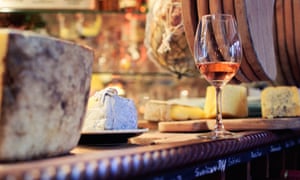
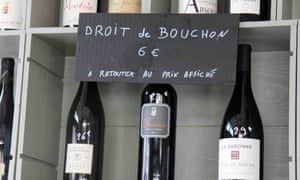
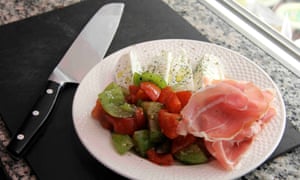
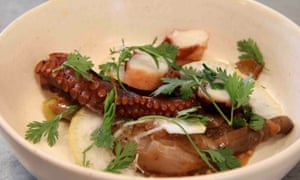
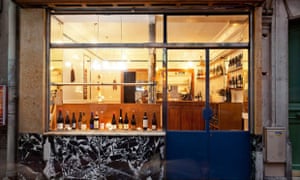
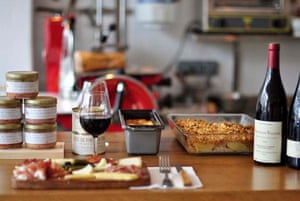
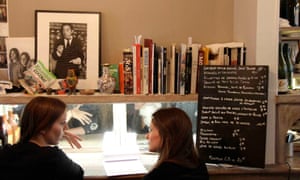
Caves à Manger – wine bars with a difference – are popping up all over Paris at the moment, offering the combination of a stunning selection of reasonably priced wines that are usually organic, biodynamic or “natural” low-sulphite, accompanied by French-style deli snacks. These new-generation wine shops have a special licence that allows drinking on the premises only if customers order something to eat. The deal is that wines display their takeaway price, usually starting at €8-€9 a bottle, then a droit de bouchon (corkage) of €4-€8 is added for serving along with at least one of the tempting list of sharing plates on offer:planches of charcuterie and cheese, or more gourmet dishes such as grilled octopus with aubergine. Here’s our pick of 10 great caves across the city, plus a tip on which wine to order from each caviste.

Le Barav

La Cave du Barav, Cave a Manger,  Paris.
Pinterest
 Photograph: John Brunton
Wine lovers are spoiled for choice in the Marais district, from Versant Vins in the buzzing Marché des Enfants Rouges to newcomers such as Monsieur Henri, already crowded every night. But it is difficult to find a better spot than friendly Le Barav, which still has the feel of a neighbourhood hangout rather than the latest bourgeois bohème (bobo) flavour of the week. At first, Barav looks like a classic bistrot as, apart from a host of tapas-style plates, it does a range of main dishes such as duck shepherds pie or grilled sausage with lentils. A dozen wines by the glass can be chosen from the blackboard but if you ask for a bottle you’ll realise this is a unique cave à manger as the waitress asks you to go next door and choose from one of the 300 vintages stocked in its cellar. The friendly caviste, Stan, gives helpful advice, and you take your bottle back to the table for the waitress to open.
 Corkage €6. 6 rue Charles-François Dupuis, 75003, +33 1 48 04 57 59,lebarav.frWine pick: Pithon-Paille chenin blanc from the Loire, €14

Le 5e Cru

5ème Cru Cave a Manger, Paris
Pinterest
Although it is right by the Boulevard Saint-Germain and the iconic Institut du Monde Arabe, the 5e Cru is very much an under-the-radar address. This chameleon cave à manger attracts a loyal collection of colourful Rive Gauche locals at lunchtime, drawn as much by the changing plat du jour that owner/chef/sommelier Jean de Rotalier serves for just €10, as his stellar list of 250 organic wines. Then at night, a trendier, wine-fanatic crowd converges from all over Paris, along with a smattering of curious tourists. Jean does no cooked food in the evening, but there is still a long list of sharing plates like mackerel marinated in Sancerre, scallop rillettes, and duck breast with foie gras. There are always 10-12 wines available by the glass, starting at €4
 Corkage €6. 7 rue du Cardinal Lemoine, 75005, +33 1 40 46 86 34, 5ecru.comWine pick: Domaine de Mouscaillo Limoux blanc sec, €17

Le Quincave

La Quincave. Cave a manger
Pinterest
 Photograph: John Brunton
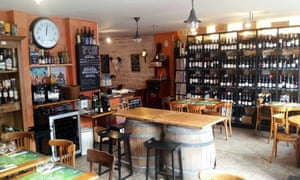
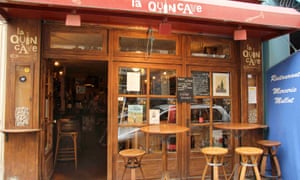
The Quincave may be one of the few wine cellars that does not serve by the glass, but with bottles starting at €9 and a plate of saucisson from Ardèche, Cantal cheese or rustic terrine costing €5, it is no surprise that this cosy locale is packed most nights. Customers perch on bar stools made from barrel staves and garrulous owner Fred Belkamp is a mine of information as he has personally tracked down most of the makers of the couple of hundred wines he stocks. Fred is a pioneer caviste, opening 12 years ago in this lively Left Bank street near legendary Montparnasse brasserie La Coupole. Squeezed between the wine are bottles of craft beer, olive oil, artisan vinegar, rum, sake and potent fruit brandies. And don’t be surprised to see clients disappearing through a side door behind the bar counter – they are just heading for the outdoor loo at the back of the courtyard.
 Corkage €7. 17 rue Bréa, 75006, +33 1 43 29 38 24, quincave.pagesperso-orange.frWine pick: L’Amourier from the Minervois, €9

Pratz

Pratz Pigalle Cave a manger
Pinterest
Pratz is one of the newer caves à manger. It is in the fashionable Sopi (south of Pigalle) neighbourhood. Owner Thomas Babot offers an inspired selection of biodynamic or natural wines and creates delicious tapas in an open kitchen. Apart from plates of chorizo, serrano ham, and mozzarella and burrata, he has a daily selection of gourmet sandwiches stuffed with the likes of truffle-scented ham, melted provolone and sun-dried tomatoes. His 100-strong selection of wines begins at €8.90 a bottle, while half-a-dozen by the glass are priced from €4-€7. Babot has also had the clever idea of offering a sac apéro, a chic cotton picnic bag of cheese and charcuterie, half a baguette, a bottle of wine and plastic glasses, all for €19.
 Corkage €8. 59 rue Jean Baptiste Pigalle, 75009, +33 1 77 10 67 03, pratz-pigalle.comWine pick: Entre Chien et Loup, dry white from Alsace, €12.50

La Cave à Michel

La Cave a Michel. Cave a manger
Pinterest
 Photograph: John Brunton
Rue Sainte-Marthe and its cobbled square are a goldmine of cheap-and-cheerful bohemian restaurants and now La Cave à Michel is one of the hottest new addresses for wine and food lovers. It is a joint venture between chef Romain Tischenko and caviste Fabrice Mansouri. Tischenko shot to fame when he won France’s Masterchef and with the winnings opened his own restaurant, Le Galopin, in Place Sainte-Marthe. Last year he joined forces with Mansouri and, during the day, La Cave à Michel operates as a normal wine shop, but from 6.30pm Tischenko comes over from Le Galopin to spend the evening cooking gourmet tapas in a minuscule kitchen at the end of the classic zinc bar. The narrow, standing-room only joint buzzes at night, with Mansouri at one end explaining some of the 300 wines it stocks while, at the other end, Tischenko cooks up a storm with dishes such as Galician octopus grilled with organic aubergine, Basque peppers stuffed with yoghurt and tarragon, and a fresh, tangy mix of tomatoes, peaches and coriander.
 Corkage €8. 36 rue Sainte-Marthe, 75010, +33 1 42 45 94 47, FacebookWine pick: Piak! Domaine Bobinet Saumur-Champigny, €10

La Buvette

La Buvette, Paris
Everything in this enchanting tiny bar is minimalist but perfect, from the small 50-odd list of surprising wines to the half-a-dozen delicate sharing plates, handwritten on a mirror, often including broad beans and lemon zest, fresh goat’s cheese with black garlic and cherries, and marinated baby octopus with saffron. La Buvette used to be the local cheese shop, and owner Camille Fourmont has left the 19th-century decor intact, and runs the whole show all alone behind a simple wooden bar. She learned her trade as sommelier in the designer Mama Shelter hotel and restaurant Le Dauphin, owned by cult chef Inaki Aizpitarte. Although La Buvette is at the quiet end of hip Rue Saint-Maur, Camille already has a serious following, so be prepared to brave the crowds who cram in here most nights – with no reservations possible. By the glass, there is a choice of six reds and six whites, priced from €5-€6.50, and while the cheapest bottle of wine is €12, there is nothing more than €55, as she is determined not to stock really expensive vintages.
 Corkage €8. 67 rue Saint-Maur, 75011, +33 09 83 56 94 11, FacebookWine pick: Les Débonnaires, Chinon from the Loire, €14

Le Siffleur de Ballons

LE SIFFFLEUR DE BALLONS Cave a manger
Not far from foodies’ favourite Marché d’Aligre, Le Siffleur is an offshoot of one of Paris’s classic bistrots, L’Ebauchoir, which is right across the street. The creative snacks served at Le Siffleur are overseen by L’Ebauchoir’s chef, Thomas Dufour, and it is difficult to resist tasty plates of potatoes smothered with melted reblochon cheese, organic Beluga lentils drizzled with truffle oil on a bed of rocket, and an unforgettable gâteau de riz grand-mère, like no rice pudding you have tasted. Then there are some 400 wines to choose from, many with great names like Rue de la Soif, French Wine is Not Dead and Tout Bu or Not Tout Bu. Fortunately, the bar is run by two young helpful sommeliers, Tristan and Fred, who also propose 13 interchanging bottles by the glass, from €3.50 for a sharp, fresh Muscadet to €9 for an elegant champagne.
 Corkage €7. 34 rue de Cîteaux, 75012, +33 1 58 51 14 04,lesiffleurdeballons.netWine pick: La Souteronne, gamay from Ardèche, €19

Lucien La Chance

Lucien La Chance.Cave a Manger, Paris
Pinterest
 Photograph: John Brunton
For the moment, Lulu is very much an insiders’ address, in a quiet street off the bustling Place de Clichy. But turn up even on a Monday night and you’ll find this romantic locale – originally an art-deco pharmacy – packed out. Created by the double act of talented chef Fabrice Mellado and wine fanatic Guillaume Blanchot, this is a rare cave à manger that does not charge corkage. Nine wines are sold by the glass or pichet. Blanchot says: “All of our 150 vintages can be bought to take away at 20%-40% less than their price on the wine list.” In a minuscule kitchen, Mellado prepares surprising dishes like beef grilled with strawberries and onions or white asparagus with succulent pig’s cheek in a prune and orange sauce. Guests are welcome from 5pm each evening until midnight, and this is a rare Parisian address that stays open seven days a week.
 8 rue des Dames, +33 09 73 52 07 14, 75017, FacebookWine pick: Grains 2 Sable, a rare red gamay from Mâcon, €38 in the restaurant, €20 to take away

En Vrac

En Vrac, Paris
Pinterest
 Photograph: John Brunton
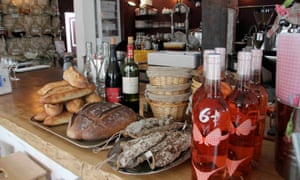
En Vrac is a cave à manger with a difference, boasting 10 shiny steel vats balancing on tree stumps where high-quality organic, zero-sulphite wine is sold to take away – bring your own container or the bar staff will fill one of the retrolimonade bottles. The brainchild of Thierry Poincin, who has a second outlet in Pigalle, En Vrac also has a varied wine selection of 150bottles, and locals crowd round a vast wooden counter laden with crusty loaves and long saucissons. It’s in a corner of Montmartre rarely visited by tourists, and there is a hearty plat du jourfor €10.50, homemade soups and salads, plus a brilliant Parisian classic: ajambon-beurre sandwich with crunchy gherkins. A deli corner stocks everything from gourmet tins of Portuguese sardines and mussels to La Parisienne craft ale and huge jars filled with rum, whisky and vodka marinating aromatic herbs and fruits. It also runs wine appreciation courses and guidance on making your own wine – something that has been pretty much heresy in France until now.
 Corkage €6. 2 rue de l’Olive, 75018, +33 1 53 26 03 94, vinenvrac.frWine pick: Popsec bubbly chenin blanc from the Loire, €18

Au Bon Vingt

Au Bon Vingt,  Cave a Manger,  Paris.
Pinterest
 Photograph: John Brunton
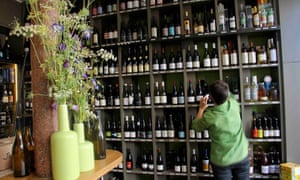
Rue de Bagnolet is like a hidden village in the far-flung 20th arrondissement, and there are a couple of great neighbourhood bars near Au Bon Vingt, Le Piston Pelican and Le Bar de la Réunion, which are well worth a visit. Agnès Baracco is a guru of vins naturels, and sommeliers from all over the city pop in to check out her latest discoveries. At the latest count she stocks over 360 natural wines in her tiny shop and customers have to squeeze in between the piles of cases she is always unpacking. This is a one-woman show, so during the day Agnès operates a simple wine boutique, but from 6pm-9pm it becomes an animated cave à manger, where she prepares generous plates of cheeses and charcuterie and gives informal wine tasting lessons. Only one red and one white are offered by the glass, but the corkage is so low that most people crack open a bottle.
 Corkage €4. 52 rue de Bagnolet, 75020, +33 1 43 56 94 55, no websiteWine pick: Coup de Coeur, gewurztraminer/riesling from Alsace, €12
By , www.theguardian.com
Follow us on Twitter: @TraveloreReport