| |||||
|
Showing posts with label #MexicanFestivals. Show all posts
Showing posts with label #MexicanFestivals. Show all posts
Tuesday, May 22, 2018
Puerto Vallarta 'May Fest 2018' Celebrates Centennial With Music, Art, Culture, Exhibitions and Sports


Friday, April 27, 2018
Vallarta Pride Brings In The Clowns To Celebrate Puerto Vallarta Centennial
| |||||
|


Wednesday, November 4, 2015
Culture Is Kicking In Pátzcuaro, Mexico
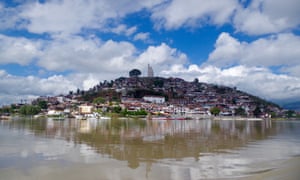 |
| Peak practice … Janitzio island, with José Morelos statue at its peak, Pátzcuaro. All photographs: Erica Buist |
Pátzcuaro may be one of the best places in Mexico to see Day of the Dead celebrations, but the Purépecha people’s heartland has great art, history and scenery all year round
A firework explodes directly above my head and I don’t even flinch. Even a brief time in Mexico will do that to you – the omnipresence of fireworks is like having a friend who habitually cracks their knuckles. When I try to find out why they started at 6am, carried on throughout the day and kept me awake until midnight, the locals shrug, and say: “Somebody’s always celebrating something.”
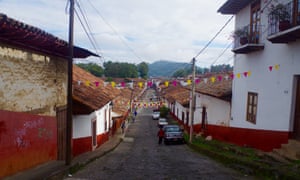
I assume Day of the Dead to be the likeliest culprit. The beautifully preserved colonial town of Pátzcuaro is the beating heart of the indigenous Purépecha people and one of the best places to witness the Day of the Dead celebrations. The run-up sees endless street stalls stocked with pan de muerto sweet rolls, chocolate coffins and sugar skulls with icing eyebrows and glittery eye sockets, and visitors are drawn here to experience Purépecha culture, buy their wares and join in with their holiday traditions. But outside popular holidays such as Day of the Dead and Christmas, the crowds have the good grace to retreat, leaving an easily explored pueblo mágico. Pátzcuaro, 370km west of Mexico City in the Michoacán highlands, got its “magico” status owing to all that stunning colonial architecture, its vibrant Purépecha artisan traditions – and dramatic scenery.
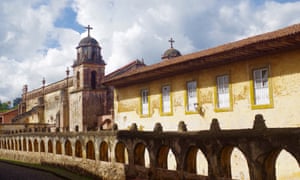
Waking up in the Sol apartment of Hotel Casa Encantada (doubles from £37) I look on to a view of misty blue-green mountains, red rooftops and the dome of the town’s oldest church, Templo del Hospitalito. Casa Encantada celebrates the local area with gusto: it’s full of local folk art, ornaments, rugs, sculptures and paintings, and there’s a traditional Catrina skeleton grinning in the courtyard year-round, welcoming guests with her bony fingers upturned.
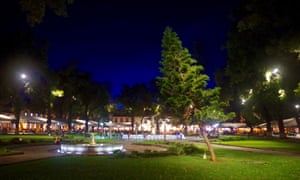
I bound outside into drizzle. Some say it’s the aftermath of Hurricane Patricia. Others say: “Rain happens. Stop whining and see some culture.” There are five art galleries close to the nearby Plaza Vasco de Quiroga (known locally as Plaza Grande) and you can’t swing a chihuahua without hitting a one-off exhibition or knocking over stalls of intricately designed artisanal wares. Shoppers head to Casa de Once Patios, a set of baroque buildings named after their 11 patios. Artisanal crockery, jewellery and fabrics burst from every cranny of the two-storey complex, and enthusiastic buyers scurry over steps and courtyards with the frustration of someone trapped in an MC Escher painting.
It’s a two-minute walk up a hill to the Colegio Jesuita (admission free), which exhibits the work of local, national and international artists. The Tzompantli exhibition, 43 papier-mache skulls decorated by 43 different artists to represent the Ayotzinapa students killed in 2014, is particularly moving. Next door, Museo de Artes e Industrias Populares (admission £1.85) exhibits aspects of Purépecha history, with quotes and detailed information in Spanish. The staff helpfully direct visitors to ensure they see every decorative mask and handmade fork in the right order. Anyone who exits the museo and doesn’t cross the road for a hot chocolate at Joaquinita Chocolate Supremo is legitimately bonkers (possibly). The family has been handmaking stunning chocolate since 1898. For something a little stronger, El Carajo mezcal bar is just steps away.
As the rain dries up, lunch at art collective Foro Cultural Café Maché beckons. Started by six young people, it’s in a colonial courtyard; the walls are covered in murals and some of the tabletops rest on car tyres rather than legs. A young man with long hair is painting a skeleton in watercolours; a pair of old women drink tea. Young Americans smoke in scarves and flip-flops, flowing seamlessly between English and Spanish. I’m served a beautifully smooth espresso and a cheesy, flaky quiche.
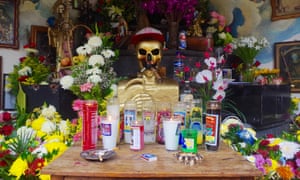
The town is stippled with altars, edible skulls and skeleton T-shirts. Though Day of the Dead only happens once a year, some keep death close by all year: the fascinating Templo de Santa Muerte is a five-minute taxi ride from the town centre and open to the public. The temple is in the front garden of a family home. A man in a baseball cap is lighting incense on an altar. The centrepiece is a skull – also wearing a baseball cap – with a cigar dangling from its mouth. Tequila shots and cigarettes have been left as offerings. A lifesize, elaborately dressed skeleton sits by a sign, “Waiting for the perfect man”. The walls are covered with framed pictures of death in billowing black robes, a scythe and a globe. Santa Muerte, thought to deliver followers safely to the afterlife, is the saint of choice fornarcotraficantes (though most followers are not narcos). Many thoughts cross my mind as I stare into the inky blackness of death’s empty eye sockets, but not one of them is, “Now there’s someone who’ll keep me safe.” Yet, it’s oddly peaceful to see families with young children offering cigars, tequila, prayers and silent reverence – definitely as worth a visit as any neoclassical, robe-swishing church.
The next morning, I’m the only tourist boarding the boat for a 30-minute ride to the sunny island of Janitzio, from the Muelle General (general dock) on Lake Pátzcuaro. Two Purépecha women sit embroidering a shawl and chatting in Tarascan, and when the island’s 40ft statue of José Morelos (one of the leaders of Mexican independence) comes into view, I’m the only one to bother scrambling over bags of grain, packets of nappies and bunches of marigolds to snap photos. We disembark on to a building site. Since the news of drug violence in Michoacán state, Janitzio – which relies solely on tourism – has been quiet. Over the next three months they’re putting in pavements, gardens and public toilets in the hope of attracting more visitors. As I climb the cobbled alleyways towards the island’s peak, it feels like a ghost town. Empty restaurants with spectacular views over the lake and mountains blast out mariachi music to no one.
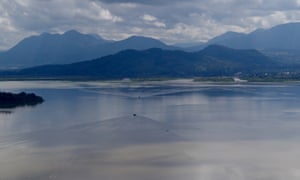
If you’re a sucker for views, from Janitzio’s peak they border on tear-jerking – even before I climb inside the Morelos monument (admission 40p) and up to his raised fist where you can peer out through a window. The lake, ringed by lush green mountains, is calm and flat and blue, dotted with the traditional fishing boats and butterfly nets that gave Michoacán its name, “place of the fishermen”. Drink and snack stalls circle the monument, with shaded areas and benches lightly graffitied with declarations of love. A girl is hanging out washing on the flat roof of one of the restaurants, as mariachi music drifts from below. Down at the dock, boats with more tourists arrive.
Back on the mainland, five minutes’ walk from the Muelle General is a magnificent lunch spot: Tiendita Verde. The ground floor feels like a grotto; even the seats are made of stone. It opens out into a lush garden. Upstairs is wood, with a glass roof and bamboo blinds. It’s like eating in a treehouse. The resident dog, a German shepherd called Locky, approaches with a stick and asks politely but consistently for a game of fetch.
By Erica Buist, www.theguardian.com
Subscribe to:
Posts (Atom)