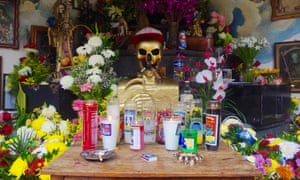
Although it is an intangible tradition, borne down from pre-Hispanic cultures, Day of the Dead is also a celebration for all the senses —even if one of them is failing you. Gerardo Ramírez, who over the years become almost blind, sums it all up in one line: “You honor people, you connect with the past.”
THE SMELL THAT GUIDES YOU FROM THE UNDERWORLD
Together, two smells show dead souls the way out of the underworld: cempasúchil — a type of marigold whose name means “flower of 20 petals in Náhuatl language” — and a tree resin called copal burned at altars.
The native species of cempasúchil smells so strong you can almost hear it, said Verenice Arenazas, a young woman who traded her HR job for her family’s traditional flower field. “As soon as you move it, it tells you ‘here I am, look at me’” she said.
Her family this year produced 17,000 cempasúchil plants in Xochimilco, Mexico City’s famed canal-crossed southern borough. Arenazas’ family grows two types of cempasúchil: those grown by selecting seeds from the most potent-smelling flowers and those that are genetically modified. Both are nearly sold out, she said with a smile.

Arenazas says the flowers smell like the “sweet, fresh, honest work” of the farmers like her who dedicate unending days caring for the flowers. They also smell of “Mexican pride,” she said.
FOOD FOR THE DEAD
On the traditional altars honoring the dead, food is a symbol of Mother Earth. Even the sweetest bread, flavored with orange blossom, has grizzly origins. According to researchers at the Mexican School of Gastronomy, the dough was prepared by mixing honey and human blood as an offering to the gods.
Other historians believe that Spanish colonizers, frightened by human sacrifices in Mexico, created a bread, dipped in sugar and painted it red, to symbolize a heart.

Today there is a special place on altars for the dead person’s favorite food and drink. “The offering loses flavor,” explained Ramírez, “because the dead actually come back; what they eat is the essence.”
Ramírez explained the communion between the living and the dead recalling an anecdote that marked him when he was a child. When his uncle died, the family placed his body on the dining table until the coffin arrived. Then they all sat down to eat there.
THE CREATIVE HANDS PREPARING THE ALTAR
Preparing an altar is a great pleasure to many Mexicans. “To feel the softness of the flowers, where you put the food, all the textures,” said Ramírez. “It’s an explosion of sensations.”
Altars welcome all sorts of handicrafts, from papier-mache skeletons to alebrijes (imaginary animal figures), but“papel picado” - very thin sheets of colored paper cut-outs - is essential. There are places where “papel picado” is still made with hammer and chisel, as in the workshop of Yuriria Torres, located south of Mexico City.
“It’s like sculpting” a work of art, says Torres, who still does the whole process by hand, eschewing stencils or laser cutters.

Some people connect Torres’ art to the sheets of amate tree bark used by pre-Hispanic communities as paper, though the Indigenous precursor was not dyed. Others say the careful cuttings originated in China, and were brought to Mexico by the Spaniards.
Either way, researchers agree that it symbolizes the union between life and death. Perhaps for that reason, the scenes that Torres represents are skulls or skeletons dancing or eating.
MUSIC OVER THE TOMBS
While some older Mexicans remember hearing only the murmur of prayers characterizing the Day of the Dead, today mariachi music can be heard over the decorated tombs of many cemeteries.
José García, a 60-year-old shoe shiner from San Antonio Pueblo Nuevo, a township 90 miles (140 kilometers) west of Mexico City, said people with money would bring a group of musicians to the cemetery to toast with their departed loved ones and listen to their favorite songs.
PHOTOS OF THE DEPARTED
Day of the Dead is one of Mexico’s great visual spectacles — and a celebration of cultural syncretism. All the while, its fundamental purpose is to remember those who have died so their souls don’t disappear forever.
Photos of the departed loved ones take the most important spot on the altar. Colors fill everything. The bright orange of the cempasúchil, the black of the underworld, the purple of the Catholic faith, red for warriors and white for children.
Remembrance is not only individual, but collective.
Some more political altars in the country’s main public university, the National Autonomous University of Mexico, remembered murdered students and the Palestinian and Israeli dead in the Israel-Hamas war. Elsewhere remembrance is institutional, like the offering in the capital’s Zócalo in honor of the revolutionary Pancho Villa on the centenary of his death.
Beyond the visual spectacle, the important thing is to “get into” the offering, to connect with the past and go beyond the senses, insists Ramírez. “It’s not something they explain to you,” he says. “From the moment you are born and experience the celebration, it’s in your DNA.”
But, he adds, one doesn’t have to have money to enjoy the music. Some people just bring “their recordings or their horns,” he said.
BY MARÍA VERZA AND FERNANDA PESCE

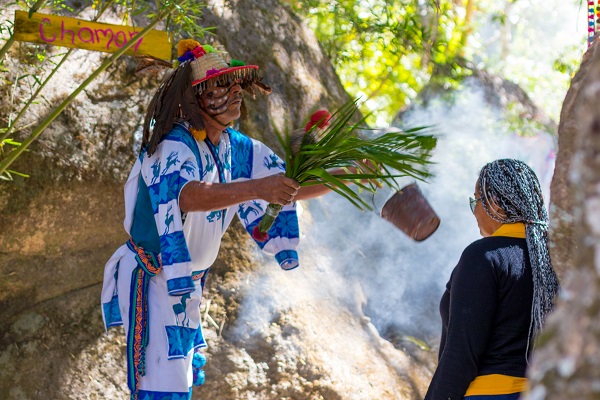 Puerto Vallarta, Mexico –As part of its ongoing commitment to showcasing Mexican cuisine, culture and traditions, Casa Velas, a boutique hotel and ocean club in Puerto Vallarta, has launched a new micro-adventure to a local Huichol village. Included in the nightly rate, guests can take part in a cultural tour led by a bilingual guide to the Kawitu Village in El Eden, Mismaloya, about an hour from the resort.
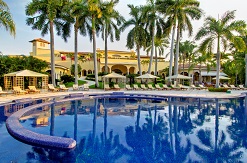 Casa Velas is a luxury all-inclusive boutique hotel and ocean club for adults only in Puerto Vallarta, reminiscent of a Spanish hacienda. The hotel features a private ocean club and is just minutes from the beach. Located just five minutes from Puerto Vallarta Airport and only 15 from the popular downtown area, art galleries and "El Malecon" (the boardwalk), the hotel features 80 spacious suites, some with private pools and Jacuzzis. Nestled on the greens of Marina Vallarta's 18-hole golf course, this Puerto Vallarta golf resort offers guests complimentary golf at three nearby signature-designed 18-hole courses. Its serene, exclusive setting provides an ideal backdrop for a Puerto Vallarta wedding ranging in size from 2 to 300. Lotus Spa at Casa Velas encompasses treatment rooms for singles and couples, a hydrotherapy area, garden-view fitness center equipped with state-of-the-art exercise equipment, and a beauty salon. A novel service is a handbag bar where guests can enjoy use of a "loaner" designer handbag at no extra charge. Emiliano, the AAA Four Diamond rated a la carte fine dining restaurant, is in the hands of one of the area's leading chefs serving Mexican and international cuisine. Guests can also enjoy dining privileges at the sister resort, Grand Velas Riviera Nayarit, with three gourmet specialty options. Forbes Travel Guide has awarded Casa Velas Four Stars, the only boutique hotel on the Mexican Pacific coast to receive. A member of SLH (Small Luxury Hotels of the World), it has been in the top five in TripAdvisor for Puerto Vallarta since 2010. Casa Velas is operated by Eduardo Vela Ruiz, founder and president of Velas Resorts, with brother Juan Vela, vice president of Velas Resorts, by his side. For more information please call 1-888-407-4869 or visit