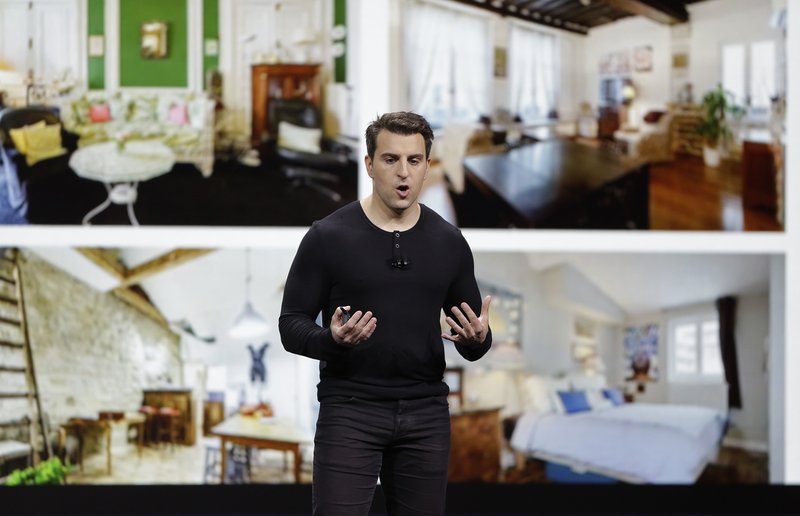
SAN FRANCISCO (AP) — Airbnb is dispatching inspectors to rate thousands of the
properties listed on its home-rental service in an effort to reassure travelers they’re
booking nice places to stay.
The Plus program, unveiled Thursday, is aimed at winning over travelers who aren’t
sure they can trust the current rating system drawn from the opinions posted by past
guests. The misleading pictures drawn by Airbnb’s rating system have become a big
enough problem to spawn
a website devoted to horror stories spanning from an
in a moldy, bug-infested apartment.
“You realize over time that you do have to take more responsibility for your platform,
you have to be hands on, you have to make judgments,” Airbnb CEO Brian Chesky said
in an interview with The Associated Press.
The hands-on touch built into the Plus program comes 10 years after Chesky and his
former roommate started Airbnb in a San Francisco apartment in hopes of bringing
in more money to pay their own rent.
Airbnb’s internal surveys have found nearly three-fourths of the travelers on its service
are willing to pay more for inspector-certified properties, allowing homeowners and
apartment dwellers to quickly recoup a $149 fee to participate in Plus.
Human inspectors will review properties based on a 100-point checklist covering
everything from the speed of the Wi-Fi to the comfort of the bedding. Properties that fail
can still be part of Airbnb’s regular listings; the company will also offer advice on
improvements to qualify.
The program will initially cover about 2,000 properties in 13 cities — Austin, Texas;
Barcelona, Spain; Cape Town, South Africa; Chicago; Los Angeles; London;
Melbourne, Australia; Milan; Rome; San Francisco; Shanghai, Sydney and Toronto.
That’s a small fraction of the roughly 4.5 million properties listed on Airbnb in 81,000
cities worldwide. By the end of the year, Chesky foresees verifying 75,000 homes in
50 cities.
Airbnb is shaking things up at a time its growth has been slowing, a trend the company
would like to reverse before it sells its stock in an initial public offering expected
within the next two years. Despite its popularity, Airbnb remains unprofitable, with a
loss of $75 million on revenue of nearly $2.6 billion last year, according to financial
statements reviewed by The Wall Street Journal.
During a presentation in San Francisco, Chesky announced other steps designed to
make Airbnb more like a traditional hospitality company instead of an industry
renegade that has siphoned business away from major hotels. Frequent travelers
will quality for discounts and other perks. The company also is adding other rental
categories, including bed-and-breakfast inns and boutique hotels.
A major hotel industry group slammed Airbnb’s expansion as a sham.
“Airbnb’s latest scheme is just further proof the company is trying to play in the
hoteling space while evading industry regulations,” said Troy Flanagan of the
American Hotel & Lodging Association. “If Airbnb wants to enter the hoteling
business, then it needs to be regulated, taxed and subject to the same safety compliances.”
Airbnb’s success since its inception a decade ago has drawn fire from city officials
upset about lost revenue from hotel taxes. It has also stirred protests from long-time
renters of homes that are being converted into short-term places to stay instead.
Airbnb’s critics contend the latter trend has been making it even more difficult to
find a place to live in cities such as San Francisco, where housing is already scarce
and expensive.
“There are things that we have done that have had negative impacts on cities and
we need to confront that,” Chesky conceded. But he said he still believes communities
have mostly benefited from Airbnb’s existence because it has helped people stay in
their homes, thanks to the additional money brought in from renting some of the
space whenever they want.
By MICHAEL LIEDTKE