Showing posts with label France travel news. Show all posts

Saturday, June 28, 2025

Travelore News: Paris Overtourism Heats Up At Notre Dame And The Louvre

The latest symbols of overtourism are two iconic Paris attractions known worldwide. Notre Dame Cathedral has been overwhelmed by visitors since reopening after a destructive fire and the Louvre museum, home of the “Mona Lisa,” is a crumbling gilded palace, forced to close its doors due to crowds.

Notre Dame Cathedral

Since the December 2024 re-opening of Notre Dame Cathedral, the visitor experience has changed. While always a popular attraction for visitors to Paris, visits were more manageable prior to the fire of 2019.

Crowds have grown considerably, creating long lines of people standing in the forecourt outside the entrance. The average number of daily visitors to Notre Dame currently stands at 29,000, a nearly 20% increase since the re-opening. Depending on the day of the week and time of day, wait times range from 15 minutes to more than two hours.

Strategies for shortening wait time include going first thing in the morning or booking a 30-minute free tour with a timed entry ticket reservation online or via the app. Slots for party sizes up to six people are only available a few hours prior to entry and sell out quickly. Opening times at Notre Dame are normally 8 a.m. to 7 p.m. Monday through Friday and until 10 p.m. on Thursdays. The Saturday and Sunday hours are 8:15 a.m. to 7:30 p.m. Three daily masses are celebrated at 8 a.m., 12 p.m., and 6 p.m.

Louvre Museum

At Musée du Louvre, the world’s most-visited museum, the doors were shuttered on at least one day last week, prompted by exhausted staff refusing to take up their positions.

CNN reports, “The Louvre welcomed 8.7 million visitors last year — more than double what its infrastructure was designed to accommodate. Even with a daily cap of 30,000, staff say the experience has become a test of endurance, with too few rest areas, limited bathrooms, and summer heat magnified by the pyramid’s greenhouse effect.”

“Roughly 20,000 people a day squeeze into the Salle des États, the museum’s largest room, just to snap a selfie with Leonardo da Vinci’s enigmatic woman behind protective glass.”

Tickets are required. Tours ae available in Engish, French, Spanish, and Italian. The Louvre hours are Monday, Thursday, Saturday and Sunday from 9 a.m. to 6 p.m. Extended hours to 9 p.m. are on Wednesday and Friday. Ticket prices are 22 euros, with free admission offered with proof of I.D. to everyone under age 18 and those under age 26 as a resident of the EEA (EU countries plus Norway, Iceland, and Lichtenstein). Additional free admssions are extended to disabled persons plus one, certain art instructors, and journalists with required credentials. Free admission to all is offered on the first Friday of the month after 6 p.m., except during July and August.

https://libertepress.com/author/laurie-jo-miller-farr/

Sunday, June 15, 2025

Rhône Valley's Côtes Du Rhône And Côtes du Rhône Villages AOCs Increase Focus On Wine Tourism

The Côtes du Rhône and Côtes du Rhône Villages AOCs, two significant appellations of the Rhône Valley, are concentrating on new and exciting wine tourism events and activities for consumers to explore this historic, dynamic part of the region. According to the French Ministry of Tourism, France is the world's leading tourist destination. The past few years have seen continued growth, with 2023 and 2024 seeing a record number of over 100 million visitors. The global wine tourism market is also expected to see continued growth over the next 10 years. The Côtes du Rhône, then, is poised to welcome visitors to this one-of-a-kind region: Imagine sipping wine under the sun, surrounded by medieval villages and rolling vineyards - the Côtes du Rhône is the ultimate getaway for adventure seekers, families, foodies, and culture lovers alike.

Cultural and Historical Wonders

The Côtes du Rhône is rich in history, with four UNESCO World Heritage sites, from the majestic Palais des Papes in Avignon, a 14th-century Gothic palace that once served as the residence of popes, to the Pont du Gard, an ancient Roman aqueduct that stands as a marvel of engineering. Stepping back even further, the Grotte Chauvet 2 cave in Ardèche, an accurate replica of the original Chauvet Caves, showcases prehistoric art that is over 30,000 years old. The stunning wine-producing villages of Séguret, Aiguèze, and La Roque-sur-Cèze truly capture the heart of the Côtes du Rhône with their beautiful scenery.

Sip, Savor, Repeat

For epicures, the Côtes du Rhône is home to a wide range of wines, from expressive reds and crisp whites to delicate rosés, paired with local delights like black truffles, creamy goat cheese, and Nyons olives for the ultimate tasting experience. Gastronomic experiences abound in the Côtes du Rhône, including chic bistros and picnics in the vineyards.

Festivals, Music, and Good Vibes

The Côtes du Rhône is known for its exciting fêtes, from lively music festivals to gourmet food events. Whether tasting through a wine festival or experiencing a traditional celebration, there is always a reason to raise a glass!

Nature, but Make It Fun

For visitors looking for outdoor adventures, the Côtes du Rhône is full of activities, from cycling through the vineyards on the scenic EuroVelo 17 (aka 'Via Rhôna'), hiking through breathtaking landscapes, to taking a guided wine walk. Sustainability is key here, and the region is dedicated to preserving its natural beauty.

Wine Tourism: A New Era

Wineries here are leaning into consumer interests - moving away from stuffy tastings and shaking things up with even more hands-on experiences, such as blending workshops, themed tastings, sensory tastings, massages in the vineyards, and overnight vineyard stays. The Côtes du Rhône region is appealing to those who are wine newbies, as well as to seasoned connoisseurs, with a wide range of unique experiences and something for everyone.

Tourists interested in planning an unforgettable trip to the Côtes du Rhône can www.vins-rhone-tourisme.fr/en for insider tips and must-visit spots.

Saturday, March 29, 2025

Air France Introduces Its New La Première First Class

It was a day of excitement and anticipation at Paris Charles de Gaulle Airport as Air France unveiled the crown jewel of its luxury offerings—the new La Première First Class. This long-awaited reveal marked a significant milestone in the airline's journey to elevate the standards of air travel.

Invited guests, including aviation enthusiasts, travel influencers, and global dignitaries, gathered in a specially designed hangar, transformed for the occasion into a haven of elegance. The stage was set with dramatic lighting and soft ambient music, perfectly reflecting the essence of the French art de vivre.

As the lights dimmed, the curtain drew back to reveal an impeccable display of the new La Première suite. Gasps of awe swept through the crowd as they took in the unparalleled sophistication of the space. Each suite featured sliding doors for complete privacy, luxurious leather seating that converted into a fully flat bed, and bespoke amenities created in collaboration with renowned French designers and brands.

At the heart of the experience was a commitment to unparalleled comfort and personalization. The onboard dining options showcased Michelin-starred menus crafted by some of France's most celebrated chefs, complemented by a curated selection of fine wines and champagnes. Passengers could also indulge in an entertainment system featuring the latest films and an extensive library of cultural content.

Thursday, February 20, 2025

Travelore Tips: Expect To Pay More For Airline Tickets To France Starting Next Month

After months of delays, the government of France is poised to increase ticket taxes on airline flights to, from, or within the country as early as next month.

France has imposed a “solidarity tax” (Taxe de Solidarité sur les Billets d’Avion – TSBA) on airline tickets since 2006, but the TBSA is set to significantly increase on March 1, 2025. For economy class tickets on short flights within France or Europe, the tax will increase from €2.63 to €7.40. For business class, the tax is €30.90. Longer economy flights will see new tax amounts ranging from €15 – €40, while business and first class will pay €120 per ticket.

Private jets will pay the most, with taxes of €2,100 for long-haul flights.

Flights to the island of Corsica, and French overseas territories, including Mayotte, Guadeloupe, French Guiana, and French Polynesia will be exempt from the tax increases.

The taxes were originally introduced to fund international aid programs and were extended in 2020 for environmental reasons in the hopes that higher taxes would drive down demand for air travel and its subsequent carbon emissions. Now, it’s a combination of environmental concerns and a large budget shortfall that are driving the tax increase.

The increase had originally been proposed last fall, but was shelved following the collapse of the Barnier government after a vote of no confidence in early December in the National Assembly. A new government was appointed by the end of December and has since begun returning to much of the legislation that was tabled by the government change.

Airlines, of course, aren’t happy. Air France has estimated the increase will cost them €100M, and compromise the competitive position of France as an aviation hub, allowing Air France to lose market share to other European competitors. The Irish low-cost carrier Ryanair threatened last fall to end service at ten French Airports if the tax increase is ultimately passed. Ryanair serves 22 airports in France.

Air France had already begun collecting the higher taxes from October 24, but suspended the practice after the government collapse in December, when the tax hike was ultimately not implemented by the original deadline. The French state owns 28% of Air France parent Air France-KLM, while The Netherlands owns 9%.

In spite of Air France’s protests, it’s worth noting that other European countries (with whom France competes for air traffic) are also planning increases to passenger taxes. The United Kingdom proposed a tax increase set to take effect in 2024, with a further increase annually through 2026.

The European Business Aviation Association (EBAA) and France’s national aviation union (FNAM) also condemned the tax increase, saying that the taxes on aviation are already high. The FNAM also criticized the government for increasing the taxes without conducting and economic impact study.

Amélie de Montchalin, France’s minister for public accounts, explained that the tax increase is a solidarity measure—essentially a luxury tax: “Twenty per cent of the population with the highest income is responsible for more than half the money spent on air travel.”

Many EU countries levy taxes on air passengers. Belgium, Denmark, and Bulgaria have plans to introduce the taxes. But other countries, specifically Spain, Portugal, and much of Eastern Europe continue to allow air passengers to travel without similar taxes added to the cost of their ticket.

Travelers won’t need to do anything extra to pay the taxes; they’ll be collected as part of the ticket taxes that airlines collect within the total ticket price.

The International Air Transport Association (IATA), a global airline trade association, estimates the aviation industry directly supports just under 5% of France’s GDP and is responsible for supporting some 1.3 million jobs. France is a major base for European commercial plane maker Airbus, which is headquartered near Toulouse.

https://www.fodors.com/news/author/scott-laird

Tuesday, January 28, 2025

French Mayor Calls For Cruise Ship Ban With Capacity Of Over 900 Passengers On French Riviera

Protestors from the group Stop Croisieres blocking MSC's mega cruise ship in 2023 (Stop Croisiers)

The mayor of Nice, France, a popular tourist destination along the French Mayor Calls for Cruise Ship Ban on French Riviera, joined the growing number of destinations calling for restrictions on cruise ships. He cited the now familiar complaints of overtourism and pollution while proposing a ban starting this summer to stop large cruise ships from anchoring in the picturesque bay between Nice and Villefranche long known as a destination for the rich and famous.

“Tourism yes, overtourism no,” Mayor Christian Estrosi said during his annual New Year’s address outlining the political goals for the coming year. Estrosi is also president of the Nice Côte d'Azur Metropolis but would require the support of other local mayors to enact his bans which focused on large cruise ships as well as house sharing through the popular site Airbnb.

“The cruises that pollute and dump their ‘low-cost clientele’ who consume nothing, but leave their waste behind have no place with us,” Estrosi declared. Already known for his criticism of the cruise industry, the mayor simply said “Nice no longer wants ‘low-cost cruises,” to stop in its port.

Speaking on a local radio program, the mayor reiterated his position saying efforts were underway to “cancel all cruises that can still be canceled ahead of drafting a banning order.” He called for a ban effective July 1 but clarified his position was specifically to stop cruise ships with a capacity of over 900 passengers or over 190 meters (690 feet) in length.

The proposed ban targets the contemporary segment of the industry with large ships carrying 4,000 or more passengers while seeking to maintain the business of the small, ultra-luxury cruise ships which are more in keeping with the image Nice seeks to project. Estrosi contends the size restriction would eliminate about 70 percent of the cruise ship passengers scheduled to land in Nice.

Estrosi declared “I don’t want these floating hotels putting down their anchors in Nice.” A spokesperson for the trade group Cruise Lines International Association however responded with surprise noting “No large cruise ships are scheduled to call at the Port of Nice in 2025.”

While a popular destination, Nice and Villefranche without docking facilities have already seen a decline in the number of cruise ship calls as the ships must tender passengers ashore. Estimates are the port had about 650,000 cruise passengers and approximately 100 cruise ship visits down from 200 or more a decade ago. French media reports indicate there are a total of 125 cruise ship calls scheduled for Nice in 2025.

Estrosi is not calling for cruise ships to stop visiting the French Mayor Calls for Cruise Ship Ban on French Riviera, but just his little part of the coast. He suggested the ships could proceed to Cannes, which already has more than two times the number of annual cruise ship calls. The large commercial port at Marseille would also be a possibility but it is about a two-hour driving distance to the west from Cannes, Nice, and Villefranche.

Local officials were quick to point out that even if Estrosi could build support for his ban, he lacks the authority to change many cruise ship visits. Local authority only extends 300 meters from the shore (less than 1,000 feet) and many of the large cruise ships anchor further out putting them in waters controlled by the federal authorities.

It is not the first attempt to limit cruise ships along France’s Mediterranean coast. The group Stop Croisières, which calls itself environmentalists, has been staging protests. The group used Greenpeace tactics taking to small boats to block the arrival of cruise ships.

Advocates point to the impact on Venice, Italy after the city was forced into banning large cruise ships while other destinations such as Key West, Florida also moved to block large ships. Bar Harbor, Maine continues to be locked in a debate and legal actions after imposing a ban on most cruise ships while other destinations such as Juneau, Alaska reached a voluntary agreement with the cruise industry. European cities ranging from Amsterdam to Barcelona have also proposed moving cruise ship docks out of the center of the city.

https://maritime-executive.com/

Sunday, December 22, 2024

Traveling by Train Between Germany And France Just Got A Whole Lot Easier As Direct, High-Speed Train Launches

German rail service operator, Deutsche Bahn, officially launched a direct, high-speed train on Monday, linking both countries between Paris and Berlin, while further strengthening the friendship bond between the two, in hopes of luring more travelers to travel by rail service.

At 9:55 a.m. (0855 GMT), on Monday, December 16th, the German ICE train departed from the French capital's Gare de l'Est station and arrived eight hours later at Berlin Hauptbahnhof at 6:03 p.m., connecting both countries by train via a once-per-day journey that is not only convenient but welcomed by many.

Germany's ICE Train Attended and Lauded by Dignitaries at Inaugural Launch and Sets Off Just in Time For the Holidays

Both France and Germany are high-stakes players within the European Union. Their close-knit relationship makes them the two most popular countries within the EU, while boasting larger-than-life economies in comparison to other European countries.

Dignitaries, such as François Delattre, the French ambassador to Germany, and Kai Wegner, the governing mayor of Berlin, were in attendance for the inaugural launch of the new, direct, high-speed train that links both capitals ‘from city center to city center.’

Commuters also get to experience the ICE train just in time for the Christmas holidays, stopping at major holiday destinations such as Strasbourg, Karlsruhe, and Frankfurt during its travels from Berlin to Paris, and vice versa.

For those traveling to Berlin, the high-speed train arrives at Hauptbahnhof each day shortly after 6 p.m. For those traveling to Paris, arrival time at the Gare de l'Est station is scheduled for slightly before 8 p.m.

And, at a reasonable price for a one-way ticket starting at €24.99 ($26.23) to upwards of €99 ($104), depending on seating class, amount of tickets, and travel dates, traveling via this rail service is a win-win for everyone.
'
The New, Direct, High-Speed Train Affords Deutsche Bahn a Chance to Redeem Itself With Commuters

Deutsche Bahn’s reputation for prompt and punctual train services has been on the negative side due to 60 percent of their long-distance trains arriving on time, while the remaining 40 percent were continuously late, causing travel nightmares for passengers trying to get to their destinations on time.

With the launch of its new, direct service linking both France and Germany’s capitals, the German rail service operator hopes to redeem itself with commuters, while increasing the percentage of punctual train arrivals by an additional 15 percent.

"German Transport Minister Volker Wissing also said it is more than “just a new, additional offer.” He said, “We still have a lot of potential to get as many people as possible onto the rails inside Europe with attractive offers, including for longer journeys and live out this friendship.”

In addition to the new, direct rail service between Paris and Berlin, Deutsche Bain offers a direct, seven-hour train journey between Munich and Amsterdam, as well.

https://www.thetravel.com/author/margherita-marullo/

Sunday, December 1, 2024

The World Gets Its First Glimpse Inside Notre Dame Cathedral After 5 Years Under Wraps

Five years after a catastrophic fire reduced Notre Dame Cathedral to a smoldering shell, journalists got a first glimpse of the Gothic masterpiece’s fully restored interiors during a visit with French President Emmanuel Macron. The transformation is nothing short of breathtaking: light dances across brilliant stone, gilded accents gleam anew, and the iconic monument’s majesty is reborn. From Dec. 8, visitors will once again marvel at the cathedral’s blend of history and craftsmanship.

Nave: brilliant stone

The nave, once darkened by soot and rubble, now radiates a celestial brilliance. Visitors can see the true color of the cathedral’s walls: a pale Lutetian limestone — named after the Roman word for Paris, Lutecia — that glows under sunlight streaming through restored stained-glass windows. The newfound blond hues highlight the soaring Gothic columns and ribbed vaults, creating a bright and uplifting atmosphere. Restorers say it’s the first time in centuries the true stone has been exposed in this way.

The polished checkerboard marble floor, glistening underfoot, is so smooth it seems you could glide across it — communicating with the gilded, golden grille partition of the choir area.

Overhead, incandescent chandeliers hang majestically from each vaulted arch, stretching from west to east, casting a warm, golden light throughout the nave.

The meticulous restoration process involved cleaning over 42,000 square meters of stone — an area equivalent to roughly six soccer fields — using innovative latex peels to strip away centuries of grime without causing damage. Conservators uncovered mason marks etched by medieval builders — intimate traces of the artisans who shaped Notre Dame in the 12th and 13th centuries.

This gleaming transformation is a stark contrast to the wreckage of 2019, when the nave was strewn with charred debris.

Altar: blaze fused into Christ’s hand

The altar in the cathedral’s chancel carries a poignant symbol of the fire’s devastation. Nicolas Coustou’s Pietà, part of the Vœu de Louis XIII ensemble, survived largely unscathed, but molten lead from the blaze fused into the hand of Christ. Restorers chose to preserve this as a subtle, yet powerful, reminder of the tragedy.

Surrounding the altar, the intricate marquetry floor, long hidden under layers of dirt, has been pieced together from fragments recovered after the fire.

Nearby, the polished Cross of Glory, which famously — literally — glowed amid the flames, now stands restored to its full brilliance. Framed by the radiant blonde stonework of the nave, the cross serves as a centerpiece of the cathedral’s rebirth.

Organ: A complex revival

The grand organ, among the largest and most storied in France, has undergone an intricate revival. Spared from the flames but coated in lead dust, its 8,000 pipes, ranging in size from that of a pen to over 10 meters (33 feet) tall, were painstakingly disassembled, cleaned, and retuned. Over two years, this work was performed with precision in the cathedral’s silent, cavernous interior, where harmonization was achieved entirely by ear.

Now, the organ’s grandeur is unmistakable. Its towering wooden case, marked with carvings left by past craftsmen, gleams under sunlight streaming through restored clerestory windows. Even in silence, it commands awe.

Chapels: murals rediscovered

The 29 chapels circling the nave and choir burst with color and detail previously dulled by dirt and neglect. Restorers revealed intricate murals, gilded stars on ceilings, and vibrant motifs originally created under Eugène Viollet-le-Duc’s direction. Each chapel tells a unique story through its designs and themes.

The Chapel of Saint Marcel stands out as a masterpiece, its mural of the saint’s relics vividly restored. Visitors are captivated by its radiant colors, producing an effect likened to the Sistine Chapel in Rome — a visual firework display. In other chapels, traces of 19th-century painters’ color tests, hidden in nooks, provide glimpses into their artistic process.

Transept crossing: rebuilding under pressure

The transept crossing, where the original spire collapsed, presented one of the restoration’s most formidable challenges. Above, soaring new vaults of Lutetian limestone replicate the medieval originals with remarkable precision.

Beneath the crossing, archaeologists uncovered a trove of history: fragments of Notre Dame’s medieval jubé, or choir screen, buried in the rubble. These intricately carved stones, some still bearing faint traces of polychrome paint, provide a rare glimpse into the cathedral’s vibrant 13th-century decorative history.

Roof, spire and safety measures

The newly restored roof draw gazes skyward, where medieval timber techniques have been faithfully recreated. Known as “the forest,” the intricate wooden framework remains hidden beneath the roofline, but glimpses into the rafters reveal the precision of both ancient and modern craftsmanship.

Outside, the spire rises 96 meters, faithfully replicating Viollet-le-Duc’s 19th-century design. Clad in oak and lead, it stands crowned by a gilded rooster containing relics of St. Denis, St. Genevieve, and a fragment of the Crown of Thorns, alongside a scroll listing contributors to the restoration.

The spire also honors the late General Jean-Louis Georgelin, who oversaw the project until his death in 2023. His name is now etched at its base.

There’s more than meets the eye in this restoration. Notre Dame now features unseen state-of-the-art fire prevention systems to guard against future disasters. Thermal cameras monitor the roof, and a fine misting system, designed to extinguish flames at their source, is seamlessly integrated into the structure. Fireproof barriers divide the roof into compartments, preventing flames from spreading.

Reinforced water supply lines can deliver 600 cubic meters (21,188 cubic feet) of water per hour, ensuring the cathedral is better protected than ever before.

By THOMAS ADAMSON

Tuesday, September 17, 2024

The Bells Are Back At Notre Dame Cathedral In Paris. They’ll Ring For The Post-Fire Reopening

Notre Dame Cathedral in Paris is getting its bells back, just in time for the medieval landmark’s reopening following a devastating 2019 fire.

A convoy of trucks bearing eight restored bells — the heaviest of which weighs more than 4 tons — pulled into the huge worksite surrounding the monument Thursday on an island in the Seine River.

They are being blessed in a special ceremony inside the cathedral before being hoisted to hang in its twin towers for the Dec. 8 reopening to the public.

Cathedral Rector Olivier Ribadeau Dumas, wearing a hardhat as he prepared to enter the cathedral and bless the bells, called them ‘’a sign that the cathedral will again resonate, and that its voice will be heard again. A sign of the call to prayer, and a sign of coming together.”

The bells will be raised one by one and tested out, but they won’t ring in full until the day of the reopening, said Philippe Jost, overseeing the massive Notre Dame reconstruction project. He called the bells’ arrival ‘’a very beautiful symbol of the cathedral’s rebirth.’

While construction on the cathedral started in the 12th century, the bronze bells damaged in the fire are from the 21st century. They were built according to historical tradition to replace older bells that had become discordant, to mark the monument’s 850th anniversary.

The cathedral’s roof and spire, which collapsed in the fire, have been replaced, and scaffolding is being gradually removed from the site.

PARIS (AP)

Sunday, April 28, 2024

Paris To Face Major Disruption Ahead Of Games Opening Ceremony, Says Police Chief

Paris will face major disruption ahead of the Olympics opening ceremony along the Seine on July 26, as organisers ramp up security measures to safeguard the event, the city's police chief said.

Organisers hope the opening ceremony, in which 160 boats carrying athletes from around the world will travel a 6 kilometre route along the Seine river towards the Eiffel tower, will deliver a jaw-dropping spectacle. Some 300,000 spectators will watch from the banks of the Seine as a global audience tunes in on TV.

But the ceremony is also a major security headache, taking place against a backdrop of wars in Ukraine and Gaza. French President Emmanuel Macron has already floated the possibility of scrapping the river ceremony and reverting to at least two back-up plans if the security risks become untenable.

Paris residents with a view of the Seine can invite friends to watch the opening of the 2024 Summer Games from their balconies, but should prepare for heavy traffic and limited movement, Paris police chief Laurent Nunez said at a press conference.

Adjacent metro stations, most river crossings and all water traffic will be halted in the week before the open-air ceremony, Nunez said, adding that some bridges will remain open "in order not to cut Paris in two halves."

Everyone who wants to access the immediate surroundings of the Seine in the week before the Games will need to sign up on an online platform, Nunez said. Local residents hoping to access their homes, which are among the most prestigious addresses in France, will need to do the same.

Paris mayor Anne Hidalgo, who also spoke at the event said the disruption would impact around 20,000 residents and business owners.

Asked about Macron's comments earlier this month, Nunez said his teams were still working on the 'Plan A' of the river ceremony.

"As of today, we have no reason to be worried," Nunez said.

https://www.reuters.com/authors/vincent-daheron/

Monday, April 8, 2024

British, French Troops March In Historic Joint Parades In London And Paris In A Show Of Solidarity

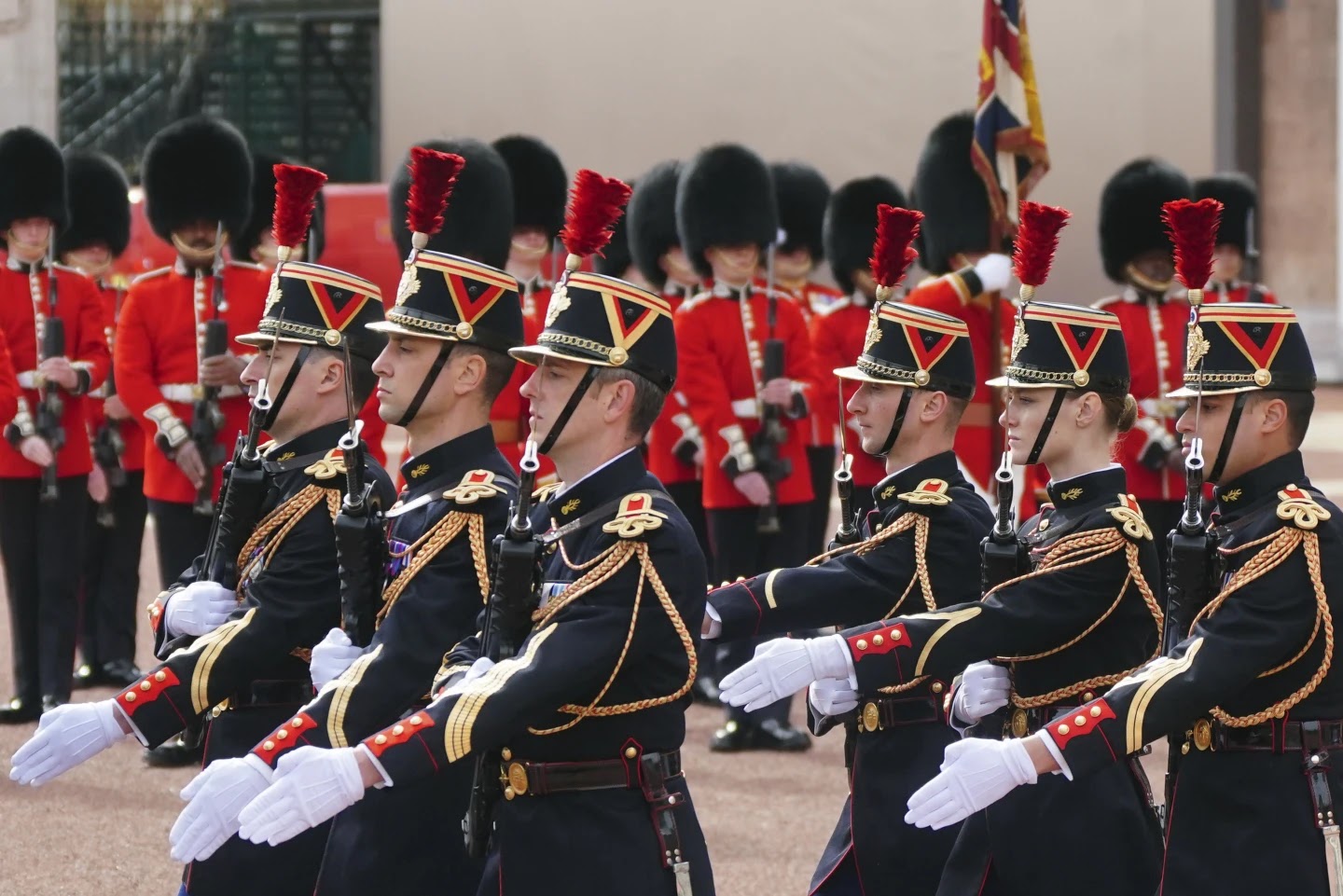
French troops joined their British counterparts in the famous Changing of the Guard ceremony outside Buckingham Palace for the first time Monday, marching together in a display of solidarity between Britain and France amid the war in Ukraine.

At a parallel ceremony in Paris, British soldiers wearing tall bearskin hats took part in an unprecedented joint military parade in front of the presidential Elysée Palace, as the French army choir sang the two national anthems, “God Save the King” and “La Marseillaise.”

The twin events were to celebrate the 120th anniversary of the Entente Cordiale, the 1904 diplomatic agreement between Britain and France that paved the way for their collaboration in both World War I and World War II.

In a video message posted on social media on Monday, French President Emmanuel Macron said the alliance serves as a foundation for deepening Anglo-French relations particularly at a time of the return of war.

“Our Entente Cordiale remains as relevant as ever,” Macron said. “Faced with the resurgence of war in Europe, we stand together to defend the values we share and to support Ukraine as it defends itself against its aggressor.”

British Foreign Secretary David Cameron and his French counterpart, Stéphane Séjourné, used a joint opinion piece published Monday in the Daily Telegraph to urge allies to boost funding for Ukraine.

“It is not for France and Britain alone to solve these challenges. But, together, we can rally others to join us in overcoming them,” they wrote. “We must do even more to ensure we defeat Russia. The world is watching – and will judge us if we fail.”

Prince Edward and his wife Sophie inspected the joint parade in London, which included 32 members of the Gendarmerie’s Garde Républicaine and 40 guardsmen from the Scots Guards. Edward and Sophie were representing King Charles III, who is continuing his cancer treatment and was not at Buckingham Palace.

It was the first time a country that isn’t part of the Commonwealth group of nations has taken part in the traditional Changing of the Guard ceremony, though the French troops did not participate in guarding the royal residence — a ceremonial duty that can only be performed by U.K. or Commonwealth troops.

In Paris, 16 members of the Coldstream Guards were the first foreign troops ever to take part in guarding the French presidential residence.

Britain and France said Monday’s ceremonies were part of a wider program this year to celebrate the two countries’ historic military and diplomatic ties. This includes major events in Normandy in June to commemorate the service of Allied veterans who fought to liberate France from Nazi occupation.

Last year, King Charles chose France as the destination for his first foreign visit after becoming monarch. The state visit, which was planned for March but was postponed to September amid large demonstrations in France, was a statement underlining the ties between the two countries.

BY SYLVIA HUI

Monday, March 11, 2024

The Château L'Hospitalet Wine Resort Beach & Spa In Narbonne, South Of France, Joins The Small Luxury Hotels Group

Nestled in the heart of vines on the Mediterranean coast, Château L'Hospitalet Wine Resort Beach & Spa ***** offers a sumptuous retreat in an exceptionally beautiful natural setting. Overlooking the sea and green hills, and surrounded by the garrigue's delicate fragrances, this 5-star hotel is a paradise for wine enthusiasts, foodies and nature lovers.

In the heart of a winery surrounded by pines, olive trees and garrigue, the Château L'Hospitalet and its Villa Soleilla blend into a landscape of biodynamic vineyards and expansive gardens. Swimming pools, tennis courts, a putting green and walking routes in the vast and protected La Clape area offer a variety of activities. Visitors also enjoy a wine immersion with guided tours following the production of wine from the vine to the glass. Enthusiasts can go further by reserving a masterclass.

The restaurants follow the seasons. In fall and winter, restaurant Chez Paule offers traditional wood-burning cuisine. In spring and summer, L'Hospitalet Beach offers a selection of Mediterranean dishes. And year-round, the Art de Vivre gourmet restaurant offers a delightful experience, combining food and wine for vertical cuisine.

The Spa Soleilla uses expert face and body care rituals, offering the luxury of an ultra-personalized approach and in line with the philosophy of partner products, Biologique Recherche© and Holidermie©. The view of the vineyards and a sauna complete the experience.

Small Luxury Hotels of the World (SLH) is a collection of luxury independent hotels in various locations around the world. Founded in 1990, this organization brings together high-end hotel establishments that are distinguished by their charm and offer a quality travel experience focused on uniqueness, exceptional service and commitment to excellence. Their global presence offers travellers a variety of options for luxurious and memorable stays.

Château L'Hospitalet Wine Resort Beach & Spa Route de Narbonne Plage – 11100 Narbonne – France https://www.chateau-hospitalet.com/?

Wednesday, February 14, 2024

Notre Dame Reveals New Spire And Golden Rooster As Scaffolding Removed

The remaining process of removing all of the scaffolding could take weeks if not months.

The scaffolding surrounding the top of Paris' Notre Dame Cathedral was taken down on Monday, nearly five years into the reconstruction process.

Notre Dame Cathedral, ravaged by fire in April 2019, draws closer to its renaissance.

Giant cranes, removing sections of scaffolding, unveiled the cathedral's recently installed spire along with the new golden rooster and a cross that crown it.

While much of the cathedral remains surrounded by scaffolding, the clearing of the structures around its peak offers both the general public and the devout a glimpse into the future appearance of Notre Dame once the restoration is complete.

The last few months have seen remarkable progress on the cathedral’s rebuilding putting it well on track for a December 8 reopening, a date eagerly awaited by Paris residents and millions of tourists who normally visit the cathedral every year.

Although the cathedral will not be open to the public during Paris 2024 Summer Olympics, when millions of visitors flock to the French capital for the Games starting July 26, the rebuilt spire and roof should be complete, giving the cathedral a finished look from outside.

https://www.euronews.com/

Sunday, February 11, 2024

As The Olympics Loom, Parisians Ask: Should We Skip Town? Games Organizers Work To Win Their Hearts

Before the Paris Olympics open and upend the French capital’s usual rhythms, retiree Pierre Schapira plans to hire a car and quit town.

But with the intense Olympic security measures and traffic disruptions they’ll cause, will that even be doable? For his answer, Schapira went straight to the top — popping the question this week to chief of police Laurent Nunez himself.

As he’s already done at other town hall meetings, did so again at this one, and will do at more to come, Nunez ever-so-patiently explained that Parisians are going to have to adapt to the July 26-Aug. 11 extravaganza but that it’s not going to put their lives and livelihoods on hold.

“It’s not going to stop you from entering or leaving Paris,” Nunez said Thursday to the audience of about 200 people, including some watching via video link in an overflow room next door.

Holding the Games in the bustling heart of such a compact city, rather than in a purpose-built Olympic park in the outskirts like Rio de Janeiro in 2016 and other previous hosts, was always going to rile and worry some Parisians who can be cantankerous at the best of times. Nunez, Games organizers and City Hall officials are finding that out for themselves as they embark on a concerted campaign to win Parisian hearts and minds and get people in the Olympic mood or, at least, get ready.

“We laugh about it ... because we are spending nearly all of our evenings together,” Deputy Paris Mayor Pierre Rabadan said after he, Nunez and other organizers spent more than two hours at the meeting detailing Games preparations and responding to questions.

“It’s quite time consuming but necessary,” Rabadan said. One of their aims, he added, is “to go against the talk at the moment that it’s better to leave, that being in Paris is going to be a catastrophe and whatnot. You get that at every Games and obviously we knew that because of our concept, we’d hear that, too.”

By mostly using existing sports venues as well as temporary ones that will be erected in the shadow of the Eiffel Tower and at other iconic sites before being dismantled again, Paris’ goal is to avoid the legacy of waste and vast cost generated by other Games and reduce the mega-event’s environmental impact. Images of Olympians competing amid the architectural beauty of central Paris should, organizers and the government hope, make France shine.

But for the 2.1 million people who live within the city limits and hundreds of thousands of others who commute in from the suburbs, the consequences of 10,500 athletes competing in their midst are going to be considerable. Traffic restrictions, special permits for this and that, police checkpoints, road and Metro station closures, millions of visitors from elsewhere in France and around the world. The list goes on.

“It’s a fantastic gamble but it’s going to be quite disruptive for residents,” said 79-year-old Schapira after hearing Nunez and the other speakers.

Jean-Pierre Rollin, who owns two souvenir stores near Notre Dame Cathedral on its island in the River Seine, wanted to know whether tourists will be able to get past police checkpoints before and during the July 26 opening ceremony. It is being held on the river and a security cordon will be in place along both banks.

“If we have no customers, there’s no point staying open,” Rollin told Nunez. The police chief acknowledged the security that day is going to make getting around more complicated.

Other questions also focused on the impacts of security measures. One man asked whether there’ll still be fireworks for France’s July 14 national holiday and was told there will.

Only once, when a retailer said he’d heard that daytime deliveries would be banned, did the police chief lose patience, puffing out his cheeks.

Not true, he insisted.

“I can’t repeat things 50,000 times,” he said. “I don’t want to hear things like that.”

The work of preparing people clearly has a way to go. A government website, “Plan for the Games,” offers tips. Among them: avoid Olympic crowds on public transport by riding bikes or walking.

Schapira, the retired dentist and former politician, came out of the meeting thinking that “it is indeed extraordinary to have the Games inside Paris.”

But he was nevertheless grateful that he’ll be in the Alps by then, on holiday.

“I prefer to watch them on the television,” he said. “I’m not enough of a sports fan to stay. I am happy to be leaving.”

BY JOHN LEICESTER, AP

Monday, February 5, 2024

Warning To Tourists In France As Bottled Water Found To Have Come From Contaminated Source

A French bottled water producer has been illegally treating contaminated water in their products, it has been revealed.

Nestle was found to have been hiding the fact the water it was selling under its Perrier, Vittel and Contrex brands had come from a contaminated source, which had been hidden by prohibited purification systems.

Some 30percent of the brands' products are thought to have undergone the illegal treatment which was uncovered in an investigation by Le Monde and Radio France.

French newspaper Los Echos revealed last Monday that Nestle had "breached regulations to maintain the safety of its water".

According to Le Monde the Swiss food and drink giant used disinfectants “due to sporadic bacterial or chemical contamination”

French law does not allow producers to use purification techniques on products labelled as ‘spring’ or ‘mineral’ water, as they are supposed to come from preserved underground resources and should already be safe to drink when they emerge from the well.

In a statement, the water producer admitted it had “microfiltration at [its] waters sites at a finer level than was previously recognised by the French authorities”.

It said: "We have also used activated carbon filters and ultraviolet systems which, though permitted by other jurisdictions, are not in line with applicable French natural mineral water regulations."

Nestle said it had "proactively" reported its use of the illegal methods to French authorities in 2021 and “presented them with several options to ensure compliance moving forward”.

Source: https://www.express.co.uk/journalist/123507/Casey-Cooper-Fiske

Saturday, January 20, 2024

Inside The $760M Restoration Of Notre Dame Cathedral

The spire of Notre Dame, crowned by a brand new golden rooster, regained its place in the Paris skyline last week.

As tourists and Parisians gathered outside the UNESCO-listed cathedral to admire the return of one of its most emblematic features — for now, still encased in scaffolding — the Notre Dame worksite remained in full swing. Nearly 500 craftspeople are busy with rebuilding efforts, working to ensure the Parisian landmark is ready for its grand reopening to the public less than a year from now.

“It’s fascinating to see how something of such historical value is being restored,” said Stephan Book, a tourist visiting Paris from Sweden with his daughter and 80-year-old father. “And the ambition to do it all in five years,” he added, “It’s like when Kennedy said (humans) were going to the moon.”

On a recent visit to the construction site, President Emmanuel Macron promised works were “on schedule” for Notre Dame to open to the public on December 8, 2024, five years and seven months after the fire that destroyed large parts of the 860-year-old building in April 2019.

“By the time the Olympic Games come around (in July), we expect to have un-scaffolded the upper part of the spire and completed most of the roofing, so that Parisians and visitors from all over the world can see just how close the cathedral is to reopening,” Philippe Jost of Rebuilding Notre Dame de Paris (the public body responsible for the conservation and restoration of the cathedral), told the French parliament on December 13.

Already, those admiring the gothic structure from the outside are excited by the prospect of being able to re-enter the cathedral.

“The first time I came to Paris was 60 years ago, then 40 years ago,” said Stephan’s father, Göran Book, who remembers entering Notre Dame on every one of his previous visits to Paris. “Now I’m 80,” he added. “If I’m still alive next year, I’ll have to come back to see the reopening.”

A monumental effort

According to Rebuilding Notre Dame de Paris, there are nearly 250 companies and art workshops across France tasked with “working on the cathedral’s renaissance.” This includes carpenters, stonemasons, scaffolders, sculptors, gilders, glassmakers and even organ builders, who are restoring the 8,000 pipes and 115 stops of Notre Dame’s great organ, the largest in France.

After the 2019 fire, the first two years of work were devoted to securing the building, completing project studies and awarding tenders. The restoration phase then officially began in September 2021.

In recent months, the most visible advances have been made on the restoration of the framework of the roof, the spire and the large upper galleries.

Alban Dubois, who works as a waiter in Cafe Panis, just across the street from Notre Dame, has been observing the daily progress from the windows of his workplace.

He was there, serving tables, on the day of the infamous fire, and remembers watching in shock as the flames grew larger and the windows of his restaurant became progressively hotter. “People gathered (in the restaurant) and looked on helplessly,” he said. “Some people were crying… It was all very sad.”

Now, Dubois looks forward to the cathedral reopening and predicts lots of people will stop by to pay it a visit. “Even though (Notre Dame) has been here for so many years, it’s going to be a bit like an inauguration,” he said.

According to Jost, 14 million visitors are expected to “flock to see the results of (the) restoration.”

Marking the 21st century

While Notre Dame’s original appearance will be restored, President Macron has also expressed a desire for our century to “have its place among the many others that feature in the works of this cathedral.”

Earlier this month, he announced a competition to allow contemporary artists to recreate six of the stained glass windows on the southern side of Notre Dame, in order to “mark this 21st century.”

In similarly commemorative fashion, the name of the French general who had been overseeing the reconstruction of Notre Dame before his death in a mountain accident earlier this year, was engraved in the wood of the spire. Jean-Louis Georgelin “will remain forever” part of Notre Dame, said Macron, who personally took part in the engraving process on December 8, the day that the cathedral’s oak spire regained its place.

The names of others who took part in the reconstruction of Notre Dame have also been made a permanent fixture of the new cathedral. A sealed tube was placed inside the golden rooster mounted atop the spire on December 16, containing a document listing the 2,000 names of those who have been involved in the works.

The cathedral spire’s previous rooster had been found, damaged among the rubble, the day after the fire. Inside it were the relics (the mortal remains) of Saint Denis and Saint Geneviève, as well as a fragment of Christ’s crown of thorns, all of which remained intact and have now been placed inside the new rooster, according to the Diocese of Paris.

The old rooster — alongside the six stained glass windows set to be replaced — will be housed in a new museum dedicated to Notre Dame, the opening of which was announced recently by Macron. “It will be a museum of art, a museum of history, a museum to describe the permanent construction site of Notre Dame de Paris,” he said.

The cost of rebuilding Notre Dame is expected to be approximately 700 million euros ($767 million). In total, 846 million euros ($928 million) were raised in donations from 340,000 donors in 150 countries, according to Rebuilding Notre Dame de Paris.

Jost has said that any donated money that isn’t spent on the reconstruction will likely be used to “benefit the cathedral” in other ways

https://www.cnn.com/

Wednesday, December 6, 2023

Paris Is Getting A Huge Whole New Metro Network, With A Targeted Opening For The Olympics

With gorgeous art nouveau entrances, maze-like tunnels and trains that rattle briskly under, and occasionally over, some of the world’s most famous streets, it’s a transport network that has inspired movies, novels and poetry.

It has stations named after a South American revolutionary, a US president and a Soviet victory. Fittingly, in a city that is home to some of the world’s most famous galleries, some of the stations are considered works of art in their own right.

But the Paris Métro railway system, built in the 1900s and now carrying nearly four million passengers every day, is struggling to cope with the demands of modern commuting, its ageing facilities and infrastructure creaking under the city’s growing population.

For many in Paris, particularly those living or working around its less fashionable outer suburbs, it’s a challenge to navigate across the city without having to route each journey through the central districts, adding travel time and worsening congestion.

But change is coming – and on a huge scale. The venerable Paris Métro is about to get its most significant upgrade in decades with the arrival of the Grand Paris Express, a new 200-kilometer (120-mile) system that will add four lines and 68 brand-new stations to the network.

These will mainly be connecting suburban towns without passing through the densely populated city of Paris – adding outer rings to an underground map of Paris that has, until now, been made of 14 lines that only reach out from the center like spokes.

It’s been an epic undertaking. Construction of the lines, which began in 2016, is the biggest civilian infrastructure project in Europe, according to the French government. Inevitably, given the scale, it has been hit by delays.

Driverless trains

But that didn’t stop the city from showing some Parisian pzazz late last month as the first train for the new Métro lines was taken for a test drive, attracting crowds of invited onlookers to a railway depot in the suburb of Champigy-sur-Marne.

The 108-meter-long six-car train, the first of its kind produced by Alstom for the Grand Paris Express, made its debut amid triumphal music and a light show of lasers in the French flag colors of white, blue and red.

“To change people’s lives, we will have to change how they move,” French Transport Minister Clément Beaune said at the November 28 event, which saw the train make a successful two-kilometer test run along a section of line 15, one of the new routes.
A rendering showing how part of Gare Villejuif, one of the stations on the new Grand Paris Express network, will look.

France hopes the Grand Paris Express will significantly cut transport time for suburb-to-suburb movement on public transit and reduce car usage for residents in the Greater Paris region.

Unlike other Métro lines, it will use driverless trains to create a fully automatic rapid transport network, meaning there will be no need to hire and train new drivers, plus there will be greater resilience against disruptions from strikes.

“We are on the right track for success,” Beaune laughed. “It will serve as a good example for cities across France.”

Paris was among the world’s first cities to have a metro system. Its first line opened in 1900 as part of the city’s construction efforts to host the Olympic Games that same year. It expanded rapidly and extensively during the decades that followed.

Prior to the opening of the Grand Paris Express, it had already evolved into a sprawling 800-kilometer mega system encompassing 16 central city metro lines and five Réseau Express Régional, or RER, commuter rail lines for the surrounding suburbs.

The new project will introduce four new lines – 15, 16, 17 and 18 - plus extensions to existing lines 11 and 14.

A greener future

For many living in the city, the new routes can’t come quickly enough.

“I love living in Versailles but sometimes it’s just a lot,” said Lauren Bain, 26, a journalist working in Paris but living in the city of Versailles, roughly 20 kilometers southwest of the capital.

Bain says she attends church in the neighboring town of Saint Aubin, ostensibly a 20-minute drive away, but two hours by bus, which is how she currently makes the journey. It can take even longer; she was stuck on a bus half-submerged in water during heavy rainfall.

She commutes to work in the center of Paris via the RER C line, which she has little love for despite the convenience of a station in Versailles.

Once the new Grand Paris Express line 18 opens, connecting Versailles directly to Saint Aubin, as well as Paris Orly Airport, the city’s second-busiest, her options are set to improve.

“Line 18 cannot open sooner,” Bain said.

Mohamed Mezghani, secretary general of the International Association of Public Transport, based in Brussels, says the new lines puts Paris at the forefront of city public transport networks – alongside Tokyo, Moscow and Washington D.C., looking to reduce environmental impact through suburban interconnectivity.

“The Grand Paris Express, with its circular lines, encourages movement from suburb to suburb,” Mezghani said.

“People in big cities are realizing that cars are not a solution, congestion keeps worsening and building more roads will only attract more traffic.

“We need this updated version of public transportation.”

“That thing is terrible,” she said. “I arrive late at work all the time! Just earlier this week, my train was canceled for no reason.”

The Olympic finish line

One big question for many Parisians – and for visitors to the city – is whether the new network will be operational in time for the 2024 Olympic Games, which will mostly be staged around the French capital.

This was the original plan when the project was announced by then President Nicolas Sarkozy in 2009, long before the city won its Olympic bid. But numerous delays have stretched the timeline.

A full opening of line 14 by now, plus partial opening of lines 15, 16, 17 and 18, which together connect to both Paris international airports, had been promised by Sarkozy and his successor François Hollande.

However, the project has been hit by various setbacks during the years, including construction site floods, delays in equipment delivery, and perhaps most crucial of all, the Covid pandemic.

And eight months before the 2024 Olympic Games, only the extension of line 14 to Orly Airport is expected to open in time. The other lines will gradually come on line starting in late 2025, according to the project’s official website.

France’s Transport Ministry remains upbeat about the impact the new rail lines will have on Paris, insisting that network capacity will be increased by 15% in time for the Games, which are forecast to attract millions of visitors to the city, already a popular summer destination.

“Our action plan is clear, and we’re on schedule,” it told CNN.

Even behind schedule, the new lines are likely to enhance the French capital’s appeal.

As writer Ernest Hemingway once remarked: “There are only two places in the world where we can live happy: at home and in Paris.” And once the new Grand Express lines open, hopefully the distance between them will shrink a little further.

By Xiaofei Xu, CNN

Wednesday, October 18, 2023

Travelore News: Air France To Stop Most Domestic Flights From Orly Airport By 2026

(Reuters) - Air France said it would stop operating most domestic flights from Paris-Orly airport by the summer of 2026 and operate domestic and international flights from Paris Charles de Gaulle airport to cope with falling demand for domestic flights.

"The rise of video conferencing, the drop in domestic business travel and the growing shift toward rail are leading to a structural fall in demand on Air France's domestic point-to-point network," the airline said in a statement.

Between 2019 and 2023, traffic on domestic routes out of Paris-Orly fell by 40%, and by 60% for day return trips, it said.

Air France said the impact on jobs in the regional airports of Toulouse, Marseille and Nice would be limited, and would be managed through voluntary transfers and departures.

Regarding employees based in Paris-Orly, it said staffing needs at Paris-Charles de Gaulle would be such by 2026 to guarantee everyone an equivalent position at the Roissy site.

Reporting by Dominique Vidalon; editing by Christina Fincher

Thursday, October 12, 2023

Travelore News: Star Alliance Opens New Lounge At Paris Charles De Gaulle Airport

Star Alliance, the world’s largest airline alliance, today inaugurated its second lounge at Paris Charles de Gaulle airport. Starting October 13, it will welcome First and Business Class passengers and Star Alliance Gold status customers on member airline flights departing from gates 10 to 38 in Terminal 1. Eligible United Club and Air Canada Maple Leaf Club members may also access the lounge.
The new lounge is conveniently located airside after immigration and security controls in the newest part of the terminal. The sprawling but intimate space can accomodate over 300 guests across approximately 1,300 square meters. It has been designed by the leading architecture firm, Gensler, which also designed the award-winning Star Alliance Los Angeles airport lounge in 2013.

Star Alliance CEO Theo Panagiotoulias said: “Star Alliance stands for elevating the experience of its member airline passengers, and airport lounges play a vital role. We’re very proud to present our new Paris lounge, which is not only a delight to experience but also thoughtfully designed to meet the needs of the modern frequent traveller.”

With great runway views, the lounge offers ample natural light with a glass façade running across its length, giving a sense of further largeness to the space. It continues the design tradition of uniting the evolving desires of today’s travellers with an ambience inspired by the local touch of the destination.

The space is enriched by local brands and artists for the quintessential French charm. Reminiscent of the timeless Parisian aesthetics with wall mouldings and archways, decorated with captivating black and white photographs of the Eiffel Tower, and furnished with meticulously selected pieces by French artists, the lounge promises a visual delight like no other.

Standout features include a stunningly designed Welcome Bar offering a range of beverages, an immersive Wine Bar featuring master wine maker Gerard Bertrand and their wines from the South of France, and a Tea Salon offering an assortment from around the world. For business travellers who prefer a quieter space, there are private work cabins and secluded nooks throughout the lounge.

“Our new Paris lounge expands the count of Star Alliance branded lounges to seven worldwide and takes the airport lounge experience to new heights,” said Christian Draeger, Star Alliance’s Vice President for Customer Experience. “Whether it is the design, décor or the F&B experience, we have carefully curated the lounge for a multi-sensorial experience for guests departing from the dazzling city of Paris.”

The new Star Alliance Paris Lounge offers something for every visitor. Guests can unwind in an abundantly lit Winter Garden or a spacious outdoor courtyard, or freshen up in the well-appointed shower suites.

There are two Star Alliance lounges operating in Terminal 1 now. The first lounge, refurbished in 2019 and located prior to security on level 10, will now serve passengers departing on intra-Schengen flights from gates 50 to 78, as well as guests from various lounge access programs departing from all gates.

At present, 20 Star Alliance member carriers operate from Paris – CDG, offering 464 weekly departures to 34 destinations in 22 countries.

Monday, October 9, 2023

New Van Gogh Show In Paris Focuses On Artist’s Extraordinarily Productive And Tragic Final Months

Planted in a field, Vincent van Gogh painted furiously, bending the thick oils, riotous yellows and sumptuous blues to his will. The resulting masterpiece, “Wheatfield with Crows,” bursts off the canvas like technicolor champagne. Art historians believe the Dutch master painted it on July 8, 1890.

As far as they can tell, Van Gogh then churned out another stunning work the very next day, July 9, of more wheat fields under thunderous clouds. In the painting’s vibrant greens, the mind’s eye can imagine the artist working frenetically amid the sashaying stalks.
On or around July 10, then came yet another Van Gogh marvel — a painting of a tidy garden with a prowling cat. And the day after that, July 11, the artist appears to have headed back to the fields, likely having risen early as was his habit, painting them spotted with blood-red poppies, under skies of swirling blue.

At age 37 and the height of his powers, Van Gogh was splurging out genius at a rate of a painting a day. But less than three weeks later, he was dead, shot by his own hand.

A new exhibition at Paris’ Orsay Museum that focuses on Van Gogh’s last two months before his death on July 29, 1890, is extraordinary and extraordinarily painful — because this final period in the artist’s life was also one of his most productive. The tragic paradox of the unprecedented assemblage of paintings and drawings is that it shows Van Gogh on fire creatively just as his life was tick-tick-tocking to its fateful end.

After a year’s stay in a psychiatric hospital, which he entered voluntarily a few months after cutting off his left ear, Van Gogh had resettled in the French village of Auvers-sur-Oise, north of Paris. It had picturesque landscapes that also inspired Paul Cézanne, Camille Pissarro and other artists. And it had a doctor who specialized in depression, Paul Gachet, who took Van Gogh on as a patient.

Adhering to the doctor’s advice, Van Gogh went into creative overdrive, throwing himself into his work to not dwell on his mental illness. He churned out an astounding 74 paintings, including some of his masterpieces, and dozens of drawings in 72 days.

After arriving May 20 in Auvers and checking into an auberge, Van Gogh immediately got busy with his brushes and paints, apparently polishing off at least seven paintings of houses, flowering chestnut trees and Dr. Gachet’s garden in his first week.

“Painting quickly was important for him, to capture a feeling, to capture a vision,” Emmanuel Coquery, one of the show’s curators, said.

“He’d get up very early in the morning, around 5 o’clock, have his coffee, go out with his easel, canvas and brushes, and set up in front of the subject he’d identified. He would paint all morning and go back to work in the studio in the afternoon,” Coquery said.

“He’d spend his whole days painting, perhaps 12 hours a day.”

For the exhibit titled “Van Gogh in Auvers-sur-Oise: The Final Months,” the Musée d’Orsay, which boasts the world’s richest collection of Impressionist and post-Impressionist art, has assembled around 40 of Van Gogh’s paintings and about 20 drawings from this fleeting, tragic period. It took four years of research and persuasion to liberate valuable works on loan from other museums and collections, with the Orsay clinching deals by also loaning some of its pieces in return.

The exhibit includes 11 paintings that Van Gogh painted on unusual elongated canvases, experimenting to stunning effect. Their dimensions — 1 meter long, 50 centimeters tall (30 inches by 19.6 inches) — give the paintings a dramatic, wide-screen, panorama look.

Loaned from eight museums and collections, it is the first time the 11 paintings have been shown together. Another version of the exhibition, with 10 of the elongated canvases, was first shown at Amsterdam’s Van Gogh Museum earlier this year.

They include the masterful “Wheatfield with Crows,” loaned from Amsterdam, with its foreboding black birds that can almost be heard caw-cawing as they take flight.

Equally poignant, but also unnerving, is “Tree Roots,” in part because it is thought to be Van Gogh’s last work.

He is thought to have painted it on July 27, 1890, before shooting himself in the chest that evening. Van Gogh managed to get back to his room but died two days later. Two American authors cast doubt on this account in 2011, suggesting the artist was shot by two teenage boys. But the ultimately fatal suicide attempt is the version more widely believed.

In the painting’s jumble of tree roots in blues that wrestle for attention with the greens of shaggy undergrowth and the browns of soil, the viewer imagines confusion, angst and pain. In 2020, a Dutch researcher pinpointed the exact location where Van Gogh painted the work, a discovery that shed new light on the anguished artist’s final hours.

Like the music of rock god Jimi Hendrix, the poetry of Sylvia Plath or the graffiti wildness of New York artist Jean-Michel Basquiat, the Van Gogh show forces the question: What other marvels would he have left had he lived longer?

Yet being able to experience the world through Van Gogh’s eyes, with his colors and scenes so alive that they seem to breathe, is also a gift that keeps on giving. For the viewer, the show is a mind-blowing combination of regret and awe.

“The quality is dazzling,” said Coquery, the curator. “It’s a real fireworks show.”

“Van Gogh in Auvers-sur-Oise: The Final Months” runs at the Musée d’Orsay through Feb. 4, 2024.

BY JOHN LEICESTER, AP.

Monday, June 5, 2023

France’s Spectacular Abbey Mont-Saint-Michel Celebrates 1,000th Birthday

France’s beloved abbey of Mont-Saint-Michel has reached a ripe old age. It’s been 1,000 years since the laying of its first stone.

The millennial of the UNESCO World Heritage site and key Normandy tourism magnet is being celebrated until November with exhibits, dance shows and concerts. French President Emmanuel Macron is heading there on Monday.

Macron plans to deliver a speech and to see a new exhibit tracing the Romanesque abbey’s history via 30 objects and pieces, including a restored statue of Saint Michael. Legend has it that the archangel Michael appeared in 708, duly instructing the bishop of nearby Avranches to build him a church on the rocky outcrop.

The exhibit, two years in the making, opened last month. It covers the complex process of building what is considered an architectural jewel on a rocky island linked to the mainland only by a narrow causeway at high tide.

Four crypts were constructed on the granite tip along with a church on top. The exhibit explains how the original structure, built in 966, became too small for pilgrims, spurring on the builders to create the 11th century abbey that stands to this day.

France has spent more than 32 million euros ($34 million) over 15 years to restore the building, and the work is nearing completion. Authorities have also tried in recent years to protect the monument’s surrounding environment from the impact of mass tourism.

One of the most popular French destinations outside Paris, Mont-Saint-Michel island attracted 2.8 million visitors last year, including 1.3 million for the abbey. It was not closed to visitors for the presidential visit, but local authorities were taking measures for it to go as smoothly as possible.