View from the Kamp Lili campsite on Hvar island in Croatia. Photograph: Kevin Rushby for the Guardian
On the first leg of a road trip to the Balkans and the Baltic, our writer and his family hurtle through the rain to reach the brilliant sunshine of Croatia
By the time we disembark from the ferry at Zeebrugge, I’m wondering if our great European adventure is going to be sunless. The drab landscape is apparently hammered flat by cold rain. We turn south-east and drive all morning, until a horrible rattle from under the car starts just before the Luxembourg border.
The whole idea for this escapade came from a feeling that eastern and central Europe are a vast under-explored region – particularly by me. I’m more familiar with Papua New Guinea than Poland, or any one of a dozen other European countries. In a cold English spring I sketched out a plan for a massive summer road trip, an ambitious loop around the Balkans, then up through Europe as far as the Baltic. I calculated the distances – around 5,000 miles – and decided six weeks would be sufficient.
The route threw up immediate questions. Does British vehicle insurance cover Albania? Answer: normally, no. I switched companies. What other paperwork and equipment was required? Answer: lots. Green cards, vignettes, international driving permits (1949 convention), a fire extinguisher, a Croatian fishing licence and more. On the last shopping day before departure, I filled the car with an inflatable canoe and piles of outdoor gear. My wife Sophie and daughter Maddy (12) refused to allow a speargun, but compromised on the lobster pot.
Crossing the Alps on the Grossglockner High Alpine Road in Austria. Photograph: Kevin Rushby for the Guardian
On that road near Luxembourg we discover that our car’s front trim is hanging off, but rattle on into Germany and spend a superb first night at Camping am See near Augsburg. The next day we wind up through the Alps, avoiding motorways and piercing the ghost of the iron curtain at the Wurzen Pass on the Austrian border before arriving at Slovenia’s Lake Bled.
The next day, still in heavy rain, we enter Croatia and the sun emerges. Our first stop is Pag Island, which we reach via a ferry from the fishing port of Prizna. The queue for the ferry is massive and filled with young men high on Red Bull, beer and the rest. Pag, they tell us, is a party island. Sophie pulls me aside. “Aren’t you writing about the best, most secluded spots in Croatia?” I nod, a little nervously. I’m hoping my contacts are not mistaken.
A paški sir cheese factory in the village of Kolan, Pag island … most cheese there is still made in cottages. Photograph: Kevin Rushby for the Guardian
Pag itself is like a bone: wind-dried and white. We leave the partygoers behind (they all head for the beaches around the town of Novalja) and find an elemental landscape with stirring views of an improbably blue sea. On every corner there is someone selling home-grown olive oil, liquors and cheese – home-produced shopping that is to prove one of the great pleasures of Croatia. We stock up onprošek (a thick sweet dessert wine), paški sir (the island’s own rich, salty sheep’s cheese) and olive oil, then locate Branimir, the owner of the cottage we are booked into. He adds to our shopping a bottle of his father’s travarica, a spirit infused with 12 herbs, and takes us to a little stone cottage by the sea with a shady terrace and steps to a rocky shoreline.
We explore the coast by canoe and soon realise that selecting the “10 best beaches of Croatia”, as some websites do, is like picking the 10 best stars from the Milky Way. Everywhere we look there are perfect little coves and clear deep blue water speckled with schools of fish that are far too wily to be caught. At the northern end of the island we discover the ancient olive groves of Lun, a 24-hectare (60 acre) labyrinthine marvel of curving stone walls and trees that date back an average of 1,200 years – one tree is 1,600 years old. Inevitably, there are perfect small coves for swimming.
Sophie paddles along the shoreline of Pag island. Photograph: Kevin Rushby for the Guardian
Croatia, you might think, has long been on the tourist radar. Back in 1964 Alfred Hitchcock declared the sunsets from Zadar, south of Pag, the best on Earth. But the truth is that most visitors head for a few well-known spots, leaving many areas to be discovered. The north has some fantastic islands such as Rab (great sandy beaches and historic town), Cres (griffon vultures fly over this idyllic island) and Silba (not even bicycles are allowed to disturb the peace). Further south you could try Šolta or Vis, both accessible by ferry from Split. There are 47 inhabited islands – a further 671. The inflatable canoe, I declare to a sceptical family, is ready.
One evening Branimir invites us to a beach party at the secluded cove of Girenica, where we drink fine red wine from the Pelješac peninsula and eat grilled fish followed by fritules, sweet dumplings. A guitar appears and everyone sings Croatian songs which are, apparently, all about love or the sea. One of Branimir’s mates even fixes our car and when we move on, southwards, we don’t rattle any longer.
In good spirits … Branimir (third from left), host of House Tomislav and friends at Girenica Bay on Pag island. Photograph: Kevin Rushby for the Guardian
The Croatian mainland coast is 1,104 miles (1,777km) long and we cover a lot of it over the next few days. Island hopping with a car seems relatively simple: turn up at a port, buy a ticket and wait until there is space. Waiting was never so easy: you swim off the sea walls, picnic and shift the car when need be. On the island of Hvar, a lush contrast to Pag’s austere moonscape, we drive through a mile-long single-track tunnel and emerge to find the idyllic Kamp Lili campsite, a clutch of tents under shady pines with several coves to swim around.
Advertisement
There are few reminders of the Balkan war of the 1990s here, but there is a 25km section of Bosnia-Herzegovina to negotiate before Croatia resumes. Here, in the town of Neum, the atmosphere is suddenly very different: ladies in stout swimwear lying in the shade of the bombed-out post office, a victim of Serbian army artillery. This tiny corridor of land was ceded to the Ottoman Empire in 1699, a buffer between the independent city state of Dubrovnik and the then Venetian-controlled north. We push on south, back into Croatia, stopping briefly in stylish Dubrovnik, then onwards, as I write, through Montenegro, heading for our next stop, Albania. The adventure is definitely under way.
•Ferry crossing was provided by P&O Ferries (Hull-Zeebrugge one way for a car plus two adults and one child, with cabin from £200, poferries.com). Accommodation on Pag island was provided by Croatia Tourism (croatia.hr): House Tomislav can be booked through Adriagate (adriagate.com) which has a range of cottages on the mainland and islands, some only accessible by boat, from £16pppn. Camping am See (tent and car £6, adults £5, children £3, bauer-caravan.de; Camping Bled (from £16 for tent plus two adults, sava-hotels-resorts.com); Kamp Lili (£6 per adult, children £3, under three free, price includes tent and car,kamplili.hr). For information on Croatian ferries see (jadrolinija.hr/en/ferry-croatia)
Books: Kevin read Rebecca West’s classic travelogue Black Lamb and Grey Falconwhich he says “is proving to be an astonishing companion, full of memorable images and quotations: ‘I had come to Yugoslavia to see what history meant in flesh and blood.’”
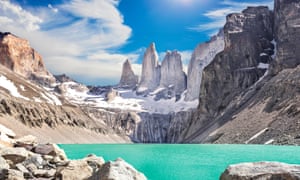
The Torres del Paine mountains in Patagonia, southern Chile. Photograph: Alamy
Forty years ago this month, Bruce Chatwin visited Patagonia and his subsequent book lit a beacon for the remote region in many travellers’ minds. Chris Moss picks the highlights among its peaks, glaciers and lakes
For my first forays into Patagonia, in the 1990s, I left behind my guidebooks and travelogues. Travelling light, I was blown away by big, jagged mountaintop glaciers and – more literally – the fierce westerlies that gusted summer long. Between the gawping and the roast lamb dinners, I struggled to make sense of German settlements, Tehuelche place names, Anglophile ranch-owners and ruddy Welsh faces on the coast; crossing the empty steppe, I wondered why any of these would come to such an arid, godforsaken
place to make a home.
Later on, Bruce Chatwin’s In Patagonia helped me to make sense of all this. Chatwin visited the region 40 years ago this month to write what would become In Patagonia, published in 1977 to great acclaim. Drawing on a wide range of sources, from Shakespeare’s The Tempest to the accounts of the 1921-2 farm workers’ uprising (collected by Argentine author Osvaldo Bayer), the book fills the empty spaces of southern South America with people, myths and magical happenings. In Patagonia is as much a homage to storytelling as it is to the place itself.
Patagonia covers some 400,000 square miles – roughly one and a half times the size of the UK – and visitors need to plan ahead. Established tourism is found in the northern lake districts of Argentina and Chile, and around Los Glaciares national park in the former, and Torres del Painenational park in the latter. Elsewhere, the wilderness still rules, and a cursory glance at a map reveals that Argentinian Patagonia is mainly empty spaces and ranching country, while Chilean Patagonia is a collage of islands, inlets and labyrinthine channels.
Chatwin stayed for four months, but you probably won’t have that much time – below are some experiences you can fit into a 10-day or two-week trip, and a few odysseys aimed at the time-rich traveller. Tour packages from the UK are included, but it’s easy to visit Patagonia independently – there are hostels all over, excellent campsites, frequent buses and mini-buses, and English is widely spoken. Pound sterling is very strong against the Argentine peso, so short local flights are affordable right now. Across the region, food and drink are excellent value too. A few decades ago, Patagonian cuisine consisted of grilled lamb and tripe stew; these days restaurants serve everything from cured wild boar to snook-and-hake ceviche, while local parrillas (grills) are always a safe bet for a meaty feast.
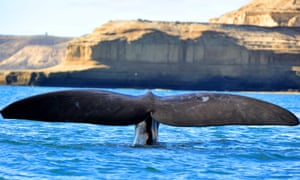
A southern right whale off the Valdés peninsula, Patagonia, Argentina. Photograph: Pablo Cersosimo/Robert Harding World Imagery/Corbis
Argentinian Patagonia is generally defined as the land south of the Rio Negro, which meets the sea near the town of Viedma. Exploring Patagonia’s Atlantic coast is relatively easy: the Ruta Nacional 3 highway runs all the way from Buenos Aires to Rio Gallegos, where you take a ferry across the Strait of Magellan to Tierra del Fuego, to complete the 3,000km run. Andesmar, Condor, Don Ottoand El Pinguino operate comfortable, economical long-distance buses to the main towns (Buenos Aires to Puerto Madryn costs from £70). Hiring a car allows greater freedom, but you’d have to bring it back to the pick-up point – a 14-day hire of a small vehicle from Buenos Aires starts at £350 with Europcar or Budget.
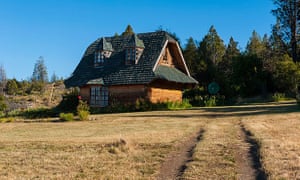
A Welsh-styled house at Chubut, Patagonia. Photograph: Alamy
On the northern coast, the two big stories are Wales and whales. In 1865, 165 migrants arrived from Wales aboard the Mimosa and established settlements beside the River Chubut. The towns that grew out of these hamlets – Rawson, Puerto Madryn, Trelew and Gaiman – are easy to visit by bus or car, with chapels and Welsh-themed teashops concentrated in the latter. If you want to do as the Welsh – and Chatwin – did, and travel all the way to the Andes, it’s a long bus ride or drive across the steppe. A side-theme here is dinosaurs; lots of fossils have been found in Patagonia and Trelew has an excellent collection at its Egidio Feruglio Museum of Paleontology.
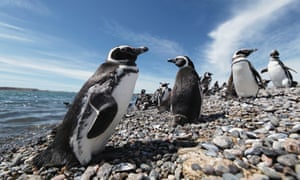
The South Atlantic teems with marine life. Southern right whales can be seen calving in the southern winter (July-September) off Puerto Madryn, though the best place to see them is Puerto Pirámides on the Valdés peninsula, from which smallish boats allow visitors to get close to the huge cetaceans. Pods of orcas, as well as elephant seals, sea lions and fur seals are visible off the peninsula’s coast year round. South of Madryn, at Punta Tombo, there are 210,000 breeding pairs of Magellanic penguins – the largest colony in the world – resident from September to March. Further south, at Puerto Deseado, you can see rockhopper penguins, five species of cormorant and Commerson’s dolphins in the estuary, and a huge seal colony at Cabo Blanco.
The most southerly important landmark on the coast is Puerto San Julián. It is here that Portuguese explorer Ferdinand Magellan made landfall in 1520, encountering the tall Tehuelche tribesmen whom he called Patagones, after a mythical character in a chivalric tale, leading to the region’s name. There is a fine 12km coastal walk here from the town centre to the abandoned Swift meatpacking plant.
There’s little reason to go further south than this unless you’re driving and bound for Cabo Virgenes, at the southeastern-most tip of mainland Argentina. This dramatic cape looks out over the Atlantic and the Strait of Magellan – the Estancia Monte Dinero is open to visitors and runs the cosy Al Fin y Al Cabo cafe-bar at the foot of the lighthouse, with sweeping views over the ocean. There’s another huge Magellanic penguin colony nearby.
Magellanic penguins near Puerto Madryn. Photograph: Picavet/Getty Images
Where to stay
El Gualicho hostel, Puerto Madryn
Three blocks from the sea, this popular, brightly decorated hostel (orange paint is the main theme) can help guests organise diving trips and other excursions. •£54 per double or twin, B&B, +54 02 80 445 4163, elgualicho.com.ar
Monte Dinero
One of only a few working sheep farms open to visitors; accommodation is lavish and the food some of the best in Patagonia. •£260 per double, full board, +54 29 6642 8922, montedinero.com.ar
Territorio, Puerto Madryn
A stylish sort of haute motel right on the bay, equipped with library, spa, sauna and a good restaurant. • Doubles from £135; + 54 28 0488 3180, hotelterritorio.com
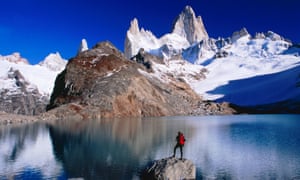
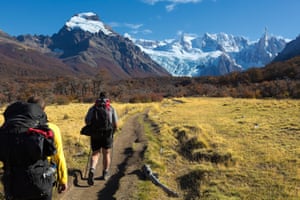
Hiker admiring Monte Fitz Roy from Laguna de los Tres. Photograph: Getty Images/Lonely Planet Image
The most populated and developed area of Andean Patagonia is the lake district of Río Negro and Neuquén provinces. The latter is more popular with Argentinians than foreign visitors, but the quaint towns of Junín de los Andes, San Martín de los Andes and Villa La Angostura are good bases for camping, hiking, trout fishing, horse riding and quad biking. A photogenic drive (or tour-bus ride) here is the Seven Lakes route, which winds for 110km between a series of lakes surrounded by Andean peaks and beech and myrtle forests enlivened by red anemone-like notros and yellow michay flowers.
Bariloche, on the banks of the immense Nahuel Huapi lake, is a major town, and a base for trekking and mountain biking; Apurabici rents bikes for £15 a day and organises half-day guided rides along mountain trails for £50pp.
A popular excursion from here is a through-Andes ferry-and-bus ride to Puerto Varas in Chile, allowing you to see the further reaches of the lakes that are inaccessible by road. Operated by Cruce Andino (cruceandino.com), a single costs £146.
Bariloche is a natural starting point for a drive south along Argentina’s Ruta Nacional 40. This long, largely paved highway actually runs the length of the country, skirting the Andes, and the Patagonian section runs past all the towns listed below.
From Bariloche to Cabo Virgenes it’s 2,300km; Audley Travel can arrange a 14-day car and accommodation package for £4,295 per person, including all flights and a 4WD vehicle.
To do it yourself, use bus firms that operate along the entire route, such asChaltén Travel and TAQSA (one-way Bariloche to El Calafate from £106). A small operator, Cal Tur, connects Los Antiguos with El Calafate.
A cabin at the Butch and Sundance ranch, Cholila, Patagonia. Photograph: Chris Moss
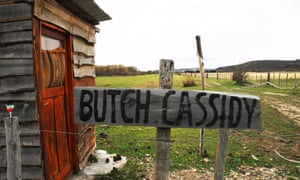
South of Bariloche are a string of pleasant towns, including El Bolsón – a former hippy hangout, and still popular with Argentinian campers – and Cholila, where Butch Cassidy and the Sundance Kid bought a ranch (you can visit Cassidy’s log cabin there). Close by, Los Alerces national park has some of the nicest campsites in Patagonia, especially those on the edges of Bahía Rosales and on the Kruger and Rivadavia lakes. There are seven serviced campsites and nine basic ones, and a further seven areas that allow wild camping. It’s $80 (£6) to enter the park and camping costs £8-10 per night. There’s good trekking throughout the park, and also at nearby Lago Puelo, and its namesake national park.
From Esquel, the steam-powered La Trochita train – aka the Old Patagonian Express – still has weekly departures, but most only go 20km, to Nahuel Pan. Close to the town is the Museo Leleque. Supported by the Benetton family, it showcases 14,000 native artefacts, including arrowheads, bone drills, ceremonial axes, grinding stones and pottery shards.
South of Esquel is Trevelin, where you enter, briefly, another Welsh-themed area, after which comes a lot of nada – the great empty spaces of central Patagonia. The Ruta Nacional 40 passes through backwater towns like Tecka, José de San Martín and Alto Río Senguer, and the main population centres – Río Mayo (“the national capital of shearing”), Los Antiguos (which sits on the shores of the immense Lago Buenos Aires), and Bajo Caracoles. There’s not a lot to see on the roadside except sheep, though you may catch sight of a fox, a guanaco (a camelid), or a choique (aka Darwin’s rhea – like an emu), or the whiff of a skunk.
One major highlight en route is the Unesco-listed Cueva de las Manos (Cave of Hands). On a gravel road off the Ruta Nacional 40, around 165km south of the town of Perito Moreno, are overhanging caves where, in 1972, archaeologists found 9,000-year-old stencilled handprints and galloping guanacos painted by ancient peoples – probably the ancestors of the native Tehuelche nomads. The art is thought-provoking and the setting, overlooking a deep gorge, is superb (entrance: £6).
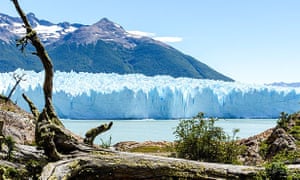
The Perito Moreno glacier, one of the most spectacular, and popular, attractions in Patagonia. Photograph: Alamy
Continuing south, you arrive – eventually – in the extraordinarily beautiful Los Glaciares national park, a huge area that protects the southern ice field, dozens of glaciers, virgin forests of lenga, ñire and guindo trees. The star attractions are the towering Fitz Roy massif at its northern end, and the huge, turquoise-colouredLago Argentino to the south. Many travellers come here to see the lake’s glacier,Perito Moreno; it’s world-famous, because the ice expands until the warmer waters beneath undermine it and cause a calamitous implosion, sending tsunami-like waves on to the terminal moraine.
There’s plenty to do in the park, from ice-hiking to walking up to ogle 3,405m Mount Fitz Roy, to Land Rover excursions to the top of the barren summit of Cerro Huyliche (with calafateextremo.com.ar). Alternatively, you can relax in the backpacker town of El Chaltén, admiring the views, the condors and the craft beers – La Vineria has a great stock of ales and Patagonian wines. Frequent minibuses connect El Chaltén to the other main town, El Calafate.
Where to stay
America del Sur hostel, El Calafate
Simple, clean rooms in a wooden villa, five minutes’ walk from the town centre. •From £20 for a bed in a four-berth dorm, +54 29 0249 3525,americahostel.com.ar
Hostería Canela, Esquel
This homely B&B is a tranquil bolthole just outside the town. •from £105 per double, +54 29 45 453 890, canelaesquel.com
Estancia Don José, Rio Mayo
On a working guanaco farm, this country house has comfortable rooms and there’s a quaint cottage set apart from the main house. • £168 per double B&B,+54 29 71 5624 9155, turismoguenguel.com
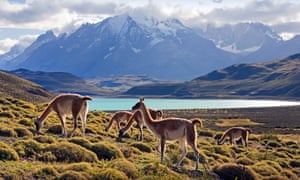
Guanacos grazing in Torres del Paine national park, Chile. Photograph: Jose Fuste Raga/Corbis
No one can really agree where Chilean Patagonia begins. Much of the south of this long, skinny country is jagged coastline, uninhabited islands, roads that come to dead ends, and impenetrable forests and ice fields. The lake district looks like a mirror image of Argentina’s, though German settlers have left their mark on the churches and houses of Frutillar, Puerto Octay and Puerto Varas. These towns (and Pucón to the north) are close to a series of national parks that protect the lakes and forested slopes of the Villarrica and Puyehue volcanoes. Trekking, cycling, kayaking and rafting trips are easy to organise from any of the towns, andPachamagua, in Puerto Varas, is a canyoning specialist.
Horse riding is available all over Patagonia, but for those seeking an adventure, the Puelo valley between Cochamó in Chile and Lago Puelo in Argentina has become something of a classic; specialists Ride World Wide and In the Saddleoffer a variety of itineraries along the valley. The low pass through the Andes is also used by scores of trekkers each summer.
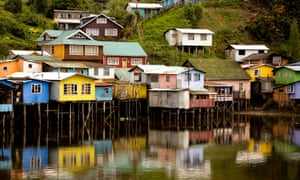
Stilt houses in southern Chile. Photograph: Rod Irvine/Getty Images/Flickr RF
To the south is genuine wilderness, with the main road interrupted by river crossings. A drive down the 1,247km Carretera Austral (Southern Highway) from Puerto Montt to Villa O’Higgins is a great way to see the lushly forested Palena and Aysén regions, and Lago General Carrera, the second biggest lake in South America. Four-wheel-drive vehicles are recommended, and you’ll need at least 10 days; it’s wise to book some accommodation beforehand, especially in the holiday months of January and February.
For the southern section, the highway follows the Río Baker (until recently the river was threatened by a hydroelectricity scheme) and passes the new Parque Patagonia. This protected swath of steppe and low mountain ranges is starkly beautiful, with the coirón grasses and spiny bushes providing a habitat for rhea,tinamou, pigeon and burrowing owl. In the mountains are eagles and vultures, including the condor, while the beech forests teem with treecreepers, woodpeckers and even hummingbirds.
Tailor-made firms such as Last Frontiers can organise flights, accommodation and a car for around £5,000 per person, but Europcar at Coyhaique’s Balmaceda airport will rent 4WD pick-ups for two weeks from around £1,100, and you could keep costs down by packing a tent or using hostels. For those on a tight budget, there’s a ferry from Puerto Montt to Chaitén; the service takes 10-12 hours and costs £17 (navieraustral.cl). Becker Buses operates on the northern section of the Southern Highway (Chaitén-Coyhaique, £25). See villaohiggins.com for connecting buses south.
The path to Los Cuernos ‘the Horns’ at Torres del Paine national park. Photograph: Alamy
The centrepiece of Chilean Patagonia is the Torres del Paine national park. The park’s 130km circuit is popular, though those tight for time can opt for shorter sections. There are great campsites, several superlative hotels, some challenging walks, and the chance to see guanaco and condor against quite stunning landscapes. Several firms are now offering puma-tracking trips in the park. Chilean firm Far South Expeditions offers packages from £1,650 – it’s cheaper with a larger group of travellers; UK luxury operator Miraviva will organise a five-night puma-themed safari, from £4,825 per person (excluding flights). From nearby Puerto Natales, Skorpios offers four-day excursions into the fjords around the southern ice field from £1,100 full-board.
Punta Arenas, an important port before the opening of the Panama Canal, has stately mansions, museums and an old cemetery – Chatwin visited his uncle’s grave here, as he brought his story to its conclusion. It’s also the departure port for the excellent Australis small-ship expedition cruises to Cape Horn and Ushuaia (four nights from £920), Argentina’s – and South America’s – southernmost city.
Where to stay
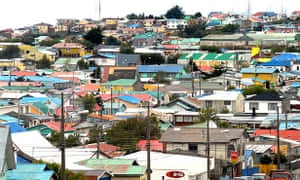
Punta Arenas, Chile. Photograph: Alamy
Singing Lamb, Puerto Natales
Friendly, cosy, colourfully decorated hostel with free internet, library and an international clientele. The generous breakfast is a combination of eggs, freshly baked bread, homemade marmalade, and locally grown prunes, sarsaparilla and gooseberries. •Doubles from £51 B&B (also has cheap dorms), +56 61 241 0958,thesinginglamb.com
Hotel Nogueira, Punta Arenas
This small, rather grand 22-room hotel (former guests include King Juan Carlos of Spain and Princess Anne) was once the mansion of sailor José Nogueira, one of the founding fathers of Punta Arenas. •Doubles from £80 B&B, +56 61 271 1000, hotelnogueira.com
Antumalal, Pucón
Bauhaus-style hotel built in the 1940s on the edge of Villarrica lake, beneath the volcano. The interior is all fleece, posh fabrics and Mapuche crafts. • Doubles from £160, +56 45 244 1011, antumalal.com