Showing posts with label Croatia holidays. Show all posts

Monday, August 29, 2016

Bay Of Pigging Out – Town-Hopping In Croatia’s Kvarner Gulf


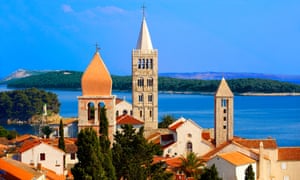
View from St John Church tower over the medieval roof tops of Rab.
Bells and whistles … view from St John Church tower over Rab’s main town. Photograph: Alamy

Touring four towns on three islands, Kevin Rushby enjoys fennel liqueur, sheep’s cheese and seafood, while teenage Maddy prefers a papal cake sugar hit 

Opposite a vast painting of the Last Supper in 13th-century Saint Francis of Assisi monastery in Cres town is a small alcove. Smiley father Zdrak, whose benign presence is like a tonic, leads us there. And in the alcove is another kind of tonic. No, not the half-empty orange Fanta bottle, but a glass urn of greenish liqueur from which the father pours with some glee. “It’s calledkoromac,” he says, “We make it using fennel from our garden.”
It is delicious. We repeat the tasting. My daughter Maddy (13) turns down the koromac and gazes longingly at the Fanta, but it is not offered. It is 9am and Maddy, my partner Sophie and I are just beginning our exploration of the island cities of the Kvarner gulf, the broad bay of Adriatic sea that snuggles up under Croatia’s Istrian chin.
Cres Town is an easygoing place, little frequented by tourists and pleasant to stroll around, even in August. (The pronunciation of the island’s name is subtle and sibilant and not at all like cress, stress or tress, but somewhere between the three. A glass of koromac is probably required for precision.) We buy olive oil from the co-operative and admire the work of Mate Solis, a local artist and character now in his 80s who still finds inspiration in Cres’s pretty boat-filled harbour.
Early morning in Krk town with the day’s first bread delivery.
Pinterest
 Early morning in Krk town with the day’s first bread delivery. Photograph: Kevin Rushby
Next day we take a short ferry ride to Krk, which is a big change after the depopulated harshness of Cres. Krk is verdant and well-inhabited: its main town, also Krk, is busier than Cres but with similar cool stone lanes. A walk through its crowded streets can be slow, but why hurry? There are so many strange highlights: the temple of Venus that is now a beachwear shop, the restaurant (Konoba Maritim) that serves us tangy sheep’s cheese with octopus and squid (Maddy looks wistfully at other diners’ spaghetti), and a little doorway in the city wall that leads to one of the world’s most astonishing cafes: Volsonis.
Volsonis cafe in Krk town, built in Roman walls.
Pinterest
 Volsonis cafe in Krk town, built in Roman walls. Photograph: Kevin Rushby
The building was bought in 1999 by Maria Elena and Goran Stanic, who set about converting it to a cafe, but discovered a Roman wall, and then a tomb under the floor. In some countries that might have ended any hopes of a cafe, but in Krk things are different: they simply integrated a cafe, nightclub and gallery into the structure of an ancient building. The result is startling and original – and they do good coffee.
We take a day trip to Vrbnik, in Krk’s wine region. This handsome hilltop seaside town sees no need to lure tourists: there are few hotels or cafes, and lots of ungentrified winding lanes, including one, Klancic, that is so narrow we have to squeeze through sideways. There is also a luminously brilliant family-run restaurant: Nada. They love their local wines here – all based on the indigenous žlahtina grape. We eat a grand seafood dinner and remember not to attempt the Klancic on our way back to the car.
Octopus,squid and cheese at Maritim restaurant, Krk town.
Pinterest
 Octopus, squid and cheese at Maritim restaurant, Krk town.
Our fourth town is Rab, on the island of the same name and about an hour away by ferry. These inter-island ferries, operated by Jadrolinija, are fast becoming real pleasures on this trip. You queue on the road outside the port and race the other drivers to the ticket office. On board it’s like being on a mini-cruise: lovely views and a decent cafe. If the breeze is right, you can smell the different islands: I swear I can detect Cres’s sage, Krk’s pine and, coming up on the bow, Rab’s lavender. Maddy is unconvinced, claiming that it is chocolate and chips.
Vrbnik, Krk island.
Pinterest
 Vrbnik, Krk island. Photograph: Alamy
Someone on the ferry tells us Rab “fancies itself”. That’s immediately obvious in the super yachts moored by the old town and the chi-chi boutiques that line the main street. But this is a subtle and complex town. An enquiry at the tourist office for “something unusual” leads us to the headquarters of the medieval order of crossbowmen, a surreal mix of weaponry, heraldry and archive photos of Rab in the 1930s. That was when Rebecca West came, writing in her 1941 travel masterpiece Black Lamb and Grey Falcon of stricken people with the faces of “crucified Christs”. The island is, thankfully, a lot more prosperous now.
Maddy is asleep on the hallowed bench of the crossbowmen. She has the face of a crucified teenager in dire need of sugar. But first we must visit the four bell towers of Rab, a sequence that has all the rhythm and resonance of a peal. We climb two before we relent and help our wilting daughter towards the dangling carrot that has kept her feet moving since breakfast: Rab cake.
Rab town. Three of the belltowers
Pinterest
 Another view of three of Rab Town’s belltowers.
When Pope Alexander III came to the island in 1177, the sisters of St Anthony concocted a cake to celebrate: a filling of eggs, almonds, sugar, citrus zest and cherry liqueur baked in a spiral-shaped pastry case. At Rabska Torta on the edge of town they show you how – with great deliberation. Maddy is twitching like an addict awaiting her fix, but finally the cake is done. We retire to the garden half-expecting a refusal followed by demands for Kit Kat, but no: rabska torta is a hit.
Selection of cakes at Rabska Torta.
Pinterest
 Selection of cakes at Rabska Torta. Photograph: Kevin Rushby
She eats more than Pope Alexander, then, sweating, asks about a swim. Simple: there’s a wild forested peninsula next to town, dotted with coves. We stumble to the harbour and hire a boat for the afternoon.
• Accommodation on Rab was provided by Prestige Holidays (01425 480400,prestigeholidays.co.uk), which has a week’s B&B in Hotel Padova from about £469pp, including flights and transfers. For further information, visit croatia.hr

Discovering Croatia: fruits of the sea

Croatia is a seafood lovers’ paradise. Ivana Gamulin from the renowned Villa Spiza restaurant in Split gives her take on the country’s best fish. “The most important thing is seasonality. Sardines are best in May, calamari in summer.Brudet is the classic dish: a stew of garlic, onion, white wine, tomatoes and fish. If I find kosmej or grancigula crabs, I use them, too. A very traditional recipe is fažol na brudet, a bean and fish dish. Wash it down with white wine (bogdanuša or parčgrape) or a light red (plavac mali).”
Next week: Kornati islands


Wednesday, July 6, 2016

The Great Eastern European Road Trip, Part One: Island Hopping In Croatia


View from the Kamp Lili campsite on Hvar island in Croatia.
View from the Kamp Lili campsite on Hvar island in Croatia. Photograph: Kevin Rushby for the Guardian

On the first leg of a road trip to the Balkans and the Baltic, our writer and his family hurtle through the rain to reach the brilliant sunshine of Croatia

By the time we disembark from the ferry at Zeebrugge, I’m wondering if our great European adventure is going to be sunless. The drab landscape is apparently hammered flat by cold rain. We turn south-east and drive all morning, until a horrible rattle from under the car starts just before the Luxembourg border.
The whole idea for this escapade came from a feeling that eastern and central Europe are a vast under-explored region – particularly by me. I’m more familiar with Papua New Guinea than Poland, or any one of a dozen other European countries. In a cold English spring I sketched out a plan for a massive summer road trip, an ambitious loop around the Balkans, then up through Europe as far as the Baltic. I calculated the distances – around 5,000 miles – and decided six weeks would be sufficient.
The route threw up immediate questions. Does British vehicle insurance cover Albania? Answer: normally, no. I switched companies. What other paperwork and equipment was required? Answer: lots. Green cards, vignettes, international driving permits (1949 convention), a fire extinguisher, a Croatian fishing licence and more. On the last shopping day before departure, I filled the car with an inflatable canoe and piles of outdoor gear. My wife Sophie and daughter Maddy (12) refused to allow a speargun, but compromised on the lobster pot.
Crossing the Alps on the Grossglockner High Alpine Road in Austria
Pinterest
 Crossing the Alps on the Grossglockner High Alpine Road in Austria. Photograph: Kevin Rushby for the Guardian
On that road near Luxembourg we discover that our car’s front trim is hanging off, but rattle on into Germany and spend a superb first night at Camping am See near Augsburg. The next day we wind up through the Alps, avoiding motorways and piercing the ghost of the iron curtain at the Wurzen Pass on the Austrian border before arriving at Slovenia’s Lake Bled.
The next day, still in heavy rain, we enter Croatia and the sun emerges. Our first stop is Pag Island, which we reach via a ferry from the fishing port of Prizna. The queue for the ferry is massive and filled with young men high on Red Bull, beer and the rest. Pag, they tell us, is a party island. Sophie pulls me aside. “Aren’t you writing about the best, most secluded spots in Croatia?” I nod, a little nervously. I’m hoping my contacts are not mistaken.
A paški sir cheese factory in the village of Kolan, Pag island … most cheese-making is still done in cottages.
Pinterest
 A paški sir cheese factory in the village of Kolan, Pag island … most cheese there is still made in cottages. Photograph: Kevin Rushby for the Guardian
Pag itself is like a bone: wind-dried and white. We leave the partygoers behind (they all head for the beaches around the town of Novalja) and find an elemental landscape with stirring views of an improbably blue sea. On every corner there is someone selling home-grown olive oil, liquors and cheese – home-produced shopping that is to prove one of the great pleasures of Croatia. We stock up onprošek (a thick sweet dessert wine), paški sir (the island’s own rich, salty sheep’s cheese) and olive oil, then locate Branimir, the owner of the cottage we are booked into. He adds to our shopping a bottle of his father’s travarica, a spirit infused with 12 herbs, and takes us to a little stone cottage by the sea with a shady terrace and steps to a rocky shoreline.
We explore the coast by canoe and soon realise that selecting the “10 best beaches of Croatia”, as some websites do, is like picking the 10 best stars from the Milky Way. Everywhere we look there are perfect little coves and clear deep blue water speckled with schools of fish that are far too wily to be caught. At the northern end of the island we discover the ancient olive groves of Lun, a 24-hectare (60 acre) labyrinthine marvel of curving stone walls and trees that date back an average of 1,200 years – one tree is 1,600 years old. Inevitably, there are perfect small coves for swimming.
Sophie paddles in a canoe along the shoreline of Pag island.
Pinterest
 Sophie paddles along the shoreline of Pag island. Photograph: Kevin Rushby for the Guardian
Croatia, you might think, has long been on the tourist radar. Back in 1964 Alfred Hitchcock declared the sunsets from Zadar, south of Pag, the best on Earth. But the truth is that most visitors head for a few well-known spots, leaving many areas to be discovered. The north has some fantastic islands such as Rab (great sandy beaches and historic town), Cres (griffon vultures fly over this idyllic island) and Silba (not even bicycles are allowed to disturb the peace). Further south you could try Šolta or Vis, both accessible by ferry from Split. There are 47 inhabited islands – a further 671. The inflatable canoe, I declare to a sceptical family, is ready.
One evening Branimir invites us to a beach party at the secluded cove of Girenica, where we drink fine red wine from the Pelješac peninsula and eat grilled fish followed by fritules, sweet dumplings. A guitar appears and everyone sings Croatian songs which are, apparently, all about love or the sea. One of Branimir’s mates even fixes our car and when we move on, southwards, we don’t rattle any longer.
At Girenica Bay on Pag island.
Pinterest
 In good spirits … Branimir (third from left), host of House Tomislav and friends at Girenica Bay on Pag island. Photograph: Kevin Rushby for the Guardian
The Croatian mainland coast is 1,104 miles (1,777km) long and we cover a lot of it over the next few days. Island hopping with a car seems relatively simple: turn up at a port, buy a ticket and wait until there is space. Waiting was never so easy: you swim off the sea walls, picnic and shift the car when need be. On the island of Hvar, a lush contrast to Pag’s austere moonscape, we drive through a mile-long single-track tunnel and emerge to find the idyllic Kamp Lili campsite, a clutch of tents under shady pines with several coves to swim around.
Advertisement
There are few reminders of the Balkan war of the 1990s here, but there is a 25km section of Bosnia-Herzegovina to negotiate before Croatia resumes. Here, in the town of Neum, the atmosphere is suddenly very different: ladies in stout swimwear lying in the shade of the bombed-out post office, a victim of Serbian army artillery. This tiny corridor of land was ceded to the Ottoman Empire in 1699, a buffer between the independent city state of Dubrovnik and the then Venetian-controlled north. We push on south, back into Croatia, stopping briefly in stylish Dubrovnik, then onwards, as I write, through Montenegro, heading for our next stop, Albania. The adventure is definitely under way.
• Ferry crossing was provided by P&O Ferries (Hull-Zeebrugge one way for a car plus two adults and one child, with cabin from £200, poferries.com). Accommodation on Pag island was provided by Croatia Tourism (croatia.hr): House Tomislav can be booked through Adriagate (adriagate.com) which has a range of cottages on the mainland and islands, some only accessible by boat, from £16pppn. Camping am See (tent and car £6, adults £5, children £3, bauer-caravan.de; Camping Bled (from £16 for tent plus two adults, sava-hotels-resorts.com); Kamp Lili (£6 per adult, children £3, under three free, price includes tent and car,kamplili.hr). For information on Croatian ferries see (jadrolinija.hr/en/ferry-croatia)
Books: Kevin read Rebecca West’s classic travelogue Black Lamb and Grey Falconwhich he says “is proving to be an astonishing companion, full of memorable images and quotations: ‘I had come to Yugoslavia to see what history meant in flesh and blood.’”