No matter how many times you go to Ireland you’re going to discover something new.
Ireland is a destination that is constantly adding more experiences to its extensive list of top quality things to see and do, meaning there is always a reason to head for its welcoming shores.
Among the newest experiences are a driving school for children at Tayto Park in County Meath and the recently opened Roe and Co. Distillery in Dublin, both of which have made it into Lonely Planet’s Best in Travel 2019, the highly anticipated annual collection of the best travel destinations, trends, journeys and experiences to have in the year ahead.
The collection outlines the top 10 countries, cities, regions and best value places to visit in the coIrelandming year, as well as the 10 best New Openings, Places to Stay, Food Experiences and Attractions for Kids.
The Attractions for Kids list features the Nissan Driving School at Tayto Park, Ireland’s first ever driving school for kids and an exciting new dimension to the ever popular theme park and zoo. Children get the chance to drive a miniature battery-operated Nissan car along a purpose-built, road-marked traffic course, learn the rules of the road and get their own special driving licence.
On the New Openings list is Roe & Co. Distillery, named in honour of the world-famous nineteenth-century Irish whiskey maker. Scheduled to open in April 2019, it is the latest addition to Ireland’s burgeoning whiskey industry. The distillery has created a blend of the finest quality malt and grain whiskies, aged in first-fill ex-bourbon casks, which will be celebrated and explored in a new visitor centre.
For whiskey lovers, a further new offering is also available in the newly released Teeling Single Pot Still, the first new Dublin distilled Irish whiskey for nearly 50 years. Produced from 50% unmalted barley and 50% malted barley, a uniquely Irish mash bill made famous by Dublin distillers of old, the new whiskey is exclusively available in Ireland. It’s a great reason to visit the working Teeling Distillery, soak up the sights and sounds and sample a piece of liquid gold history.
For those who prefer a pint of the famous ‘black stuff’ there is another new attraction at the Guinness Storehouse in Dublin. Ireland's most popular attraction features seven floors of interactive experiences revealing the history of the brew and its place in Ireland’s heritage.
Now the Guinness STOUTie presents the ultimate in pint personalisation. Using technology to add natural malt extract to the iconic creamy head of a Guinness pint, the Storehouse can adorn a pint with a sepia toned selfie of the drinker.
An innovative way to come face to face with the perfect Irish pint.
Lonely Planet has produced this article for Tourism Ireland. All editorial views are those of Lonely Planet alone and reflect our policy of editorial independence and impartiality.
Northern Ireland is beautiful, wonderfully scenic and packed with attractions both historic and contemporary. The landscape is rejuvenated and the people, warm and welcoming. Here are the top ways to experience Northern Ireland, past and present.
The world’s most famous shipwreck was built in Belfast (‘she was fine when she left here’ is a popular quip) and the head of the slipway where Titanic was built is now a multimedia visitor experience charting the history of the city and the world’s most famous ocean liner through a range of interactive exhibits. It opened on the centenary of its sinking, in April 2012, and has since become Northern Ireland’s most popular tourist attraction.
Giant’s Causeway
The grand geological centrepiece of the Antrim Coast is the Giant’s Causeway, a spectacular rock formation composed of countless hexagonal basalt columns emerging from the sea that look to all the world like they could be the handiwork of mythical giants attempting to build a footbridge between Ireland and Scotland. Not true, unfortunately, but it’s a nice story. Visiting the Giant's Causeway itself is free of charge but you pay to use the car park and the Giant's Causeway Visitor Experience (giantscausewaycentre.com).
Black Taxi Tour
West Belfast, the neighbourhood that for three decades was at the heart of the conflict known as ‘the Troubles,’ is now perfectly safe to visit, and the best way to do so is on a black taxi tour. The cabs visit the more spectacular murals as well as the Peace Line (where you can write a message on the wall) and other significant sites, while the drivers provide a colourful commentary on the history of the area. There are a number of companies offering tours, including Harper Taxi Tours (harperstaxitours.co.nr) and Official Black Taxi Tours (belfasttours.com).
One of the most popular spots along the Antrim Coast is the small village of Bushmills, site of the world’s oldest (legal) distillery. King James I granted a license in 1608, and the whiskey is made with Irish barley and water from St Columb's Rill, a tributary of the River Bush, and matured in oak barrels. Following the distillery tour you get the chance to taste what the fuss is all about.
Ulster American Folk Park
One of the best museums in Ireland, the Exhibition Hall explains the close connections between Ulster and the USA (the American Declaration of Independence was signed by several Ulstermen) and includes a genuine Calistoga wagon. But the real appeal of the folk parkis the outdoor museum, where the 'living history' exhibits are split into Old World and New World areas, cleverly linked by passing through a mock-up of an emigrant ship. At least half a day is needed to do the place justice.
Historic Derry/Londonderry
Northern Ireland’s second city is full of historic interest, from walking the 1.5-km-long, 17th-century-walls – they’re the only city walls in Ireland to survive almost intact – to visiting the Bogside Murals that decorate the gable ends of houses along Rossville St, near Free Derry Corner. Mostly painted between 1997 and 2001, these 12 murals commemorate key events in the Troubles.
Belfast has a handful of beautiful pubs that seem not to have changed a jot since opening in the 19th century. The most famous of these is theCrown Liquor Saloon, a mass of stained and cut glass that was declared a national monument. Also worth a visit is the Duke of York, where Sinn Fein leader Gerry Adams once worked as a barman; and the absolutely wonderful John Hewitt Bar & Restaurant, another Victorian classic that serves good food and has music nightly.
Ulster Folk & Transport Museums
Really two museums in one, the Ulster Folk & Transport Museum is one of the region’s finest. Farmhouses, forges, churches and mills, and a complete village have been reconstructed at the folk museum, while across the road the Transport Museum is a sort of automotive zoo. In captivity is the stainless steel-clad prototype of the ill-fated DeLorean DMC, made in Belfast in 1981. The car was a commercial disaster but achieved everlasting fame in the Back to the Future films. The Titanica exhibit includes the original design drawings for the Titanic and its sister ship Olympic, as well as photographs of their construction.
The magnificent 18th-century Mount Stewart House & Gardens is one of Northern Ireland’s grandest stately homes. Treasures include the chairs used at the Congress of Vienna in 1815 (embroidery added in 1918–22), and a painting of the racehorse Hambletonian by George Stubbs, one of the most important paintings in Ireland.
Florence Court
Set in lovely wooded grounds in the shadow of Cuilcagh Mountain – and not to be confused with the nearby, single-worded village of Florencecourt – Florence Court is an 18th-century baroque country house built by William Willoughby Cole (the first Earl of Enniskillen) and famous for its rococo plasterwork and antique Irish furniture. The house was badly damaged by fire in 1955 and much of what you see on the one-hour guided tour is the result of meticulous restoration, but the magnificent plasterwork on the dining room ceiling is original.
This article was published September 2014 and updated February 2016.
Come and discover Ireland, from the vibrant cities of Belfast and Dublin to charming seaside towns dotting rugged and majestic coastal routes. Learn more at www.ireland.com.
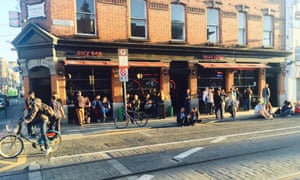
Roll on … the Dice Bar, on Queen Street, is one of the district’s cool drinking destinations
Temple Bar and Grafton Street get the tourist traffic but novelist Rob Doyle knows that Stoneybatter’s the cool neighbourhood to explore – if you want a taste of little Williamsburg by the Liffey
Until a few years ago, Dublin’s working-class neighbourhood of Stoneybatter and its environs, just north of the river Liffey, were run-down and little talked about. The O’Devaney Gardens high-rise flats – now eerily deserted amid fenced-off fields and wasteland – were particularly notorious. Following a surge of ambivalently received gentrification, Stoneybatter has become synonymous with Dublin hipsterism. Mountain beards and craft beers are de rigueur, and you needn’t look hard to find “hot yoga” venues, art spaces and community squats.
Alongside the greasy spoons and chippers, there are newer, more self-conscious cafes of the produce-our-own-newsletter variety. Through a double shot of sudden money and cultural ferment, the area has become something of a little Williamsburg by the Liffey. Dublin rents have become appallingly high of late: I felt lucky to move into a small but pleasant semi in Stoneybatter a year and a half ago at a relatively decent rate.
A 10-minute walk from the city centre, and served by the LUAS tram line, Stoneybatter still has plenty of the red-brick charm of old inner-city Dublin. It’s an interesting place to live during this vivid moment in the city’s history, as Ireland continues to cast off the shackles of old (in 2015 it became the first country to adopt LGBT marriage equality by popular vote). A newly sophisticated art and youth culture has also taken root in the area.
The lounge area at Generator hostel. Photograph: Nerissa Sparkman
This being Dublin, visitors to Stoneybatter will find no shortage of opportunities to slake their thirst. Older pubs such as the much-loved Cobblestone on Smithfield Square, where traditional musicians gather for regular sessions, and Walsh’s, which hosts an informal folk music night on Mondays, compete with pricier, IPA-savvy gastropubs such as Mulligan’s.
Facing each other across a quayside street are the fun and frisky Dice Bar, where I’ve spent many a tipsy Friday night, and the agreeably diveish Frank Ryan’s. The latter always seems to have a shaggy dog running around, and is named after the Spanish civil war hero also commemorated in the classic Pogues song The Sick Bed of Cuchulainn. The bar staff will also whip you up toasted ham and cheese sandwiches no matter the hour.
Stoneybatter is bordered on one side by the Phoenix Park, western Europe’s largest city park, with its towering Wellington monument and roaming herds of deer. It’s something of an open secret that magic mushrooms grow wild in the park. Foragers – or my friends and I at any rate – stoop to their task in the shadow of the Papal Cross, erected in 1979 to mark the pope’s first and only visit to Ireland.
It’s a lovely place to trip: as the sun goes down you can sit on a hillside bench overlooking Chapelizod, the river, and the southern suburbs that stretch toward the mountains, all of it lighting up in hallucinatory shimmer. To the other side of “the Batter” is Smithfield Square, the site of an inner-city regeneration project some years ago, and now verged by cafes, restaurants, a Generator hostel popular with backpackers, and the excellent Light House cinema, which screens an agreeable mixture of mainstream and independent films.
In the aftermath of the culturally barren Celtic Tiger years, Ireland is said to be undergoing something of a literary rebirth. It’s now harder than ever to swing a cat in Dublin without skulling a handful of writers and dole-queue poets. Debut novels and short story collections are launched with pummelling frequency. Stoneybatter has become a hub of this renaissance.
The offices of the Lilliput Press, where the curious are welcome to wander in and browse shelves stacked with the publisher’s titles, play host to readings and literary events (as with much of Stoneybatter’s cultural life, social media is the best way to find out about upcoming events). The suave, silver-fox proprietor, Antony Farrell, keeps the press running with the aid of an ever-rotating crew of young interns, giving the premises the vibe of an affable and bookish Bond villain’s lair.
A word to the hungry: Stoneybatter’s tastiest almond croissants are found in theGreen Door Bakery on Manor Street – but only if you get there early enough, which I have managed on no more than two occasions. A few doors down is a real gem, still largely unheralded: the pleasant and unpretentious Biscotti Caffe, which offers what is hands down Dublin’s most satisfying full Irish breakfast (available all day, too).
On the same street, Mi Thai is a decent spot for Asian cuisine (it’s next door to the superbly named – and stocked – off-licence, Drinkstore). Nearby, the Slice cafe and Wuff bistro are popular daytime food stops, while Love Supreme is the go-to place for Stoneybatter’s nouveau coffee aristocracy. The brightly fronted K Chidoon Chancery Street is a great stop-off for inexpensive Mexican food – served out of a food truck.
For accommodation, the Ashling (doubles from €119, room only) and Phoenix Park (doubles from €69 room-only) hotels are well-situated, with the park, river and city centre all close by. A plaque outside the Ashling indicates that philosopher Ludwig Wittgenstein lived and worked there for a couple of years in the 1940s: interesting to wonder whether he ever tried the magic mushrooms growing a stone’s thrown from his door.
Sites of cultural and historical interest in the area are plentiful. There is Collins Barracks, with its expansive courtyard, which houses the National Museum of Ireland’s Decorative Arts and History collection. Just behind the Barracks is Arbour Hill Cemetery, resting place of the leaders of Ireland’s 1916 Easter Rising, which also has a wall commemorating John F Kennedy’s visit during his 1963 trip to Ireland. The cemetery and gardens are a nice place to enjoy a serene moment away from the bustle and the hipness. Back over on Smithfield Square, the Old Jameson whiskey distillery offers tastings and tours (from €14.40; I’ve never got round to trying it though), as does the hugely popular Guinness Storehouse across the river in the Liberties area (I have tried this: it’s fun).
Stoneybatter is not all working-class charm and gentrified allure. Over the past two years, opposition to government-imposed austerity following Ireland’s economic crisis has coalesced around the water charges being introduced by some of the people widely thought to have got us into this mess in the first place. Stoneybatter has been the most visible locus of the protest, with many residents blocking the installation of the water metres outside their homes, and determined not to pay up regardless.
If you aren’t put off by a high density of boutique moustaches and pedantic coffee connoisseurs, Stoneybatter is a worthwhile deviation from Temple Bar, Grafton Street and the other well-trodden tourist zones. As with all that is best about the city, it feels like a village, but with the perks of a (currently exhilarating) capital.
Rob Doyle’s short story collection, This is the Ritual, is out now (Bloomsbury Publishing, £16.99). To buy a copy for £12.99 including UK p&p visitbookshop.guardian.com or call 0330 333 6846