Showing posts with label South Australia. Show all posts

Saturday, May 7, 2016

48 Hours In Adelaide: German-Influenced Wine And Cakes Make A Foodie Heaven

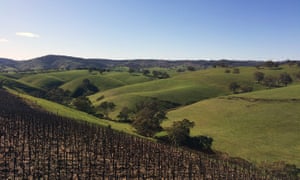
Siegersdorf lookout near Adelaide, South Australia.
The high altitude of the Siegersdorf vineyard protects its grape harvest from the extreme heat of the South Australian summer. Photograph: Adam Brereton for the Guardian


Urban redevelopment, quirky little bars, experimental wineries in the Barossa. This once sleepy city and its surrounds are having a moment in the sun

  I knew Adelaide had a reputation for staid conservatism before my first visit, but it didn’t hit home until I was wandering the city’s streets in a nicotine-deprived stupor at 6pm on a Sunday, desperately searching for somewhere to buy cigarettes.
“Welcome to Adelaide!” my friends messaged me. Yeah, yeah.
My arrival had been much more congenial: a perfect powder blue sky and the promise that the place was on the up and up. Between the rejuvenation of Adelaide’s restaurant and bar scene, the broadening of the Barossa’s appeal beyond wine sales at the cellar door and the redevelopment of the Adelaide Oval sports precinct, the southern capital was, I had been told, having its moment in the sun.
My short-lived nicotine quest aside, 48 hours there confirmed this was, indeed, the case.

Sunday

1pm: lunch at 2KW Bar & Restaurant
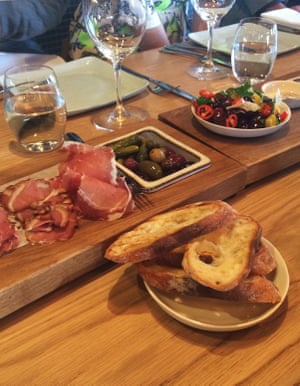
Charcuterie, olives and bread at 2KW restaurant in Adelaide.
Pinterest
Charcuterie, olives and bread at 2KW restaurant in Adelaide. Photograph: Adam Brereton for the Guardian
Several storeys up, overlooking parliament house and across to the Adelaide Oval, 2KW is a bright, airy restaurant and bar with a fantastic menu. Big plates for sharing are in vogue everywhere and here they don’t disappoint: oysters, sardines and charcuterie to start, with more substantial dishes of braised kangaroo and crispy skin duck afterwards. Much of the fare is sourced locally, including the wine; among the highlights were Pike’s 2014 Clare Valley riesling (fresh and much drier than I had expected – pick up a bottle, you won’t regret it) and The Bogan, Kaesler’s 2012 shiraz (knockout flavour and more tannin than a Chesterfield sofa).
2pm: hoofin’ it around Adelaide
Adelaide is pretty flat. That’s great if you like to walk, which I do. The city was flooded with Crows and Port supporters heading to the newly developed park to watch the game on a big screen and eat from food trucks. I went for a wander to check out the city’s famous churches, which really are beautiful. Perhaps I’d overdosed on Lutheranism but Victoria Square, the open and austere city centre, felt more like a Victoriaplatz. The mild culture shock had me wondering about Sydney’s residual Irishisms.
7pm: dinner at Street ADL
Back to the food. To call ADL eclectic would be an understatement. Alongside the ubiquitous share plates, this time a mixed bag of street food – ceviche, bruschetta, sang choi bow, quesadillas – is a kind of Australiana sub-menu of roasted pumpkin, saltbush and macadamia nuts, eucalyptus-smoked lamb and so on. Then there’s food truck standards such as mac-and-cheese-burgers and roasted corn cobs ... it’s as if the chefs are trying to run with half a dozen food trends at once. As far as pub grub goes, it was pretty hearty. Better was the country and western singer who ripped out a solid Jolene on request. Even better was the decent range of bottled beers (I couldn’t face any more grape juice).
9pm: small bars of Adelaide
Redrawn licensing laws, in force from 2013, set off Adelaide’s small bar scene. Along Peel Street, there are a few joints that would not seem amiss in the trendier parts of Melbourne or Sydney: Clever Little Tailor, all wood panels and snug booths; Udaberri Pintxos y Vino, which serves Spanish nibbles and cocktails; and Maybe Mae, which follows the speakeasy trend by disguising its entrance behind a wood panel in a staircase. I managed a few mugs of porter before well and truly hitting a wall and beating a retreat back to the hotel.

Monday

Advertisement
ADVERTISEMENT
8am: wine wine wine
After a solid day of eating and drinking in Adelaide, it was time for a change of pace: eating and drinking in the Barossa Valley. The region has long been known as Australia’s prime region for grape-growing, winemaking and Germans, but is being transformed in subtle and interesting ways. There are innovative small vineyards flourishing in the shadow of the all-consuming Jacob’s Creek industrial complex and the area is becoming a foodie paradise, as you may have guessed from that Nick Cave tourism advert where they roll around in the dirt.
I joined a tour group run by Life is a Cabernet, whose owner, Ralf Hadzic, used to be the guy in the cat suit on popular TV show Fat Cat and Friends. His jokes were pretty salty, which only intensified my raging thirst ... for wine.
Ballycroft Vineyard and Cellars was the first stop. Owner and winemaker Joe Evans is a stickler for quality, letting the soil and sun do their work while he keeps a close eye on the grapes. He’s big on permaculture too and, during a foray into cheesemaking, sprayed whey on the vines to control pests.
Ballycroft’s “small berry” shiraz is the result of careful cultivation; rather than overwatering, leading to high berry weight, Evans aims for less juice and more flavour and colour from the skins. The cellar-door experience was wonderful – this winemaker knows how to spruik his wares and there was plenty to taste too. Eftpos is, luckily, available on site.
10am: morning tea at Tanunda bakery

Tray of cream-filled doughnuts
Pinterest
Cream-filled doughnuts are among the offerings at Tanunda Bakery. Photograph: Adam Brereton for the Guardian
Germans began to settle the Barossain the mid-19th century. Some came freely – winemaking families among them – and others as religious refugees, fleeing state interference by Frederick III in the conduct of Lutheran worship. The immigrants brought much of their traditional life with them, which explains the varieties (hello, riesling) and the age of some of the vines (some of the shiraz vines here were planted in 1847).

Other traditional practices continue too. At Tanunda bakery, a local institution, there is a mind-boggling selection of bread, German doughnuts and strudels. The coffee was good, too, in that frothy European style. Bring a working pancreas and an appetite for whipped cream and icing sugar.
11am: riesling tasting at Siegersdorf lookout
The amazing Siegersdorf lookout – a high-altitude vineyard planted, improbably, on limestone – escapes the worst of the summer heat and moisture and produces the nicest riesling I think I’ve ever tasted. Looking out over the rolling green hills, you’d have no idea that, at the top of summer, it frequently peaks above 40C down on the flat. The wine itself was really delicate with a nice fruity mid-palate and a bit of fizz. Just wonderful and not that expensive to order online.
12pm: lunch at Artisans of Barossa
Six wineries comprise the Artisans of Barossa, a co-operative cellar door/restaurant. They’re all subregional winemakers, some older and some younger, and there’s loads on offer as far as variety and price is concerned. The restaurant, Harvest Kitchen, opened in March 2015 with MasterChef contestant Tracy Collins at the helm.
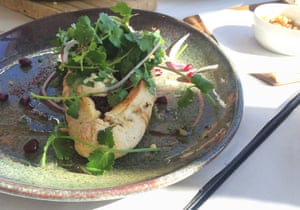
Empanada at Harvest Kitchen.
Pinterest
Empanada is among the outstanding menu items at Harvest Kitchen. Photograph: Adam Brereton for the Guardian
If you’ve come for big sips of Barossa shiraz, you’ll find them here, alongside more unusual offerings. The Spinifex rosé was a particular treat – bone dry with a peach tint, rather than the familiar sickly pink stuff. The food is outstanding too. After the endless share plates, I longed for an entree and main, but was brought around by the $55pp “Feed me like a Barossan” menu with its sizeable dishes of moreish grain-based salad, empanadas, fried chicken and roast lamb.
Looking out over the vineyards as you graze through all the produce on offer, one thought does pass through your mind: by now it would be highly illegal for me to drive.

2pm: Maggie Beer’s farm shop
Maggie Beer’s little pates, spreads and quince pastes are a staple of cheeseboards everywhere and, if you visit her farm store, you can taste as much as you want. The store, beside a charming dam, has coffee and more substantial food on offer, while peacocks freely cavort in the car park. Truth be told, I was too full from lunch to properly appreciate it and had already bought enough wine to cart around. Perhaps it would be wise to schedule a visit in the morning – before you’re bursting at the seams and hankering for a nap.
2:30pm: Tscharke’s Place
By the time we arrived at Tscharke’s Place, my capacity to drink loads more wine had been miraculously restored. The winery is a fascinating interweaving of history and modernity; the Tscharke family can trace their Barossa roots to Prussian immigrants who bought land in the area in 1869 and the hi-tech winery is adorned with old family photos.

Tscharke’s winery in the Barossa valley
Pinterest
Tscharke’s winery in the Barossa valley is built on a long heritage in the region. Photograph: Adam Brereton for the Guardian
Damien, the winemaker, is a young viticulturist concerned with sustainability and it shows in recent improvements to the site. In particular, to beat the heat, a huge underground storage facility has recently been excavated. The wine, stored in a long concrete vault, will ferment in a more stable environment and this will cut out the outrageous expense (and carbon emissions) of air conditioning above-ground storage in 40C heat.

The tasting, held in a separate underground room below the main house, was great fun. Experimental “emerging wines” can be had for a steal too. We tried Eva Frizzante, a sweet fizzy white made for a German palate and named for Damien’s wife (and drunk in decent quantities at their wedding, we were told).
7pm: a game
The Adelaide Oval redevelopment has been a huge deal for the cityscape, bringing footy and soccer into a central position. Team signings in Rundle Mall are now only a short walk across the footbridge from the stadium, which hosts high-profile international matches. Liverpool FC played Adelaide FC in an exhibition game in July, and the stadium will host a World Cup qualifier with the Socceroos in March. If you’re a sports fanatic, you’ll already know all this and the revitalised scene in Adelaide will make your trip a treat.


Sunday, December 7, 2014

Australia's Best Food Experiences: State By State

For a nation so long wed to the pale culinary shadow of the English Sunday dinner (meat and three vegetables, anyone?) Australia has come a long way. Inspired by local ingredients, Pacific-rim cultures and techniques, Modern Australian cooking (‘Mod Oz’) is about as far removed from Yorkshire pudding as you can get. This wide brown land has become a very fine place to dine. 
Soft shell crab dish / Image by Greg Elms / Getty ImagesSoft shell crab dish / Image by Greg Elms / Getty Images
Add to the mix a wide-awake coffee scene, celebrity chefs, stonkingly good wines and a bubbling craft-beer scene, and it’s actually increasingly difficult to walk away from a table in Australia feeling disappointed. A sweeping generalisation, of course: deep-fry takeaway joints and instant-coffee motel rooms still prevail in some parts, but most Australian restaurants are no longer places where tradition is a given. And, beyond the big smoke you’ll find cellar doors, cheese wrights, microbreweries, farm-gate wholesalers…

New South Wales and Canberra

With direct fishing-fleet access to the South Pacific, Sydney is seafood central. Swing by the Sydney Fish Market in Pyrmont and check out the catch of the day: crayfish, Sydney rock oysters, snapper, tuna, squid, Balmain bugs, whiting, abalone, prawns, flathead, blue-swimmer crabs…Take a tour, or arrive early (5.30am!) on a weekday and watch the fish auctions.
If you’d rather see your seafood on a plate Sydney’s harbourside restaurants await, helmed by chefs with big media profiles. Standouts include Neil Perry’s Rockpool, Peter Gilmore’s Quay and Matt Moran’s Aria. Inevitably, Opera House views come with a price tag: if you’re on a budget, eating fish and chips on Bondi Beach is a quintessential Aussie experience.
A few hours north Sydney, the Hunter Valley is one of Australia’s most-visited wine regions: expect stylish cellar door experiences and superb semillon. Surprisingly, the tiny Australian Capital Territory – encircled by NSW and home to Australia’s blustering politicians – also produces some top drops. There are 30-something wineries within 30 minutes of Canberra (canberrawines.com.au) producing interesting cool-climate pinot noirs and chardonnays.
Oysters at the Sydney Fish Market / Image by LWYang / CC BY 2.0Oysters at the Sydney Fish Market / Image by LWYang / CC BY 2.0

Queensland

Queensland is tropical Australia in all its laid-back, hedonistic glory. Given the humidity, it’s a surprise to find such a rigorous coffee culture in Brisbane. Bean roasters and baristas are as prevalent here as they are down south, keeping the city humming day and night. Check out Brew (brewgroup.com.au), an arty downtown laneway cafe/bar; and Blackstar Coffee Roasters (blackstarcoffee.com.au) in the West End, brewing up punchy cups of the black stuff.
With the tropics comes tropical fruit: pineapples, bananas, mangoes, pawpaw, coconuts, avocados, guavas, breadfruit, lychees, jackfruit… Launch your morning with a tropical fruit salad and you’ll be positively with glowing with vitamins. James St Market (jamesstmarket.com.au) in Brisbane offers a shiny selection.
Beef is big in Queensland too, sourced from the state’s vast inland cattle farms. Rockhampton bills itself as the ‘Beef Capital of Australia’: don’t leave town without chewing on some eye fillet.

Victoria

Down south, the nights are cool and so are Melburnians, shuffling between cafes and laneway bars, clutching novels and looking wan. Coffee is king here. Fuel up on a double-shot flat white and go searching for your next one (you won’t have to walk far). In the city, Pellegrini's is the quintessential Melbourne cafe, unchanged for decades.
Continuing the liquid theme, Victoria’s wine regions have serious cred. Both easy day-trips from Melbourne, the Yarra Valley and Mornington Peninsula bottle-up brilliant cool-climate wines, with particularly good pinot noir and pinot gris. There are dozens of cellar doors to wobble between here.
Hungry? Many of Melbourne’s best restaurants are in Chinatown: Flower Drum has long sat atop of the culinary tree here. If you’re on a budget, fuel-up on dumplings at a late-night, no-frills Chinese diners like Hutong Dumpling Bar.
To the east, cheeses and beef from Gippsland are show-stoppers: look for anything from Jindi Cheese (jindi.com.au) in local shops (we love that rustic washed-rind brie). Melbourne’s Queen Victoria Market is a great place to load up on cheese, plus seafood, beef, sausages, breads, coffee, fruit, veg, baked goods…
Degraves Espresso in Melbourne / Image by Rachel Lewis / Getty ImagesDegraves Espresso in Melbourne / Image by Rachel Lewis / Getty Images

Tasmania

Tasmania – aka the ‘Apple Isle’ – has much more than just apples in its lunch box these days. Truffles, walnuts, blueberries, pears, plums, gooseberries, raspberries, stone fruit, honey… The whole island is one big food bowl. Travelling through the Huon Valley south of Hobart, you’ll come across roadside stalls selling bags of the latest harvest for just a few dollars.
Hops are big business here too, particularly around the Derwent Valley north of Hobart. Cascade dominates the beer taps in the state’s south; James Boags to the north. Both have been huge international marketing successes, and both run excellent brewery tours.
The craft beer scene is bubbling away: look for pilsner from Moo Brew (moobrew.com.au) or real ales and ciders from Two Metre Tall (2mt.com.au). Tasmanian cool-climate wine also demands attention: don’t go past bubbly (aka ‘Méthode Tasmanoise’) from Jansz (jansz.com.au) in the north, or anything from Moorilla (moorilla.com.au) near Hobart.
On the dairy front, a visit to King Island Dairy on King Island between Tasmania and mainland Australia is one of the more generous food experiences you could imagine: an entire walk-in cool room crammed with outstanding cheeses to sample.
Seafood from ‘Tassie’ is also top-notch: try some salmon at the Salmon Shop (tassal.com.au) off Salamanca Place in Hobart, or some oysters from Get Shucked (getshucked.com.au) on Bruny Island in the southeast. Trout (and single-malt whiskey!) from the central highlands is also worth shouting about.

South Australia

If you haven’t heard about South Australian wine, you can’t have been listening. SA’s iconic wine regions – McLaren Vale, Barossa Valley, Clare Valley, the Coonawarra and the Adelaide Hills – produce some of the world’s biggest, boldest reds (shiraz and cabernet sauvignon) and classy whites (riesling and sauvignon blanc). Most of these regions are an easy day-trip from Adelaide; all of them are expertly geared towards tourism (cellar doors, accommodation, winery restaurants, bike trails).
Short on time? Visit the National Wine Centre of Australia in Adelaide and sample the best of a good bunch. Or, if your wallet can stand the heat, try some famous Grange red on a tour of Penfolds Magill Estate just east of the city.
South Australia’s seafood is also sublime. The vast, semi-arid Eyre Peninsula in the state’s west produces amazing King George whiting, tuna and oysters. An excellent one-stop seafood shop here is the Fresh Fish Place (portlincolnseafood.com.au) in Port Lincoln, or pull into the roadside Ceduna Oyster Bar and pick up a dozen briny molluscs for $1 each. If you like the product, come back in October for Oysterfest (ceduna.sa.gov.au/oysterfest).
South Australian vineyard /  Image by Sami Keinänen / CC BY-SA 2.0South Australian vineyard / Image by Sami Keinänen / CC BY-SA 2.0

Western Australia

‘WA’ is a law unto itself in many ways. A gargantuan landmass a long way from anywhere else (Perth is as close to Singapore as it is to Sydney!), things are done a little differently over here. A seriously different WA crustacean is the marron, a large, scary-looking freshwater crayfish with a delicate taste: try some at restaurants around Perth.
A short hop south of Perth, Fremantle is a rambling Victorian-era port that’s loaded with arty cafes, bars and eateries. Grab some Indian Ocean fish-and-chips at Fishing Boat Harbour (fremantlefishingboatharbour.com), sluiced down with a pale ale from one of Australia’s best breweries, Little Creatures. The Little Creatures experience is decadent: hip staff, fabulous beer and zippy food in a cavernous waterfront space, backed by huge stainless steel brewing vats.
Not to overlooked, West Australia wine also stands out. The southwest is the place to try it, particularly around Margaret River, a town that’s irresistible to surfers, hippies and yuppie weekenders alike. Look for divine cabernet sauvignon and chardonnay from Vasse Felix (vassefelix.com.au).
Tapas meal in Perth / Image by Terence Lim / CC BY ND 2.0Tapas meal in Perth / Image by Terence Lim / CC BY ND 2.0

Northern Territory

The Northern Territory swings between baking deserts in the south and tropical monsoon jungle in the north. At Stuart Highway roadhouses in the desert it’s not uncommon to see camel schnitzels, kangaroo steaks, even emu burgers on the menu.
If dining on the Australian coat of arms doesn’t appeal, around Darwin you can try crocodile, which is commercially farmed here – apparently for the leather, but crocodile meat (which tastes a bit like chicken) is a delicious by-product.
Finally, you can dine out on Australian-Asian fusion treats at the Mindil Beach Sunset Markets on the Darwin waterfront. Crack open a cold something, crack into a bucket of prawns and contemplate your national culinary journey.


Read more: http://www.lonelyplanet.com/pacific/travel-tips-and-articles/australias-best-food-experiences-state-by-state#ixzz3LEakynDw


 CHARLES RAWLINGS-WAY

Follow us on Twitter: @TraveloreReport

Sunday, July 13, 2014

Where To Find The Best Marine Encounters

Dive in and get up close and personal with the planet’s fascinating array of marine creatures. This article is adapted from Lonely Planet's 1000 Ultimate Adventures.

Floating fly-bys with manta rays, Fiji

The Pacific nation of Fiji is exceedingly laid back, but after swimming with manta rays with wingspans of up to five metres it’s quite OK for visitors to the Yasawa islands to be more than a little excited. Nature’s largest rays – reputedly the inspiration for the iconic shape of the stealth bomber – move with surprising speed through the tropical waters. Their underwater action is almost bird-like, with wingtips propelling them gracefully and purposefully. Keeping up with them isn’t easy, so boat trips deliver swimmers in front of where the rays are heading. Time it right and you can get very close.
Go: From April to October, manta rays congregate in the feeding channels around Naviti Island and Drawaqa Island in Fiji’s Yasawa group. Contact www.barefootislandfiji.com.

Swimming with dolphins, New Zealand

Hector's Dolphin by Harald Selke. Creative Commons Attribution ShareAlike Licence.
Yes, it can be a long journey to New Zealand but when the reward is swimming with the world’s smallest and rarest dolphin, it’s a trip worth taking. The Hector’s dolphin is only found in New Zealand waters and stunning Akaroa harbour is the location for regular tours. The harbour is the flooded crater of an extinct volcano, so the dolphin experience often takes place in sheltered waters framed by spectacular volcanic cliffs. If you’re keen to experience more Southern Hemisphere marine thrills on New Zealand’s South Island, also make time for sea kayaking around Akaroa’s quiet bays.
Go: Go overboard with Hector’s dolphins from October to April; see Black Cat Cruises (www.blackcat.co.nz). If you’re there in October, don’t miss the biannual French Fest celebrating Akaroa’s Gallic heritage.

Communing with tuna, South Australia

How do you like your tuna? Lightly seared with a soy, ginger and lime sauce or plated gracefully as gossamer-thin layers of sashimi? How about speeding past your face underwater at 70km per hour? Swimming with fish in Port Lincoln’s tuna farms is akin to crossing a busy street in a big Asian city. Like traffic in Hanoi or Bangkok, the fishy commotion effortlessly parts and the sleek beasties divert carefully around swimmers without actually touching. Some tuna weigh up to 150kg and a steady supply of pilchards keeps them eating and moving so the water is almost white water, roiling with a restless energy from their smoky-black piscine muscularity.
Go: See www.swimwiththetuna.com.au. Go tuna crazy at Port Lincoln’s annual Tunarama Festival (www.tunarama.net) around Australia Day weekend every January.

Splash out with sea lions, South Australia

Australian sea lions by caccamo.Creative Commons Attribution Licence.
Say g’day – with a broad Aussie accent – to some of the most curious and playful creatures in the Great Australian Bight. Baird Bay Ocean Eco Experience has been visiting sea lions since 1992; tours also include swimming with dolphins. The surrounding waters are shark territory but interactions with the sea lions take place in safe and shallow rock pools around the coast, making this an ideal experience for families. Wetsuits are provided but bring along an underwater camera for surprising sea lion portraits.
Go: Exciting sea lion adventures can be undertaken year round in Baird Bay; see www.bairdbay.com. Visit in summer to see the stunning Eyre Peninsula at its best.

Hanging out with whale sharks, Western Australia

If Western Australia were a separate country it would be the world’s tenth-largest nation, so it’s appropriate the ocean’s largest fish chooses to drop by the World Heritage–listed Ningaloo Marine Park each year. These gentle giants of the sea – up to 10m long – return for seasonal feeding in the Indian Ocean’s nutrient-rich waters. Snorkelling with the creatures, you quickly segue from anxious to blissful. The worryingly familiar profile of a shark, only much larger than expected, emerges from Ningaloo’s sun-dappled depths but the huge creatures drift innocuously past, their expansive mouths hoovering up nutritious coral spawn.
Go: Whale sharks return to Ningaloo Marine Park from April to July. From June to November manta rays and humpback whales also swing by.

Peaceful drifting with jellyfish, Palau

Close-up of jellyfish in Palau by Stephen Master.Creative Commons Attribution Licence.
Palau’s jellyfish lake – Ongeim’l Tketau in the local language – is less than six hectares (14 acres) in area but that’s still enough to accommodate around 10 million jellyfish. The lake’s population of endemic golden jellyfish actually waxes and wanes – 31 million were estimated to be in the forest-clad waters in 2005. Every day the jellyfish follow the sun to make a 1km migration across the lake and a lack of natural predators means they have evolved without being poisonous. Recommended form for swimmers is to drift languidly in the water, reducing the potential to damage the delicate creatures.
Go: Get jiggy with jellyfish from December to April, avoiding Palau’s rainy season from May to December and the possibility of typhoons from July to October.

Exploring the deep blue with humpback whales, Niue

Defiantly alone in the planet’s biggest ocean, the Pacific island of Niue (population 1400) is the world’s smallest self-governing nation. But despite the compact isle’s remote and rocky isolation, humpback whales are regular return visitors from their nutrient-rich feeding grounds in the Southern Ocean. Dropping carefully into the waters above them is a humbling experience. Newly born calves nestle close to their leviathan mothers in shallow waters just fifty metres off Niue’s cave-studded coastline. Diffuse Pacific sunlight refracts through crystalline waters to project whale-shaped shadows on the ocean floor, and languid flicks of their giant tails propel them slowly and silently through the sea.
Go: Humpback whales calve in Niue’s warm and clear waters from June to October. Book a snorkelling trip with Niue Dive (www.dive.nu).

Snorkelling with manatees, Florida

Florida manatee by USFWS.Creative Commons Attribution Licence.
Even a manatee gets chilly in Florida, especially during winter. That’s why the warm springs of the Crystal River National Wildlife Refuge are such an important habitat for the West Indian manatee. More than 30 natural springs create a consistent temperature of 22ºC (72ºF), comfortably tepid to support the survival of this endangered species. Manatees aren’t too keen on the bubbles from scuba tanks so a leisurely snorkelling trip is the best option for interaction. A wetsuit is also recommended – the water’s warm, but not that warm – and the manatees are surprisingly curious and social.
Go: Visit from mid-October to mid-March when up to 400 manatees crowd around warmer underwater springs during winter cold snaps. See Birds Underwater Inc (www.birdsunderwater.com).

Diving with fur seals, New Zealand

Near the South Island coastal town of Kaikoura, a playground for New Zealand fur seals is concealed in the knotty tangle of kelp surrounding Barney’s Rock. Adolescent seals spin, dive, and lay back amidst this labyrinthine marine forest but it’s the younger seals that seem most interested in the wetsuited interlopers floating amongst them. Curious pups sweep recklessly towards swimmers, make underwater eye contact and then dart playfully away into an inky darkness broken by occasional beams of light. Older seals laze in the sun on the rocks above, throwing an occasional languid glance towards the energetic marine nursery below.
Go: Book with Seal Swim Kaikoura (www. sealswimkaikoura.co.nz) from October to May. Kaikoura is also a good spot to tuck into local kai moana (seafood) including crayfish.

Paddling with penguins, Galapagos Islands

Galapagos Penguins by Dallas Krentzel.Creative Commons Attribution Licence.
It’s around Isla Bartoleme’s crescent-shaped beach where the true diversity of the Galapagos Islands is brought home. Equipped only with snorkelling gear, you can encounter many species on their own terms in the water. Harmless reef sharks mingle with flightless cormorants and curious sea lions, and Humboldt penguins zip past in the crystalline depths, celebrating an equatorial environment that’s only possible because of the cool waters of the Humboldt current. Awkward on land, they’re entirely different creatures after sliding their plump but sleek bodies into the water, where clumsy Chaplin-esque shuffling is replaced with effortless underwater action.
Go: Visit from June to November, when the cooler Humboldt Current flows north from Antarctica to enrich the ocean with nutrients and increase marine life.


Read more: http://www.lonelyplanet.com/travel-tips-and-articles/77800#ixzz37MAFK2Yn


Follow us on Twitter: @TraveloreReport