Showing posts with label Wall Street Journal Travel features. Show all posts

Wednesday, November 14, 2018

Racing For Your Flight But Need A Winter Coat? Try The Airport Vending Machine

Zara Harding had a nagging concern as she walked to her gate after an airport layover in June. She had run out of time to buy a coat for the glacier hike in Washington’s Cascade Mountains she was heading to and was “worrying about being cold in the snow.”
There, at Hollywood Burbank Airport, she found her solution. “Lo and behold,” she says, “a Uniqlo brand vending machine appeared in my path.”
Racing for Your Flight but Need a Winter Coat? Try the Airport Vending Machine
Ms. Harding, 39, a group fitness instructor from Northern California, paid $69.90 for an ultralight down jacket made by the Japanese retailer owned by Fast Retailing Co. She recalls swiping her card and exclaiming, “Take my money!”
Uniqlo last year started placing vending machines selling jackets, vests and other clothes in airports around the U.S. Uniqlo declines to discuss its sales. San Francisco International Airport officials say the machine there brings in around $10,000 a month. Later this year, the airport plans to add a Yo-Kai Express Inc. machine that sells ramen noodles.
Vending machines selling clothing, makeup, electronics and high-end foods are cropping up at U.S. airports where officials are competing for passengers with improved amenities.
Airports have long tried with shops to get passengers to open their wallets before boarding, but they have to keep things fresh: specialty retail sales, which exclude duty free as well as convenience and newsstand items like gum and magazines, have fallen 10% since 2012 to $1.66 per departing passenger at North America’s top 50 airports last year, according to trade publication Airport Experience News.
Now, airports are using vending machines to test the appeal of more unusual products, airport operators and vendors say. The machines can be stationed in unused corners of an airport and make sales around the clock. Some new machines have touch screens and robotic suction arms to deliver expensive products.
“There’s only so many stores you can fit in an airport,” says Elias Bizannes, chief executive of ZoomSystems, which operates machines for brands including Best Buy Co., Benefit Cosmetics LLC and Uniqlo.
Sarah Skwire, a senior fellow at a think tank in Indiana was on her way to Washington, D.C., when she got a text message that she needed her own makeup for a filming. At Indianapolis International Airport, she found one of the pink, 59 bus-shaped Benefit machines that are parked at 37 U.S. and Canadian airports.
Uniqlo last year started placing vending machines selling jackets, vests and other clothes in airports around the U.S.
Uniqlo last year started placing vending machines selling jackets, vests and other clothes in airports around the U.S. PHOTO: UNIQLO
Before, she says, “I would make sarcastic remarks—who’s going to blow $40 on Benefit while waiting for a plane, from a vending machine?”
This time, Ms. Skwire, 47, bought a travel makeup kit to get herself camera-ready. A few months later, she was back at a Benefit machine after a compact of pressed powder came apart in her bag during a security screening. “I went from a skeptic to a minor enthusiast.”
At some airports, vending machines offer local flavor. Ted Drewes, a St. Louis frozen-custard institution, has been selling $6 “concretes”—custard so thick you can turn it upside down without spilling—from machines at St. Louis Lambert International Airport since mid-2015. Travelers bought 15,000 concretes in the machines’ first year and sales climbed 25% the next year, according to AVendCo, which operates the four frozen-custard machines.
At Pittsburgh International Airport, a vending machine operated by Arcadia Publishing sells books on the history of local neighborhoods for about $20.
Gloves, hats and socks are among the offerings in the Buffalo Wool Co.’s machines.
Gloves, hats and socks are among the offerings in the Buffalo Wool Co.’s machines. PHOTO: THE BUFFALO WOOL CO.
Other machines offer products that are hard to find elsewhere, including Buffalo Wool Co., which sells gloves, beanies, socks and other goods made from bison wool online and at trade shows. Co-owners Ron and Theresa Miskin spend a month in Alaska each year selling at the state fair, so they knew they could find customers willing to pay $95 for bison-wool gloves at the Ted Stevens Anchorage International Airport.
But the company is based in Texas, and Mr. Miskin said it didn’t want to hire employees or rent a storefront. So it got two vending machines. The Buffalo Wool machines in Anchorage can make sales of as much as $500 a day each, he says. “A lot of people fly up there and then fly out to much colder places.”
Airport vending has had its challenges. ZoomSystems filed for bankruptcy in 2015 after several customer projects hit delays and the company breached debt covenants. The company emerged later that year with a plan to repay debt and reduce costs. ZoomSystems was acquired last year, and Mr. Bizannes says it is investing in new robotic and sensor technology for retail.
In 2013 Flat Out of Heels LLC introduced a vending machine to sell flat shoes to women walking—uncomfortably—through Hartsfield-Jackson Atlanta International Airport. But the machine was often offline because it couldn’t get a strong enough cell signal to process credit-card payments and was removed two years later, says Dawn Dickson, the Miami company’s founder.
Ms. Dickson’s other company, Columbus, Ohio.-based PopCom Inc., has spent two years developing an improved vending machine—the PopShop—and plans to use it to relaunch Flat Out of Heels and for other retailers at airports. “It’s a captive audience,” she says of the airport.
Some companies are also revisiting the vending machine’s original product line: food. Briggo Inc., a Texas company that operates automated coffee kiosks, largely in offices, recently installed a machine at Austin-Bergstrom International Airport. It brews customized drinks that passengers can order on a touch screen or through an app while they’re waiting to get through security. Being at the airport, says CEO Kevin Nater, is “like being on the world stage.”
A salad in a jar from Farmer’s Fridge, which has seven vending machines in Chicago’s O’Hare International Airport.
A salad in a jar from Farmer’s Fridge, which has seven vending machines in Chicago’s O’Hare International Airport. PHOTO: FARMER'S FRIDGE
Farmer’s Fridge, a Chicago company that dispenses fresh salads, soups and sandwiches from vending machines around that city and Milwaukee, is considering additional airport locations in its plans to expand to new cities. The company’s seven machines at O’Hare International Airport have generated $600,000 in sales this year through August, according to Chicago’s Department of Aviation.
Daniel Burka, a 39-year-old designer who lives in Brooklyn, N.Y., was passing through Chicago on his way from New York to Palm Springs, Calif., for his father’s 70th birthday when he spotted the refrigerator with a touch screen.
“I immediately thought of wilted brown salad in a sad refrigerator,” he says, but took a chance anyway. He was pleasantly surprised by the jar of fresh cauliflower salad and side of white cheddar cheese that popped out for about $9.
“The bar is low in an airport,” he says, and “the green fridge was an oasis by comparison to the usual junk.”
Write to Alison Sider at alison.sider@wsj.com

Sunday, July 15, 2018

Chateau Margaux For Seat 2A: Emirates Rewrites Rules For Airlines


Image result for Emirates Airline

The carrier goes all in on luxury, betting high profit margins from first-class tickets will relieve pressure to chase masses of discount travelers

DUBAI—In a world buzzing with budget carriers, Emirates Airline is flying in the opposite direction.

Other full-service airlines have tried in recent years to match the prices and passenger growth of discount carriers, which now fly almost everywhere. Emirates is doubling down on a very different strategy.
It has revved up the glitz by pouring billions of dollars into its fleet of planes, in-flight entertainment, wine lists and seats in order to hold on to a relatively small but fiercely loyal group of the world’s biggest-spending travelers.
A wine-tasting class for Emirates cabin crew this month.
A wine-tasting class for Emirates cabin crew this month. PHOTO: CELIA PETERSON FOR THE WALL STREET JOURNAL (2)
Chateau Margaux for Seat 2A: Emirates Rewrites Rules for Airlines
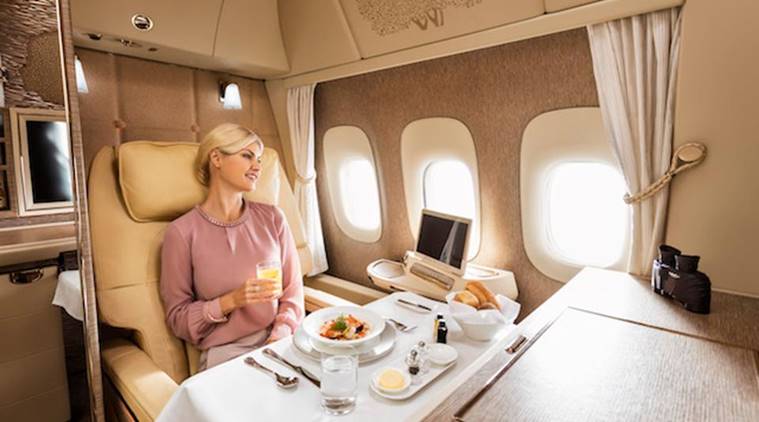
In November, Emirates rolled out private suites on its newest Boeing 777 jets—three of the 40-square-foot single-seat cabins fit across the width of the airliner. It has upgraded its fleet of chauffeured cars that whisk upmarket fliers to and from the airport, replacing Volvos with BMWs equipped with Wi-Fi hot spots. It spent $6.7 million building a lavish lounge at Boston’s Logan airport, part of a global makeover that included upgrades for lounges in Singapore and Bangkok.
Last year, Emirates spent $56 million on its collection of fine French wines alone. It has splashed out $780 million on the stuff since 2006 and owns its own wine cellars in France. On a recent flight, cabin crew poured a $566 bottle of 1998 Chateau Margaux for its first-class passengers. On some routes, the airline regularly offers the exclusive Hennessy Paradis Imperial cognac, which retails for more than $1,000 a bottle. Emirates surprised its first- and business-class passengers on a Dubai-Paris flight in April with an onboard wine-tasting master class led by a top vintner.
“I want it to feel like you are walking into a Ritz-Carlton,” says longtime President Tim Clark, who helped start the Dubai-owned carrier more than 30 years ago.
The airline is betting that the high profit margins of its luxury tickets will allow it to avoid chasing masses of travelers riding in discounted coach seats. The idea threatens to overturn one of the tenets of how to thrive as a large network carrier.

Profit Engine

Emirates' profit has turned higher after a sharp drop during the oil-price bust. Its margins have historically beaten the industry.

Note: 1 billion dirham = $272.2 million at the current exchange rate
Sources: the company; International Air Transport Association (industry average)
For most of the rest of the industry, the strategy has, until recently, seemed too expensive and too risky. Carriers have always pushed higher-margin first-class and business seats. Analysts say those seats can make up about half of a big airline’s revenue and most of its profit.
But they have also relied on filling the rest of their planes with lower-paying economy passengers to squeeze revenue out of every flight. Big carriers add capacity when times are good, trying to fill planes and capture market share. But the excess supply naturally depresses prices, eroding profit margins.
Emirates’ focus on its top-paying customers—who aren’t as inclined to make purchases based on price—insulates it somewhat from the industry’s boom-and-bust cycle. It has a higher proportion of business and first-class seats than its peers, and it puts less emphasis on filling every seat in the plane.
Emirates’ load factor, a measure of seats sold per plane, is roughly 78%, compared with the industry average of more than 80%.
The amenities keep P.N.C. Menon, the founder and chairman of Dubai-based property developer Sobha Group, coming back. “I don’t fly with anybody else unless Emirates doesn’t operate there,” he says. He always books first class. Emirates consistently scores among top carriers in rankings by Skytrax, a London-based consultancy that factors in customer feedback.
Emirates is investing in revving up the luxury areas of its fleets.
Emirates is investing in revving up the luxury areas of its fleets. PHOTO: JASPER JUINEN/BLOOMBERG NEWS
Ticket prices are highly variable, but Emirates’ can be notably higher. On Emirates, a round trip between Dubai and London for mid-July travel was recently priced at around $10,400 in first class and $4,600 in business. A round-trip “upper class” ticket on Virgin Atlantic, with a seat that converts to a flat bed, between the cities was selling for around $3,400.
Between 2010 and 2015, Emirates’ profit margin averaged 5.5%, more than double the 2.3% average margin for the industry as a whole, according to data from the International Air Transport Association.
But Emirates has an extra sensitivity to oil prices. Lower fuel costs usually help carriers, but since so many of Emirates’ customers are in the business, a drop can hurt ticket sales.
In 2016, when oil prices were at lows, the margin slipped to 1.5%, recovering to 3% by 2017. Airlines globally averaged a 4.7% margin over the 2016-17 period.
The airline, part of Emirates Group, reported revenue of $25.2 billion for the latest fiscal year ended March 31, and profit of $762 million. It is 100%-owned by the government of Dubai, one of seven semiautonomous states that make up the United Arab Emirates. Its shares don’t trade on any exchange, so disclosure has always been limited, and analysts don’t follow it closely.
That has raised skepticism from competitors. American and European airlines accuse Emirates and other Mideast carriers of benefiting from unfair, hidden subsidies from their oil-rich government owners. Emirates and the others deny that.

Stretching Out

Emirates is one of the world's biggest buyers of jets as it adds routes and passengers, but it at times has a lower load factor, a measure of seats sold per plane.

Note: For fiscal years ending March 31, except for load factor
Sources: the company (aircraft, passengers, destinations); International Air Transport Association (load factor)
Despite suspicions that Emirates’ strategy alone isn’t creating all its profits, some airlines are now taking a page from its playbook. Deutsche Lufthansa AG , one of Emirates’ chief rivals in Europe, is rolling out an upgraded business class when it takes delivery of a fleet of new Boeing jets in two years. The seats will convert into 7-foot beds, which can be controlled by a passenger’s smartphone. The airline offers a cigar bar in its Frankfurt first-class lounge. It arranges rental Porsche 911s for passengers looking to kill time between flights.
“We want to offer as much premium as possible,” says Stefan Kreuzpaintner, head of Lufthansa sales for Europe, the Middle East and Africa. U.S. carriers, including Delta Air Lines Inc. and United Continental Holdings Inc., are also spiffing up their premium classes. Delta last year introduced a new business class seat, with shoulder-high privacy doors and “memory” foam cushions that retain the contours of a passenger’s body.
“Early on, some of what Emirates offered was seen as gimmicky,” says airline consultant John Strickland.  “People no longer scoff,” he says.
Reviewing products for passengers at headquarters in Dubai.
Reviewing products for passengers at headquarters in Dubai. PHOTO: CELIA PETERSON FOR THE WALL STREET JOURNAL (2)
Chateau Margaux for Seat 2A: Emirates Rewrites Rules for Airlines
In some ways the superluxe strategy has been around since the start of long-haul commercial aviation—for years, a mode of transportation only the rich could afford. In the 1940s, Pan Am’s fleet of long-range Flying Clippers offered filet mignon on white tablecloths. A few decades later, the Concorde came to embody the new, global jet set. A handful of Asian carriers, like Cathay Pacific andSingapore Airlines , marketed themselves as more exclusive, pricier, options for long-haul travel.
Emirates, which started in 1985 as a shuttle service between Dubai and Pakistan, turbocharged that model, taking advantage of the geography of its hub in Dubai, situated between Asia and the West. It spawned copy cats of its own—Abu Dhabi’s Etihad Airways and Qatar Airways.
Dubai is opening in phases a sprawling new airport that will require a fast resumption of growth at the airline to justify the cost, already $30 billion in the initial stages. Dubai’s current airport—itself a luxurious destination full of high-end lounges and services—hosts 90 million passenger a year. The new airport’s capacity is expected to eventually reach 200 million.
Low oil prices in recent years frightened off some of Emirates’ most lucrative travelers—international oil and gas executives and big spenders in the Middle East. A short-lived ban on travel to America from several Mideast countries and temporary gadget restrictions hit traffic. U.S.-bound passengers fell by 35%.
In the darkest days of the oil-price rout, when profits and margins sank, Mr. Clark cut costs—but only behind the scenes, and in the back of the plane, where economy passengers sit, not in the premium cabin. Mr. Clark brought some parts production, such as seat-number plates, in house. Emirates started serving its own, cheaper bread rolls. In economy, it stopped handing out hot towels and served less-expensive cuts of meat.
Tim Clark, president of Emirates Airline, sits in a first-class suite.
Tim Clark, president of Emirates Airline, sits in a first-class suite. PHOTO: CHRISTIAN CHARISIUS/DPA/ZUMA PRESS
Emirates also experimented with tactics some other airlines had adopted from budget carriers. It started selling discounted fares in its economy cabin, charging extra for a seat assignment or checked luggage. Last year, it began to team up with budget airline Flydubai, also owned by the Dubai government, to cooperate on some routes.
But Emirates refused to skimp on business and first-class customers. “The amount of money you would save by going from Champagne to orange juice in business class is infinitesimally small,” Mr. Clark says. “The effect on the brand is devastating.”
Now, the oil price is back up to around $75 a barrel—from a low of around $25 two years ago—and lucrative flights are being reinstated. For its flight to Houston, a key route for high-paying energy executives, Emirates has resumed using giant Airbus A380s. Emirates has been, by far, the biggest buyer of the superjumbo jet—the world’s biggest commercial aircraft—in part because of all the room it provides for business and first-class space.
The Dubai-Houston flights are now configured with 14 first-class seats, 76 business class seats and about 400 coach seats. That’s up from eight first-class and 42 business class seats and around 400 coach seats on the Boeing 777 used in recent years.
An Emirates business-class cabin in an Airbus A380.
An Emirates business-class cabin in an Airbus A380. PHOTO: CHRISTIAN CHARISIUS/PICTURE ALLIANCE/GETTY IMAGES
Two years ago, Mr. Clark hired Christoph Mueller, who previously helped turn around two troubled airlines, Ireland’s Aer Lingus and Malaysia Airlines, to push Emirates’ luxury offerings beyond just comfortable seats and expensive wine lists. Mr. Mueller has a goal to turn Emirates into a high-end lifestyle companyfor the world’s wealthiest passengers.
He aims to make Emirates’ high-end passengers’ journeys as seamless as possible—from pickup at home to drop-off at the hotel. Passengers drinking a certain white wine in an Emirates lounge should be welcomed with a glass of the same once on board, Mr. Mueller says. A passenger watching a movie on their tablet on the way to the airport should be able to arrive aboard and find it spooled up and ready to continue on the plane.
A lobster dish for first-class passengers.
A lobster dish for first-class passengers. PHOTO: IMAGO/ZUMA PRESS
Emirates plans to reconfigure its onboard kitchens to offer by year-end meal service to business-class passengers on demand, rather than at set times. Mr. Mueller wants to personalize menus, so you don’t have to eat the same thing everyone else is having.
Outside of its planes, the airline is also pushing into concierge services, such as booking hard-to-get restaurant reservations and offering all-in-one holiday packages at Dubai’s glitzy resorts.
Corrections & Amplifications 
Emirates’ load factor is roughly 78%. An earlier version of this article and an accompanying graphic incorrectly stated it was 67%. (July 12, 2018)
By Robert Wall and
 Nicolas Parasie
Write to Robert Wall at robert.wall@wsj.com and Nicolas Parasie at nicolas.parasie@wsj.com
Appeared in the July 13, 2018, print edition as 'Chateau Margaux for Seat 2A: Emirates Rewrites Airline Rules.'