Showing posts with label Worlds Beyond Earth. Show all posts

Wednesday, February 26, 2020

Dazzling Redesign Of The Allison And Roberto Mignone Halls Of Gems And Minerals At The American Museum Of Natural History Will Open In Fall 2020

150th Logo.png
February 25, 2020
_________________________________________________________________________________
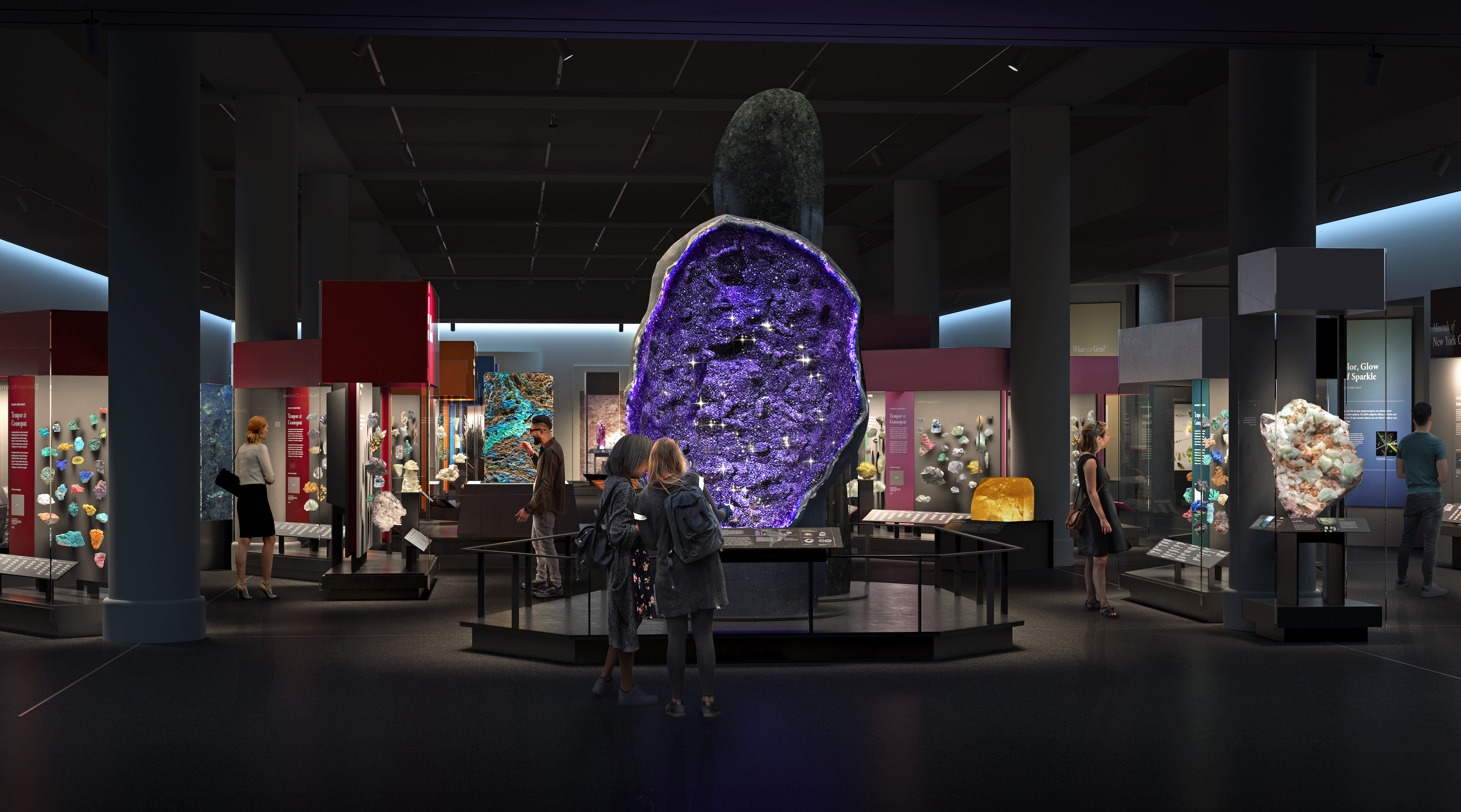
MHGM - looking north - amethyst geode.jpg


Re-Envisioned Halls Will Present the Current Science of Mineral Formation and

Showcase Spectacular New Specimens and World-Renowned Collection


A New Temporary Exhibition Gallery to Open with Beautiful Creatures,

A Celebration of Vintage and Contemporary Jewelry Inspired by Animals


The American Museum of Natural History today announced that it will open the completely redesigned Allison and Roberto Mignone Halls of Gems and Minerals in fall 2020. A brilliant showcase for one of the greatest collections of its kind and an engaging guide to recent science about our dynamic planet, the 11,000-square-foot halls will feature:
  • recently acquired specimens, including two remarkable amethyst geodes that are among the world’s largest on public display
  • a gallery of gems re-presenting treasures such as the legendary 563-carat “Star of India” sapphire and 632-carat Patricia emerald
  • and the halls’ first temporary exhibition gallery, opening with Beautiful Creatures, a celebration of exquisite historic and contemporary jewelry inspired by animals.
With interactive displays, touchable specimens, and media, the halls’ redesigned exhibits will tell the fascinating story of how the vast diversity of mineral types—which, similarly to biological organisms, are grouped into species—arose on Earth, how scientists classify them, and how humans have used them throughout the millennia for personal adornment, tools, and technology.

Highlights will include a luminous gallery featuring a wall-sized panel of rock glowing fluorescently in shades of orange and green; a pair of exquisite amethyst geodes from Uruguay that tower to a height of 12 feet and 9 feet; and the 9-pound almandine “subway” garnet discovered under Manhattan’s 35th Street in 1885. Jewelry in animal forms featured in the temporary exhibition gallery will include pieces by Cartier, Bulgari, and Tiffany & Co., as well as by contemporary designers such as Bina Goenka. The halls are curated by George E. Harlow, curator in the Museum’s Division of Physical Sciences. Marion Fasel is guest curator for the Beautiful Creatures temporary exhibition.

The halls of gems and minerals are named for Roberto and Allison Mignone, long-time Museum supporters and volunteers. Roberto Mignone is a Museum Trustee and Allison Mignone is vice chair of the Museum’s Campaign.

The halls are undergoing renovation as part of the physical and programmatic initiatives undertaken in conjunction with the 150th anniversary celebration of the Museum, which was founded in 1869. These projects will culminate in the opening of the Richard Gilder Center for Science, Education, and Innovation, a major new facility that will house exhibition galleries, education spaces, and collections.

“The opening of the Mignone Halls of Gems and Minerals will be a milestone in a wide range of capital and programmatic enhancements commemorating the Museum’s 150th anniversary,” said Ellen V. Futter, President of the American Museum of Natural History. “By telling the fascinating stories of the complex processes that gave rise to the extraordinary diversity of minerals on our dynamic planet and describing how people have used them throughout history for personal adornment, tools, and technology, the Halls will not just be glittering but also intellectually engaging. The new Mignone galleries will also be a major gateway, directly linking visitors to the new Richard Gilder Center for Science, Education, and Innovation. We are indebted to Allison and Roberto Mignone for making this important project possible.”

“When I first started as a curator at the Museum over 40 years ago, the most recent version of these galleries had just opened. Science has progressed significantly in that time, such as with the concept of mineral evolution,” said George E. Harlow, curator of the new halls. “These new exhibits will present our current scientific understanding of gems and minerals, present the environments in which they form, and focus on the intimate relationship between minerals and life.”

“Halls like these are crucial and tangible teaching tools that communicate an understanding of humanity’s place in the universe,” said Allison Mignone. “Our family’s experiences at the Museum have helped us see the discoveries and sparks that take place when spectacular exhibits such as this one are on view, and remarkable stories, such as those that will be featured in these renovated galleries, are told.”

Exhibits in the Mignone Halls of Gems and Minerals will explore the conditions on our planet that have made possible the extraordinary variety of mineral species found on Earth. In addition to the role of plate tectonics and fluids responsible for the formation of crystals, exhibits will reveal how the introduction of free oxygen into the Earth’s atmosphere more than 2 billion years ago triggered an explosion not only in biological life but also in mineral diversity. The oxygenated atmosphere—produced by cyanobacteria, a group of photosynthetic organisms—made it possible for oxygen to combine into many more vividly colorful minerals on Earth, now numbering approximately 5,500 species.

The section of the Museum that will house the Mignone Halls of Gems and Minerals had long been a cul-de-sac, which could be entered and exited only from the south end. In the future, the Mignone Halls of Gems and Minerals will be linked to the new Gilder Center, allowing visitors to circulate with greater ease and less congestion.

The Mignone Halls of Gems and Minerals will be a striking complement to the David S. and Ruth L. Gottesman Hall of Planet Earth and Hayden Planetarium in the Rose Center for Earth and Space, and the Arthur Ross Hall of Meteorites. The Gottesman Hall of Planet Earth illustrates the evolution and inner workings of our dynamic planet with outstanding geological specimens and interactive exhibits on climate change, while the Hayden Planetarium educates visitors about the latest space science through immersive presentations such as the Museum’s newest Space Show Worlds Beyond Earth. The Ross Hall of Meteorites—which is immediately adjacent to the Mignone galleries—explores the origins of our solar system through holdings from the Museum’s world-class collection of meteorites, which contain some of the same minerals found on Earth.

With exhibits that support New York State and national science education standards, these halls serve as a vital resource for school and camp groups, educators, and graduate students in the Museum’s Master of Arts in Teaching program, which provides a specialization in Earth science for teachers of grades 7 through 12.
The Mignone Halls of Gems and Minerals is designed by Ralph Appelbaum Associates together with the American Museum of Natural History’s award-winning Exhibition Department under the direction of Lauri Halderman, vice president for exhibition.
The Museum gratefully acknowledges Allison and Roberto Mignone for their leadership support of the redesigned Halls of Gems and Minerals.
Generous support has been provided by the Arthur Ross Foundation.
Worlds Beyond Earth is dedicated to the memory of Charles Hayden in celebration of the 150th anniversary of his birth and made possible by the generous support of the Charles Hayden Foundation.
Proudly sponsored by Bank of America.
Generously sponsored in loving memory of Wallace Gilroy.

About the American Museum of Natural History (amnh.org)
The American Museum of Natural History, founded in 1869 and currently celebrating its 150th anniversary, is one of the world’s preeminent scientific, educational, and cultural institutions. The Museum encompasses 45 permanent exhibition halls, including those in the Rose Center for Earth and Space plus the Hayden Planetarium, as well as galleries for temporary exhibitions. It is home to New York State’s official memorial to Theodore Roosevelt, a tribute to Roosevelt’s enduring legacy of environmental conservation. The Museum’s approximately 200 scientists draw on a world-class research collection of more than 34 million artifacts and specimens, some of which are billions of years old, and on one of the largest natural history libraries in the world. Through its Richard Gilder Graduate School, the Museum grants the Ph.D. degree in Comparative Biology and the Master of Arts in Teaching (MAT) degree, the only such free-standing, degree-granting programs at any museum in the United States. Annual on-site attendance has grown to approximately 5 million, and the Museum’s exhibitions and Space Shows can be seen in venues on six continents. The Museum’s website, digital videos, and apps for mobile devices bring its collections, exhibitions, and educational programs to millions more around the world. Visit amnh.org for more information.

Hours
The Museum is open daily, 10 am–5:45 pm. The Museum is closed on Thanksgiving and Christmas.
Admission
Museum admission is free to all New York City school and camp groups.
Pay-what-you-wish admission is available only at ticket counters, where the amount you pay is up to you.
General Admission, which includes admission to all 45 Museum halls and the Rose Center for Earth and Space but does not include special exhibitions, giant-screen 2D or 3D film, or Space Show, is $23 (adults), $18 (students/seniors), and $13 (children ages 2–12). All prices are subject to change.
General Admission Plus One includes general admission plus one special exhibition, giant-screen 2D or 3D film, or Space Show: $28 (adults), $22.50 (students/seniors), $16.50 (children ages 2–12).
General Admission Plus All includes general admission plus all special exhibitions, giant-screen 2D or 3D film, and Space Show: $33 (adults), $27 (students/seniors), $20 (children ages 2–12).
Public Information
For additional information, the public may call 212-769-5100 or visit the Museum’s website at amnh.org.

Follow
Become a fan of the American Museum of Natural History on Facebook at facebook.com/naturalhistory, follow us on Instagram at @AMNH, Tumblr at amnhnyc, or Twitter at twitter.com/AMNH

Wednesday, January 15, 2020

World's Beyond Earth, A New Hayden Planetarium Space Show Opens January 21 At The American Museum Of Natural History

150th Logo.png

_________________________________________________________________________________


narrated by Academy Award winner Lupita Nyong’o, new show features
a stunning exploration of worlds that share our solar system


Featuring immersive visualizations of distant worlds, groundbreaking space missions, and breathtaking scenes depicting the evolution of our solar system, the American Museum of Natural History’s new Hayden Planetarium Space Show, Worlds Beyond Earth will open January 21, 2020, using a new planetarium projection system that is the most advanced in the world, and is part of the Museum’s 150th anniversary celebration. Worlds Beyond Earth, narrated by Academy Award winner Lupita Nyong’o, takes viewers on an exhilarating journey that reveals the surprisingly dynamic nature of the worlds that orbit our Sun and the unique conditions that make life on our planet possible.

In the past 50 years, humankind’s ability to travel through and study our solar system has increased exponentially with the advent of robotic spacecraft, and we have learned much about our neighboring planets—how they were formed and what they are like today,” said Ellen V. Futter, President of the American Museum of Natural History. “As with our previous, enormously popular Space Shows, Worlds Beyond Earth is a feat of science visualization, built on real data and research, and now dazzlingly showcased through the Hayden Planetarium’s new cutting-edge projection system. We can think of no better way to celebrate the thrilling state of space science today as well as the Museum’s 150th anniversary of bringing the world and the universe to our visitors.”

While humans have to yet to walk on another world beyond the Moon, Worlds Beyond Earth celebrates the extraordinary Age of Exploration carried out by our closest proxies, robotic explorers, over the past 50 years. Created by an award-winning team that includes Museum scientists, educators, and science visualization experts, Worlds Beyond Earth is an immersive theater experience based on authentic data from NASA, European Space Agency (ESA), and Japan Aerospace Exploration (JAXA) missions, telescopes, supercomputer simulations, and research conducted at institutions around the globe. Viewers will be taken on an adventure across the solar system, from our Moon and planetary neighbors Mars and Venus to beyond the asteroid belt, where worlds of ice and gas like Saturn and Jupiter host moons revealing active weather, erupting volcanoes, and buried oceans.

“Our ability to render these distant worlds is nothing short of astonishing, thanks to past and current space missions and the data they provide,” said Carter Emmart, the Museum’s director of astrovisualization and the director of Worlds Beyond Earth. “We’re not making anything up here. The height, color, and shapes we see come from actual measurements. In the Space Show, you see these beautiful objects as they actually are, to the best of our abilities.”

This is the first Hayden Planetarium Space Show that will “land” audience members on other worlds in our solar neighborhood, reconstructing actual events at specific locations, including a landing on the gray, cratered surface of the Moon, which viewers will reach by following an Apollo launch out of Cape Canaveral and the subsequent landing of the Lunar Module “Falcon,” carrying the first Lunar Roving Vehicle; and the liquid methane lakes of Saturn’s moon Titan, an almost Earthlike but extremely cold world 1.4 billion kilometers away, illuminated by ESA’s Huygens probe, launched from NASA’s Cassini spacecraft. Visualizations based on 13 years of data from NASA’s Cassini spacecraft will show viewers Saturn’s impressive, swirling rings as never before: bubbling with moonlets—house-sized baby moons—that form through a process that scientists think may parallel planet formation in the solar system. In addition, audiences will encounter one of Jupiter’s many moons, Io, which is the most volcanically active object in the solar system despite being covered by ice; Europa, another Jupiter moon with more liquid water beneath its icy crust than all of the oceans on Earth; Comet 67P, a frozen object traveling between the inner and outer solar system that the ESA’s Rosetta spacecraft chased for 10 years; and the dry and dusty landscape of Mars, based on high-resolution global maps from NASA’s Mars Reconnaissance Orbiter, Mars Global Surveyor, and ESA’s Mars Express.

“I don’t think many people realize just how much we, as the human race, have seen of our solar system,” said Worlds Beyond Earth curator Denton Ebel, a curator in the Museum’s Department of Earth of Planetary Sciences and chair of the Division of Physical Sciences. “But we are out there, via these incredibly complex and successful spacecraft, and what we’re learning about our unique place in it is surprising and also a bit sobering.”

For example, as Worlds Beyond Earth audiences will see, NASA’s Magellan mission to Earth’s “twin” planet, Venus, revealed a world that once may have had conditions very similar to our planet’s but today has a surface hot enough to melt lead because of its long-term buildup of greenhouse gases. Sending spacecraft to explore Venus deepened scientists’ understanding of global warming and illuminated that pumping carbon dioxide into our own atmosphere leads to rising temperatures and threatens civilization on Earth. In contrast, our other solar neighbor, Mars, is freezing cold. Exploration reveals that Mars’ once-plentiful water supply and active volcanoes created conditions for life but that they didn’t last long, as demonstrated in a dramatic simulation of Mars’ surface evolution. The Red Planet’s core cooled quickly, causing its magnetic field to decay and allowing most of its atmosphere to be stripped away. What is left is a dry, frozen desert—a “failed Earth.”

Unlike Venus and Mars, Earth is surrounded by a strong magnetic field—powered by its hot, churning outer core, which is visualized in Worlds Beyond Earth—that forms a shield that deflects solar wind and protects our atmosphere. Our planet pumps out heat, feeding volcanoes at the surface and helping to sustain this atmosphere with the perfect blend of molecules for life.

Worlds Beyond Earth is the first Museum Space Show to take full advantage of the world’s most advanced planetarium projection system, installed last year in the Hayden Planetarium. The first-of-its-kind high dynamic range (HDR) laser system displays the widest color gamut of any planetarium in the world, allowing visitors to experience as never before both the darkness of outer space and the most colorful worlds in our solar system (see release on Hayden Planetarium upgrades).

Worlds Beyond Earth is part of the Museum’s 150th anniversary celebration, which officially began in March 2019 and includes a series of events, programs, and exhibitions inspired by the Museum’s legacy of scientific exploration and science education, including the role of the historic Hayden Planetarium in bringing the latest space science to the public. First built in 1935 and named for philanthropist Charles Hayden, the world-famous facility has transported generations of New Yorkers to the edges of the observable universe, revealing mysterious cosmic phenomena and nurturing their curiosity about the magnitude and workings of our universe. The new Space Show is dedicated to the memory of Charles Hayden and opens during the 150th anniversary of the year of his birth (see release on history of the Planetarium).

“We are proud to be an ongoing supporter of the Hayden Planetarium at the American Museum of Natural History. Worlds Beyond Earth will continue the Museum’s long legacy of presenting the latest space science to NYC students and the general public.”

Worlds Beyond Earth is sponsored by Bank of America.

“Bank of America is pleased to sponsor the exciting new space show, Worlds Beyond Earth,” said Anne Walker, NYC President, Bank of America. “As one of the largest corporate supporters of arts and culture programming world-wide, we believe in the power of the arts to help communities thrive, educate, inspire, enrich societies, and create greater cultural understanding.” 

Worlds Beyond Earth is curated by Denton Ebel, curator in the Museum’s Department of Earth of Planetary Sciences and chair of the Division of Physical Sciences, who specializes in the study of meteorites and cosmochemistry, and directed by Carter Emmart, who, in addition to his work as the Museum’s director of astrovisualization, was one of the original team members of the NASA-funded Digital Universe and OpenSpace projects, which continue to redefine how planetarium theaters present science to the public through immersive data visualization.

Worlds Beyond Earth is produced by Vivian Trakinski, who directs the Museum’s science visualization program, and documentary filmmaker Gavin Guerra. Rosamond Kinzler, senior director of science education, co-director of the Museum’s Master of Arts in Teaching program, and the principal investigator of the OpenSpace project, is the executive producer.

The script for Worlds Beyond Earth is written by Natalie Starkey, a geologist who is an author and science communicator. The score is written by Robert Miller, a New York City composer who also wrote the music for four previous Museum Space Shows, and was primarily recorded in Abbey Road Studios in London. It includes a classical guitar segment recorded in New York by musician and former New York Yankees player Bernie Williams.

Worlds Beyond Earth is the Hayden Planetarium’s sixth Space Show since the opening in 2000 of the Rose Center for Earth and Space, which premiered the first Space Show, Passport to the Universe, narrated by Tom Hanks, that same year. Previous Space Shows have included The Search for Life: Are We Alone? (2002), narrated by Harrison Ford; Cosmic Collisions (2006), narrated by Robert Redford; Journey to the Stars (2009), narrated by Whoopi Goldberg; and Dark Universe (2013), narrated by Neil deGrasse Tyson, Frederick P. Rose Director of the Hayden Planetarium.

Worlds Beyond Earth was created by the American Museum of Natural History,
the Frederick Phineas and Sandra Priest Rose Center for Earth and Space,
and the Hayden Planetarium.

Worlds Beyond Earth is dedicated to the memory of Charles Hayden in celebration of the 150th anniversary of his birth and made possible by the generous support of the Charles Hayden Foundation.
Proudly sponsored by Bank of America.
Generously sponsored in loving memory of Wallace Gilroy.

OpenSpace is based upon work supported by NASA under award No. NNX16AB93A. Any opinions, findings, and conclusions or recommendations expressed in this material are those of the author(s) and do not necessarily reflect the views of the National Aeronautics and Space Administration.

About the American Museum of Natural History (amnh.org)
The American Museum of Natural History, founded in 1869 and currently celebrating its 150th anniversary, is one of the world’s preeminent scientific, educational, and cultural institutions. The Museum encompasses 45 permanent exhibition halls, including those in the Rose Center for Earth and Space and the Hayden Planetarium, as well as galleries for temporary exhibitions. It is home to New York State’s official memorial to Theodore Roosevelt, a tribute to Roosevelt’s enduring legacy of environmental conservation. The Museum’s five active research divisions and three cross-disciplinary centers support approximately 200 scientists, whose work draws on a world-class permanent collection of more than 34 million specimens and artifacts, as well as on specialized collections for frozen tissue and genomic and astrophysical data and on one of the largest natural history libraries in the world. Through its Richard Gilder Graduate School, it is the only American museum authorized to grant the Ph.D. degree and also to grant the Master of Arts in Teaching degree. Annual visitation has grown to approximately 5 million, and the Museum’s exhibitions and Space Shows are seen by millions more in venues on six continents. The Museum’s website, mobile apps, and massive open online courses (MOOCs) extend its scientific research and collections, exhibitions, and educational programs to additional audiences around the globe. Visit amnh.org for more information.
Follow
Become a fan of the American Museum of Natural History on Facebook at facebook.com/naturalhistory, follow us on Instagram at @AMNH, Tumblr at amnhnyc, or Twitter at @AMNH