Wednesday, April 15, 2020

Indulge In New Mexico's Centuries-Old Chocolate Customs

The tradition of cacao has endured in the region for more than a thousand years
Kakawa Chocolate House in Santa Fe makes traditional chocolate elixirs, as well as such treats as chocolate-dipped chile de árbol — Photo courtesy of Kakawa Chocolate House

Today, cacao is a staple of Valentine’s Day chocolates, but the food is hardly a modern marvel. Indigenous peoples were consuming cacao in what is now the American Southwest more than a thousand years ago, long before it was shaped into truffles and packaged in heart-shaped boxes.
University of New Mexico archeology professor Dr. Patricia Crown led a team of researchers to two ground-breaking discoveries that placed chocolate in the Southwest centuries before it was thought to have arrived in the region.
Previously, the Spanish were thought to have carted it into the area in the 15th century. Crown and her team — which included W. Jeffrey Hurst, formerly of the Hershey Technical Center in Hershey, Pennsylvania — found that the Hohokam peoples consumed cacao in what is now Arizona between 750 and 900 A.D.
Crown also traced chocolate consumption to today’s Chaco Culture National Historical Park, in western New Mexico, to around 900 and 1100 A.D. To discover this connection, the team looked for biomarkers for specific substances in centuries-old ceramics. They found residue of theobromine: a telltale chemical in cacao.
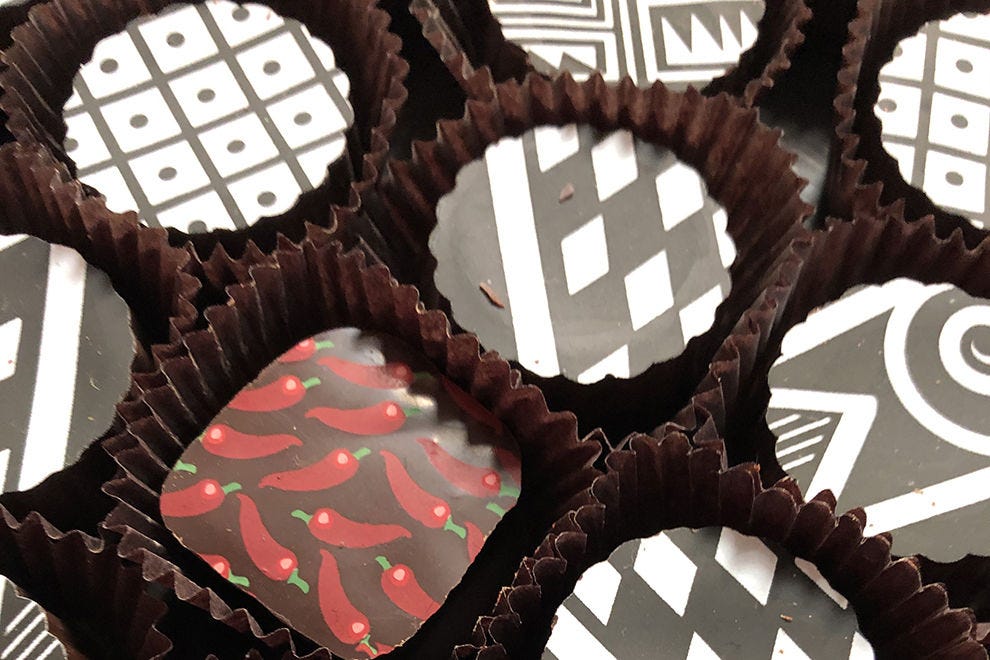
Art of Chocolate / Cacao Santa Fe creates chocolate truffles with pottery-inspired designsArt of Chocolate / Cacao Santa Fe creates chocolate truffles with pottery-inspired designs — Photo courtesy of Art of Chocolate / Cacao Santa Fe
Because cacao can’t grow in the arid southwest, Crown says these discoveries point to trade between the ancient peoples who resided there and Mesoamerica. “It had to come from the tropics. It was a trade item,” she explains. “If you’re going to use it in ritual activity, which is what we think they were doing, you’d have to establish an ongoing supply.”
Crown believes the cacao was consumed as drinking chocolate, similar to how the Aztecs and Maya consumed it. These ancient civilizations have an even longer history of consuming the plant. Their drinking chocolate wasn’t the milky, hot chocolate popular today; cacao powders were dissolved into water, making for a complex, potent elixir.
At Chaco, the team discovered cacao in cylindrical pottery jars made in pairs with lids of sandstone discs. “Hard chocolate, like candy bars, is a relatively recent invention. In the past, cacao was consumed by drinking it or in sauces, like moles,” she says. “Throughout Mesoamerica, the froth was considered the most delicious part. At Chaco, we believe they created froth by pouring the chocolate back and forth between cylindrical jars. That’s why they were made in sets of two to four jars.”
More than a thousand years after cacao’s arrival in the American Southwest, several chocolate shops in Arizona and New Mexico are continuing to tap into these traditions and regional flavors.
Monsoon Chocolate creates truffles sourced from local ingredientsMonsoon Chocolate creates truffles sourced from local ingredients — Photo courtesy of Monsoon Chocolate / Julius Schlosburg
Located in Santa Fe, New Mexico, Kakawa Chocolate House and Art of Chocolate/Cacao Santa Fe both serve chocolate elixirs. Kakawa celebrates historic European elixirs as well as more traditional Mesoamerican elixirs. Using archeological research and accounts by Spanish settlers, the intimate chocolate house has recreated recipes using ground cacao beans, spices, chile, and herbs.
The Art of Chocolate/Cacao Santa Fe too blends drinking chocolates and elixirs. Historical documents also inspire their recipes, which use unsweetened chocolate that begins in bean form and is roasted and ground in-house. The Zapotec Tejate incorporates ground blue corn, which the indigenous peoples of the Southwest have long cultivated. The Tolteca Notchli is sweetened with prickly pear cactus juice (another local ingredient) and chile powder.
Although they specialize in hardened chocolate bars that the peoples of the ancient Southwest wouldn’t recognize, the bean-to-bar makers at Taos, New Mexico's Chokolá celebrate the “food of the gods.” The craft chocolaterie specializes in single-origin chocolate bars, truffles and mousses. Often its chocolate originates in Central and South America.
In Arizona, Tucson chocolate maker and confectioner Monsoon Chocolate creates truffles utilizing regional flavors — some that may have even been present when the Hohokam were first consuming cacao more than a thousand years ago. For example, the Chiltepin truffle uses dark-chocolate ganache infused with chiltepin pepper: the wild chile pepper native to the Southwest consumed by indigenous peoples. The Sonoran Sea Salt Dark Chocolate truffle is garnished with Tohono O’odham salt from the Sonoran flats at the Gulf of California.
Monsoon Chocolate also draws from more modern inspirations, such as in the Whiskey del Bac Dorado truffle, which layers caramel and chocolate. The chocolate makers infuse both elements with mesquite-smoked whiskey from Tucson spirit-maker Hamilton Distillers. Though it’s a contemporary creation, it’s still imbued with the tastes of the desert where America’s obsession with chocolate first began.
All of the chocolate artisans discussed here – Kakawa Chocolate House, The Art of Chocolate/Cacao Santa Fe, Chokolá, and Monsoon Chocolate – ship at least some of their confections through their websites. As of this writing, many of them also offer local delivery or curbside pickup as well.

Sunday, April 12, 2020

Travelore Editorial: The Coronavirus And Returning To Our Travels And Regular Day-To-Day Loves

By Allen Barkus, Publisher.

The travel and hospitality industry is facing the largest challenges in our lifetimes. I believe we will recover and possibly come back, with patience, stronger than ever. In my over 40 years experience in travel writing and in business in general I have observed that those who survive in the down times are the ones that most benefit when we emerge in recovery. I was personally traveling a week after 9/11 when airports had armed guards and people were afraid to travel.

The most important thing now for us is personal self care. As a senior yoga teacher since 2004 focusing on healing I've learned how moving forward with our lives with positive actions, physical and emotional, can have a huge long term benefit. I am fortunate to live in a suburban area with gardens to work in and safely walk. If you do not have that level of freedom of movement I encourage you to do what ever activities that bring you joy; ideally movement/exercise, intellectual stimulation, and healthy eating. Please also keep in touch with family and friends via phone, texts, and video chatting; especially the elderly.

Before you know it we will be ready to resume our regular day-to-day loves. I expect there will be
some alterations we will make including continuing to wear masks and honoring social distancing until effective vaccines and treatments are widely available. Apple and Goggle are developing an app
able to allow us to identify and track people with positive diagnoses, which should also be interesting.  Supermarkets are now considering widespread temperature checks before entering, also something I can foresee at restaurants and airports too to build consumer confidence as our economies restart up.

One of the things we suggest to jump start the travel and cruise industry is doing quick testing, offering travel travel health insurance, supplemental life insurance, and trip interruption coverage covering hotel and return flights if any Caronavirus issue occurs.

Allen Barkus has been actively writing for the Travelore Report for over 40 years, originated by his Father Ted in 1971.  He has been teaching Ashtanga Healing Therapy since 2004, https://www.ashtangabyallen.com/


Wednesday, April 8, 2020

Not Ready To Fly This Summer? United, American Extend Waivers For Free Changes, Cancellations


With summer travel plans in jeopardy as the coronavirus crisis drags on, major U.S. airlines are allowing travelers to change or cancel their tickets without paying a hefty change fee.
United Airlines moved first Tuesday, becoming the first major U.S. airline to extend its coronavirus travel waivers to cover flights through the end of the year. 
The waiver applies to travelers holding tickets bought before March 3.Travelers who booked, say, a summer flight from New York to Los Angeles or Europe last fall, can change their flight to another date or cancel their trip and receive an electronic travel credit, all without paying ticket change fees that start at $200 a person.
The new fee waiver policy does not cover travelers who bought or will buy tickets between March 3 and April 30. United already offers them a fee-free change for travel into next year.
Until Tuesday, United's change fee waiver for tickets bought before the coronavirus outbreak deepened only applied to travelers with flights through May 31. That meant passengers who voluntarily canceled summer, fall and even holiday flights they booked well in advance had to pay a change fee when they redeemed their travel credit.
There is a catch to United's new policy: travelers must make a decision and change or cancel their flight by April 30. (Travelers due to fly before May 31 don't have to meet this deadline.) 
"Many customers' previous plans for travel, including summer vacations, conferences and events have changed or are uncertain due to the COVID-19 outbreak,'' the airline said in a statement.  "To help with the uncertainty around their future travel, customers who wish to change their dates of travel can do so without paying a change fee.''
Late Tuesday, American Airlines said it was extending its change-fee waiver for travel through Sept. 30 for tickets purchased prior to April 7. The previous waiver only covered flights through May 31, which excludes the busy summer travel season.

Unlike United, American ticket holders don't have a deadline to decide whether to change or cancel their ticket,
Like United, American has a separate fee-change waiver for travelers who bought tickets more recently.
At United and American, travelers who change their ticket to another date will pay any applicable fare difference. And those who cancel their trips will not receive a refund unless it's a refundable ticket. They will receive a voucher for the value of the ticket.

Cancel or change your ticket now? Or wait?

Some travel experts, including Scott Keyes of Scott's Cheap Flights, have been advising travelers who want a cash refund to hold off on canceling their flights until the last minute in hopes the airline cancels it first or makes a significant change to the flight times. In those cases, travelers are entitled to a cash refund instead of just a travel voucher or credit, which airlines are pushing as they try to conserve cash.
The U.S. Department of Aviation last week warned airlines that they must provide a prompt refund in those cases, even during the unprecedented coronavirus crisis. United has been heavily criticized for not offering refunds to those with canceled flights or big schedule changes. Earlier this week, a passenger filed a class-action lawsuit against United for not providing a refund.

Check which waivers apply to your flights before making any decisions

Airlines have been issuing – and extending – a variety of waivers since coronavirus outbreak began in January.
Last week, United and Delta extended the expiration date of travel credits to two years.


USA TODAY


Sunday, April 5, 2020

For Your Post Coronaviris Travels: New Henequén Cultural Experience with Private Helicopter to Merida Available this Summer & Beyond at Grand Velas Riviera Maya

GVRM logo lr.jpg


   Guests staying at the AAA Five Diamond Grand Velas Riviera Maya this summer and beyond can embark on a journey back in time by exploring a historic Yucatan landmark with the resort’s new Henequén Experience.
The adventure begins with a private helicopter ride to the Hacienda Sotuta de Peon, a revived hacienda built in the late 1800s located just outside of the Yucatan’s vibrant capital, Merida. Over the course of three and a half hours, guests will dive into the deep-rooted history behind the henequen plant, known for transforming the Yucatan economy and cultural landscape in the 19th century. While on property, guests will also tour the hacienda’s surrounding plantation on a carriage pulled by mules, stop and swim in the Dzul Ha, a Yucatan freshwater cenote, and more.
Upon return to Grand Velas Riviera Maya, travelers will partake in the resort’s signature ancestral beverage tasting featuring Mexico’s ancient liquors like bacanora, sotol, tuxca, and pox. Following, guests will enjoy a private dinner in the resort’s Mayan restaurant, Chaká, which offers modern Yucatecan dishes inspired by the region’s traditional cuisine. Standout menu items include tender leaves on papaya with piloncillo honey, toasted seeds, fresh tomatoes, sour orange vinaigrette with Xtabentun, short rib "Pibil Style," sausage Risotto from Valladolid, Huitlacoche Salbute, Cochinita juice, cream cheese "Gallo Azul", semi-bitter cocoa crumble, caramel ice cream, and more.
Accommodations are offered in the resort’s tranquil Zen Grand Suites, which boast private terraces and overlooking the sacred jungle landscape, fully stocked mini-bars, Jacuzzi tubs, Nespresso coffee makers, 24-hour concierge service, and more.
The four-night Henequen Tour Experience costs $3,488 USD per person for 2 people. Rates are per person based on double occupancy and include luxury suite accommodations, à la carte gourmet meals at a variety of specialty restaurants, premium branded beverages, 24-hour in-suite service, fitness center, taxes, gratuity and more.  The experience is available from April 26 until December 18, 2020. Blackout dates are from Nov 21 to 28, 2020. For reservations or additional information, call 1-888-407-4869, or visit https://rivieramaya.grandvelas.com.
About Grand Velas Riviera Maya:
A member of the Virtuoso Hotels & image003.jpgResorts Program and Preferred Hotels & Resorts, the AAA Five Diamond Grand Velas Riviera Maya in Mexico is an ultra-luxury all-inclusive. Guests can choose accommodations among oceanfront, ocean view and a Zen-like setting, embraced by the flora and fauna of the Yucatan Peninsula’s jungle and mangroves. All 539 suites are more than 1,100 sq. ft., with balconies and some with private plunge pools. Eight restaurants, including five gourmet offerings, present a tour through Mexico, Europe and Asia. Cocina de Autor, at the hands of world-renowned celebrity chefs Bruno Oteiza and Mikel Alonso, holds the AAA Five Diamond Award, the first all-inclusive restaurant in the world to win this prestigious distinction. Included on Forbes Travel Guide’s list of The World’s Most Luxurious Spas, SE Spa is known for its authentic Mexican treatments, offerings from around world and signature seven-step Water Ceremony. Other features include 24-hour Personal Concierge; 24/7 in-suite service; three swimming pools; two fitness centers; water sports; innovative Kids’ Clubs and Teens’ Club; and Baby Concierge. The resort offers more than 46,660 square feet of indoor meeting space plus outdoor areas for events. Eduardo Vela Ruiz, founder and president of Velas Resorts, operates Velas Resorts with brother Juan Vela, vice president of Velas Resorts, by his side. Explore tips, recipes, lifestyle and travel trends, and the latest news about Velas Resorts on the digital mag: www.velasmagazine.com. 

Thursday, April 2, 2020

17 Sweet Travel Destinations For Chocolate Lovers, Wonderful Places To Consider After Travel Restrictions For Coronavirus Are Lifted.

1
Hershey, Pennsylvania

Gary Burke via Getty Images
Home to The Hershey Co., this destination in Derry Township, Pennsylvania, features Hershey's Chocolate World factory store and tour, Hersheypark theme park, The Hotel Hershey and its "chocolate spa," and many other attractions for lovers of all things chocolate.

2
St. Lucia
FREDERIC J. BROWN via Getty Images
The Caribbean island of St. Lucia is a popular chocolate tourism destination with its cocoa farms, chocolate-themed hotels, chocolate heritage month and more.
3
Barcelona, Spain
Museu de la Xocolata
Barcelona is a great city for chocolate lovers. In addition to the delicious cocoa cuisine (shoutout to churros dipped in chocolate), there are also chocolate walking tours and the famous Museu de la Xocolata, which covers the history and production of chocolate and houses impressive chocolate sculptures.
4
Switzerland
AGF via Getty Images
Switzerland is an obvious chocolate travel destination. Many of its famous chocolate brands offer on-site factory tours to visitors wanting to learn more about the production (and try some samples). Popular tours include Maison Cailler in Broc, Läderach in Bilten and Camille Bloch in Courtelary.
5
Bariloche, Argentina
Christian Ender via Getty Images
San Carlos de Bariloche, aka Bariloche, is a town in Patagonia famous for its Alpine architecture and chocolate production. Many chocolate shops and cafes, including the popular Mamuschka, line Mitre Street.
6
Vienna, Austria
ullstein bild via Getty Images
Vienna boasts a rich cultural history that includes the invention of Sachertorte, a delicious chocolate cake that's become an Austrian staple. You can sample this sweet treat at a variety of spots, including Demel pastry shop and Hotel Sacher.
7
Oaxaca, Mexico
Phil Clarke Hill via Getty Images
There are ample places where cacao lovers can taste delicious chocolate throughout Mexico, but the best destination is probably the Oaxaca area. Although it's not a major growing region, Oaxaca's gastronomical history centers largely on cacao. Popular specialties include champurrado (a hot chocolate drink) and mole sauce prepared with chocolate.
8
Brussels, Belgium
ullstein bild via Getty Images
Visiting the source of Belgian chocolate is another obvious move in the world of choco-travel. Brussels is home to the Choc-Story museum, as well as famous chocolatiers like Neuhaus, Pierre Marcolini, Mary, Wittamer and Godiva.
9
Birmingham, England
PAUL ELLIS via Getty Images
In 1824, John Cadbury began selling tea, coffee and drinking chocolate in Birmingham, England, and over time his business grew into the confectionary brand we know as Cadbury. Today, visitors to Birmingham can check out Cadbury World to learn about the history of the company, shop in the world's largest Cadbury store, sample Cadbury treats and participate in a variety of chocolate-themed activities.
10
Ecuador
RODRIGO BUENDIA via Getty Images
Ecuador produces world-renowned chocolate, and tourists can take farm and factory tours. Pacari Chocolate in Quito and the Guayas province-based Chchukululu offer popular tours.
11
Cologne, Germany
picture alliance via Getty Images
If you find yourself in Germany, consider checking out The Imhoff-Schokoladenmuseum aka The Chocolate Museum in Cologne. The scenic museum presents the global history of cocoa and a look at contemporary chocolate production, as well as a popular cafe and shop.
12
San Francisco
Smith Collection/Gado via Getty Images
Although the factory is no longer there, Ghirardelli Square still features a popular ice cream and chocolate shop from the brand. Visitors to San Francisco can also tour the Dandelion Chocolate factory and sample artisanal chocolates and cocoa treats throughout the city (special shoutout to Fog City News).
13
Vietnam
HOANG DINH NAM via Getty Images
Vietnamese chocolate has been described as "unlike any other." Tourists with a sweet tooth can explore the offerings from Marou or Azzan, which both offer tours.
14
Paris
Richard Bord via Getty Images
If you time your Paris visit right, you can experience the annual Salon du Chocolat trade fair, which includes fun events like a chocolate fashion show. Paris also has world-class chocolate offerings throughout the year, like the amazing chocolat chaud at Angelina and chocolatiers like La Maison du Chocolat and Jean-Paul Hévin .
15
Peru
Fotoholica Press via Getty Images
Peru has "ChocoMuseos" in Cusco and Lima, as well as popular chocolatiers like Roselen, and cacao jungle tours.
16
Ghana
Christian Science Monitor via Getty Images
Ghana is the second-largest producer of cocoa in the world, so the Ghana Tourism Authority recently launched its Cocoa Ecotourism Initiative to promote cocoa farms as a tourist attraction. Indeed, travelers can take tours to learn about the history and current practice of cocoa production in the country.
17
Tuscany, Italy
Amedei
Although Tuscany is probably best known for its wine, the region also has a lot to offer to chocolate fans. The so-called Chocolate Valley is a triangle between Pisa, Prato and Pistoia that boasts many small chocolate manufacturers, including Amedei.