Showing posts with label Airline food secrets. Show all posts

Monday, December 30, 2019

What You Should Know Before You Eat Airplane Food

Anuj Shrestha / for NBC News
By Adiel Kaplan, Lindsey Bomnin, Vicky Nguyen, Julianna Rennie and Erin Williams
Jason Alderman was hungry. It was the beginning of his regular Sunday night commute from San Francisco to Boston, but unlike most weeks, he hadn't grabbed food before boarding his plane. So that June 2018 evening, the public relations executive did something he'd sworn he'd never do again: He ate the in-flight meal.
Sitting in business class, he ordered the duck ravioli after he says the flight attendant assured him it was "very good." But a few hours later, Alderman knew something was wrong.
"About three-quarters of the way through the flight, I start feeling really bad. Really, really bad," he recalled. "If you've never had food poisoning before, it's like going 10 rounds with Muhammad Ali."
Alderman says he managed to reach his Boston apartment before he became violently ill.
He can't remember how long it lasted. "You sort of get lost in this time warp of misery," he said. "I got a few hours of sleep, cleaned myself off, took a shower, and went into work. It was probably one of my lower performing days."
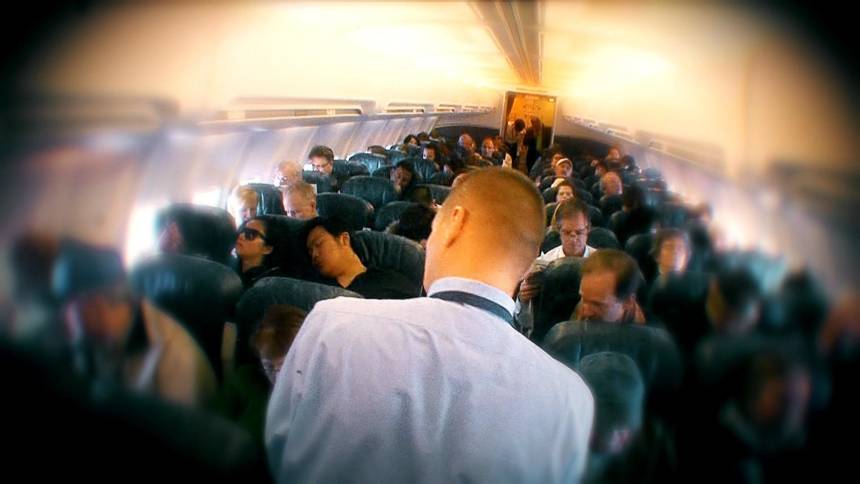
Alderman's story may carry a familiar ring for many travelers. Jokes and tales about the quality of in-flight meals are nothing new. But just how safe is airline food?
An NBC News investigation of airline catering found an industry with limited oversight in which outbreaks are difficult to track. Food safety for airline caterers and airlines is regulated by the federal Food and Drug Administration, which requires inspections of this industry far less frequently than it recommends local health agencies inspect restaurants. When airline food inspections do occur, they can reveal serious safety violations — as many as 22 in a single inspection — but rarely lead to penalties.
Under the FDA's rules, the agency only has to inspect airline caterers every three to five years. FDA rules for airlines are even looser than for caterers: planes receive random FDA inspections "when time and opportunity allow," according to an agency manual.
In contrast, the FDA's food code, which guides the food safety rules adopted by state and local governments, recommends that local authorities inspect food establishments every six months, with exceptions for low-risk facilities. But airline catering facilities don't always fall under those codes. The FDA considers them different from restaurants because caterers do not sell food directly to consumers, instead contracting with airlines that do.
Jason Alderman
Jason Alderman said the most disappointing part of getting food poisoning after eating duck ravioli on a plane was trying to tell authorities what happened.TODAY
Some states, like California, do send health inspectors to airline catering facilities. But state and local inspection agencies in multiple states — including those that oversee the cities and counties where both Chicago airports, the Dallas-Fort Worth airport and the Atlanta airport are located — told NBC News that airline caterers were outside their jurisdiction, and only inspected by the FDA.
"Dates of inspection represent only a snapshot of FDA's engagement with companies," the FDA said in a statement. "They are not an accurate indicator of FDA's overall engagement. Between inspections, FDA often engages regularly with companies, particularly regarding corrective actions."
In the past four years, FDA inspectors have found condensation dripping onto food, fans blowing dust on food, thermometers off by as much as 25 degrees, raw meat contaminating cooked meat, moldy bread, live birds and insects, as well as bird and rodent poop and more at airline catering facilities, according to more than 1,000 pages of inspection reports obtained by public records request.
Whether those violations may have led to illnesses is difficult to say, according to food safety experts. NBC News also found that tracking foodborne illnesses from airplane food is particularly challenging. First of all, the victims disperse.
"Outbreaks from airline food are very difficult to identify because the people get dispersed into various locations," said Roy Costa, an environmental health inspector and trainer who has worked as a state food inspector and served as an expert witness in food safety lawsuits. "It's not like having a cluster of people that you can identify all had one exposure, so it's difficult to pin them down."
The Centers for Disease Control and Prevention estimates that 48 million Americans get food poisoning every year. Scientists have identified more than 250 foodborne illnesses ranging from mild to deadly, all with different incubation periods. The most common ones can hit anywhere from 30 minutes after eating to up to four weeks later, according to the CDC. The longer the incubation period, the harder it is to connect it to the food that spread the bacteria.
Travel isn't the only barrier to discovering potential outbreaks. The systems for reporting illnesses can be confusing to navigate — so even when passengers try to report their illnesses, the stories can fall through the cracks.

'Oh, it's negligent'

Airline catering is a nearly $6 billion industry in the United States alone, according to an analysis of the industry by market research firm IBISWorld. It is dominated by three companies: LSG Sky Chefs (owned by the German airline Lufthansa and larger than the next two caterers combined), Gate Gourmet and Flying Food Group. Together, they make up nearly half the U.S. market. While a few airlines, like United, do some of their catering in-house, most in-flight meals and snacks on major airlines are supplied by catering companies.
Airline catering is a nearly $6 billion industry in the U.S. alone
Airline catering is a nearly $6 billion industry in the U.S. alone.Kondor83 / Getty Images/iStockphoto
Catering facilities are typically on airport grounds, or located within a few miles of the tarmac. After preparation, food is loaded onto narrow carts that fit in airplane aisles, then placed on trucks with hydraulic lifts that take it to waiting planes.

Sunday, May 8, 2016

8 Tips And Tricks For Making The Most Of Your Meal On The Plane


After logging nearly 200,000 flight miles last year, TPG Contributor Amber Gibson, who also writes about food for Saveur, Plate, Departures, Hemispheres and American Way, shares some of her tips for navigating the treacherous world of airline food. Follow her adventures on Instagram. (All photos by the author).
1. BYO Tea Bag
If you are a tea drinker, always have a couple of tea sachets from your favorite brand on hand and just ask for hot water. The tea they serve on airlines is atrocious and there never seems to be a good selection, but at least they can usually get the hot water part right. Tea bags weigh next to nothing (a mere two grams!) and won’t get confiscated when you go through security. They don’t go bad either —the flavor just decreases over time — so even if you forget that it’s in your carry-on for months, you’ll get a pleasant surprise when you do rediscover your favorite tea. Mine is Rishi by the way.
2. Order the Hindu Vegetarian Meal in United Airlines Economy 
A Hindu vegetarian dinner on a United Airlines flight from Chicago to London in June 2015.
On international flights that are long enough, United Airlines serves all passengers a hot meal, but the selections can be unappetizing at best. If you view your reservation online, you can request one of nine special meals up to 24 hours before departure. In the last couple of years, I’ve requested everything from gluten-free and vegan meals to Muslim and Kosher meals in the search for a lesser evil. For my taste, Hindu vegetarian meals are the best choice, mostly because chana masala, aloo gobi and mattar paneer have an inherently mushy consistency that stands up to reheating. The airline versions aren’t as tasty as your favorite Indian takeout place, but they tone down the spice, too, so the meal isn’t so pungent that you’re sweating spices from your pores and your neighbors give you dirty looks — at least I haven’t received any yet.
3. Order a Special Meal to be Served First
Even if Indian food isn’t your thing, if you request any kind of special meal, you’ll be served before anyone else in the economy cabin since flight attendants prepare and deliver all the special meals before continuing with regular meal service. It’s a good choice if you fear you’ll be starving and sitting at the very back of the plane. You know they won’t run out of the option you’re after by the time they get to you, plus these meals are made in smaller quantities and tend to be fresher.
4. The “Champagne” Might be a Sham
One of the nicest perks of flying in a premium cabin is the unlimited free bubbly starting from before you even take off. On many domestic carriers, flight attendants offer Champagne, water or orange juice already poured in small glasses as you’re settling in. While plenty of airlines do serve great Champagne, especially on international flights, I’ve caught both American Airlines and United Airlines passing off cheap Prosecco instead. Not that there’s anything wrong with Prosecco, but Champagne must be made in the Champagne region of France. Don’t be afraid to ask to see the bottle or politely inquire if it’s Champagne, Prosecco or a domestic sparkling wine if you’re suspicious.
5. On Cathay Pacific, Stay Awake for Coffee Service
A slice of sacher torte with a trio of chocolate bonbons — hazelnut, sesame and raspberry — in Cathay Pacific business class.
A slice of Sachertorte chocolate cake with a trio of chocolate bonbons — hazelnut, sesame and raspberry — in Cathay Pacific business class.
If you’re flying in business class or first class on Cathay Pacific, don’t lay your chair flat and go to sleep immediately after dinner. Even if you don’t drink coffee, it’s worth waiting for coffee service if you like chocolate. Along with coffee and tea, Cathay Pacific offers premium cabin passengers a selection of custom-made chocolate bonbons produced by a local company in Hong Kong that are wicked good. On a recent flight from Hong Kong to Chicago, I had a choice of hazelnut, sesame praline, raspberry and salted caramel — you guessed it, I tried one of each.
6. BYO Nut Butter
If peanut butter is a comfort food, bring a single-serve packet of nut butter with you for a long flight when you think the meal served will be questionable. If the options (chicken or pasta?) don’t sound too appetizing but you’re hungry and don’t want to pay for food, you can at least take whatever warm bread they have — they’ll almost always offer seconds, too — and add nut butter. There are so many kinds available today, from cashew, almond, pecan and walnut to regular peanut butter — Justin’s squeeze packs are my favorite. The ratio of protein and healthy fats is good for keeping you sated without feeling bloated. Even in a worst-case scenario with inedible bread, you can always eat the nut butter straight from the packet. Guilty as charged.
7. Don’t Order Seafood 
Prawns, salmon tartare and eggplant dolma on Turkish Airlines, one of the only airlines where I'll consume seafood.
Prawns, salmon tartare and eggplant dolma on Turkish Airlines, one of the only airlines where I’ll consume seafood.
Unless you are flying first class on a top-notch airline known for good food, I would stay away from seafood as it tends to be dodgy at best. Based on my experience and from speaking with many friends and colleagues about the matter, we all agree that this is your best bet for getting sick. And a tiny airplane bathroom on a long-haul international flight is definitely not the place to go through that.
8. Bring a Gift for the Flight Attendant 
Pick up a cool souvenir from your travels, or maybe a box of chocolates from the duty-free store to give to your flight attendant. If you can befriend a crew member, there’s a small chance that you may be able to get food from business or first class even if you’re stuck sitting in economy. There’s almost always extra food on board and while it’s not technically allowed, there have been a few times where this has worked for me. There are no guarantees, but it never hurts to try.
Bottom Line
With a little preparation and imagination, you too can have a decent meal on the plane, whether you’re flying in first, business or economy. If all else fails, stick to these guidelines and hope for the best!
What’s your best trick for enhancing plane food when you travel? Share your tips with us, below.