Showing posts with label Health news when traveling. Show all posts

Monday, December 30, 2019

What You Should Know Before You Eat Airplane Food

Anuj Shrestha / for NBC News
By Adiel Kaplan, Lindsey Bomnin, Vicky Nguyen, Julianna Rennie and Erin Williams
Jason Alderman was hungry. It was the beginning of his regular Sunday night commute from San Francisco to Boston, but unlike most weeks, he hadn't grabbed food before boarding his plane. So that June 2018 evening, the public relations executive did something he'd sworn he'd never do again: He ate the in-flight meal.
Sitting in business class, he ordered the duck ravioli after he says the flight attendant assured him it was "very good." But a few hours later, Alderman knew something was wrong.
"About three-quarters of the way through the flight, I start feeling really bad. Really, really bad," he recalled. "If you've never had food poisoning before, it's like going 10 rounds with Muhammad Ali."
Alderman says he managed to reach his Boston apartment before he became violently ill.
He can't remember how long it lasted. "You sort of get lost in this time warp of misery," he said. "I got a few hours of sleep, cleaned myself off, took a shower, and went into work. It was probably one of my lower performing days."
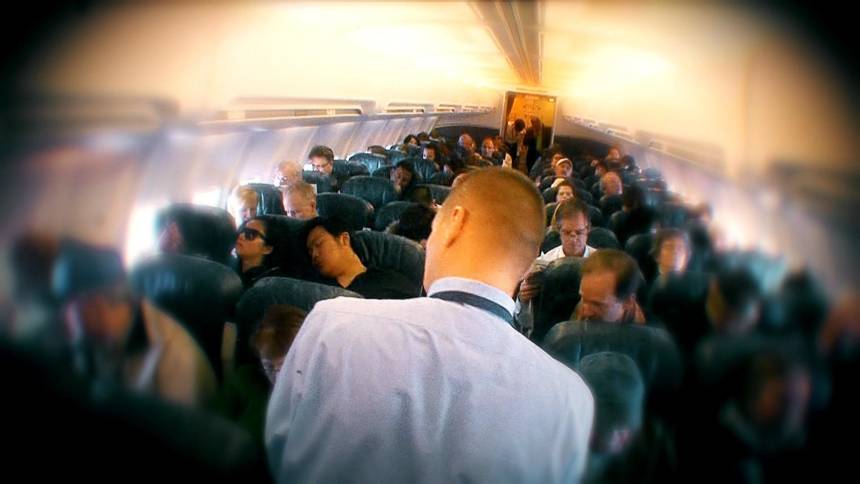
Alderman's story may carry a familiar ring for many travelers. Jokes and tales about the quality of in-flight meals are nothing new. But just how safe is airline food?
An NBC News investigation of airline catering found an industry with limited oversight in which outbreaks are difficult to track. Food safety for airline caterers and airlines is regulated by the federal Food and Drug Administration, which requires inspections of this industry far less frequently than it recommends local health agencies inspect restaurants. When airline food inspections do occur, they can reveal serious safety violations — as many as 22 in a single inspection — but rarely lead to penalties.
Under the FDA's rules, the agency only has to inspect airline caterers every three to five years. FDA rules for airlines are even looser than for caterers: planes receive random FDA inspections "when time and opportunity allow," according to an agency manual.
In contrast, the FDA's food code, which guides the food safety rules adopted by state and local governments, recommends that local authorities inspect food establishments every six months, with exceptions for low-risk facilities. But airline catering facilities don't always fall under those codes. The FDA considers them different from restaurants because caterers do not sell food directly to consumers, instead contracting with airlines that do.
Jason Alderman
Jason Alderman said the most disappointing part of getting food poisoning after eating duck ravioli on a plane was trying to tell authorities what happened.TODAY
Some states, like California, do send health inspectors to airline catering facilities. But state and local inspection agencies in multiple states — including those that oversee the cities and counties where both Chicago airports, the Dallas-Fort Worth airport and the Atlanta airport are located — told NBC News that airline caterers were outside their jurisdiction, and only inspected by the FDA.
"Dates of inspection represent only a snapshot of FDA's engagement with companies," the FDA said in a statement. "They are not an accurate indicator of FDA's overall engagement. Between inspections, FDA often engages regularly with companies, particularly regarding corrective actions."
In the past four years, FDA inspectors have found condensation dripping onto food, fans blowing dust on food, thermometers off by as much as 25 degrees, raw meat contaminating cooked meat, moldy bread, live birds and insects, as well as bird and rodent poop and more at airline catering facilities, according to more than 1,000 pages of inspection reports obtained by public records request.
Whether those violations may have led to illnesses is difficult to say, according to food safety experts. NBC News also found that tracking foodborne illnesses from airplane food is particularly challenging. First of all, the victims disperse.
"Outbreaks from airline food are very difficult to identify because the people get dispersed into various locations," said Roy Costa, an environmental health inspector and trainer who has worked as a state food inspector and served as an expert witness in food safety lawsuits. "It's not like having a cluster of people that you can identify all had one exposure, so it's difficult to pin them down."
The Centers for Disease Control and Prevention estimates that 48 million Americans get food poisoning every year. Scientists have identified more than 250 foodborne illnesses ranging from mild to deadly, all with different incubation periods. The most common ones can hit anywhere from 30 minutes after eating to up to four weeks later, according to the CDC. The longer the incubation period, the harder it is to connect it to the food that spread the bacteria.
Travel isn't the only barrier to discovering potential outbreaks. The systems for reporting illnesses can be confusing to navigate — so even when passengers try to report their illnesses, the stories can fall through the cracks.

'Oh, it's negligent'

Airline catering is a nearly $6 billion industry in the United States alone, according to an analysis of the industry by market research firm IBISWorld. It is dominated by three companies: LSG Sky Chefs (owned by the German airline Lufthansa and larger than the next two caterers combined), Gate Gourmet and Flying Food Group. Together, they make up nearly half the U.S. market. While a few airlines, like United, do some of their catering in-house, most in-flight meals and snacks on major airlines are supplied by catering companies.
Airline catering is a nearly $6 billion industry in the U.S. alone
Airline catering is a nearly $6 billion industry in the U.S. alone.Kondor83 / Getty Images/iStockphoto
Catering facilities are typically on airport grounds, or located within a few miles of the tarmac. After preparation, food is loaded onto narrow carts that fit in airplane aisles, then placed on trucks with hydraulic lifts that take it to waiting planes.

Wednesday, October 15, 2014

Five Myths About Germs On Aircraft

635487831047070274-512832103
(Photo: Getty Images/iStockphoto)

It's hardly news that many travelers are concerned about germs and diseases when they fly these days. But in the airborne petri dish that contemporary aircraft have become, fliers may well be worrying about the wrong things. Here are five myths about germs in aircraft.
1. The most dangerous health hazard in the air is the cabin air itself.
"That's wrong," says Michael Zimring, director of travel medicine at Mercy Medical Center in Baltimore, and the author of Healthy Travel. "The cabin air is fine and aircraft are outfitted with HEPA filters to clean it."
The real problems lie on the chair upholstery, the tray table, the armrests and the toilet handle, where bacteria such as methicillin-resistant Staphylococcus aureus (MRSA) and E. coli can live for up to a week on airplanes that aren't properly cleaned. These findings are the result of a two-year study by a team of microbiologists and engineers at Auburn University in Alabama, who presented it at the American Society for Microbiology's annual meeting.
"I can't say I was surprised by the findings," said James Barbaree, professor associate and director of the Auburn University Detection & Food Safety Center and a 20-year veteran of the Centers for Disease Control and Prevention (CDC), who led the study. Tray tables had the highest levels of bacteria, and seat belts and armrests were also singled out as places where bacteria can survive. Barbaree and his researchers tested six types of bacteria and learned that MRSA could last for up to 168 hours on the back pocket of an airplane chair, while E. coli could remain active for 96 hours on the armrest. Although bacteria lived longer on porous surfaces and for shorter periods of time on hard plastic surfaces, those plastic surfaces were the most efficient at transmitting it to the next set of hands. Think of an armrest, the remote control or window shade, as well as the door handles of the bathroom.
2. The bagged airline pillows and blankets are OK to use.
Today's aircraft are short on creature comforts, so it's mighty tempting to grab a blanket and a pillow when boarding, one of the last "free" perks of any flight. But the sage advice is to give them a pass.
"I don't use any of them," says John Gobbels, vice president and COO of Medjet Assist, which arranges air medical transport for its members. "For a long-haul flight, I bring a fleece jacket to stay warm. If I ever use a blanket, it's one sealed in plastic but then only for my lower legs."
As for pillows, "never" is the operative term.
"I see them thrown in the overhead compartments," Gobbels says, "and no one is changing the pillow cases."
Bringing you own neck pillow is a much better idea, but Gobbels cautions that you should use one that can be laundered, because "it can transmit germs as well."
3. Airlines clean the aircraft between flights.
How often and how well an aircraft is actually cleaned is something of a secret. Removing trash and old magazines is one thing, but most industry watchers say that a proper cleaning doesn't occur that often. The FAA doesn't regulate or inspect aircraft cleaning, so frequency and thoroughness are left up to the airlines themselves. Gobbels of MedJet Assist says that as a rule of thumb, an aircraft is supposed to be completely wiped down after every 30 days of service or at 100 flying-hour intervals. But in theory, that means that an aircraft can be used for dozens of flights between deep cleanings.
"There's a lot of cost-cutting among the airlines, and cleaning is one area that gets cut," says Gobbles. "Yes, there are standard operating procedures and certain chemicals that are supposed to be used. But the airlines often use third-party cleaning services and much of the time, the cleaners seem more intent upon a fast turnaround and getting the seat ready for the next passenger to occupy."
How clean is the corner of the airline aisle seats that every passenger grabs on their way back to their seat after using the bathroom? Or the seat headrest? It's anyone's guess. Nor should you expect to see much cleaning during a flight.
"I just came back on a flight from Italy last week," says Zimring. "My advice is that if you need to use the bathroom on a long-haul flight, do it early on. Not after eight hours in the air. They don't clean bathrooms on a long flight."
4. The airlines have taken steps to ensure that passengers can't contract diseases like the Ebola virus in the aircraft.
There have not been any reported cases of the Ebola virus spreading within the confines of an aircraft cabin. Ebola, Zimring points out, is not an airborne virus but is spread through blood and body fluids. But airline passengers should adhere to rigorous hygiene practices to limit exposure to the virus, says Gobbels of MedjetAssist.
"Ebola can be transferred through open wounds and mucus membranes such as the mouth and eye," says Gobbels, "so cover exposed areas of skin and be mindful of the method of transmission. Wash your hands often and use alcohol-based hand cleansers. Refrain from any contact with blood or body fluids and do not handle anything that could have come into contact with infected fluids. If you travel to or with people who may have come from Ebola-infected areas, watch your health for signs and symptoms of Ebola for 21 days after travel and seek immediate medical attention if required."
This is not the first time that the United States has had concerns about the Ebola virus, James Barbaree points out, noting that the CDC has been working on Ebola since an outbreak in Africa in 1976. Hygiene aside, Barbaree says that "there is very little that passengers can do about the Ebola problem except be patient as the new screening procedures and guidelines are put into place. It is unfortunate that our officials did not act promptly and prudently to protect our population."
5. Let's face it, there's not much I can do to protect myself when I'm trapped in an aircraft cabin.
Not true. There are multiple steps that every flier can take to prevent the spread of bacteria when they fly. First, they should travel with and use an alcohol-based hand sanitizer. They should also travel with a small pack of disinfectant wipes. Gobbels says that "the first thing I do when I sit down is to wipe down the armrest and tray table because that's where my arms will be. You need to decontaminate where you'll be spending your time and eating."
Staying hydrated also helps, says Zimring. So does using a tissue or a paper towel to open bathroom doorknobs and touch toilet handles. The most vulnerable area may well be your eyes, and medical professionals advise not going anywhere near them with your hands, as tear ducts are a fast route for germs to the nose and throat.
"There are people who now fly with a face mask, gloves and special jacket," Gobbels says. "We're going to see more of that."

Everett Potter, Special for USA TODAY
Follow us on Twitter: @TraveloreReport