Showing posts with label Asia news. Show all posts

Sunday, May 31, 2026

From 8 Hours To 40 Minutes: The Tunnel In China Changing Everything

China is once again pushing the boundaries of what’s humanly possible. As of May 2026, the nation has reached a pivotal moment in its infrastructure journey, with multiple record-breaking tunnels either newly operational or entering high-stakes construction phases.

While the world previously looked to Switzerland's Gotthard Base Tunnel (57 km) as the gold standard, China is currently moving forward with the Bohai Strait Tunnel, a project so massive it dwarfs almost everything that has come before it.

The Crown Jewel: The Bohai Strait Tunnel

The most ambitious project on the horizon is the Bohai Strait Tunnel. Designed to link the port cities of Dalian and Yantai, this tunnel is set to become an engineering marvel of the 21st century.

Total Length: Approximately 123 kilometers (76 miles).

Subsea Section: Roughly 90 kilometers (56 miles) will be entirely underwater—longer than the submerged sections of the Channel Tunnel and Japan's Seikan Tunnel combined.

The Impact: Currently, traveling between these two cities requires an 8-hour ferry ride. Once the tunnel is complete, high-speed trains traveling at 150+ mph will slash that journey to just 40 minutes.

The Cost: Estimates for this "mega-link" sit between $32 billion and $43 billion.

Recent Milestones (2025–2026)

China isn't just planning for the future; it's delivering today. Several other "world's longest" titles have recently been claimed:

Tianshan Shengli Tunnel: Opened in December 2025, this 22.1-km passage through the Tianshan Mountains in Xinjiang is officially the world’s longest expressway tunnel. It bypasses dangerous mountain passes, providing a year-round link between northern and southern Xinjiang.

Tianshan Shengli Tunnel: In April 2026, China completed the excavation of a high-speed rail tunnel beneath the Yangtze River. Spanning 14.25 km, it allows trains to cross the river at a staggering 350 km/h without slowing down.

Why It Matters: Connectivity and Economy

These tunnels are more than just bragging rights. They are the arteries of China’s economic strategy:

Urban Agglomeration: By turning 8-hour trips into 40-minute commutes, China is effectively merging giant industrial hubs into single economic zones.

Technological Superiority: Projects like the Bohai Strait serve as a "live laboratory" for Tunnel Boring Machines (TBMs) capable of withstanding extreme underwater pressure.

Resilience: New tunnels are being built with advanced fiber-optic sensors and earthquake-resistant designs, ensuring they remain operational even in high-risk zones.

The Road Ahead

The Bohai Strait Tunnel is expected to take 10 to 15 years to fully complete, with a tentative opening date in the late 2030s. As China continues to lay down thousands of miles of high-speed rail and expressway, the "world's longest" record is likely to be broken by China itself, over and over again.

"Future tunnels will not simply be longer. They will be smarter, digitally monitored, and integrated into broader economic systems." — Engineering Experts on the Bohai Project

Sunday, October 9, 2022

China’s Vast Xinjiang Hit With COVID-19 Travel Restrictions

BEIJING (AP) — The sprawling Xinjiang region in western China has been hit with sweeping COVID-19 travel restrictions as the government ratchets up control measures across the country ahead of a key Communist Party congress later this month.

Trains and buses in and out of the region of 22 million people have been suspended, and passenger numbers on flights have been reduced to 75% of capacity in recent days, according to Chinese media reports.

A notice from the regional government on Tuesday said the measures were enacted to “strictly prevent the risk of spillover” of the virus. A Xinjiang official apologized for the spread of the epidemic to other regions and provinces in China, particularly in recent days.

As is often the case with China’s draconian “zero-COVID” policy, the measures seemed out of proportion to the number of cases detected. The National Health Commission announced Thursday that 97 cases had been recorded in Xinjiang in the latest 24-hour period, after 91 cases were reported the previous day. All of them were asymptomatic.

Officials are desperate not to be called out for new outbreaks in their regions and Xinjiang has been under special scrutiny over the government’s establishment of a series of prison-like re-education centers in which Muslim minorities have been taught to renounce their religion and allegedly subjected to a range of human rights abuses.

Xinjiang’s vast surveillance system, relying on ubiquitous checkpoints, facial and even voice recognition software, and universal cell phone monitoring has made controlling travel among the population especially easy.

An earlier 40-day lockdown in Xinjiang left many residents complaining about inadequate food supplies.

“Zero-COVID” has been closely identified with Communist Party leader Xi Jinping, who is expected to receive a third five-year term in office at the congress beginning Oct. 16. That’s despite criticisms from the World Health Organization and massive disruptions to the economy, education and normal life in China.

Last month, a nighttime bus crash that killed 27 people who were being forcefully moved to a mass quarantine location in southwestern China set off a storm of anger online over the harshness of the policy. Survivors said they had been compelled to leave their apartments even when not a single case had been discovered.

“Zero-COVID” has been celebrated by the country’s leaders as evidence of the superiority of their system over the U.S., which has had more than a million COVID-19 deaths.

Xi has cited China’s approach as a “major strategic success” and evidence of the “significant advantages” of its political system over Western liberal democracies.

Yet even as other countries open up, the humanitarian costs to China’s pandemic approach have grown. With national and some provincial borders closed, tourism has all but dried up and the economy is forecast by the World Bank to grow by an anemic 2.8% this year. Xinjiang has been hit especially hard because of sanctions brought against some of its officials and products over human rights concerns.

Even without nationally identified criteria, testing and lockdowns have become the norm for tens of millions of people in China from the North Korean border to the South China Sea, as local officials desperately seek to avoid punishment and criticism.

Earlier this year in Shanghai, desperate residents complained of being unable to get medicines or even groceries during a two-month lockdown, while some died in hospitals from lack of medical care as the city restricted movement. All 26 million city residents in China’s largest city and financial hub have been ordered to undergo two additional days of testing this week, despite the announcement of just 11 new cases Thursday, none of which showed symptoms.

Friday, February 11, 2022

Hong Kong’s Zero-Covid Approach Meets Growing Frustration

HONG KONG (AP) — Hong Kong residents expressed growing frustration Thursday after new, tighter coronavirus restrictions went into effect, imposed by city leaders in line with Beijing’s zero-COVID policy.

Hong Kong leader Carrie Lam ordered new strict measures to take effect Thursday as the highly-contagious omicron variant of the virus causes record daily cases.

That includes limiting public gatherings to two people and private ones to members of only two households. Places of worship, hair salons and other businesses were ordered to close.

Such measures are part of Hong Kong’s effort to align itself with mainland China’s “zero-COVID” policy, which aims to totally stamp out outbreaks, even as infection numbers continue to rise and other countries shift their approach to living with the virus.

Outside a vaccination center in the Sai Wan Ho area on Thursday, retiree Ken Wong waited in a long line to get his first shot so that he would qualify for a “vaccine pass” when it’s available.

“This is insane,” the 70-year-old said. “There is no way to reach zero cases. If we are going to achieve zero cases it would mean everyone’s wallet will become empty because a lot of people will be out of work and have no income.”

The latest measures will remain until at least Feb. 24, when the vaccine pass will be rolled out, allowing only vaccinated people to visit places like shopping malls and supermarkets.

Newly confirmed cases fell slightly on Thursday to under 1,000 after hitting a daily record 1,161 on Wednesday, Hong Kong health authorities reported. Overall, Hong Kong has seen only about 18,500 cases of COVID-19 and 215 deaths among its population of some 7.5 million.

Opponents of the zero-COVID approach contend that with nearly 65% of the population fully vaccinated and signs the omicron variant of the virus is less severe for those with some immunity, that it is time to change course.

“The government is having difficulties adopting a new strategy which will both align with mainland China but also serve the interests and adapt to the situation in Hong Kong,” said Jean-Pierre Cabestan, a professor of political science at the Hong Kong Baptist University.

“Nothing can be decided without Beijing’s green light, and the local authorities don’t want to take any chance with that.”

Hong Kong, a former British colony, was handed over to communist-ruled China in 1997. Under the “one country, two systems” principle, the territory was to retain its own political, social and financial institutions for 50 years after being transferred from British rule.

But China has been tightening its control, stamping out political opposition and curtailing free speech. It imposed a sweeping National Security Law following anti-government protests in 2019, resulting in the imprisonment, intimidation and exile of most opposition voices.

There’s a practical reason for complying with zero-COVID policies — to facilitate travel between Hong Kong and the mainland under less stringent quarantine rules than the three weeks or more required of all foreigners arriving in the Chinese mainland.

Beijing will not let Hong Kong’s borders to the mainland be reopened unless the city reaches and maintains zero-COVID.

This week, Beijing officials and Chinese state media warned Hong Kong against any changes, saying that adopting a “living with the virus” policy would overwhelm its medical systems, the newspaper South China Morning Post reported.

In the upscale Discovery Bay neighborhood on mountainous Lantau island, home to many foreigners, all residents were ordered tested this week after authorities found traces of the virus in the sewage.

Sewage testing is a common practice in Hong Kong, but government demands for entire communities to be tested if the virus is detected are stretching the patience of residents enduring long lines at testing centers.

“The approach is obviously not working,” said Ivan Serrano, a 42-year-old from Spain who had just been tested with his son.

“We can see that other countries with different approaches — apparently the situation currently is better and here, it just got worse.”

Wednesday, February 2, 2022

Celebrations For Year Of The Tiger Are Muted, But Bring Hope

People across Asia prepared Monday for muted Lunar New Year celebrations amid concerns over the coronavirus and virulent omicron variant, even as increasing vaccination rates raised hopes that the Year of the Tiger might bring life back closer to normal.

The Lunar New Year is the most important annual holiday in China and falls on Tuesday, Feb. 1. Each year is named after one of twelve signs of the Chinese zodiac in a repeating cycle. The Year of the Tiger follows the Year of the Ox.

This will be the third new year in a row celebrated in the shadow of the pandemic. It was two days before the holiday in 2020 that China locked down Wuhan — a city of 11 million people — following the detection of the coronavirus there.

Some 85% of Chinese are now fully vaccinated, according to Our World in Data, and more Chinese have been traveling domestically this year, despite government warnings. Many people prepare to celebrate by buying red lanterns and other decorations for their homes, and food to mark the beginning of a new year.

Still, 63-year-old retiree Huang Ping lamented as he shopped at a Beijing flower market that the new year’s “atmosphere has faded” with the closure of temples and seasonal fairs to prevent large crowds. He said he hoped for better times soon.

“I wish for the epidemic to pass as early as possible and for the economy to recover as well,” he said.

Another retiree, Han Guiha, said he was planning on making the best of the situation.

“I’ll stay at home enjoying good food and wine,” the 62-year-old said. “I will make my house clean and beautiful. Right now the virus is spreading and we need to be careful.”

Some 260 million people traveled in China in the first 10 days of the holiday rush starting Jan. 17 — fewer than before the pandemic but up 46% over last year. Overall, the government forecasts 1.2 billion trips during the holiday season, up 36% from a year ago.

This year the celebrations coincide with the Beijing Winter Olympics, which open near the end of the weeklong holiday. The Chinese capital has been tightening controls to contain coronavirus outbreaks ahead of the sporting event.

The Games are being held inside sealed-off “bubbles,” and organizers have announced that no tickets will be sold to the general public and only selected spectators will be allowed.

“I’ll watch the games with my kid, but of course on TV,” said Wang Zhuo, a retail manager from Beijing.

In Hong Kong, which saw a surge in cases in January, people wore surgical masks as they shopped for red and tiger-themed holiday items. The city has closed schools because of the outbreaks and required restaurants to close at 6 p.m., forcing many to dine at home for traditional New Year’s Eve family dinners.

With the Year of the Tiger, many are hoping the traditional powers attributed to the animal will help put the country on a path out of the pandemic, said Chen Lianshan, a Beijing university expert on Chinese folklore.

“The tiger is a protection against evil spirits and it can defeat demons and ghosts of all kinds, and the Chinese believe that the plague is one kind of an evil spirit,” he said.

Elsewhere in Asia, there were signs that celebrations might not be as subdued as they were last year. Despite ongoing pandemic restrictions, most people are now vaccinated with at least two shots in many of the region’s countries.

In the old quarter of Hanoi, people flocked on the weekend to the traditional market to get decorations and flowers for the festival, known as Tet in Vietnam.

Vietnam’s daily case count remains at about 15,000 new infections but its low hospitalization and death rate has allowed the country to reopen for business and cautiously resume social activities.

More than 70% of Vietnamese are fully vaccinated, and 80% have had at least one shot, according to Our World in Data.

Still, the country has cancelled Tet fireworks and other large events to minimize risks this year.

In Thailand, where 69% of people are fully vaccinated, Bangkok decided this year not to hold traditional Lunar New Year celebrations in Chinatown for the second year in a row, but was going ahead with lighting seasonal lanterns on the district’s main street.

In Singapore, Lunar New Year celebrations are more subdued due to coronavirus restrictions that allow residents to receive only five unique visitors a day, and preferably only one visit daily. The rules are likely to get in the way of the tradition of visiting relatives during the holiday.

“This year it will be rather quiet, as people are spacing out visiting over the next two weeks instead of on the first or second day of the new year,” said Sebastian Lim, a Singapore resident.

Business was brisk at a flower market in the Taiwanese capital of Taipei on Monday as people made last minute purchases. Some 73% of Taiwanese are fully vaccinated.

“The pandemic is surely affecting it a bit, but people still like flowers, so they come out and buy flowers,” said one shopkeeper, who only gave his name as Lee.

“But prices are lower because we have overproduction and we can’t export some items — this is our biggest problem.”

Ethnic Chinese shopkeepers in Myanmar face a bigger dilemma, as the new year coincides with the one-year anniversary of the military’s seizure of power from the democratically-elected government.

Supporters of the growing anti-military movement have called for people to close their shops and businesses in a nationwide “silent strike” protest. Military leaders have warned that anyone who participates could face legal action, including charges of violating the country’s counter-terrorism law.

But that has left shopkeepers who had planned to close anyway for the Lunar New Year to spend time with their families wondering what to do.

“Normally we are closed during Chinese new year, but don’t know what to do this year,” said Hu, a noodle vendor in Yangon who wouldn’t give his full name out of fear of reprisal. “We want to close, but we have to be afraid of the authorities.”

Saturday, December 4, 2021

Laos Opens Railway To China As Debt To Beijing Rises

BEIJING (AP) — After a blessing by Buddhist monks, Lao Prime Minister Phankham Viphavanh on Friday rode the first run of a $5.9 billion Chinese-built railway that links isolated, mountainous Laos with southern China in an effort to increase trade.

Both governments tout the 1,035-kilometer (642-mile) line from the Lao capital, Vientiane to Kunming in China’s poor southwest as a boost to economic growth. But it leaves a debt that foreign experts warn Laos, a country of 7 million people wedged between China, Vietnam and Thailand, might struggle to repay.

The railway is one of hundreds of projects under Beijing’s Belt and Road Initiative to build ports, railways and other facilities across Asia, Africa and the Pacific. Poor countries welcome the initiative, but some complain they are left owing too much to Chinese banks.
The first train pulled out of Vientiane following an inauguration ceremony conducted by Chinese President Xi Jinping and his Lao counterpart, Thongloun Sisoulith, over a video link from their capitals, the Lao news agency reported.

On Thursday, saffron-robed Lao monks conducted a ceremony for the railway, according to the Lao news agency.

The railway is to carry only cargo across the border for now due to curbs on passenger travel imposed to contain the coronavirus.

The Kunming-Vientiane railway is a link in a possible future network connecting China with Thailand, Vietnam, Myanmar, Malaysia and Singapore. That would give southern China more access to ports and export markets.

contractors are building a high-speed rail line from the Thai capital, Bangkok, to the Lao border. That won’t be completed until 2028 and will leave a gap between the border and the line to China.

Borrowed money makes up 60% of the railway’s investment. Foreign experts say that is unusually high for an infrastructure project and increases the risk that the railway might fail to generate enough revenue to repay its debt.

Laos has been one of the world’s fastest-growing economies over the past decade but still is among the poorest. Its average economic output per person more than doubled since 2010 but stands at $2,600.

Thursday, September 26, 2019

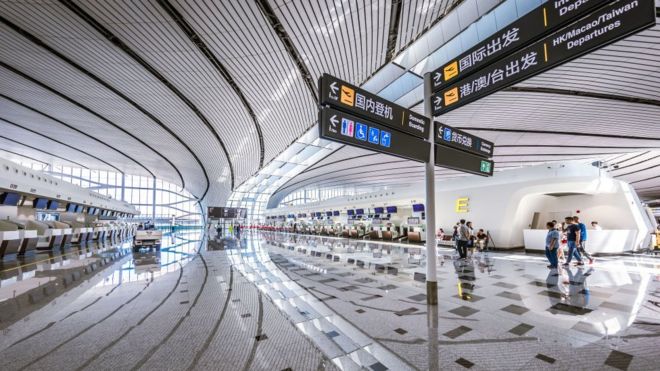
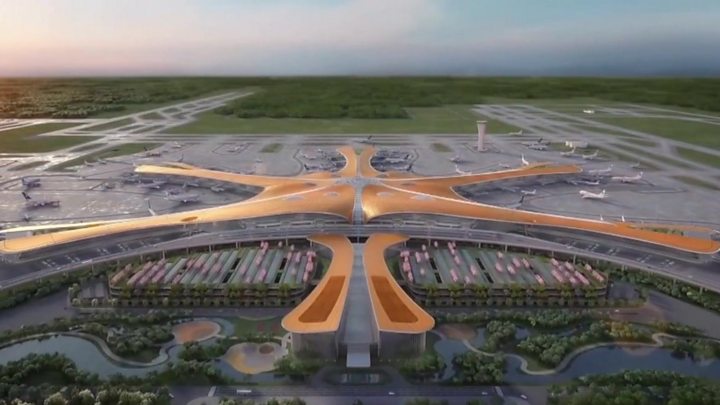
Beijing Daxing: China's Huge New 'Starfish' Airport Opens Its Doors

Beijing Daxing airportImage copyrightGETTY IMAGES
Image captionChina's new mega-airport is the size of 98 football fields
China's new $11bn (£8.8bn) mega airport has opened its doors, days before the country's 70th anniversary celebrations.
The Daxing International Airport in the capital Beijing was formally opened by President Xi Jinping on Wednesday.
Beijing's existing airport is the world's second busiest behind Atlanta, according to the Airport Council.
But officials say a new airport was needed to take the pressure off the overcrowded Beijing Capital International Airport.
Media captionWhat does the world's largest single-building airport terminal look like?
The Daxing airport - said to be the world's largest terminal in a single building - is expected to receive a large amount of the 170m passengers the city expects to welcome by 2025.
According to state agency the Global Times, seven domestic airlines were expected to begin operations out of the new airport on Wednesday. The first flight - a China Southern Airlines A380 - took off at 16:23 local time.
And international carriers including British Airways, Cathay Pacific and Finnair have already announced routes to Daxing.
The new airport, which is located around 46km (29 mi) south of Tiananmen Square, was designed by famed architect Zaha Hadid.

Source: www.bbc.com 

Sunday, September 17, 2017

Travelore News: Flights, Trains Not Operating In Japan After Typhoon Talim Hit


Typhoon Talim, still a powerful typhoon has ripped into southern Japan, dumping torrential rain, grounding hundreds of domestic flights, and halting train services.
Typhoon Talim made landfall in Kyushu, the southernmost of Japan’s four main islands, on Sunday, packing winds of up to 105 mph, the Japan Meteorological Agency said.
At least 644 domestic flights have been cancelled because of strong winds, according to public broadcaster NHK, while all major regional train services have been suspended, operator JR Kyushu Railway said.
Authorities have issued warnings of rainstorms, high seas, possible landslides, and flooding across the southern half of the Japanese archipelago.

The meteorological agency said the typhoon was expected to head northwards, dumping heavy rain across a large area, including on Tokyo.

The typhoon had earlier battered the southern Okinawan island chain, dumping the most rain seen over a 24-hour period in 50 years on the city of Miyako, before it hit Kyushu.

Monday, November 7, 2016

Hong Kong Protesters Clash With Police As China Plans Political Intervention


Officers use pepper spray on protesters angry that Beijing will issue an interpretation of the semiautonomous city’s Basic Law

Police stopped demonstrators as they protested on Sunday against what they called Beijing's interference in local politics and the rule of law, a day before China's parliament was expected to announce its interpretation of Hong Kong’s Basic Law in light of two pro-independence lawmakers' oath-taking controversy.

fullscreen
Demonstrators throng the streets in Hong Kong. REUTERS
Police stopped demonstrators as they protested on Sunday against what they called Beijing's interference in local politics and the rule of law, a day before China's parliament was expected to announce its interpretation of Hong Kong’s Basic ...
Police stand guard during a standoff with demonstrators in Hong Kong on Sunday. AGENCE FRANCE-PRESSE/GETTY IMAGES
A protester holds a banner near the China Liaison Office in Hong Kong. EUROPEAN PRESSPHOTO AGENCY
Thouands of people march through the streets of Hong Kong. EUROPEAN PRESSPHOTO AGENCY
Police pepper-spray protesters denouncing what they call Beijing's interference in Hong Kong politics and the rule of law.REUTERS
Yau Wai-ching, right, of the Youngspirations organization, stands in front of riot police amid protests in Hong Kong on Sunday. AGENCE FRANCE-PRESSE/GETTY IMAGES
Protesters sit in a road as police in riot gear stand guard during the demonstrations. AGENCE FRANCE-PRESSE/GETTY IMAGES
Demonstrators throng the streets in Hong Kong. REUTERS
Police stopped demonstrators as they protested on Sunday against what they called Beijing's interference in local politics and the rule of law, a day before China's parliament was expected to announce its interpretation of Hong Kong’s Basic Law in light of two pro-independence lawmakers' oath-taking controversy. REUTERS
Police used pepper spray on protesters in Hong Kong on Sunday evening as thousands rallied against Beijing’s plans to intervene in a political standoff over two local lawmakers who insulted China in the city’s legislature.
The conflict was the latest in a deepening rift between Beijing and many in Hong Kong over how much autonomy the city should have. Hong Kong is allowed to govern itself under a miniconstitution—the Basic Law—and has an independent judiciary. But on Saturday, China’s top legislative body said it is prepared to override Hong Kong’s legal authority over how to handle the local lawmakers’ actions, which Beijing denounced as a threat to national security.
The Standing Committee of China’s National People’s Congress said Saturday it would issue its own interpretation of the Basic Law as Beijing “cannot afford to sit idle” when faced with challenges to its authority over Hong Kong, according to the government-run Xinhua News Agency.
On Sunday, thousands marched in Hong Kong to protest China’s looming intervention. In scenes reminiscent of the city’s pro-democracy protests of 2014, video taken by local press showed police spraying the crowd and protesters protecting themselves with umbrellas. (Latest news: China Says Two Elected Hong Kong Lawmakers Can’t Retake Oaths)

Hong Kong Police Force Senior Superintendent Lewis Tse confirmed officers used pepper spray during a “chaotic” confrontation with protesters late Sunday. He said two men—aged 39 years and 57 years—were arrested.
Hundreds of protesters gathered near Western Street, in the city’s Sai Ying Pun district as the march against China’s reinterpretation of the Basic Law turned into a standoff with the police. People held umbrellas aloft and wore face masks to protect themselves from the pepper spray.
“We were trying to occupy Connaught Road...but there were too many police and there were some conflicts between us,” said Hayley Lee, 27, an airline cabin-crew member. “They used pepper spray. We tried to step back and fight again, but they kept on spraying.”
In the crowd, familiar faces from the 2014 pro-democracy protests, known as the Umbrella Movement, were present.
“The police was using very brutal violence to depress us,” said Nathan Law Kwun-chung, the 23-year-old newly elected “localist” who has advocated for greater autonomy from China. “We were very angry because we think that for such an important issue, we at least have our right to protest,” he said of police attempts to move the crowd near China’s official Liaison Office on Connaught Road.
As the night wore on, rows of police held their lines, while others looked on from the steps of the Western Police Station. Officers stood with shields, warning protesters to stay calm.
Protesters continued to mill around, disorganized, and many were unsure about whether they would stay out for the whole night. Still, they agreed they wanted to take a stand against Beijing’s decision expected to be made Monday.
“We don’t know what’s the next move,” said Hang Tsoi, 25, who is also a cabin-crew member. “We are just trying to occupy.”
Around 1:00 a.m., Joshua Wong, a member of Demosisto—one of the political parties that participated in the evening protest—said several groups had announced the demonstration was over in order to avoid a “major sacrifice” amid the “unfavorable situation.”
The group called on the protesters to leave the scene.
0:00 / 0:00
Despite a big protest in Hong Kong on Sunday night against Beijing’s intervention, China’s top legislative body on Monday barred two newly-elected lawmakers from taking office over anti-China protests they made while being sworn in last month. Photo: Reuters
Hong Kong started legal proceedings Thursday over whether its legislature should allow two politicians who advocate for greater Hong Kong autonomy to take office, after the pair staged an anti-China protest at their swearing-in ceremony last month.
Beijing’s interpretation of the relevant provision in Hong Kong’s Basic Law would supersede any local court ruling. Hong Kong lawyers have voiced concern that such an intervention would undermine the city’s semiautonomous status.
The NPC Standing Committee, which added deliberations over the Basic Law to its agenda during a regular meeting this past week, said its intervention was “timely and necessary” to prevent a nascent Hong Kong independence movement from damaging the city’s “stability,” Xinhua reported.
The two politicians, democratically elected to Hong Kong’s Legislative Council in September, “have hit the bottom line of the ‘one country, two systems’ principle and posed a grave threat to national sovereignty and security,” the Standing Committee said, according to Xinhua.
In October, Yau Wai-ching and Sixtus Leung attempted to swear in as Legislative Council members while modifying their oath of office to pledge to defend a “Hong Kong nation,” displaying a banner stating “Hong Kong is not China,” and using a derogatory term for China.
The council barred their oaths, while their subsequent attempts to retake their oaths were rebuffed by the council president pending a local court ruling on whether the two had disqualified themselves from office.
Protesters used umbrellas to block pepper spray outside the Chinese central government's liaison office in Hong Kong on Sunday. ENLARGE
Protesters used umbrellas to block pepper spray outside the Chinese central government's liaison office in Hong Kong on Sunday. PHOTO: ASSOCIATED PRESS
The legal proceedings center on article 104 of the Basic Law, which states that legislators must swear allegiance to the “Hong Kong Special Administrative Region of the People’s Republic of China.”
The Standing Committee discussed a draft interpretation of that article on Saturday, the details of which weren’t disclosed in Xinhua’s report. The committee is expected to vote on the interpretation before its meeting concludes Monday.
Earlier Sunday, protesters began gathering in central Hong Kong to march in the streets, carrying banners and shouting slogans.
“We are here to oppose the Chinese government’s so-called re-explanation of the law,” said Sunny Chan, 38 years old, who works in the investment field.
Some protesters see it as a move by Beijing to undermine the rules established when Hong Kong was handed over to China by the U.K. in 1997.
“I want them to keep the agreement of the basic law, give us universal suffrage and keep the ‘One Country, Two Systems’ as it was listed,” said Chris Fan, who works for an IT firm.
Still, others held modest expectations for what the march would achieve.
“I don’t think marching will do any good,” said Ives Cheng, 25, who is unemployed. “It’s just an act to demonstrate our anger.”
Sixtus Leung and Yau Wai-ching during a protest march in Hong Kong on Sunday.ENLARGE
Sixtus Leung and Yau Wai-ching during a protest march in Hong Kong on Sunday. PHOTO: EUROPEAN PRESSPHOTO AGENCY
Beijing’s ruling would be only the fifth time since Hong Kong’s handover in 1997 that China has interpreted the Basic Law. On previous occasions, Beijing has issued rulings—upon request from the city’s government—over the right of abode in Hong Kong and how many years the city’s top official should serve after his predecessor resigned midterm.
This time, however, Hong Kong authorities hadn’t asked China to issue an interpretation, local government lawyers and legislators said.
Beijing’s move to rule in the matter would “deal a severe blow to the independence of the judiciary and the power of final adjudication of the Hong Kong court,” the Hong Kong Bar Association said in a statement on Wednesday.
Write to Ese Erheriene at ese.erheriene@wsj.com, Chester Yung at chester.yung@wsj.com and Chun Han Wong at chunhan.wong@wsj.com