Showing posts with label Family holidays. Show all posts

Tuesday, December 25, 2018

It’s A Jungle Out There: Costa Rica With Kids

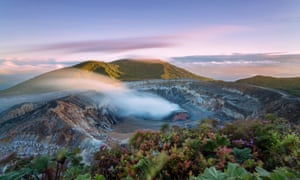
High angle view of Poas volcano crater emitting smoke at sunset, Costa Rica.

 Crater expectations … Poás, one of six active volcanoes in Costa Rica. Photograph: Matteo Colombo/Getty Images

Contributed by 
Full of exotic animals and rainforests but also child-friendly, Costa Rica is the perfect natural playground for a family adventure


It’s dark in the rainforest, the air thick with strange croaks and chirps, and our group moves slowly, following José’s torchlight. As he gestures for us to stop, we gather around in silence, the adults as keen as the children to see what he’s spotted. There on a leaf, with its bulging orange eyes, neat green body and comically big tangerine feet, sits a Costa Rican tree frog. Cue delighted squeals all round.
“It’s so cute!” whispers my niece, Georgia, and I nod, partly relieved it’s not a boa constrictor or tarantula.
We’re halfway through a night safari at Maquenque Ecolodge in the far north of the country and the jungle feels tangibly alive. Caiman eyes shine at the edge of the lagoon and frogs and toads of all colours and sizes add to the howler monkeys, turtles and toucans we’d seen earlier in the day.
For somewhere the size of Denmark, Costa Rica packs a powerful punch when it comes to wildlife. A quarter of its land is protected and, with half a million species, it’s one of the world’s most biodiverse countries.
A wild natural playground with decent tourist infrastructure, it seemed the perfect choice for an adventure to remember with a 12-year-old. It is our first trip together, my first time alone in charge of a child (I don’t have kids) and the longest Georgia has been away from her parents. My plan is to show her a world away from life at home – and get her back in one piece.
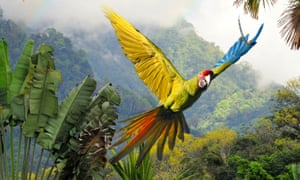
Close up of great green macaw flying through the rainforest in Costa Rica, showing the yellow underside of one wing, the blue top of the other, a red head and green and red tail
Pinterest
 Flight of fancy … great green macaw. Photograph: Getty Images

After a night in the capital, San José, we hit the road. The landscape quickly changes as we snake up into the hills, swathes of mist hanging in the cloud forest. Road signs warn of fauna crossing: monkeys, anteaters and a badger-shaped creature with a long, raised tail that we don’t recognise, though one soon scurries across our path (we later find out it’s a raccoon-like coati).
It’s an easy three-hour drive to La Fortuna, our base for the next couple of nights. The small mountain town is the gateway to Arenal Volcano national park and a hub for activities from zip-wire tours to white-water rafting.
Our first foray is a safari on Rio Blanco (its waters more of a muddy brown than white), floating on rafts through a landscape Georgia deems “just like The Jungle Book”.
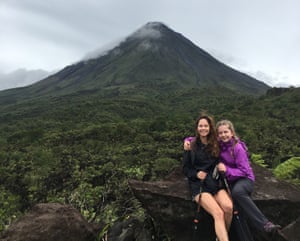
Jane and Georgia walking in the foothills of Arenal Volcano
Pinterest
 Jane and Georgia walking in the foothills of Arenal Volcano
We pass monkeys swinging through the canopy, a sloth hanging motionless in a tree and an iguana high up on branches, silhouetted against the sky. Bright blue morpho butterflies flit alongside us and there’s nervous excitement as we come surprisingly close to a caiman and spot crocodiles on the riverbank. A torrential downpour – our school summer holidays fall during Costa Rica’s rainy season – just adds to the fun.
The rain stops in time for an afternoon trek in the national park, dense mist clearing to reveal the looming volcano. Arenal last erupted in 1968, and we hike over a black lava landscape, already thick with rainforest, climbing higher for phenomenal views across lakes and mountains.
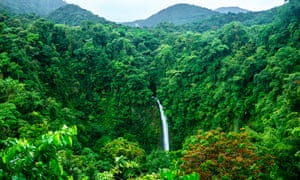
A distant shot of the waterfall of La Fortuna in the verdant Arenal Volcano National Park, Costa Rica,
Pinterest
 Green giant … La Fortuna waterfall. Photograph: Getty Images

Hot springs go hand in hand with volcanoes and there are several to visit in the area. It’s almost dark when we arrive at Ecotermales, a magical place with naturally warm waterfalls and various-sized thermal pools – perfect for an after-hike soak.
La Fortuna is fully geared up for tourists (restaurant tips include Snapper House for delicious ceviche) but our next stop, a homestay in Juanilama, a rural community three hours north, takes us well off the beaten tourist track. The women who founded it aim to give visitors an authentic taste of village life and bring in a bit of extra cash.
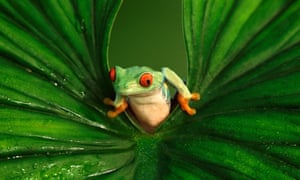
Red-eyed tree frog emerging from between the folds of a wet leaf
Pinterest
 Now you see me … red-eyed tree frog. Photograph: David Tipling/Getty Images
Our host is Eli, who lives with her three children and three-year-old granddaughter Victoria, and we stay in a simple wooden cabin in her garden. Georgia practises her Year 7 Spanish, bonding with Victoria as they play with kitten Blancanieves (Snow White). We eat fried plantain and gallo pinto(Costa Rican rice and beans) and on a tour of a smallholding learn about everything from pineapples – which each take a year and half to grow – to cassava, and press our own fresh sugarcane juice.
The next day, our drive to Maquenque takes us farther north again, over bright green hills and along bumpy unpaved roads lined with pineapple plantations. The lodge is part of the Maquenque Wildlife Refuge – a remote area of lowland tropical rainforest and wetlands to the south of the Nicaragua border. It’s exciting just getting there: cars are abandoned for a boat to take us across the river.
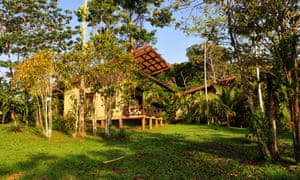
Accommodation is in 15 wooden bungalows with terraces overlooking a lagoon, or high up in treehouses. You don’t need to leave the 68-acre grounds to see incredible wildlife. There are 8km of marked trails through the forest. With more than 400 species of birdlife (including the rare great green macaw), there’s constantly something to gawp at: we see huge scarlet parrots, iridescent green ibises and a chestnut-bellied heron, wings outstretched in the sun.
On our last morning I sign us up for a kayaking trip on the San Juan river. Monkeys, iguanas and crocodiles are among wildlife we’re likely to spot, says Cristian, our guide.
Not the best place then to capsize – and we’re reassured that no one ever has. So it’s a bit of a shock when somehow we do just that and end up in the water, clinging to our kayak, drifting downstream. We’re soon safely back on and Georgia’s laughing – but it’s a while before I can fully focus again on the lush jungle scenery and the kingfishers and giant lizards Cristian points out.
It’s another memory-bank moment from an action-packed week – a proper adventure and one I doubt either of us will ever forget.

Way to go

Rickshaw Travel offers tailor-made itineraries to Costa Rica. The three-day Lava Flows of Arenal Volcano costs £235pp; the two-day At Home with the Tico costs £98pp and the three-day Nature Calls costs £245pp. Transport (either transfers or car hire) and flights extra. British Airways flies direct to Costa Rica from London Gatwick
A wooden bungalow on stilts on bright green lowland tropical rainforest
FacebookPinterest
 ‘A little slice of Eden’ … Maquenque Eco-Lodge
It’s a little slice of Eden, untamed but very comfortable, and great for children, with a pool hidden in the jungle and a restaurant right on the water. Most produce served comes from the gardens and we drink straight from coconuts and dine on plantain and baked fish.

On our last morning I sign us up for a kayaking trip on the San Juan river. Monkeys, iguanas and crocodiles are among wildlife we’re likely to spot, says Cristian, our guide.
Not the best place then to capsize – and we’re reassured that no one ever has. So it’s a bit of a shock when somehow we do just that and end up in the water, clinging to our kayak, drifting downstream. We’re soon safely back on and Georgia’s laughing – but it’s a while before I can fully focus again on the lush jungle scenery and the kingfishers and giant lizards Cristian points out.
It’s another memory-bank moment from an action-packed week – a proper adventure and one I doubt either of us will ever forget.

Way to go

Rickshaw Travel offers tailor-made itineraries to Costa Rica. The three-day Lava Flows of Arenal Volcano costs £235pp; the two-day At Home with the Tico costs £98pp and the three-day Nature Calls costs £245pp. Transport (either transfers or car hire) and flights extra. British Airways flies direct to Costa Rica from London Gatwick


Monday, August 29, 2016

Bay Of Pigging Out – Town-Hopping In Croatia’s Kvarner Gulf


View from St John Church tower over the medieval roof tops of Rab.
Bells and whistles … view from St John Church tower over Rab’s main town. Photograph: Alamy

Touring four towns on three islands, Kevin Rushby enjoys fennel liqueur, sheep’s cheese and seafood, while teenage Maddy prefers a papal cake sugar hit 

Opposite a vast painting of the Last Supper in 13th-century Saint Francis of Assisi monastery in Cres town is a small alcove. Smiley father Zdrak, whose benign presence is like a tonic, leads us there. And in the alcove is another kind of tonic. No, not the half-empty orange Fanta bottle, but a glass urn of greenish liqueur from which the father pours with some glee. “It’s calledkoromac,” he says, “We make it using fennel from our garden.”
It is delicious. We repeat the tasting. My daughter Maddy (13) turns down the koromac and gazes longingly at the Fanta, but it is not offered. It is 9am and Maddy, my partner Sophie and I are just beginning our exploration of the island cities of the Kvarner gulf, the broad bay of Adriatic sea that snuggles up under Croatia’s Istrian chin.
Cres Town is an easygoing place, little frequented by tourists and pleasant to stroll around, even in August. (The pronunciation of the island’s name is subtle and sibilant and not at all like cress, stress or tress, but somewhere between the three. A glass of koromac is probably required for precision.) We buy olive oil from the co-operative and admire the work of Mate Solis, a local artist and character now in his 80s who still finds inspiration in Cres’s pretty boat-filled harbour.
Early morning in Krk town with the day’s first bread delivery.
Pinterest
 Early morning in Krk town with the day’s first bread delivery. Photograph: Kevin Rushby
Next day we take a short ferry ride to Krk, which is a big change after the depopulated harshness of Cres. Krk is verdant and well-inhabited: its main town, also Krk, is busier than Cres but with similar cool stone lanes. A walk through its crowded streets can be slow, but why hurry? There are so many strange highlights: the temple of Venus that is now a beachwear shop, the restaurant (Konoba Maritim) that serves us tangy sheep’s cheese with octopus and squid (Maddy looks wistfully at other diners’ spaghetti), and a little doorway in the city wall that leads to one of the world’s most astonishing cafes: Volsonis.
Volsonis cafe in Krk town, built in Roman walls.
Pinterest
 Volsonis cafe in Krk town, built in Roman walls. Photograph: Kevin Rushby
The building was bought in 1999 by Maria Elena and Goran Stanic, who set about converting it to a cafe, but discovered a Roman wall, and then a tomb under the floor. In some countries that might have ended any hopes of a cafe, but in Krk things are different: they simply integrated a cafe, nightclub and gallery into the structure of an ancient building. The result is startling and original – and they do good coffee.
We take a day trip to Vrbnik, in Krk’s wine region. This handsome hilltop seaside town sees no need to lure tourists: there are few hotels or cafes, and lots of ungentrified winding lanes, including one, Klancic, that is so narrow we have to squeeze through sideways. There is also a luminously brilliant family-run restaurant: Nada. They love their local wines here – all based on the indigenous žlahtina grape. We eat a grand seafood dinner and remember not to attempt the Klancic on our way back to the car.
Octopus,squid and cheese at Maritim restaurant, Krk town.
Pinterest
 Octopus, squid and cheese at Maritim restaurant, Krk town.
Our fourth town is Rab, on the island of the same name and about an hour away by ferry. These inter-island ferries, operated by Jadrolinija, are fast becoming real pleasures on this trip. You queue on the road outside the port and race the other drivers to the ticket office. On board it’s like being on a mini-cruise: lovely views and a decent cafe. If the breeze is right, you can smell the different islands: I swear I can detect Cres’s sage, Krk’s pine and, coming up on the bow, Rab’s lavender. Maddy is unconvinced, claiming that it is chocolate and chips.
Vrbnik, Krk island.
Pinterest
 Vrbnik, Krk island. Photograph: Alamy
Someone on the ferry tells us Rab “fancies itself”. That’s immediately obvious in the super yachts moored by the old town and the chi-chi boutiques that line the main street. But this is a subtle and complex town. An enquiry at the tourist office for “something unusual” leads us to the headquarters of the medieval order of crossbowmen, a surreal mix of weaponry, heraldry and archive photos of Rab in the 1930s. That was when Rebecca West came, writing in her 1941 travel masterpiece Black Lamb and Grey Falcon of stricken people with the faces of “crucified Christs”. The island is, thankfully, a lot more prosperous now.
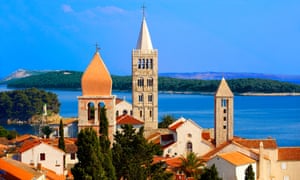
Maddy is asleep on the hallowed bench of the crossbowmen. She has the face of a crucified teenager in dire need of sugar. But first we must visit the four bell towers of Rab, a sequence that has all the rhythm and resonance of a peal. We climb two before we relent and help our wilting daughter towards the dangling carrot that has kept her feet moving since breakfast: Rab cake.
Rab town. Three of the belltowers
Pinterest
 Another view of three of Rab Town’s belltowers.
When Pope Alexander III came to the island in 1177, the sisters of St Anthony concocted a cake to celebrate: a filling of eggs, almonds, sugar, citrus zest and cherry liqueur baked in a spiral-shaped pastry case. At Rabska Torta on the edge of town they show you how – with great deliberation. Maddy is twitching like an addict awaiting her fix, but finally the cake is done. We retire to the garden half-expecting a refusal followed by demands for Kit Kat, but no: rabska torta is a hit.
Selection of cakes at Rabska Torta.
Pinterest
 Selection of cakes at Rabska Torta. Photograph: Kevin Rushby
She eats more than Pope Alexander, then, sweating, asks about a swim. Simple: there’s a wild forested peninsula next to town, dotted with coves. We stumble to the harbour and hire a boat for the afternoon.
• Accommodation on Rab was provided by Prestige Holidays (01425 480400,prestigeholidays.co.uk), which has a week’s B&B in Hotel Padova from about £469pp, including flights and transfers. For further information, visit croatia.hr

Discovering Croatia: fruits of the sea

Croatia is a seafood lovers’ paradise. Ivana Gamulin from the renowned Villa Spiza restaurant in Split gives her take on the country’s best fish. “The most important thing is seasonality. Sardines are best in May, calamari in summer.Brudet is the classic dish: a stew of garlic, onion, white wine, tomatoes and fish. If I find kosmej or grancigula crabs, I use them, too. A very traditional recipe is fažol na brudet, a bean and fish dish. Wash it down with white wine (bogdanuša or parčgrape) or a light red (plavac mali).”
Next week: Kornati islands