Showing posts with label Cuba travel tips. Show all posts

Tuesday, July 15, 2025

U.S. Tourist Ban At A Legendary Caribbean Hot Spot Worsens With A New $250,000 Fine

Americans have some of the best Caribbean resorts around the world to choose from. Heck, they can even pick a Caribbean location with the best mountain hikes. The options are indeed endless, with different perks. However, there remains one location that Americans are forbidden from accessing.

Given the new rules, U.S. travelers won't be able to visit this area for at least another five years, primarily for tourism purposes. We are going to take a closer look at the renewed travel ban to the Caribbean destination and what it means for Americans. We'll reveal the steep fine that Americans face if the rules aren't met, while putting the spotlight on other key requirements needed for those who actually plan on visiting the said country for reasons outside of tourism.

It remains to be seen if the policy will be altered. But for now, Americans are being told to look elsewhere for a Caribbean adventure.

Americans Risk A $250,000 Fine For Visiting Cuba Over The Next Five Years

President Donald Trump has strengthened the policy of the United States toward Cuba. President Trump has just signed a National Security Presidential Memorandum (NSPM), which reverses some of the Biden Administration's policies that eased pressure on the Cuban regime, according to the White House report. The National Security Presidential Memorandum (NSPM) also reinforces the ban on Americans visiting Cuba, at least for the next five years.

The White House report states, "It enforces the statutory ban on U.S. tourism to Cuba and ensures compliance through regular audits and mandatory record-keeping of all travel-related transactions for at least five years."

The U.S. Department of State has warned travelers to respect these rules in its advisory to Cuba. Not meeting these standards can lead to major penalties and prosecutions.

"Failure by a person subject to U.S. jurisdiction to act consistently with the regulations may result in penalties and criminal prosecution. Travel to Cuba without an OFAC license is illegal."

The U.S. Department of State did not disclose the potential penalty amount. However, several other publications have linked the fine to a steep $250,000 penalty, applicable over the next five years following the signature of the National Security Presidential Memorandum (NSPM).

There are ways for Americans to enter Cuba despite the latest ban; however, according to the U.S. Embassy, specific criteria must be met, or Americans may face the risk of penalties or prosecution again.

Americans Can Only Visit Cuba Is One Of 12 Categories Of Travel Are Met

The Department of Treasury’s Office of Foreign Assets Control (OFAC) has set 12 general licenses for travel to Cuba. For those who meet those requirements, an additional license from OFAC for travel to Cuba is not required.

Authorized Travel To Cuba Includes:

Family visits

Official business of the U.S. government, foreign governments, and certain intergovernmental organizations

Journalistic activity; professional research and professional meetings

Educational activities

Religious activities

Public performances, clinics, workshops, athletic and other competitions, and exhibitions

Support for the Cuban people

Humanitarian projects;

Activities of private foundations or research or educational institutes

Exportation, importation, or transmission of information or informational materials

Certain authorized export transactions.

For those who are allowed to visit Cuba, a reminder that all U.S. credit and debit cards cannot be used in Cuba.

For Americans that require cash in Cuba, U.S. dollars can be exchanged into Cuban currency at hotels, the airport, and specialized exchange locations.

The U.S. Department of State currently has Cuba under a Level 2 warning, advising tourists to "Exercise increased caution." The main reason for the warning is due to crime and unreliable electrical power.

The Department of State writes, "Petty crime is a risk for travelers in Cuba. This includes pick pocketing, purse snatchings, and car break-ins. Violent crime, including armed robbery and homicide, is also on the rise in Cuba." They added, "Cuba's electrical supply is unreliable. Since October 2024, there have been several prolonged nationwide power outages."

For those that do plan on visiting Cuba outside of tourism purposes, the Department of State has issued a few recommendations.

Advisories For Travel To Cuba:

Stay aware of your surroundings.

Do not physically resist any robbery attempt.

Do not display signs of wealth, such as expensive watches or jewelry.

Prepare for prolonged power outages.

Obtain any required OFAC licenses as it is illegal to travel to Cuba without an appropriate license.

Prepare a plan for emergency situations.

Overall, tourism to Cuba has decreased in recent years. Not only are American travelers banned, but significant decreases have occurred in its tourism.

​​​​​​​In 2024, Cuba experienced a 9.6% decline in visitors compared to 2023. With several major power outages in recent years, Cuba's tourism sector has suffered a significant setback. Numbers are still trending downward in 2025, with fewer visits from Canadians compared to years past.

https://www.thetravel.com/author/a-passalalpi/

Thursday, January 9, 2020

Can Americans Travel To Cuba?


Last June, President Trump’s administration announced new, more restrictive measures for travel to Cuba.

Those rules suddenly barred Americans from visiting the island by cruise ship or under the “People to People” visa.

Then in October, the rules tightened again, and President Trump eliminated commercial air service to most Cuban airports except Havana. So, does this mean you can’t travel to Cuba? That’s not necessarily true.

Even though the current administration has reinstated many of the restrictions that the Obama administration lifted in 2016, there are still 12 approved categories of authorized travel, including educational travel and religious missions. A number of U.S. companies still offer the trips under these umbrellas.

But the trips offered have much more rigid itineraries, which means you won’t have a lot of free time and may not be spending too much time drinking mojitos at the bar. Just abide by the rules, and you can still get there from here.

Wednesday, December 5, 2018

Cuba To Begin Full Internet Access For Mobile Phones

HAVANA (AP) — Cuba announced Tuesday night that its citizens will be offered full internet access for mobile phones beginning this week, becoming one of the last nations to offer such service.
Mayra Arevich, president of the Cuban state telecom monopoly ETECSA, went on national television to say Cubans can begin contracting 3G service for the first time Thursday.
Until now, Cubans have had access only to state-run email accounts on their phones.
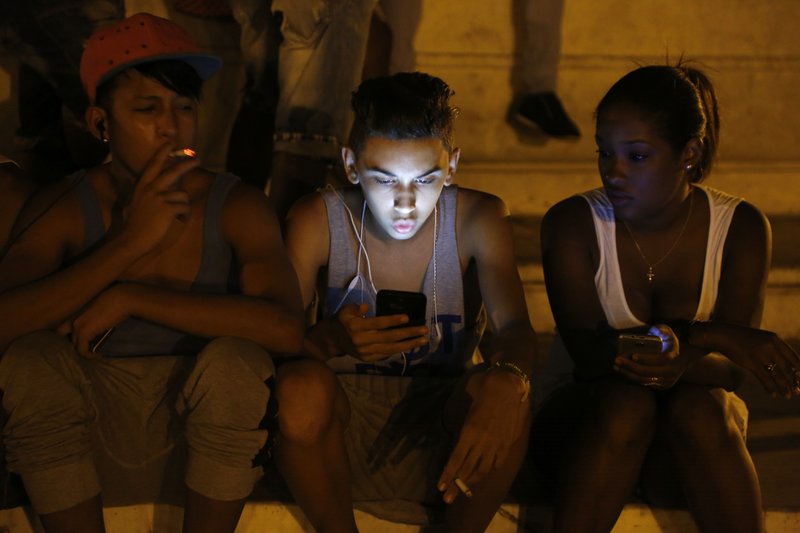
FILE - In this July 1, 2015 file photo, youths use a password protected wifi network coming from a five star hotel to surf the Internet on their smart phones in downtown Havana, Cuba. Cuba's government announced on Tuesday, Dec. 4, 2018 that its citizens will be offered full internet access on mobile phones starting Thursday, Dec. 6, becoming one of the last nations to do so. (AP Photo/Desmond Boylan, File)

The Cuban government has been building a 3G network in cities across the island and some tourists, Cuban government officials and foreign businesspeople have had access to it for several years.
The communist-governed island has one of the world’s lowest rates of internet use but that has been expanding rapidly since Presidents Barack Obama and Raul Castro declared detente in 2014. Expansion has not slowed with President Donald Trump’s partial rollback of relations.
Cuba authorized home internet in 2017 and hundreds of public Wi-Fi connection points have opened in parks and plazas around the country.
The new service will cost about 10 cents per megabyte, with packages ranging from 600 megabytes for about $7 to four gigabytes for about $30.
Those prices are roughly in line with global standards but still out of reach for many Cubans who subsist on state salaries of about $30 a month.
Cuba ran a fiber-optic connection to Venezuela in 2012, allowing the island to shift from slow and costly satellite links. It then began the slow process of allowing citizens to get online.
The government opened state-run internet cafes in 2013, joined by Wi-Fi sites two years later. The number of sites has grown to more than 800.
The Cuban internet is mostly uncensored but the government blocks a small number of sites like the U.S.-funded Radio and Television Marti networks and others that advocate for systematic change on the island.
ETECSA vice president Tania Velázquez said the new service would come online in stages from Thursday through Saturday to avoid the congestion that struck the mobile network during a series of heavily criticized tests this year.
___
Andrea Rodriguez on Twitter: www.twitter.com/ARodriguezAP

Monday, August 1, 2016

Want To Travel To Cuba? There Are Some Extra Rules You Need To Know.


Want to Travel to Cuba? There Are Some Extra Rules You Need to Know.
Photo by Jason Leppert
It's easy to get excited about Cuba, but many travelers may be unaware of just how prepared they need to be. 
This isn't just grabbing extra sunscreen and bugspray for your tropical vacation — although, that's important — U.S.-to-Cuban travel carries with it the burden of being scrutinized at both ends of the journey thanks to governments whose relationship might be thawing, but is still less sunny than an afternoon in Havana. 
The hoops to jump through may be only nominally more difficult than traditional international travel, but it's important to note that they are new and different hoops than even veteran international travelers might be used to. For newer and inexperienced travelers, the process could be daunting, but it doesn't necessarily have to be.
Tourism to Cuba is technically still illegal under U.S. law. 
No, that is not a typo. 
The new Cuban travel guidelines have 12 legal reasons an American citizen can enter Cuba, but general tourism is not one of them. If all you're desiring is a chance to sample Arroz con Pollo, artisanal rum and a fine cigar, you may start to book your trip and find yourself rebuffed. 
On the other hand, the 12 legal reasons are objectively very general and broad. They are also objectively very subjective, and the burden of deciding who fits under those categories falls to the traveler alone. Is that scary in a way? Sure, because lying throughout the process is perjury and subject to penalty. However, when the categories include person-to-person educational travel, journalism and humanitarian projects, the hurdles to climb seem pretty low. 
Want to head to Cuba? Head to social media and find a Cuban or multiple Cubans who are willing to teach you about the country while you are there. Meeting new people and seeing the top sites? That's probably the exact reason you want to go. Cuba even has companies that set this sort of thing upprofessionally.
Or, in a social media age where everyone is a content creator, create your own blog or pitch other blogs on your trip to Cuba. "Freelance Journalism" is one of the subcategories of journalism according to the treasure, and that just means self-employed. One could quibble with being self-employed with zero income coming in, but everyone's got to start somewhere. 
Humanitarian projects? My goodess, it's a gold mine. Even the most novice of Googlers should be able to find projects they could work on while down in Cuba. You can spend your entire trip on the beach if you spend some time cleaning it up. Want to take in the best cuisine? Spend an evening donating your time serving some if it to others. Is your Spanish rusty? You can get better at Spanish linking up teaching some English as a Second Language classes. 
Responsible tourism is all the rage anyway. 
There are other categories your travel may fit into, but none of them are heading down to a resort and enjoying yourself for a week and then returning to lie to customs. Plan ahead. Of course, the bonus for setting up some of these activities to legitimize your trip is that you'll make friends along the way. The next time you want to go to Cuba, visiting them is all you need to do!
Cuba also requires foreign travelers to have health insurance. If yours has lapsed for whatever reason, you can't go to Cuba. However, airlines are looking to bundle temporary health insurance right into tickets! Travel insurance companies also often bundle medical protection right into their plans. If someone isn't covered now, a host of ways to get covered already exist. It's just one more low hurdle to clear. 
From there, the rules are just about over, but it's not quite as easy as hopping on a plane. U.S. cell phones aren't generally going to work in Cuba and neither are credit and debit cards linked to U.S. financial institutions. Internet access is hard to come by and Wi-Fi is next-to-nonexistent. No one who travels from the U.S. to Cuba will be as connected as when they left home. It's not just a culture shock, it could leave many unprepared. 
Again, plan ahead. 
An unlocked cellphone (even a disposable one) can become the home for a Cuban SIM card. American companies are increasing the availability of prepaid Cuba-ready cell phones as well. Still, those cell phones aren't going to have the data service Americans are accustomed to, and that means more preplanning your trip (no instant Yelp!) or depending on locals for advice—and fewer of them speak English compared to other tourism hotspots. 
Cash is a must, and exchanging those dollars into Cuban pesos is a first-things-first sort of activity upon entering the island. Thankfully, Cuba recently got rid of a 10 percent tax on the exchange of American dollars, but being without money in a foreign, semi-friendly country is not likely on anyone's to-do list.
In all, no one should be deterred from visiting Cuba, but the trip to Havana is going to take a little more than a trip to Seattle or Cancun. Go, absolutely go as soon as you can, but it takes just a little extra ambition to make sure your trip of a lifetime doesn't turn into a major headache. 
By | MICHAEL SCHOTTEY | www.travelpulse.com

Thursday, January 28, 2016

Travelore Tips: 9 Things To Know When Visiting Cuba


Image result for cuba photos


January marks exactly one year since President Barack Obama expanded the categories of authorized travel 
to Cuba thereby inspiring an increasing number of Americans to add the largest – yet previously forbidden – 
Caribbean island to their adventure bucket list.  Jumping on the bandwagon are at least three U.S.-based
 cruise lines which have been advertising itineraries that leave from PortMiami this winter and spring.
Cuba expert and author Ted Henken, an associate professor at Baruch College, offers 9 essential tips
 to bring along on your Cuba trip besides your Visa.

1. Expect a warm welcome
Despite half a century of embargo and strife, Cubans love to engage with Americans. They are friendly
 and gregarious people, and will become even more so when they discover you are Americano.  So, 
return the warm welcome with a smile and a handshake.

2. Cash is king
It's still virtually impossible to use your American credit or debit card in Cuba, despite the Obama
 administration's efforts. Some hotels have developed workarounds that allow you to pay with a credit
 card via the Internet, but don’t count on it. Bring plenty of cash, but you’ll have to convert your
 dollars into convertible pesos (CUCs), Cuba's invented tourism script – at the painful rate of 87 
cents on the dollar.

3. Adventures in living offline
Internet access in Cuba is among the slowest and most expensive in the Western Hemisphere. Few
 Cubans have access at home, and an hour online costs $2, or about 10% of the average monthly
 wage of $20. Even at Havana's luxury hotels, access can be spotty and frustratingly slow. There
 are signs of progress: The government recently opened 35 wi-fi hotspots in public plazas and
 parks. Just look for the crowds and the glow of their digital screens in public places.

4. Freedom of the pixel, but not of the press
Cubans who do manage to get online have access to websites that challenge the propaganda flowing 
from Cuba's state-controlled mass media. There’s a loophole in Cuban law that criminalizes all private 
printed media as "enemy propaganda," but says nothing about media deployed in cyberspace. Examples include 14ymedioOnCubaHavanaTimes.org, & Periodismo de Barrio (the first three of which
 produce some content in English).

5. Diplomatic relations do not equal "normal" relations
While the Obama administration has reestablished diplomatic relations with Cuba, the trade embargo
 still is in force. Lifting it would require new legislation, which is not likely in the Republican-majority
 U.S. Congress. So while official relations are indeed thawing, they are still quite "frozen" in some
 areas, and it's best to step lightly. 

6. Cubans mean it when they say “mi casa es su casa”
Skip the hotels, which are probably fully booked anyway, and use a service like Airbnb to reserve a
 room in a private Cuban home. It’s a rare win-win-win-win: You get a more authentic Cuban
 experience by staying with a Cuban family; that family gets hard currency directly in their pockets; 
the overloaded Cuban tourism industry gets to welcome more visitors; and President Obama gets
 a small boost for his policy of “empowerment through engagement.” 

7. A taste of capitalism at the paladars
After the 1991 collapse of the Soviet Union, Cubans desperate for income in hard currency set up
 tiny mom-and-pop restaurants called paladarsin their own homes, catering to foreign tourists. 
Since Raul Castro's economic reforms that began in late-2010, the paladar phenomenon has
 expanded beyond private homes, and Havana now has more privately run restaurants and hotspots
 than you can hit in a two-week trip. Start with these: L'Atieler, Doña Eutimia, Starbien, La Cocina
 de Lilliam, La Guarida, El Cocinero, El Gringo Viejo, 304 O'Reilly, Casa Miglis, Decameron,
 Le Chansonier, La Casa, Bollywood, Azucar, La Mulata de Sabor, and Cafe Laurent. 

8. You’re going to Cuba for research purposes, right?
Despite the improved relations, you can only legally go to Cuba from the U.S. if you fit into one
 of the 12 categories of traveler approved by the U.S. The categories include things like students,
 journalists, researchers – but "tourists" are still not permitted.  Of course, certain "people-to-people"
 trips are not really tourism, but rather “empowerment through engagement.” In any event, you no
 longer have to apply for a license to visit Cuba, you just "self certify" that you fit into a proper category.

9. Bring home (a little of) the legendary rum and cigars
You can now legally impress your friends at home by bringing back Cuban rum and cigars, but
 you’re limited to $100 worth combined.  Wait until departure to buy rum at the airport, as prices
 are the same everywhere in Cuba, but you may get a better deal for cigars at the cigar factory itself.

Contributed by Professor Ted Henken, an expert on Cuban culture and society and has been widely quoted
 in the news media, particularly since diplomatic relations were restored with the United States.  
 Henken has published numerous books on Cuba, including the recentEntrepreneurial Cuba: The Changing
 Policy Landscape, which he co-authored with Archibald R.M. Ritter.

Sunday, December 20, 2015

Direct Flights To Cuba And Other Rule Changes Explained


Alexandre Meneghini/Reuters
Nearly a year after the United States announced it would be loosening travel restrictions to Cuba, the two countries have reached an agreement on regularly scheduled commercial flights to the island, the Associated Press has reported. Coupled with the previous rule changes for travelers, commercial flights to the island from the United States would make it possible for practically anyone who wishes to visit Cuba to do so. Here is what you need to know before you go:
Q. Can I fly to Cuba now?
A. Given the agreement, previous predictions that U.S. airlines may begin offering regularly scheduled flights to Cuba in the coming months appear to be on track. Commercial flights would eliminate the expensive charter flights that currently take travelers from Miami, New York and elsewhere to Cuba.
Regulations issued by the Department of Commerce in September already allow American companies to establish offices and premises in Cuba and airline crews to stay overnight on the island. They also allow the sale of equipment related to aviation safety to Cuba.


How to Travel to (and in) Cuba

Learn everything you need to know about how to plan a trip to Cuba with coverage from the New York Times Travel section.

Of course, non-American commercial airlines fly to Cuba from many destinations. Americans who meet Treasury Department requirements can fly through a third country, such as Mexico, Panama, Grand Cayman or Canada — an option that can be less expensive and more convenient than taking charter flights.
Can any American citizen visit Cuba now?
As long as the trip falls within one of 12 purposes, Americans can go to Cuba without having to apply for permission, in the form of a license, from the government. The 12 categories of legal travel include visits to close relatives, academic programs for which students receive credits, professional research, journalistic or religious activities and participation in public performances or sports competitions. As Robert Muse, a Washington-based lawyer who specializes in U.S.-Cuba related law, put it: If somebody wishes to travel to Cuba and they “can’t think up a way to fit into those categories, they are not trying.”
Still, ordinary tourism remains off limits and travelers have to mark a box to denote the purpose of their trip, and they are required to keep travel receipts for five years after they return. In most cases, they are also expected to have a full-time schedule of activities related to their category of travel.
What are people-to-people trips?
People-to-people trips are educational programs that fall into one of the 12 categories of general-license travel. They’re one of the most popular ways to go to Cuba because anybody can join a trip and your itinerary is worked out for you. Because they are organized trips with full schedules of meetings, lectures and visits to artists’ studios or small businesses or community projects, they are pricey — about $2,500 to $4,000 per week including accommodations and flights.
Will cruise ships sail to Cuba?
Under the new regulations, owners of cruise ships and passenger ferries can operate between the United States and Cuba without a license, so long as the people they are carrying are licensed to travel there. The infrastructure to accommodate a cruise ship is available since ships owned by non-American companies, which are usually smaller than American ones, have been sailing to Cuba in recent years.
The government had awarded licenses to a handful of ferry and cruise companies earlier this year, including Carnival Corporation, which said in July that it would begin sailing to Havana in April.
Who will keep track of what I do in Cuba?
Good question. Senior officials at the departments of Treasury and Commerce said the government continues to take restrictions on travel to Cuba seriously. But there are no reports of officials prosecuting people who travel to Cuba and end up spending their time on the beach. That said, if you sign an affidavit saying you are going to Cuba for a particular purpose and, in fact, spend a week at the beach, you would be breaking the law.
Where would I stay?
Cuba has a shortage of high-end hotels, and that will become more acute if the number of American visitors rises significantly. An estimated 400,000 Cubans and Cuban-Americans visited from the United States last year, as well as 100,000 non-Cuban Americans. Some tour operators are already block-booking rooms through 2016. There are about 61,000 hotel rooms in Cuba, according to the tourism ministry, of which 65 percent carry four- and five-star ratings. Bed-and-breakfasts are an attractive alternative to hotels, as they include the chance to make contact with Cuban families and often provide good meals. There are hundreds of bed-and-breakfasts, known as casas particulares, in Havana and popular tourist towns like Trinidad, Viñales and Cienfuegos. Searching for casas on the Internet is not easy, but you can book them through travel agents like Cubania Travel or look on TripAdvisor. Airbnb started offering its service on the island in April. The company, which lets users list their homes and apartments for short-term rentals, said payments to the Cuban hosts are deposited into their bank accounts by intermediaries or any other manner they select, including door-to-door payments.
Can I use credit cards?
American travelers to Cuba may open a bank account there and pay for expenses with an American credit card. In reality, few people who take the short trip abroad have cause to open a bank account. But A.T.M.s are few and far between in Cuba, and many establishments do not have the means to process credit card payments. So, cash will be king for some time to come. It may be a good idea to take British pounds and euros, which get a better exchange rate in Cuba than the United States dollar.
How do I call home?
Calls on the Etecsa network, the Cuban state-owned telecommunications company, are expensive, and getting a phone can involve long lines. But Verizon Wireless announced in September that it would allow its users to make voice calls, send text messages and use data services through the company’s pay-as-you-go International Travel option. At $2.99 a minute, you will not linger on the line.
What can American citizens bring back?
Americans can now bring back up to $400 in souvenirs, including $100 worth of cigars. Mr. Kavulich notes that, according to State Department records, Secretary of State John Kerry, who inaugurated the embassy in Havana in August, brought back an $80 humidor, $80 worth of cigars and a bottle of rum.
 By 
Additional reporting by Elaine Glusac.

Sunday, May 24, 2015

Everything You Need To Know About Visiting Cuba

Getty Images

Since regulations prohibiting travel to Cuba were relaxed in January, U.S. travelers have been clamoring to visit—though trip planning takes some determination. Senior digital editor Laura Dannen Redman went step by step through the process with Traveler aviation correspondent Barbara Peterson, answering all the questions she—and you—might have.
LR: I want to go to Cuba to cover the Havana Biennial, running May 22–June 22. I’m a journalist, so I fall under one of the 12 categories of U.S. traveler allowed to visit now. My dates are flexible. So…what should I do first?
BP: Will you be traveling as part of a group or as an individual? If it’s the former, dozens of companies specialize in what’s known as “people to people” packages and like most organized tours, you’d be part of a group that is going for a designated purpose—humanitarian, research, or cultural—that meets the legal requirements.
The good part is that they’ll take care of the paperwork—obtain a visa (good for 30 days), get you on a charter flight from the U.S., and book a hotel room, all rolled into the total price. Prices vary, though we found trips that range from three to nine days for under $3,000.
I’d really rather go as an individual. Any problem with that?
No, since you're already authorized to go under the new rules, and you don’t need to be in a group to buy a seat on a chartered plane. But remember, tourism is not a valid reason to visit Cuba and you must be able to document that you are there for the approved purpose. Spend too many hours sunning on the beach or sipping mojitos, and you could run afoul of U.S. enforcers. Under rules spelled out by the Treasury Department’s Office of Foreign Assets Control, you’re supposed to keep all documents related to your trip—a schedule, a record of appointments, receipts, and so on—for up to five years in case you get audited.
What kind of documents do I need for my trip?
Basically, the Cuban government requires that you possess a passport that’s valid for at least six months beyond the dates of travel, proof of health insurance coverage, and a visitor's visa.
Embassy re-openings are still in the works. How do I actually get a visa?
Consider working with a charter operator to get the ball rolling; a few of the bigger companies are Cuba Travel ServicesMarazul, and ABC Charters, which asks you to download a travel affidavit affirming you meet the Treasury requirements. But when Traveler's Cynthia Drescher talked to Brian Kelly, founder of ThePointsGuy.com, about his trip to Cuba in early January via the Cayman Islands, Kelly had an easier experience: “Procuring my visa took literally a $20 bill and a smile from a Cayman Airways ticket agent; [Cuban immigration] didn't even ask for the reason for my visit when going through. They saw the tourist visa and asked if I wanted a stamp and I was in.”
Do I need to get a visa before I book my flight?
That depends. If you’re planning to fly via a charter flight from the U.S., you can fill out the visa application form at the time of booking, as well as the affidavit. If you’re taking scheduled airline flights via a third country, such as Mexico, as Kelly says above, you may not need a visa until you’re actually halfway there and checking in for your Cuba-bound flight.
Isn’t flying through a third country kind of dodgy?
Until very recently, it was—an unknown number of U.S. travelers skirted the ban on travel to Cuba by going that route. Now, though, as long as you’re following the rules in every other respect, the question of how you fly there is really up to you, according to a Treasury spokesperson I talked to last week.
Is there any way to do an apples-to-apples comparison of all flights and fares, both charter and scheduled airline, by date? Are they listed in any search engines or booking sites like Expedia or Priceline.com?
Not yet. After the rules changed in January, Kayak.com announced that it would list flights for informational purposes, though you can’t book through the site or see the availability of seats. Cheapair.com also lists some options. As of yesterday, there were dozens of flights via Copa, Cayman Airways, and Aeromexico via a third country, some with extended layovers. You'll likely end up doing your own legwork or go through a travel agency who can help. Brian Kelly worked with tour operator AC Journeys to research charter flights.
Getty Images
I hear that JetBlue has charter flights—what’s that all about?
JetBlue just announced it will begin flying weekly non-stops on Fridays, starting July 3, from its hub at JFK to Havana, in cooperation with Cuba Travel Services. The planes and crews will be JetBlue’s, but keep in mind that JetBlue can’t sell the tickets because U.S. airlines are still prohibited from operating scheduled flights to Cuba. The seat inventory and sales are all under control of the charter operator. There's a growing number of charter flights leaving each week from the U.S. to Cuba, most of them from south Florida, and prices range from around $400–$500 round-trip from Miami and about $850 from New York. American Airlines flies from Miami and Tampa; Sun Country already has a weekly flight on Tuesdays from JFK. The Transportation Department lists public charter filings on its site.
If I’m a journalist but my husband isn’t, can he still go with me?
A lot of us might want to go with someone, but the Treasury Department takes a dim view of family members tagging along if they don’t qualify under the rules.
What if my husband goes on, say, a humanitarian project?
He would be able to go, but he has to have documentation with him of his (approved) mission like you do. Per my Treasury contact, "An entire group does not qualify for the general license [authorizing travel] merely because some members of the group qualify individually." A spokesperson for Customs and Border Patrol added that "it is the responsibility of all returning residents to declare if their travels have taken them to Cuba. Such travelers must be prepared to present lawful authorization for Cuba-related travel to CBP officers upon request."
Flights are booked. Do I need special permission to book a hotel or Airbnb if I’m not going with a group?
No, though you’ll have an easier time of it if you work with a travel agent or Cuba travel specialist who can open doors. Havana hotels are packed right now—On Cubamagazine reported in April that Old Havana hotels were nearly booked solid. Travelerhas worked with Cuba specialists Adam Vaught at GeoEx and Tom Popper at Insight Cuba. The Points Guy worked with Johnny Considine of Esencia Experiences, who bills himself as a "luxury concierge.” A. Nash Travel in Toronto also books a lot of travel to Cuba. The other advantage of using these guys? You can pay themwith your credit card.
How much U.S. cash should I bring, if any?
In theory, you can now use your American credit card; in practice, very few establishments accept them, according to The Points Guy. Amex and MasterCard say they're working on it, but that won't help if you're going soon. Plan to bring plenty of cash and prepay whatever you can—hotel, rental car, etc. If you have a foreign credit card, that might work; Kelly's traveling companion when he went in January used her Spanish credit card.
What kind of souvenirs can I bring home, if any?
You can bring up to $400 worth of goods, including $100 worth of tobacco and alcohol products (combined).
Can I use Wi-Fi there?
According to reports from recent visitors, Internet is very difficult to access in Cuba, aside from at the larger Havana hotels; expect to disconnect from your devices—and plan accordingly.
Is there a way to get to Cuba I haven't thought of?
If you can wait until later this year, go by cruise ship. Traveler'sPaul Brady reports that "the 48-passengerPanoramawill let travelers explore Cienfuegos, Cuba before embarking on a seven-night sail to Havana. The new offer, from International Expeditions, makes its first departure late this year and is operated as a legal, people-to-people trip open to any American visitor."


Sunday, March 22, 2015

How To Fly To Cuba Right Now

 
© Grant Rooney Premium / Alamy

The first nonstop flights have started from New York to Havana since President Obama's January announcement loosing restrictions on charters, which is only the beginning of relaxed relations between the two countries.
We named Cuba one of Condé Nast Traveler’s top 15 places to go in 2015, and now that airlines and tour organizations have finally wrapped their heads around the new regulations (or, rather, lack thereof), it's clearer than ever that now is the time to travel to Cuba. But how to get there?
Full diplomatic relations between the U.S. and Cuba will resume on April 10, and the six-story building off Havana’s Malecón esplanade that was once the U.S. embassy (and is now the U.S. Interests Section) is primed to reclaim its status after 54 years. Tourism infrastructure catering to U.S. travelers is next, but flights from the U.S. to Cuba are hardly new.
Bloomberg Business reports that, every month, "hundreds of people from the 12 categories of travelers cleared for trips to Cuba fly to the island. In January, about 250 flights took off from the U.S. to Cuba and 193 Cuba-bound planes flew last month, according to industry-data tracker MasFlight."
Currently all Cuba-bound flights originating in the United States are charter flight operations, their seats solely booked through tour companies. Flights which originate elsewhere, such as in Canada, Mexico, or the Caribbean, may be booked directly with the airline. No matter how a U.S. citizen organizes air travel to Cuba, however, they still must have a justifiable rationale for the visit.
So, how does one go about fitting into one of the 12 categories? The White House’s official blog announced that U.S. citizens who want to travel to Cuba will still need to fall under the umbrella of “Purposeful Travel,” so tanning on the beaches of Varadero or drinking a Cuba Libre in the lobby of the Hotel Nacional are not yet valid reasons to book that ticket. The goal as stated by the White House is, after all, to "increase people-to-people contact; support civil society in Cuba; enhance the free flow of information to, from, and among the Cuban people; and help promote their independence from Cuban authorities.”
The 12 categories of approved U.S. traveler to Cuba are:
  • Family visits
  • Official business of the U.S. government, foreign governments, or intergovernmental organizations
  • Journalistic activity
  • Professional research and/or meetings
  • Educational activities
  • Religious activities
  • Public performance (as a performer)
  • Clinics, workshops, athletics, or other competitions and exhibitions
  • Support for the Cuban people or humanitarian projects
  • Activities of private foundations or institutes
  • Exportation, importation, or transmission of information or information materials
  • Authorized export transactions
While the relaxed regulations mean travelers may simply decide for themselves if they qualify for one of these categories, they should be prepared to provide proof if and when requested. For example, a U.S. traveler decides to book a Cuba trip, but must have a rationalization for the visit, such as being a musician intent on hearing Cuban music in order to incorporate the style into one's own compositions, or, as a chef "researching" regional cuisines of the island nation.
Brian Kelly, founder of ThePointsGuy.com, was one of the first American tourists to arrive in Cuba after the relaxation of relations on January 16. He decided to travel under the "journalistic activity" provision, as he would be writing about the trip. “I booked [the flight] at, like, at 4 p.m. and arrived in Havana at 12:30 a.m., 30 minutes after the new rules were in place, so there was still some confusion,” said Kelly. “Procuring my visa took literally a $20 bill and a smile from a Cayman Airways ticket agent; [Cuban immigration] didn't even ask for the reason for my visit when going through. They saw the tourist visa and asked if i wanted a stamp and I was in.” He even Instagrammed the customs form.
If, like Kelly, you’re anxious to get down to Cuba as soon as possible, check out the many licensed Cuba tours and cultural programs we recently highlighted.

Contributed by , www.cntraveler.com

Follow us on Twitter: @TraveloreReport