Showing posts with label #Cuba. Show all posts

Wednesday, December 5, 2018

Cuba To Begin Full Internet Access For Mobile Phones

HAVANA (AP) — Cuba announced Tuesday night that its citizens will be offered full internet access for mobile phones beginning this week, becoming one of the last nations to offer such service.
Mayra Arevich, president of the Cuban state telecom monopoly ETECSA, went on national television to say Cubans can begin contracting 3G service for the first time Thursday.
Until now, Cubans have had access only to state-run email accounts on their phones.
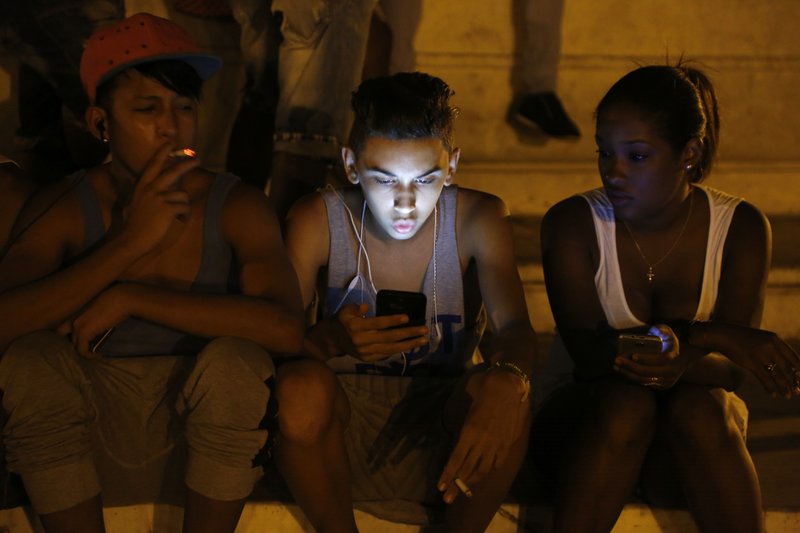
FILE - In this July 1, 2015 file photo, youths use a password protected wifi network coming from a five star hotel to surf the Internet on their smart phones in downtown Havana, Cuba. Cuba's government announced on Tuesday, Dec. 4, 2018 that its citizens will be offered full internet access on mobile phones starting Thursday, Dec. 6, becoming one of the last nations to do so. (AP Photo/Desmond Boylan, File)

The Cuban government has been building a 3G network in cities across the island and some tourists, Cuban government officials and foreign businesspeople have had access to it for several years.
The communist-governed island has one of the world’s lowest rates of internet use but that has been expanding rapidly since Presidents Barack Obama and Raul Castro declared detente in 2014. Expansion has not slowed with President Donald Trump’s partial rollback of relations.
Cuba authorized home internet in 2017 and hundreds of public Wi-Fi connection points have opened in parks and plazas around the country.
The new service will cost about 10 cents per megabyte, with packages ranging from 600 megabytes for about $7 to four gigabytes for about $30.
Those prices are roughly in line with global standards but still out of reach for many Cubans who subsist on state salaries of about $30 a month.
Cuba ran a fiber-optic connection to Venezuela in 2012, allowing the island to shift from slow and costly satellite links. It then began the slow process of allowing citizens to get online.
The government opened state-run internet cafes in 2013, joined by Wi-Fi sites two years later. The number of sites has grown to more than 800.
The Cuban internet is mostly uncensored but the government blocks a small number of sites like the U.S.-funded Radio and Television Marti networks and others that advocate for systematic change on the island.
ETECSA vice president Tania Velázquez said the new service would come online in stages from Thursday through Saturday to avoid the congestion that struck the mobile network during a series of heavily criticized tests this year.
___
Andrea Rodriguez on Twitter: www.twitter.com/ARodriguezAP

Wednesday, February 28, 2018

Cuba Travel Services (CTS) First U.S. Travel Company To Open Offices In Cuba


CTS will be the first U.S. based travel company to open its doors in Havana, Cuba


Cuba Travel Services, the leading charter and tour operator serving the destination with offices in California, Florida, New Jersey, and Texas, announced today the upcoming opening of their Havana location on March 31st.
It is considered a significant event as this is the first time a U.S. based travel company is awarded permission to operate in Cuba in over 60 years. Services provided by the California based company in Havana will include:
  • Flight ticket sales
  • Customer support
  • Hotel reservations
  • Tour operation support
  • Car rentals
  • Excursions
  • Transfers
  • Programmed packages
  • Cruise Support Services
  • Advisory Services
Opening a new office in Havana will allow Cuba Travel Services to monitor its operations more closely and better assist their clients while in the country.  Additionally, CTS will be better positioned to ensure their cruise and tour operator clients continue to offer OFAC compliant programs.
Cuba Travel Services will open its first office in the historic Lonja Del Comercio building located in Plaza de San Francisco just across from the Sierra Maestra cruise terminal and has plans to open additional locations in Havana, Camaguey, Cienfuegos, Varadero and Santiago de Cuba.
"Having the Ministry of Tourism grant this request to have a location in Cuba has been a big win for our organization. Our physical presence means our licensed clients will get faster service and more personalized attention directly from our staff," said Michael Zuccato, General Manager at Cuba Travel Services. "This is a very exciting time for us, to be the first U.S. based Travel Company to open its doors in Havana. We are confident our existing market expertise and knowledge combined with local representation, will result in an improved customer experience."   
For questions about the travel to Cuba or to book your next flight, hotel, activity or transfer visit us online at www.CubaTravelServices.com or call 800-963-CUBA (2822).
About Cuba Travel Services
With nearly 20 years of experience providing services to authorized companies, groups and individuals, Cuba Travel Services is the leading travel company serving the destination from the United States. They offer real-time hotel, flight and excursion bookings, transportation, OFAC compliant tour programming and a variety of other turnkey travel solutions. They also serve as key advisors to airlines, cruise companies, tour operators and other businesses entering the Cuba market. 
Headquartered in California, Cuba Travel Services currently maintains offices in Texas, New Jersey, North Carolina and Florida. The company provides specialty travel services including charter flights, private aviation services, visa processing, OFAC call center support services, cruise and yachting programs, shipments of authorized cargo and other logistical and travel support services. Follow us on FacebookTwitter or YouTube

Sunday, December 31, 2017

10 Countries with the Strictest Rules & Regulations for Tourists and Locals

In the United States, it’s easy to take for granted a certain amount of freedom. We can travel freely from state to state, and — by and large — each of us is in control of our own destiny (socioeconomic or intellectual limitations notwithstanding). That’s not the case for several places throughout the world. And while that information may not be particularly revelatory, the extent to which some countries go to crack down on perceived bad behavior for both residents and visitors is pretty amazing. From Singapore to Iran, here are the world’s strictest countries.

10. Cuba

Visitors to Cuba are usually treated very well. In fact, most tourists get easy access to amenities we take for granted (like the internet). For those people who live in the communist nation, however, things are different. Incoming and outgoing news is strictly controlled, for example, and those who are critical of the government are jailed. With the ease on travel restrictions, it’s hoped that the country will gravitate to a more liberal position, but at the moment, living there isn’t exactly a treat.


Cuba
wendyperrin.com

9. China

Another communist nation with a real jones for controlling the flow of information, China runs a very tight ship for its citizens. Like Cuba, most tourists are allowed a little bit of leeway, but it’s a tough row to hoe if you live there. The biggest hardship is the government’s harsh control over the flow of information into and out of the country. Hollywood films aren’t even regularly allowed in China unless they pass a rigorous screening process — even then there’s a strict limit on the foreign films that can be shown in the country.

China
insiderjourneys.com.au

8. Eritrea

The concept of religious freedom is nonexistent in Eritrea, an African country located in the region of the Horn of Africa. Though the country represents a mix of both Christianity and Islam, sects like Jehovah’s Witnesses and Seventh Day Adventists are actively forbidden from worshipping openly. The regime also eagerly controls the media and censors most information from the outside world.

Eritrea
madote.com

7. Syria

Most Americans would get completely shut down if they tried to enter Syria legally. Of course, that’s because the government has bigger fish to fry. These days, you could probably enter Syria illegally with little to no trouble, because the country is in the midst of a years long effort to oust entrenched jerk (and Syrian President) Bashar al-Assad. As a result of the combat, those people struggling to live a normal life in Syria must endure a statewide communication blackout that’s essentially stopped the influx of information.

Syria
nytimes.com

6. Iran

Iran is still ruled by Sharia Law, a religious tradition that’s especially tough on women. Along with the obligatory prohibitions on speaking out against the government, Sharia Law enforces a whole lot of social crimes with some pretty brutal punishments. Those found guilty of adultery are publicly stoned (women get buried up to their neck first). Men and women’s hair styles are strictly enforced. Women must cover their heads in public, and must adhere to strict dress codes. Most “Western” music and movies are strictly prohibited, as are social media outlets like Facebook and YouTube. For those people trying to gain access to the country, it’s best just to give it up now.

Iran
journal-neo.org

5. Russia

The current American President may have no problem buddying up to the folks who run Russia, but the country still has a reputation for old school oppression. Vladimir Putin has overseen a crackdown on the LGBT community that’s positively draconic. He’s also ransacked the offices of supposed detractors. What’s more, Putin’s political opponents have a weird way of getting shot in the street or disappearing. It’s nuts. If you’re an American hoping to visit Russia, you could experience some issues. Not only do most people need to be explicitly invited, but there’s also an obligatory form that asks entrants to fill out their personal information along the lines of where you went to high school, the last three places you’ve worked, your parents names, etc.

Russia
journal-neo.org

4. Saudi Arabia

In spite of the fact that the United States counts Saudi Arabia as one of its allies in the Middle East, the country’s inner workings are as different as night and day. Its social rules — even for visitors — are strict. Women aren’t allowed to drive, or spend time with a man to whom they are not related. Anyone daring to speak out against the government or its policies faces excoriation and potential job loss. While business travel into the country is increasingly relaxed, it’s still extremely difficult to get into the country on a tourist visa.

Saudi Arabia
maybank-ke.com

3. Equatorial Guinea

The dictator in Equatorial Guinea only approves state-run programming. There’s one newspaper. Citizens are actively discouraged from reading. Of course, thats not a big deal for most Americans, because most people actively petitioning for entry into Africa’s only Spanish speaking country have their visas denied immediately. In fact, to even visit Guinea, you have to go to Lisbon in Portugal, because there’s not an embassy in the US or the United Kingdom.

Guinea
bbc.com

2. North Korea

The North Koreans make no attempt to hide their suspicion of visitors. Provided you’re not from South Korea or the United States, you can visit, but you’ll be followed by a constant chaperone, called a “minder” whose sole purpose is to make sure tourists don’t break the rules. Locals, meanwhile, are diligently policed to ensure that they’re not doing crazy things like loitering in a park. In North Korea, citizens have to have an express purpose for being on the street and walking around. “I felt like it,” doesn’t work as an excuse in Pyongyang.

North Korea
cnn.com

1. Singapore

Singapore may have an international reputation for prosperity and safety, but that success comes at a cost. The city is extremely strict for both travelers and residents. Want to behave badly? You better have lots of money or thick skin, because Singaporean authorities will issue fines or corporal punishment for anything from smoking in public to wearing the wrong clothes when you’re traveling. People can’t even spit in public.

Singapore
fourseasons.com

Source: https://www.destinationtips.com

Thursday, November 9, 2017

U.S. Tightens Travel Rules To Cuba, Blacklists Many Businesses


Image result for U.S. Tightens Travel Rules To Cuba


WASHINGTON — Americans seeking to visit Cuba must navigate a complicated maze of travel, commerce and financial restrictions unveiled Wednesday by the Trump administration, part 
of a new policy to further isolate the island’s communist government.

Now off-limits to U.S. citizens are dozens of Cuban hotels, shops, tour companies and other businesses included on a lengthy American blacklist of entities that have links to Cuba’s military, intelligence or security services. And most Americans will once again be required to travel as part of heavily regulated, organized tour groups run by U.S. companies, rather than voyaging to Cuba on their own.The stricter rules mark a return to the tougher U.S. stance toward Cuba that existed before former President Barack Obama and Cuban President Raul Castro restored diplomatic relations in 2015. They come as President Donald Trump tries to show he’s taking action to prevent U.S. dollars from helping prop up the Cuban government.Still, the policy is only a partial rollback of Obama’s changes.

 Cruise ship visits and direct commercial flights between the countries will still be permitted. Embassies in Washington and Havana stay open.The rules are designed to steer U.S. economic activity away from Cuba’s military, intelligence and security services, which dominate much of the economy through state-controlled corporations. 

The goal is to encourage financial support for Cuba’s growing private sector, said senior Trump administration officials, who briefed reporters on a conference call on condition they not be quoted by name.To that end, the Treasury Department said it is expanding and simplifying a license that allows some U.S. exports to Cuba despite the embargo. They include tools and equipment to build or renovate privately owned buildings.“We have strengthened our Cuba policies to channel economic activity away from the Cuban military and to encourage the government to move toward greater political and economic freedom for the Cuban people,” Treasury Secretary Steven Mnuchin said.Trump announced his new policy in June during a speech in Miami’s Little Havana neighborhood, the cradle of Cuban-American resistance to Castro’s government. The administration took several months to finalize the details of the new rules, which will take effect Thursday.

The new policy maintains several categories of travel to Cuba that are permitted despite the embargo, which carries on decades after the Cold War’s end. Americans can still travel on educational and “people to people” trips as well as visits designed to support the Cuban people by patronizing privately owned small businesses that have popped up across the island in recent years.But those traveling to support Cuba’s people must have a daylong schedule of activities designed to expose them to Cubans and steer dollars toward citizens, such as renting rooms in private homes. Those on organized, “people to people” or educational visits must be accompanied by a representative of the U.S.-based group organizing the trip.

There was no immediate reaction from Cuba’s government. But the rules were quickly denounced by travel groups and proponents of closer U.S. ties to the island.“Cuba is still open for business,” said Charel van Dam of the Cuba Travel Network. “It is still possible for people to travel, but I think these announcements will serve mainly as something to scare off people who want to visit.”Sen. Patrick Leahy, D-Vt., a vocal advocate of improved U.S.-Cuban relations, noted the announcement came as Trump was in China pushing more U.S. business engagement with another communist-run country. “The hypocrisy of the White House ideologues is glaring,” Leahy said.

The rules come amid deep strains in the U.S.-Cuba relationship stemming from invisible, unexplained attacks that have harmed more than two dozen U.S. government personnel in Havana since 2016. The attacks led the Trump administration to order most of its diplomats to leave Cuba in September and issue a sweeping travel warning urging Americans to stay away.Officials insisted that the new, tougher rules had no connection to the attacks. The U.S. first complained to Cuba’s government about the attacks in February, four months before Trump announced his broader policy intentions.Some exceptions will accommodate Americans who already plan to visit Cuba. 

Those who booked “people to people” trips before Trump’s June announcement will be exempt, along with Americans who organized education trips before the rules start on Thursday. Business deals already reached with entities on the prohibited list will be allowed to proceed.It’s unclear how aggressively the U.S. will police the new rules. Officials said they would use information obtained from several U.S. agencies to catch violators, who could be subject to penalties and criminal prosecution.

The blacklist bars business with the large military-run corporations that dominate the Cuban economy. These include GAESA and CIMEX, holding companies that control most retail business on the island; Gaviota, the largest tourism company; and Habaguanex, which runs Old Havana.It also targets a new cargo port and special trade zone outside the city of Mariel that has been the focus of Cuba’s efforts to draw foreign investment in manufacturing and distribution.Blacklisted hotels include the Manzana Kempinski, which opened with great fanfare this year as Cuba’s first to meet the international five-star standard.The overall impact on American business with Cuba will likely be limited. Trade is sparse. Many American travelers already stay at hotels not on the no-go list, and the company that imports most American food products to Cuba is similarly unaffected.Bringing home limited quantities of rum and Cuban cigars is still allowed, officials said.

Friday, June 16, 2017

Trump Restores Some Cuba Penalties, Rejecting ‘Oppressors’

None


MIAMI (AP) — President Donald Trump declared Friday he was restoring some travel and economic restrictions on Cuba that were lifted as part of the Obama administration’s historic easing. He challenged the communist government of Raul Castro to negotiate a better deal for Cubans and Cuban-Americans.

Announcing the rollback of President Barack Obama’s diplomatic opening during a speech in Miami, Trump said Cuba had secured far too many concessions from the U.S. in the “misguided” deal but “now those days are over.” He said penalties on Cuba would remain in place until its government releases political prisoners, stops abusing dissidents and respects freedom of expression.

“America has rejected the Cuban people’s oppressors,” Trump said in a crowded, sweltering auditorium. “They are rejected officially today — rejected.”

Though Trump’s announcement stops short of a full reversal of the Cuba rapprochement, it targets the travel and economic engagement between the countries that has blossomed in the short time since relations were restored. The goal is to halt the flow of U.S. cash to the country’s military and security services in a bid to increase pressure on Cuba’s government.
Embassies in Havana and Washington will remain open. U.S. airlines and cruise ships will still be allowed to serve the island 90 miles south of Florida. The “wet foot, dry foot” policy, which once let most Cuban migrants stay if they made it to U.S. soil but was terminated under Obama, will remain terminated. Remittances to Cuba won’t be cut off.

But individual “people-to-people” trips by Americans to Cuba, allowed by Obama for the first time in decades, will again be prohibited. And the U.S. government will police other such trips to ensure there’s a tour group representative along making sure travelers are pursuing a “full-time schedule of educational exchange activities.”

Trump described his move as an effort to ramp up pressure to create a “free Cuba” after more than half a century of communism.
“I do believe that end is in the very near future,” he said.

Trump’s move was a direct rebuke to Obama, for whom the diplomatic opening with Cuba was a central accomplishment of his presidency. The new president’s action is broadly opposed by American business groups.

“U.S. private sector engagement can be a positive force for the kind of change we all wish to see in Cuba,” said Myron Brilliant, the U.S. Chamber of Commerce executive vice president and head of international affairs. “Unfortunately, today’s moves actually limit the possibility for positive change on the island and risk ceding growth opportunities to other countries that, frankly, may not share America’s interest in a free and democratic Cuba that respects human rights.”

In Cuba, Granma, the official organ of the nation’s Communist Party, covered Friday’s speech in a real-time blog, saying “Trump’s declarations are a return to imperialist rhetoric and unilateral demands, sending relations between Havana and Washington back into the freezer.”
Travel
On the stage in Miami, Rep. Mario Diaz-Balart, R-Fla., said the U.S. would no longer have to witness the “embarrassing spectacle” of an American president glad-handing with a dictator.
“President Trump will treat the Castro regime as a malevolent dictatorship that it is,” Diaz-Balart said. “Thank you, President Trump, for keeping your commitments. You have not betrayed us — you kept your promise.”

Obama announced in December 2014 that he and Cuban leader Raul Castro were restoring diplomatic ties between their countries, arguing that a new approach was needed because the policy the U.S. had pursued for decades had failed to democratize the island. Less than a year later, the U.S. Embassy in Havana re-opened.

The U.S. severed ties with Cuba in 1961 after Fidel Castro’s revolution, and spent subsequent decades trying to either overthrow the Cuban government or isolate the island, including by toughening an economic embargo first imposed by President Dwight D. Eisenhower.
The trade embargo remains in place under Trump. Only the U.S. Congress can lift it, and lawmakers, especially those of Cuban heritage, like Sen. Marco Rubio, another Florida Republican, have shown no interest in doing so.
Rubio staunchly opposed Obama’s re-engagement with Cuba, and he lauded Trump as he took the stage.
“Today, a new president lands in Miami to reach out his hand to the people of Cuba,” Rubio said.
___
Weissenstein reported from Havana. Associated Press writer Josh Lederman in Washington contributed to this report.
___
Follow Darlene Superville and Michael Weissenstein on Twitter: http://www.twitter.com/dsupervilleap and http://www.twitter.com/mweissenstein

Wednesday, February 8, 2017

Kempinski To Open First Modern Five-Star Luxury Hotel In Cuba


Kempinski will open its first hotel in Cuba in the second quarter of this year. The Gran Hotel Mazana Kempinski La Habana features 246 rooms and suites and is located within the historic Manzana de Gómez building in the heart of Old Havana - a UNESCO World Heritage site.

Even before it has opened, the Gran Hotel Mazana Kempinski La Habana is causing much excitement – not only in Cuba. Guests can choose from 246 luxury rooms and suites, ranging in size from 40 to the stunning presidential suite’s 150 square meters – all with ceilings of four to five meters. The rooftop terrace and swimming pool, with views over the old town, are just one of the many highlights. There will be a spa managed by Resense, which offers guests more than 1,000 square meters of pure relaxation, together with a choice of three restaurants, a lobby bar, cigar lounge, and a business center makes sure guests will have everything they need for a truly memorable stay.

There is no doubt that this new luxury hotel, in the heart of Havana’s most historic area, next to the city’s most interesting sights, is destined to become the place to be in Cuba's capital.

Visit website: https://www.kempinski.com/en/havana/gran-hotel-kempinski-la-habana/

Gran Hotel Mazana Kempinski La Habana pool

Gran Hotel Mazana Kempinski La Habana bedroom

Source: www.luxurytravelmagazine.com

Thursday, December 8, 2016

Royal Caribbean Approved To Begin Cuba Service

Image result for Royal Caribbean Cruises
Cruise line company will offer multiple itineraries; Florida-Havana routes are being planned

 Royal Caribbean Cruises Ltd. (NYSE: RCL)  announced that the Cuban government has granted approval for the company to begin cruises to Cuba. The company said it plans to announce its first Florida-Cuba itineraries in the near future.

“Our guests have expressed real interest in having the opportunity to experience Cuba, and we look forward to bringing them there," said Richard D. Fain, chairman and chief executive officer of Royal Caribbean Cruises Ltd. "Our discussions with our travel partners indicate that Cuba is a destination that appeals to a new generation of travelers.” 
Two RCL lines, Royal Caribbean International and Azamara Club Cruises, will provide guests with travel directly to Cuba for the purpose of providing people-to-people exchanges between guests and Cuban citizens and other travel permitted by current U.S. regulations.

The cruise itineraries will comply with U.S. Department of Treasury rules that permit travel companies to transport approved travelers to Cuba to engage in people-to-people activities as defined by the U.S. Department of Commerce, Office of Foreign Assets Control (OFAC).

Royal Caribbean Cruises Ltd. (NYSE: RCL) is a global cruise vacation company that owns and operates three global brands: Royal Caribbean International, Celebrity Cruises and Azamara Club Cruises. We also own a 50 percent joint venture interest in the German brand TUI Cruises and a 49 percent interest in the Spanish brand Pullmantur and have a minority interest in smaller regional brands. Together, these brands operate a combined total of 49 ships with an additional 13 on firm order. They operate diverse itineraries around the world that call on approximately 490 destinations on all seven continents.  Additional information can be found on www.rclcorporate.com

Friday, October 21, 2016

JetBlue Announces Service To Cuba’s Capital

Image result for JetBlue announces service to Cuba’s Capital


Nearing the Launch of Havana as Its 100th City, JetBlue Prepares to Bring Its Customer-Focused Approach to Air Travel Into Cuba’s Capital

JetBlue today announced the long-anticipated addition of service to Havana’s José Martí International Airport (HAV) starting in late November.
Havana, the airline’s fourth Cuban destination and 100th destination network-wide, will be served by daily roundtrip flights from three JetBlue focus cities on the airline’s newest Airbus A321 aircraft and its award-winning customer service:
• New York’s John F. Kennedy International Airport (JFK): Daily roundtrips begin on November 28, 2016
• Orlando International Airport (MCO): Daily roundtrips begin on November 29, 2016
• Fort Lauderdale-Hollywood International Airport (FLL): Once-daily roundtrips begin on November 30, 2016 and a second daily roundtrip (except Saturdays) begins December 1, 2016
“Our historic first flight kicked off a new era in travel to Cuba, and once again JetBlue will make history with flights that finally make flying to the Cuban capital simple, affordable and enjoyable,” said Robin Hayes, president and chief executive officer, JetBlue. “It’s remarkable that a startup airline less than 17 years old will mark Havana as its 100th destination.”
With service to Havana, JetBlue – which launched its first flight in February 2000 – will serve 100 destinations across 22 countries in the U.S., Latin America and the Caribbean.
JetBlue Celebrates the Culture of Cuba by Supporting the American Museum of Natural History’s Upcoming Exhibition: ¡Cuba!
To mark the inaugural flights, JetBlue will celebrate Cuba’s distinctive cultural heritage in its home at JFK’s Terminal 5 (T5) and in partnership with the American Museum of Natural History.
A special Live From T5 concert will kick off inaugural day on November 28 with performances from an award-winning Cuban music group and a New York-based Cuban dance group. Additionally, travelers passing through T5 will be able to take in a live mural creation by a Cuba-based artist. Other inaugural festivities will include traditional Cuban food and remarks to commemorate JetBlue’s first commercial flight to Havana.
JetBlue will also proudly highlight its support of ¡Cuba!, an exhibition by New York’s American Museum of Natural History. The exhibition opens to the public at the museum’s Manhattan location on November 21. ¡Cuba! will showcase the country’s biodiversity, culture and life and will invite visitors to discover Cuban nature and Cuban culture through music, dance performances, and a variety of interactive experiences.
“We are delighted to launch this wonderful partnership with JetBlue as corporate sponsor of our upcoming exhibition ¡Cuba!” said Ellen V. Futter, President of the American Museum of Natural History. “Our exhibition grows out of an unprecedented scientific and educational partnership with the National Natural History Museum in Havana, and we are so pleased to have JetBlue’s support of the Museum as we continue our work both globally and locally to advance scientific research, education, and cross-cultural understanding.”
As a leader in science and conservation, the American Museum of Natural History has long-standing research and capacity development collaborations with Cuban scientists at a number of institutions. Museum scientists have participated in nearly 30 expeditions and field projects to Cuba over the last 120 years.
All customers traveling to Cuba must be authorized to do so under the U.S. government’s Cuban Assets Control Regulations and they must certify that they qualify for one of the twelve approved travel categories outlined by the U.S. Department of Treasury. All travelers to Cuba must make their own determination with respect to the appropriate type of visa required by Cuba for their purpose of travel.
Schedule Between New York (JFK) and Havana (HAV)
Daily Flights Starting November 28, 2016
JFK – HAV Flight #243                 HAV – JFK Flight #242
8:58 a.m. – 1:05 p.m.
2:20 p.m. – 5:33 p.m.
Schedule Between Orlando (MCO) and Havana (HAV)
Daily Flights Starting November 29, 2016
MCO – HAV Flight #503                 HAV – MCO Flight #1004
8:26 a.m. – 10:00 a.m.                 11:30 a.m. – 12:50 p.m.
Schedule Between Fort Lauderdale-Hollywood (FLL) and Havana (HAV)
Daily Flights Starting November 30, 2016
FLL – HAV Flight #1499                 HAV – FLL Flight #1500
12:14 p.m. – 1:45 p.m.                 3:00 p.m. – 4:16 p.m.
Second Daily Flights (except Saturdays) Starting December 1, 2016
FLL – HAV Flight #799                 HAV – FLL Flight #800
7:54 a.m. – 9:15 a.m.                 10:45 a.m. – 12:02 p.m.
Flights between the U.S. and Havana will be operated on JetBlue’s Airbus A321 aircraft.