Showing posts with label Moscow. Show all posts

Sunday, January 23, 2022

Russia Shortens COVID-19 Isolation To 7 Days As Cases Surge

MOSCOW (AP) — Russian authorities are shortening the required isolation period for people infected with COVID-19 from 14 to seven days as the country faces another surge of COVID-19 cases, this time driven by the highly contagious omicron variant.

Deputy Prime Minister Tatyana Golikova, who runs the country’s coronavirus task force, said Tuesday that health officials were “optimizing our approaches to quarantine and testing of our citizens, including shortening the quarantine period to seven days.”

Golikova added that other policy changes will be adopted in the coming days, without elaborating. She also didn’t explain the rationale for cutting the isolation period. Earlier rules required a two-week isolation period for those who test positive, with a mandatory follow-up test on day 11.

Russia already has by far Europe’s worst death toll in the pandemic at over 322,000 deaths by its official tally, a number that other statistics suggest is a significant undercount.

The daily number of coronavirus infections confirmed in Russia has doubled over the past week, going from over 15,000 on Jan. 10 to 31,252 on Tuesday. Officials say the surge could end up as the country’s biggest yet but so far haven’t announced any major restrictions to stem it.

Anna Popova, the head of Russian public health watchdog Rospotrebnadzor, said last week that new daily cases might reach six figures. President Vladimir Putin has said that Russia has “a couple of weeks” to prepare for the unprecedented wave.

Saturday, October 24, 2020

Russia Shuns Tough Restrictions Even As Infections Soar

MOSCOW (AP) — It’s Friday night in Moscow, and popular bars and restaurants in the city center are packed. No one except the staff is wearing a mask or bothers to keep their distance. There is little indication at all that Russia is being swept by a resurgence of coronavirus infections. “I believe that everyone will have the disease eventually,” says Dr. Alexandra Yerofeyeva, an internal medicine specialist at an insurance company, while sipping a cocktail at The Bix bar in Moscow. She adds cheerfully: “Nothing ventured, nothing gained.” The outbreak in Russia this month is breaking the records set in the spring, when a lockdown to slow the spread of the virus was put in place. But, as governments across Europe move to reimpose restrictions to counter rising cases, authorities in Russia are resisting shutting down businesses again. Some regions have closed nightclubs or limited the hours of bars and restaurants, but few measures have been implemented in Moscow, which is once again the epicenter of the surge.
On Friday, Russian authorities reported over 15,000 new infections, the highest daily spike so far in the pandemic. Moscow — with less than 10% of the population — accounts for up to 30% of new infections each day. The health minister says 90% of hospital beds for coronavirus patients have been filled. Three times this week, Russia’s daily death toll exceeded the spring record of 232. Even these soaring virus tolls are likely undercounts; experts have cautioned that official figures around the world understate the true toll, but critics have taken particular issue with Russia’s death tolls, alleging authorities might be playing down the scale of the outbreak. Right now, situation is “difficult” but “no restrictive measures for the economy are required,” Deputy Prime Minister Tatyana Golikova told President Vladimir Putin on Wednesday. The spring lockdown hurt the country’s already weakened economy and compounded Russians’ frustration with plummeting incomes and worsening living conditions, driving Putin’s approval rating to a historic low of 59% in April, according to the Levada Center, Russia’s top independent pollster. Analysts say his government doesn’t want to return to those darks days. “They know that people have just come to the end of their tolerance of the lockdown measures that would be hugely unpopular if they got imposed again,” said Judy Twigg, a professor of political science at Virginia Commonwealth University, specializing in global health.
In fact, Putin’s government appears to be moving in the opposite direction. Russian officials announced this week that air traffic would resume with three more countries. All international air traffic was stopped in the spring. The announcement reminded people “about the necessity to take care of their health as much as possible” — a reflection of Russian authorities’ new effort to shift much of the responsibility for how the outbreak unfolds onto the people. Moscow has taken the necessary measures, “but without the people responding to these measures, helping themselves and the people around them, nothing will work,” warned Sergei Sobyanin, the mayor of the Russian capital of 12.7 million. During the summer, authorities lifted most virus-related restrictions, and life in Russia started getting back to normal. Perhaps too quickly, some critics said, noting that the government was eager to ensure that people voted on constitutional amendments extending Putin’s rule. Even as health officials still report several thousand new infections every day, restaurants and cinemas reopened, vacationers flocked to Black Sea resorts, and 17,000 took part in the Moscow Half Marathon in August. Russia’s Sports Minister Oleg Matytsin said the race “marked this victory” over the pandemic.
That same month, Putin announced regulatory approval of the first vaccine against coronavirus — although many scientists have cast doubt on the shot — and it is now being tested in a larger study. Authorities are offering it to doctors and teachers, but it’s not widely available. With Putin’s approval ratings on the rise again, the government appears reluctant to do anything that might further weaken the economy and anger the public. The authorities understand that “the economic virus is worse than the biological one,” Boris Titov, Russia’s business ombudsman, told entrepreneurs this week. Nearly 70% of the country’s businesses “will not survive the second wave” and the accompanying restrictions, he said. But doctors and experts are sounding the alarm that Russia’s health system is being stretched. Just like in the spring, media report hourslong waits for ambulances and long lines for CT scans. People who have virus symptoms — who are supposed to call a visiting doctor service — report waiting days for anyone to arrive. “When it comes to the regions (beyond Moscow), we see that they are already choking,” said Vasily Vlassov, public health expert with the Higher School of Economics in Moscow. Moscow hospitals, so far, appear to be coping. “The hospital is full, but there are free beds for now, and we haven’t yet used all of the reserve beds,” said Dr. Alexander Vanyukov of the Moscow Hospital No. 52. Life outside hospitals remains largely normal. Moscow officials have recommended the elderly and those with chronic illnesses stay home. They ordered employers to make 30% of their staff work from home, extended the fall school vacation by a week and moved middle and high school students to online classes. As at the national level, officials have focused on personal responsibility, at one point sending inspectors to theaters to look for retirees who are not self-isolating. Officials said they considered shutting bars and nightclubs, but on Thursday Moscow’s mayor proposed “an experiment” instead: Employees and customers at establishments open between midnight and 6 a.m. must register for contact tracing purposes. Margo Lankina, manager of The Bix bar, says operating during the pandemic isn’t easy. Her staff must wear gloves and masks and their health is monitored. The venue is regularly cleaned. “But on the other hand, it’s good that they allow us to work,” Lankina says. “Our guests? Well, the distance is not being observed, that’s true, what can I say?” Lankina admits. “But somehow we keep on living.” ___ Associated Press writer Kostya Manenkov contributed. ___ Follow all of AP’s coronavirus pandemic coverage at http://apnews.com/VirusOutbreak and https://apnews.com/UnderstandingtheOutbreak

Friday, May 6, 2016

Dining Out In Moscow: From Culinary Wasteland To Foodie Heaven

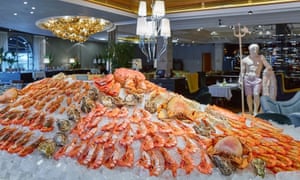
Russian seafood at Erwin

 A ban on imported ingredients from the EU has led restaurants to source local produce – sparking fresh interest in Russian food


Not so long ago, the idea of naming an upmarket Moscow restaurant after an unfashionable provincial Russian town would have been met with confusion.
These days things are different. Voronezh, which opened a few months ago in a restored central Moscow mansion, is often booked out a week in advance. Its success, and that of dozens of other restaurants, reflects trends which have, in a short space of time, transformed Moscow from culinary wasteland into foodie paradise.
Russia’s sanctions on imported fruits, vegetables, meat and fish from the EU and a number of other countries – introduced in response to western sanctions over the annexation of Crimea and war in east Ukraine – prompted anger but also provided extra stimulus to a focus on locally sourced ingredients that was already under way, and created new interest in Russian ingredients.
On top of attempts at sanctions busting, which have involved imitating European cheeses and meats, with mixed results, there has also been a drive to rediscover Russian cuisine and use Russian ingredients. Voronezh uses only Russian meat, while across town at Erwin, diners can feast on Kamchatka crab, Murmansk scallops and dozens of unusual fish from Russia’s many seas and rivers.
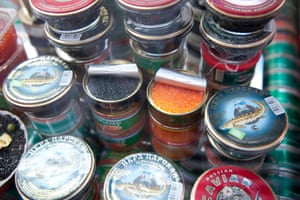
Red and black caviar for sale
Pinterest
Red and black caviar for sale Photograph: Alamy
“A few years ago there were only two or three Russian restaurants in central Moscow,” said Alexander Rappoport, the restaurateur behind Voronezh and Erwin, in an interview at Zhivago, another of his Russian restaurants. “Everyone ate Russian food at home, but you couldn’t find good Russian food in restaurants.”
Thanks to the climate and decades of shortages, traditional Russian food can be a gruelling experience for the uninitiated, such as “salads” swimming in factory-made mayonnaise, and bland root vegetables. But at Zhivago, the focus is on doing the classics well, with mouth-watering pies with various fillings, many kinds of pelmeni dumplings, and seven types of caviar to dollop on to pancakes.
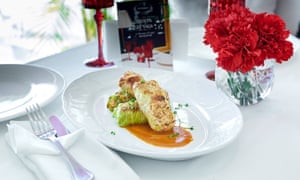
Cabbage leaves stuffed with crayfish tails at Zhivago
Pinterest
Cabbage leaves stuffed with crayfish tails at Zhivago, where the focus is on doing the classics well.
“Everyone should stay connected with their local cuisine. We all know about foie gras and sea urchin now, but for me, a celebratory meal is always going to be vodka, herring and a pie,” said Rappoport. “When I want to relax, a frosted bottle of vodka is far more delicious than any Chateau Margaux, that’s just genetically determined.”
Russian food’s new fashionable status is one of the more benign consequences of the increased nationalism of the past two years. Even the doyen of the Moscow restaurant scene, Arkady Novikov, famous for opening dozens of upmarket restaurants in the capital over the past two decades, has gone local. His recent restaurants include Cheese Factory, where analogues to sanctioned cheeses are made on the premises, and Valenok, where Soviet cafe food is given an upmarket twist in glamorous surroundings. A valenok is a traditional Russian fur boot, and a model boot the size of a house announces the restaurant from the street.
Alongside the return to well-made comfort food, something new is also happening. In much the same way as British or Scandinavian restaurants discovered their own vernacular, a whole set of Moscow eateries featuring dishes that are both traditionally Russian and completely new has sprung up.
At Kutuzovsky 5, Russian recipes from two centuries ago are given a fresh twist with fine ingredients and cutting-edge cooking techniques. At Northerners, Murmansk scallops are served with carrot hummus and beetroot slices in a Russo-Nordic mashup. Almost every week a new restaurant opens with a “new Russian” theme in the kitchen.
Ivan and Sergey Berezutskiy, chefs who opened the restaurant Twins in central Moscow in late 2014, were pioneers in the focus on Russian ingredients.
“We had both worked in various Italian and French restaurants over the years and we thought it was weird that we know so much about Parma ham and other foreign products but nothing about our own interesting ingredients,” said Sergey.
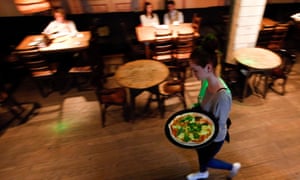
A waitress serves pizza at a restaurant in Moscow
Pinterest
A waitress serves pizza at a restaurant in Moscow. Photograph: Maxim Zmeyev/Reuters
Now, four times a year the brothers make a trip to a different Russian region to scout out the most interesting local products, most of which never leave the region and are consumed locally. Their finds include a cheesemaker in a village in the Altai mountains only accessible by horseback using traditional techniques with magical results, seaweed varieties which would fetch a fortune in Japan but are sold for 11 roubles (£0.11) a kilogram in a local market near Murmansk, and a village where for three days a year locals collect a type of mushroom completely different to any they have found elsewhere in Russia.
One item they are particularly proud of is cured goose from Bashkortostan. “We’ve found a granny who cures it for us specially. It’s impossible to buy it anywhere in Moscow, and previously nobody outside the region knew about it, but it’s as good as any jamon,” said Sergey. They serve flakes of the cured meat with pumpkin ravioli.
The sanctions have sparked a drive to improve local agriculture, but also played into a natural process of eating locally sourced products that was already getting under way.
“People have begun to realise that the most important thing is to eat fresh food,” said Sergey. “Even with the sanctions, there are plenty of other countries we can import fish from, but why should we when we live in a country with more seas, rivers and lakes than any other?”
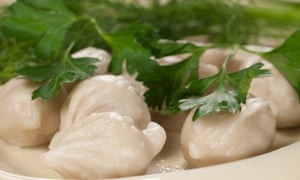
Pelmeni dumplings
Pinterest
Pelmeni dumplings. Photograph: Alamy
Rappoport agreed, noting that all his beef was sourced from a single herd on a farm just outside Voronezh. “I go there twice a month and I pretty much know every cow personally,” he said. “Of course, meat that was reared 200 kilometres from here is always going to be better than vacuum-packed meat from America, when I have no idea what the cow was like, what it ate and when it was killed.”
In a country that spans one-sixth of the world, “locally sourced” can be a relative term. Crabs from Magadan and Kamchatka have twice as far to travel to Moscow as fish from Europe, and internal Russian logistics are poor, which accounts for why so much good regional produce goes undiscovered. Restaurateurs say it is easier to bring ingredients to Moscow from Paris than it is from Murmansk.
Sanctions and the determination of Russian chefs are slowly changing that. In times of economic difficulty and a weak rouble, using local products also helps keep the bill down, and explains why so many Moscow restaurants are packed despite the troubled times. The transformation of restaurants from places for special occasions to everyday eating venues continues apace and is rearing a whole new generation of Muscovite foodies.
“Moscow is becoming one of the best places to eat in the world,” said local food critic and restaurant consultant Sasha Sutormina. “Two years ago you certainly couldn’t say that, but now when I have friends here from London, Hong Kong or Paris, they can’t believe how good it is.”

By  in Moscow

Saturday, July 11, 2015

Travelore Tips: 10 Travel Secrets From The Top Hotel Concierges In The world

Concierges are often overlooked as a resource for insider information on any given destination—called upon instead for last-minute theater tickets, restaurant reservations, and the like—but they're also experts at the destinations they represent. Certified Indigenous, a new book released by The Luxury Collection, taps concierges of the world's top hotels for their best destination secrets. Here are some of our favorites.

Ignore what all the guidebooks tell you and skip Moscow’s busy “golden period” (April-June) in favor of winter—yes, really. “Winter is the best season to visit Moscow,” promises Julia Pasechinik, Chief Concierge of Hotel National. “The streets are decorated and look so beautiful, especially at nighttime, when the trees and buildings are lit up and covered with snow. It’s magical.”
“Hire a traditional troika—a carriage pulled by three horses, once the standard mode of transport in cold weather,” adds Pasechinik. “Afterward, have a bowl of hot borscht and a small glass of vodka at Pavilion, like the natives.”
Chris Neidenthal/Getty

Jakarta might be filled with tourist traps, but there’s still lots of authenticity hidden in plain sight—if you know where to look. “Go to Setu Babakan, a cultural village that preserves the indigenous Betawi culture in Jakarta,” advises Teguh Perwira, Chief Concierge at Keraton at The Plaza. “You’ll find traditional houses, see cultural shows, and experience authentic Indonesian traditions.”
If you’re in the Old City, stop by the charming Cafe Batavia. “It’s in the second oldest building in Kota Tua and is the perfect spot for lunch. Grab a window table on the second floor, overlooking the old city hall.”
Ian Trower/Alamy

There's so much more to Vienna than palaces, gardens, and museums; it has a very fun, playful side that most tourists overlook. "Visit the Prater Amusement Park and ride the Riesenrad," advises Dieter Ludewig, Chief Concierge of the Hotel Bristol. "Then hike up Kahlenberg to its peak, Stefaniewarte, for the best views of the city."
Once you've worked up an appetite, "eat lunch at Gastwirtschaft Huth and try the tafelspitz (boiled beef),schnitzel (deep-fried veal), and apfelstrudel. Or, for a quick bite, try a sausage at Würstelstand Bitzinger for a truly local experience."

Shopaholics, rejoice: Turns out one of the best ways to experience the City of Bridges is through browsing its artisan boutiques. “Much of the beauty of experiencing Venice comes from shopping,” admits Filippo Bollani, Chief Concierge at Hotel Danieli. “Stop in the charming boutique Pied-à-terre for a pair of handcrafted leather Furlane, the famous velvet gondolier slippers, handsewn by Friulu countrywomen, using bicycle tires for the soles.”
“Then there’s Nardi. Its jewelry is beloved by clientele that have included Grace Kelly and Elizabeth Taylor. The shop also works with clients to create fabulous bespoke pieces, the ultimate Venetian keepsake. End the day with an aperitif and dinner in Restaurant Terraza Danieli.”
Reda and Co/Alamy

Shanghai

Fight the impulse to see everything in glamorous, action-packed Shanghai and, instead, just take it slow. “Take a walk through the 400-year-old Yu Garden, a tranquil private garden,” advises Stanley Shao, Chief Concierge at The Hongta Hotel. "Stop at Lu Bo Lang for Chinese radish cake and xiao long bao (steamed pork dumplings), or the Pavilion tea house to sip Chinese tea.”
“Do as the locals do and spend an evening taking a mellow boat ride down the Huangpu River, enjoying the lights and spectacle of Shanghai—from afar.”
Alex Segre/Alamy

Mallorca

The island of Mallorca may be best known for its beaches but, according to Mariano Iglesias Moreno, concierge at Castillo Hotel Son Vida, the island’s peaks are equally beautiful. “The Serra de Tramuntana mountains are my favorite natural attraction in Mallorca,” says Moreno.
“Start your day with a mild hike through the mountain range, starting in Esporles. While you’re there, try pa amb oli—an authentic snack of bread with native ramallet tomato squeezed over it, and a dash of olive oil, salt, and various toppings. Later, visit the indoor markets of Palma—Mercat Olivar and Mercat de Santa Catalina—which is like heaven for foodies.”
Marin Siepmann/Alamy

Paris

Paris, like Venice, is best experienced through admiring (and tasting!) the work of its artisans. "Visit the Delisle showroom, where, since 1895, craftsmen have been working with bronze and iron to make custom lighting, furniture, and clocks," advises Marie-Liesse Thery, Head Concierge at Prince de Galles Hotel. "Or arrange for a visit to the workshop of Manuela Paul Cavallier, an artist who use gold leaf to combine a 17th-century aesthetic with a contemporary vibe."
Like cheese? "Visit Fromagerie Quatrehomme on Rue de Sèvres. The family dairy shop has more than 200 cheeses on offer. The owner, Marie, was the first woman to be awarded the title Meilleur Ouvrier de France (Best Craftsman in France) in 2000."
Boris Karpinski/Alamy

San Francisco

When in San Francisco, it's worth exploring outside the city center. "Ride the ferry to the charming town of Sausalito, full of boutiques, outdoor cafes, galleries, and wine shops," suggests Jose Lopez, Chief Concierge at the Palace Hotel. "Spend the afternoon wandering, shopping, and tasting, and enjoy the stunning sights on the water spanning from the Golden Gate to the Bay Bridge on the way back."
"Also visit North Beach, and slip into an Italian cafe for homemade cannoli and delicious espresso."
Bob Kriesel/Alamy

Crete

Crete isn’t all sandy beaches and aquamarine waters; it’s also home to the country’s best wine, according to Konstantinos Skoumbakis, Chief Concierge at the Blue Palace. “Don’t miss Boutari Winery, near the archaeological site of Knossos, where some of the earliest traces of Western viticulture were discovered,” says Skoumbakis. “It’s a state-of-the-art winery that gives incredible insight into the country’s history in winemaking.”
“End the day at the Blue Palace. We light bonfires on the beach and slow-cook the famous antikristo lamb. Bread is baked in a stone oven, and local producers come with their honey, olive oil, herbs, and clay pottery. Crete is a magical place.”
Fanika Zupan

New York

When visiting New York, "touristy" isn't always a bad thing. "Take a stroll through Central Park—it's the world's most famous public park—and see the Reservoir, Belvedere Castle, and the Great Lawn," advises James Jolis, Chief Concierge at The Chatwal. "Art lovers should also visit the Metropolitan Museum of Art, particularly the Ancient Temple of Dendur in the Egyptian Collection."
For food: "Go to Totto Ramen for a quick bite. And indulge in one of the notable restaurants in the Theater District before seeing a show—Betony (pictured) is good for modern American fare, and ABC Kitchen for an intimate downtown vibe."
For concierge secrets in other destinations, check out The Luxury Collection's Certified Indigenous: Exceptional Itineraries for the Global Explorer.
Ilya Savenok/Getty

From www.cntraveler.com

Sunday, May 31, 2015

Travelore News: Russian Travel Ban For EU Citizens In Response To Sanctions

Russian Travel Ban for EU Citizens in Response to Sanctions


Moscow compiled a list of EU citizens banned from entering Russia in response to the European Union’s sanctions campaign, a source in the Russian Foreign Ministry said Saturday.
The source confirmed reports in several foreign media that a list of European politicians, diplomats and military experts was sent to the embassies of EU member states.
"The answer to the demands of some European countries to explain why these persons were included in the list of those who are banned from entering Russia is simple — it was done in response to a sanctions campaign unleashed against Russia by some EU member states, led by Germany," the source told journalists.
Russia Retaliates to EU Sanctions With Blacklist of 89 Officials
He added that there is a similar list consisting of US citizens, but Washington did not ask to make it public.
According to media reports, the list comprises 89 EU citizens, 18 of which have Polish citizenship, while nine are from the United Kingdom. Sweden, Estonia, Germany as well as Lithuania, Latvia and Romania also have at least five of their nationals each mentioned in the list.
Earlier in the day, the EU Delegation to Russia's spokesman confirmed authenticity of the list.
The European Union and the United States have imposed sanctions against several sectors of the Russian economy and high-profile officials, including travelling bans, citing Moscow’s alleged involvement in the Ukrainian conflict.
The Russian government has consistently denied involvement in Ukraine’s internal affairs.

Tuesday, January 6, 2015

10 Exciting Attractions Opening In 2015


From the world's largest archaeology museum to its biggest eco-park, 2015 is gearing up to be a whopper of a year for global tourists in search of the next big thing.
Video games will finally get the kind of museum treatment typically awarded to other forms of visual art.
Texas will open a Texas-sized entertainment district.
And everyone's favorite, Hello Kitty, will finally take a stab at Mickey Mouse with her own lavish theme park.
Below is our cultural calendar for 2015, highlighting the most anticipated new attractions opening around the globe.
    Each of these multi-million dollar projects will have a major impact on local tourism, and every one of them is sure to make headlines in the coming months.
    Hello Kitty Park (Zhejiang Province, China)
    Opening date: January, 2015
    This joint venture between Japan's Sanrio Corporation and China's Zhejiang New Insight Leisure Tourism Development opened to Hello Kitty's adoring fans on New Year's Day.
    The new attraction includes 11 themed facilities, such as performance venues, amusement rides, a luxury resort and even a grand mahjong hall.
    The $215 million project is the first Hello Kitty theme park outside of the cartoon's native Japan and is expected to attract up to one million visitors per year.
    Hello Kitty Park, 1 Tianshi Ave., Anji County, Zhejiang Province; +86 4009 778 899
    Inspiration for tomorrow's game-makers?
    Inspiration for tomorrow's game-makers?
    The National Videogame Arcade (Nottingham, England)
    Opening date: March 2015
    Billed as "the world's first cultural center for gaming," the forthcoming National Videogame Arcade will be a hub for video game culture, with public programs, educational outreach, archives, themed galleries and interactive exhibitions spread across a five-floor building in Nottingham's Creative Quarter.
    The $3.9 million compound will house more than 12,000 objects, and aims to "inspire and develop the game-makers of tomorrow."
    The National Videogame Arcade, 24-32 Carlton St., Nottingham; +44 788 763 3751
    Grand Texas Sports & Entertainment District (New Caney, Texas)
    Opening date: Spring 2015
    The first components of a massive new amusement zone 30 miles northeast of Houston, Texas -- including a motorsports park, sports complex and water park -- are expected to open to the public in the spring of 2015.
    The 640-acre district will eventually house seven Texas-themed attractions in total, including a shopping and entertainment complex, a multi-use event center, concert venues, a wakeboarding lake, equestrian trails, a hospitality village and the Grand Texas Amusement Park.
    Grand Texas Sports & Entertainment District, 23065 Highway 242, New Caney, Texas
    The National Blues Museum (St. Louis, Missouri)
    Opening date: Late 2015
    Blues fans will have a good reason to smile next year when the National Blues Museum opens to the public in downtown St Louis.
    Backed by everyone from blues legend Buddy Guy to actor John Goodman, the $13.5 million complex will contain 16,000 square feet of interactive exhibition space, a 100-seat theater and a robust calendar of public programming.
    The National Blue Museum, 615 Washington Ave., St. Louis, Missouri; +1 314 231 0400
    Garage Museum of Contemporary Art (Moscow)
    Opening date: June 2015
    Conceived in 2008 by Dasha Zhukova (girlfriend of Russian billionaire Roman Abramovich). the Garage Museum of Contemporary Art will finally move into its first permanent home in 2015.
    Dutch architect Rem Koolhaas helped transform a Soviet-era pavilion in Gorky Park into a 58,000-square-foot art compound that will display some of the best contemporary works from Russia and beyond.
    Garage Museum of Contemporary Art, 9, Krymsky Val, Gorky Park, Moscow; +7 495 645 05 20
    Where fantasy and cultural heritage collide.
    Where fantasy and cultural heritage collide.
    Eternity Passage (Beijing)
    Opening date: Summer 2015
    Eternity Passage claims it will be China's first hi-tech amusement park, weaving Chinese history with "technological fantasy" across two large zones (one indoor and the other open air).
    The theme park is currently under construction just outside of the Chinese capital, on the route to the Great Wall, and will be part of Beijing Outlets World, a complex with outlet shopping, resort hotels and a conference center.
    Eternity Passage, ChangPing County, Beijing
    Grand Egyptian Museum (Cairo)
    Opening date: Fall 2015
    Halfway between the Pyramids of Giza and the modern city of Cairo lies an $800 million compound that will soon be home to 100,000 ancient artifacts spanning more than 7,000 years of history.
    The Grand Egyptian Museum will become the world's largest archeological institution when it opens in the fall, and includes a conference center, training center and several archeology workshops.
    Its biggest draw card will no doubt be the display of more than 3,500 artifacts belonging to the famous King Tutankhamen.
    Grand Egyptian Museum, El Remayah Sq., Cairo-Alex. Road, Pyramids, Giza, Egypt; +202 33 776 893
    National Gallery Singapore (Singapore)
    Opening date: November 2015
    The 689,000-square-foot National Gallery will be the largest visual arts venue in Southeast Asia when it opens in the heart of Singapore's Civic District next year with a collection of regional art spanning from the 19th century to present day.
    The opening is timed to coincide with Singapore's Golden Jubilee, and marks a fresh attempt by the city-state to position itself as an international hub of the arts.
    National Gallery Singapore, 1 St. Andrew's Road; +65 6690 9400
    Funtasy Island: An eco park off the coast of Singapore.
    Funtasy Island: An eco park off the coast of Singapore.
    Funtasy Island (Riau Islands, Indonesia)
    Opening date: Late 2015
    Developers are billing this $240 million, 740-acre amusement zone just off the coast of Singapore in Indonesia's Riau Islands as "the world's largest eco-theme park."
    Eight key "eco-zones" under construction include a multi-sensory rainforest, land- and river-based safaris, snorkel and scuba zones, an interactive dolphin habitat and an aquarium where you can swim with whale sharks.
    Funtasy Island, 1 Maritime Square, Harbour Front Centre, Singapore; +65 6376 5919
    Louvre Abu Dhabi (U.A.E.)
    Opening date: December 2015
    The oil-rich emirate of Abu Dhabi paid an astounding $525 million just to be associated with the Louvre brand, along with another $747 million for art loans and managerial advice.
    Add to the price tag the cost of the building, about $100 million, and you've got yourself one of the most expensive cultural institutions ever conceived.
    Inside the domed structure, designed by Pritzker Prize-winning architect Jean Nouvel, will be 65,000 square feet of permanent installations and 22,000 square feet more set aside for temporary exhibits.
    Louvre Abu Dhabi, Cultural District, Abu Dhabi
    Renovated attractions
    - A project aimed at restoring Mont Saint-Michel's original tidal character will be completed in 2015, revitalizing both the approach to the famous Normandy abbey and the spirit of its maritime setting.
    - One year too late to coincide with its centennial celebrations, the Panama Canal's $5.2 billion expansion project should finally be completed by December with much fanfare to mark the occasion.
    - With a concourse 90 feet longer than the main concourse of Grand Central Terminal further uptown, the new wing-shaped World Trade Center Transportation Hub will serve more than 200,000 daily commuters and millions of annual visors from around the globe when completed in December 2015.
    - Another New York City institution, the Whitney Museum of American Art will move into its new building between the High Line and the Hudson River in May, vastly increasing its exhibition and programming space.
    Contributed by Mark Johanson, CNN
    Follow us on Twitter: @traveloreReport