Showing posts with label #Russia. Show all posts

Sunday, December 31, 2017

10 Countries with the Strictest Rules & Regulations for Tourists and Locals

In the United States, it’s easy to take for granted a certain amount of freedom. We can travel freely from state to state, and — by and large — each of us is in control of our own destiny (socioeconomic or intellectual limitations notwithstanding). That’s not the case for several places throughout the world. And while that information may not be particularly revelatory, the extent to which some countries go to crack down on perceived bad behavior for both residents and visitors is pretty amazing. From Singapore to Iran, here are the world’s strictest countries.

10. Cuba

Visitors to Cuba are usually treated very well. In fact, most tourists get easy access to amenities we take for granted (like the internet). For those people who live in the communist nation, however, things are different. Incoming and outgoing news is strictly controlled, for example, and those who are critical of the government are jailed. With the ease on travel restrictions, it’s hoped that the country will gravitate to a more liberal position, but at the moment, living there isn’t exactly a treat.


Cuba
wendyperrin.com

9. China

Another communist nation with a real jones for controlling the flow of information, China runs a very tight ship for its citizens. Like Cuba, most tourists are allowed a little bit of leeway, but it’s a tough row to hoe if you live there. The biggest hardship is the government’s harsh control over the flow of information into and out of the country. Hollywood films aren’t even regularly allowed in China unless they pass a rigorous screening process — even then there’s a strict limit on the foreign films that can be shown in the country.

China
insiderjourneys.com.au

8. Eritrea

The concept of religious freedom is nonexistent in Eritrea, an African country located in the region of the Horn of Africa. Though the country represents a mix of both Christianity and Islam, sects like Jehovah’s Witnesses and Seventh Day Adventists are actively forbidden from worshipping openly. The regime also eagerly controls the media and censors most information from the outside world.

Eritrea
madote.com

7. Syria

Most Americans would get completely shut down if they tried to enter Syria legally. Of course, that’s because the government has bigger fish to fry. These days, you could probably enter Syria illegally with little to no trouble, because the country is in the midst of a years long effort to oust entrenched jerk (and Syrian President) Bashar al-Assad. As a result of the combat, those people struggling to live a normal life in Syria must endure a statewide communication blackout that’s essentially stopped the influx of information.

Syria
nytimes.com

6. Iran

Iran is still ruled by Sharia Law, a religious tradition that’s especially tough on women. Along with the obligatory prohibitions on speaking out against the government, Sharia Law enforces a whole lot of social crimes with some pretty brutal punishments. Those found guilty of adultery are publicly stoned (women get buried up to their neck first). Men and women’s hair styles are strictly enforced. Women must cover their heads in public, and must adhere to strict dress codes. Most “Western” music and movies are strictly prohibited, as are social media outlets like Facebook and YouTube. For those people trying to gain access to the country, it’s best just to give it up now.

Iran
journal-neo.org

5. Russia

The current American President may have no problem buddying up to the folks who run Russia, but the country still has a reputation for old school oppression. Vladimir Putin has overseen a crackdown on the LGBT community that’s positively draconic. He’s also ransacked the offices of supposed detractors. What’s more, Putin’s political opponents have a weird way of getting shot in the street or disappearing. It’s nuts. If you’re an American hoping to visit Russia, you could experience some issues. Not only do most people need to be explicitly invited, but there’s also an obligatory form that asks entrants to fill out their personal information along the lines of where you went to high school, the last three places you’ve worked, your parents names, etc.

Russia
journal-neo.org

4. Saudi Arabia

In spite of the fact that the United States counts Saudi Arabia as one of its allies in the Middle East, the country’s inner workings are as different as night and day. Its social rules — even for visitors — are strict. Women aren’t allowed to drive, or spend time with a man to whom they are not related. Anyone daring to speak out against the government or its policies faces excoriation and potential job loss. While business travel into the country is increasingly relaxed, it’s still extremely difficult to get into the country on a tourist visa.

Saudi Arabia
maybank-ke.com

3. Equatorial Guinea

The dictator in Equatorial Guinea only approves state-run programming. There’s one newspaper. Citizens are actively discouraged from reading. Of course, thats not a big deal for most Americans, because most people actively petitioning for entry into Africa’s only Spanish speaking country have their visas denied immediately. In fact, to even visit Guinea, you have to go to Lisbon in Portugal, because there’s not an embassy in the US or the United Kingdom.

Guinea
bbc.com

2. North Korea

The North Koreans make no attempt to hide their suspicion of visitors. Provided you’re not from South Korea or the United States, you can visit, but you’ll be followed by a constant chaperone, called a “minder” whose sole purpose is to make sure tourists don’t break the rules. Locals, meanwhile, are diligently policed to ensure that they’re not doing crazy things like loitering in a park. In North Korea, citizens have to have an express purpose for being on the street and walking around. “I felt like it,” doesn’t work as an excuse in Pyongyang.

North Korea
cnn.com

1. Singapore

Singapore may have an international reputation for prosperity and safety, but that success comes at a cost. The city is extremely strict for both travelers and residents. Want to behave badly? You better have lots of money or thick skin, because Singaporean authorities will issue fines or corporal punishment for anything from smoking in public to wearing the wrong clothes when you’re traveling. People can’t even spit in public.

Singapore
fourseasons.com

Source: https://www.destinationtips.com

Friday, May 6, 2016

Dining Out In Moscow: From Culinary Wasteland To Foodie Heaven

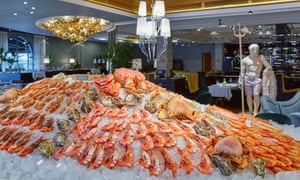
Russian seafood at Erwin

 A ban on imported ingredients from the EU has led restaurants to source local produce – sparking fresh interest in Russian food


Not so long ago, the idea of naming an upmarket Moscow restaurant after an unfashionable provincial Russian town would have been met with confusion.
These days things are different. Voronezh, which opened a few months ago in a restored central Moscow mansion, is often booked out a week in advance. Its success, and that of dozens of other restaurants, reflects trends which have, in a short space of time, transformed Moscow from culinary wasteland into foodie paradise.
Russia’s sanctions on imported fruits, vegetables, meat and fish from the EU and a number of other countries – introduced in response to western sanctions over the annexation of Crimea and war in east Ukraine – prompted anger but also provided extra stimulus to a focus on locally sourced ingredients that was already under way, and created new interest in Russian ingredients.
On top of attempts at sanctions busting, which have involved imitating European cheeses and meats, with mixed results, there has also been a drive to rediscover Russian cuisine and use Russian ingredients. Voronezh uses only Russian meat, while across town at Erwin, diners can feast on Kamchatka crab, Murmansk scallops and dozens of unusual fish from Russia’s many seas and rivers.
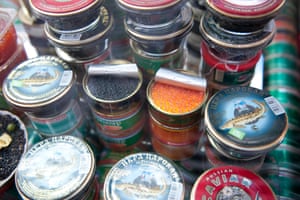
Red and black caviar for sale
Pinterest
Red and black caviar for sale Photograph: Alamy
“A few years ago there were only two or three Russian restaurants in central Moscow,” said Alexander Rappoport, the restaurateur behind Voronezh and Erwin, in an interview at Zhivago, another of his Russian restaurants. “Everyone ate Russian food at home, but you couldn’t find good Russian food in restaurants.”
Thanks to the climate and decades of shortages, traditional Russian food can be a gruelling experience for the uninitiated, such as “salads” swimming in factory-made mayonnaise, and bland root vegetables. But at Zhivago, the focus is on doing the classics well, with mouth-watering pies with various fillings, many kinds of pelmeni dumplings, and seven types of caviar to dollop on to pancakes.
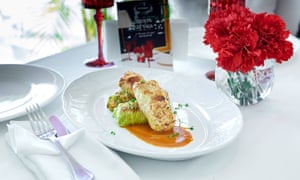
Cabbage leaves stuffed with crayfish tails at Zhivago
Pinterest
Cabbage leaves stuffed with crayfish tails at Zhivago, where the focus is on doing the classics well.
“Everyone should stay connected with their local cuisine. We all know about foie gras and sea urchin now, but for me, a celebratory meal is always going to be vodka, herring and a pie,” said Rappoport. “When I want to relax, a frosted bottle of vodka is far more delicious than any Chateau Margaux, that’s just genetically determined.”
Russian food’s new fashionable status is one of the more benign consequences of the increased nationalism of the past two years. Even the doyen of the Moscow restaurant scene, Arkady Novikov, famous for opening dozens of upmarket restaurants in the capital over the past two decades, has gone local. His recent restaurants include Cheese Factory, where analogues to sanctioned cheeses are made on the premises, and Valenok, where Soviet cafe food is given an upmarket twist in glamorous surroundings. A valenok is a traditional Russian fur boot, and a model boot the size of a house announces the restaurant from the street.
Alongside the return to well-made comfort food, something new is also happening. In much the same way as British or Scandinavian restaurants discovered their own vernacular, a whole set of Moscow eateries featuring dishes that are both traditionally Russian and completely new has sprung up.
At Kutuzovsky 5, Russian recipes from two centuries ago are given a fresh twist with fine ingredients and cutting-edge cooking techniques. At Northerners, Murmansk scallops are served with carrot hummus and beetroot slices in a Russo-Nordic mashup. Almost every week a new restaurant opens with a “new Russian” theme in the kitchen.
Ivan and Sergey Berezutskiy, chefs who opened the restaurant Twins in central Moscow in late 2014, were pioneers in the focus on Russian ingredients.
“We had both worked in various Italian and French restaurants over the years and we thought it was weird that we know so much about Parma ham and other foreign products but nothing about our own interesting ingredients,” said Sergey.
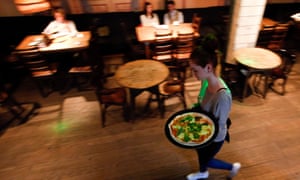
A waitress serves pizza at a restaurant in Moscow
Pinterest
A waitress serves pizza at a restaurant in Moscow. Photograph: Maxim Zmeyev/Reuters
Now, four times a year the brothers make a trip to a different Russian region to scout out the most interesting local products, most of which never leave the region and are consumed locally. Their finds include a cheesemaker in a village in the Altai mountains only accessible by horseback using traditional techniques with magical results, seaweed varieties which would fetch a fortune in Japan but are sold for 11 roubles (£0.11) a kilogram in a local market near Murmansk, and a village where for three days a year locals collect a type of mushroom completely different to any they have found elsewhere in Russia.
One item they are particularly proud of is cured goose from Bashkortostan. “We’ve found a granny who cures it for us specially. It’s impossible to buy it anywhere in Moscow, and previously nobody outside the region knew about it, but it’s as good as any jamon,” said Sergey. They serve flakes of the cured meat with pumpkin ravioli.
The sanctions have sparked a drive to improve local agriculture, but also played into a natural process of eating locally sourced products that was already getting under way.
“People have begun to realise that the most important thing is to eat fresh food,” said Sergey. “Even with the sanctions, there are plenty of other countries we can import fish from, but why should we when we live in a country with more seas, rivers and lakes than any other?”
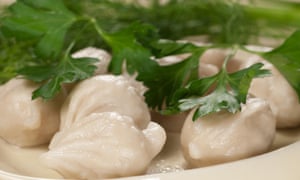
Pelmeni dumplings
Pinterest
Pelmeni dumplings. Photograph: Alamy
Rappoport agreed, noting that all his beef was sourced from a single herd on a farm just outside Voronezh. “I go there twice a month and I pretty much know every cow personally,” he said. “Of course, meat that was reared 200 kilometres from here is always going to be better than vacuum-packed meat from America, when I have no idea what the cow was like, what it ate and when it was killed.”
In a country that spans one-sixth of the world, “locally sourced” can be a relative term. Crabs from Magadan and Kamchatka have twice as far to travel to Moscow as fish from Europe, and internal Russian logistics are poor, which accounts for why so much good regional produce goes undiscovered. Restaurateurs say it is easier to bring ingredients to Moscow from Paris than it is from Murmansk.
Sanctions and the determination of Russian chefs are slowly changing that. In times of economic difficulty and a weak rouble, using local products also helps keep the bill down, and explains why so many Moscow restaurants are packed despite the troubled times. The transformation of restaurants from places for special occasions to everyday eating venues continues apace and is rearing a whole new generation of Muscovite foodies.
“Moscow is becoming one of the best places to eat in the world,” said local food critic and restaurant consultant Sasha Sutormina. “Two years ago you certainly couldn’t say that, but now when I have friends here from London, Hong Kong or Paris, they can’t believe how good it is.”

By  in Moscow