VENICE, Italy (AP) — After Venice suffered the second-worst flood in its history in November 2019, it was inundated with four more exceptional tides within six weeks, shocking Venetians and triggering fears about the worsening impact of climate change.
The repeated invasion of brackish lagoon water into St. Mark’s Basilica this summer is a quiet reminder that the threat hasn’t receded.
“I can only say that in August, a month when this never used to happen, we had tides over a meter five times. I am talking about the month of August, when we are quiet,” St. Mark’s chief caretaker, Carlo Alberto Tesserin, told The Associated Press.
Venice’s unique topography, built on log piles among canals, has made it particularly vulnerable to climate change. Rising sea levels are increasing the frequency of high tides that inundate the 1,600-year-old Italian lagoon city, which is also gradually sinking.
It is the fate of coastal cities like Venice that will be on the minds of climate scientists and global leaders meeting in Glasgow, Scotland, at a U.N. climate conference that begins Oct. 31.
Venice’s worse-case scenario for sea level rise by the end of the century is a startling 120 centimeters (3 feet, 11 inches), according to a new study published by the European Geosciences Union. That is 50% higher than the worse-case global sea-rise average of 80 centimeters (2 feet, 7 1/2 inches) forecast by the U.N. science panel.
The city’s interplay of canals and architecture, of natural habitat and human ingenuity, also has earned it recognition as a UNESCO World Heritage site for its outstanding universal value, a designation put at risk of late because of the impact of over-tourism and cruise ship traffic. It escaped the endangered list after Italy banned cruise ships from passing through St. Mark’s Basin, but alarm bells are still ringing.
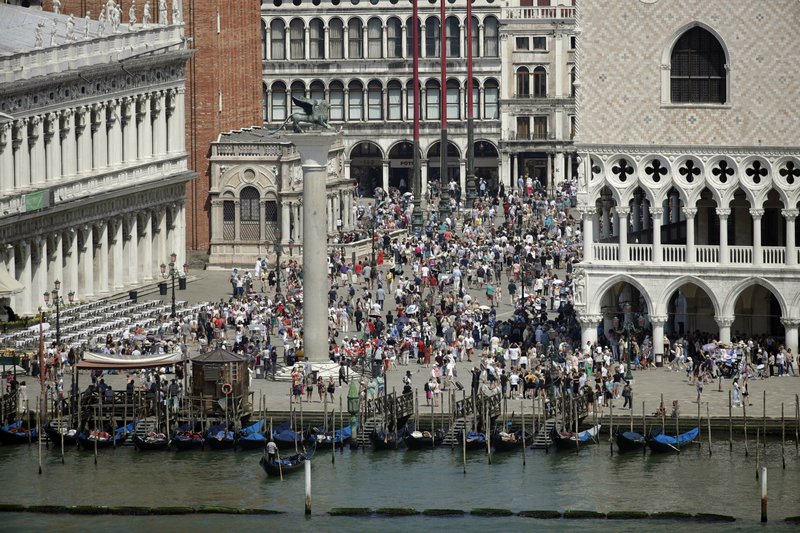
Sitting at Venice’s lowest spot, St. Mark’s Basilica offers a unique position to monitor the impact of rising seas on the city. The piazza outside floods at 80 centimeters (around 30 inches), and water passes the narthex into the church at 88 centimeters (34.5 inches), which has been reinforced up from a previous 65 centimeters (25.5 inches).
“Conditions are continuing to worsen since the flooding of November 2019. We therefore have the certainty that in these months, flooding is no longer an occasional phenomenon. It is an everyday occurrence,” said Tesserin, whose honorific, First Procurator of St. Mark’s, dates back to the ninth century.
In the last two decades, there have been nearly as many inundations in Venice over 1.1 meters — the official level for “acqua alta,” or “high water,” provoked by tides, winds and lunar cycles — as during the previous 100 years: 163 vs. 166, according to city data.
Exceptional floods over 140 centimeters (4 feet, 7 inches) also are accelerating. That mark has been hit 25 times since Venice starting keeping such records in 1872. Two-thirds of those have been registered in the last 20 years, with five, or one-fifth of the total, from Nov. 12-Dec. 23, 2019.
“What is happening now is on the continuum for Venetians, who have always lived with periodic flooding,” said Jane Da Mosto, executive director of We Are Here Venice. “We are living with flooding that has become increasingly frequent, so my concern is that people haven’t really realized we are in a climate crisis. We are already living it now. It is not a question of plans to deal with it in the future. We need to have solutions ready for today.”
Venice’s defense has been entrusted to the Moses system of moveable underwater barriers, a project costing around 6 billion euros (nearly $7 billion) and which, after decades of cost overruns, delays and a bribery scandal, is still officially in the testing phase.
Following the devastation of the 2019 floods, the Rome government put the project under ministry control to speed its completion, and last year start activating the barriers when floods of 1.3 meters (4 feet, 3 inches) are imminent.
The barriers have been raised 20 times since October 2020, sparing the city a season of serious flooding but not from the lower-level tides that are becoming more frequent.
The extraordinary commissioner, Elisabetta Spitz, stands by the soundness of the undersea barriers, despite concerns by scientists and experts that their usefulness may be outstripped within decades because of climate change. The project has been delayed yet again, until 2023, with another 500 million euros ($580 million) in spending, for “improvements” that Spitz said will ensure its long-term efficiency.
“We can say that the effective life of the Moses is 100 years, taking into account the necessary maintenance and interventions that will be implemented,” Spitz said.
Paolo Vielmo, an engineer who has written expert reports on the project, points out that the sea level rise was projected at 22 centimeters (8 1/2 inches) when the Moses was first proposed more than 30 years ago, far below the U.N. scientists’ current worse-case scenario of 80 centimeters.
“That puts the Moses out of contention,” he said.
According to current plans, the Moses barriers won’t be raised for floods of 1.1 meters (3 feet, 7 inches) until the project receives final approval. That leaves St. Mark’s exposed.
Tesserin is overseeing work to protect the Basilica by installing a glass wall around its base, which eventually will protect marshy lagoon water from seeping inside, where it deposits salt that eats away at marble columns, wall cladding and stone mosaics. The project, which continues to be interrupted by high tides, was supposed to be finished by Christmas. Now Tesserin says they will be lucky to have it finished by Easter.
Regular high tides elicit a blase response from Venetians, who are accustomed to lugging around rubber boots at every flood warning, and delight from tourists, fascinated by the sight of St. Mark’s golden mosaics and domes reflected in rising waters. But businesses along St. Mark’s Square increasingly see themselves at ground zero of the climate crisis.
“We need to help this city. It was a light for the world, but now it needs the whole world to understand it,” said Annapaola Lavena, speaking from behind metal barriers that kept waters reaching 1.05 meters (3 feet, 5 inches) from invading her marble-floored cafe.
“The acqua alta is getting worse, and it completely blocks business. Venice lives thanks to its artisans and tourism. If there is no more tourism, Venice dies,” she explained. “We have a great responsibility in trying to save it, but we are suffering a lot.”