Showing posts with label Venice travel tips. Show all posts

Wednesday, October 20, 2021

Flooding In Venice Worsens Off-Season Amid Climate Change

VENICE, Italy (AP) — After Venice suffered the second-worst flood in its history in November 2019, it was inundated with four more exceptional tides within six weeks, shocking Venetians and triggering fears about the worsening impact of climate change.

The repeated invasion of brackish lagoon water into St. Mark’s Basilica this summer is a quiet reminder that the threat hasn’t receded.

“I can only say that in August, a month when this never used to happen, we had tides over a meter five times. I am talking about the month of August, when we are quiet,” St. Mark’s chief caretaker, Carlo Alberto Tesserin, told The Associated Press.

Venice’s unique topography, built on log piles among canals, has made it particularly vulnerable to climate change. Rising sea levels are increasing the frequency of high tides that inundate the 1,600-year-old Italian lagoon city, which is also gradually sinking.

It is the fate of coastal cities like Venice that will be on the minds of climate scientists and global leaders meeting in Glasgow, Scotland, at a U.N. climate conference that begins Oct. 31.

Venice’s worse-case scenario for sea level rise by the end of the century is a startling 120 centimeters (3 feet, 11 inches), according to a new study published by the European Geosciences Union. That is 50% higher than the worse-case global sea-rise average of 80 centimeters (2 feet, 7 1/2 inches) forecast by the U.N. science panel.

The city’s interplay of canals and architecture, of natural habitat and human ingenuity, also has earned it recognition as a UNESCO World Heritage site for its outstanding universal value, a designation put at risk of late because of the impact of over-tourism and cruise ship traffic. It escaped the endangered list after Italy banned cruise ships from passing through St. Mark’s Basin, but alarm bells are still ringing.

Sitting at Venice’s lowest spot, St. Mark’s Basilica offers a unique position to monitor the impact of rising seas on the city. The piazza outside floods at 80 centimeters (around 30 inches), and water passes the narthex into the church at 88 centimeters (34.5 inches), which has been reinforced up from a previous 65 centimeters (25.5 inches).

“Conditions are continuing to worsen since the flooding of November 2019. We therefore have the certainty that in these months, flooding is no longer an occasional phenomenon. It is an everyday occurrence,” said Tesserin, whose honorific, First Procurator of St. Mark’s, dates back to the ninth century.

In the last two decades, there have been nearly as many inundations in Venice over 1.1 meters — the official level for “acqua alta,” or “high water,” provoked by tides, winds and lunar cycles — as during the previous 100 years: 163 vs. 166, according to city data.

Exceptional floods over 140 centimeters (4 feet, 7 inches) also are accelerating. That mark has been hit 25 times since Venice starting keeping such records in 1872. Two-thirds of those have been registered in the last 20 years, with five, or one-fifth of the total, from Nov. 12-Dec. 23, 2019.

“What is happening now is on the continuum for Venetians, who have always lived with periodic flooding,” said Jane Da Mosto, executive director of We Are Here Venice. “We are living with flooding that has become increasingly frequent, so my concern is that people haven’t really realized we are in a climate crisis. We are already living it now. It is not a question of plans to deal with it in the future. We need to have solutions ready for today.”

Venice’s defense has been entrusted to the Moses system of moveable underwater barriers, a project costing around 6 billion euros (nearly $7 billion) and which, after decades of cost overruns, delays and a bribery scandal, is still officially in the testing phase.

Following the devastation of the 2019 floods, the Rome government put the project under ministry control to speed its completion, and last year start activating the barriers when floods of 1.3 meters (4 feet, 3 inches) are imminent.

The barriers have been raised 20 times since October 2020, sparing the city a season of serious flooding but not from the lower-level tides that are becoming more frequent.

The extraordinary commissioner, Elisabetta Spitz, stands by the soundness of the undersea barriers, despite concerns by scientists and experts that their usefulness may be outstripped within decades because of climate change. The project has been delayed yet again, until 2023, with another 500 million euros ($580 million) in spending, for “improvements” that Spitz said will ensure its long-term efficiency.

“We can say that the effective life of the Moses is 100 years, taking into account the necessary maintenance and interventions that will be implemented,” Spitz said.

Paolo Vielmo, an engineer who has written expert reports on the project, points out that the sea level rise was projected at 22 centimeters (8 1/2 inches) when the Moses was first proposed more than 30 years ago, far below the U.N. scientists’ current worse-case scenario of 80 centimeters.

“That puts the Moses out of contention,” he said.

According to current plans, the Moses barriers won’t be raised for floods of 1.1 meters (3 feet, 7 inches) until the project receives final approval. That leaves St. Mark’s exposed.

Tesserin is overseeing work to protect the Basilica by installing a glass wall around its base, which eventually will protect marshy lagoon water from seeping inside, where it deposits salt that eats away at marble columns, wall cladding and stone mosaics. The project, which continues to be interrupted by high tides, was supposed to be finished by Christmas. Now Tesserin says they will be lucky to have it finished by Easter.

Regular high tides elicit a blase response from Venetians, who are accustomed to lugging around rubber boots at every flood warning, and delight from tourists, fascinated by the sight of St. Mark’s golden mosaics and domes reflected in rising waters. But businesses along St. Mark’s Square increasingly see themselves at ground zero of the climate crisis.

“We need to help this city. It was a light for the world, but now it needs the whole world to understand it,” said Annapaola Lavena, speaking from behind metal barriers that kept waters reaching 1.05 meters (3 feet, 5 inches) from invading her marble-floored cafe.

“The acqua alta is getting worse, and it completely blocks business. Venice lives thanks to its artisans and tourism. If there is no more tourism, Venice dies,” she explained. “We have a great responsibility in trying to save it, but we are suffering a lot.”

Wednesday, September 1, 2021

Venice Opens Film Fest With Caution

VENICE (AP) — Visitors to Venice could be forgiven for not realizing that beyond the majesty of St. Mark’s Square and the romance of gondola rides lies a city that centuries ago helped provide a baseline of what the world knows today about containing pandemics.

It was here that the term “quarantine” was coined, after merchant ships arriving in the 15th-century Venetian Republic were moored for 40 days (“quaranta giorni” in Italian) to see if their crews were afflicted with the plague. It was here that the first isolated pestilence hospital was built on a solitary island in the lagoon, a precursor to today’s COVID-19 isolation wards. And it was in Venice that 16th-century doctors donned beak-nosed masks filled with aromatic herbs to cleanse the air they breathed when treating the sick — an attempt at self-protection that today is the favored choice for Venetian Carnival costumes.

Venice’s central place in the history of battling pandemics provides a relevant backdrop to this year’s Venice Film Festival, which opens Wednesday with the premiere of Pedro Almodovar’s in-competition film “Parallel Mothers.” Almodovar developed the project during Spain’s 2020 coronavirus lockdown, one of the harshest in the West.

In a pre-opening screening Tuesday, Italian director Andre Segre presents a short documentary shot last year showing how Venice organizers coped with COVID-19 to stage the first and only in-person international film festival during the first year of the outbreak.

The scenes in Segre’s film — shocking then, normal now — feature half-full theaters for Hollywood premieres, masked movie stars, cleaners in hazmat suits and the “blink, blink, blink” of remote thermometers taking temperatures at festival checkpoints.

Festival director Alberto Barbera said Tuesday he hopes the festival’s 2021 edition will mark the “reopening that was not the case last year.” But unlike the film festival in Cannes, which came back to life this year in France after skipping 2020, Venice still has to comply with stringent Italian anti-COVID restrictions.

A huge barricade once again is sealing off public access to the red carpet and there are limited chances for fans to catch VIP water taxi arrivals on the Lido. More than 10 testing stations have been set up, and festival-goers must show proof of a negative test, vaccination or having recently recovered from COVID-19 to enter screenings. Masks are required indoors.

In other words, the Venice show is going on — other premieres at the world’s oldest film festival include the debut of Denis Villeneuve’s “Dune” and Kristen Stewart as Princess Diana in “Spencer” — even as Italy copes with new infections driven by the highly contagious delta variant.

For Venice, though, it’s really nothing new.

“The history of Venice is a history that teaches us how our city, first among European capitals, understood ahead of time how to manage viruses,” said Simone Venturini, Venice’s tourism chief. “These recurrences are studied and recalled even more today because the Venetian model is a model that paradoxically is still used.”

Beginning with the first confirmed plague to strike Venice — the 1348 outbreak that killed at least a third of its population — the city put in place containment measures even without understanding epidemiologically how it spread, said Fabio Zampieri, a history of medicine professor at the University of Padua Medical School.

Based on the belief that “bad air” was to blame for what became known as the Black Death, Venetian authorities closed churches and restaurants, canceled religious processions and ordered a thorough cleaning of homes and public venues, Zampieri said.

During the pestilence that erupted in 1423, Venice’s senate decided to lock down the whole city, prohibiting entry of people from suspected plague-ridden places and punishing locals who gave sick foreigners shelter with six months in jail, he said. A year later, Venice opened the first “lazzaretto,” a hospital on an isolated island in the Venetian lagoon dedicated exclusively to plague victims.

Thursday, October 10, 2019

Venice Day-Tripper Tax To Take Effect July 1, 2020

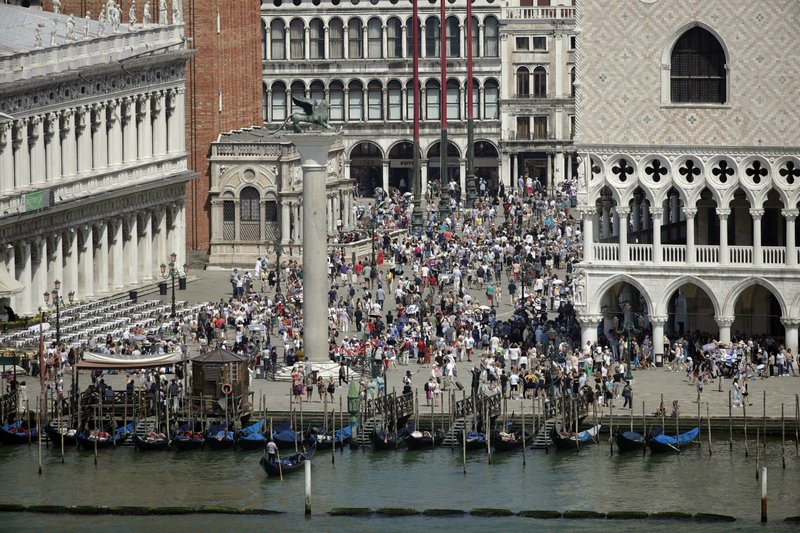
A view of the St. Mark's Square in Venice, Italy, taken on June 8, 2019. As of July 1, day-trippers to the 


MILAN (AP) — Authorities in the Italian canal city of Venice say a tax on day-trippers will start being charged on July 1, 2020.
The tax was announced nearly a year ago, but its implementation was delayed as officials worked out how it would be paid and enforced.
Authorities said Wednesday that the level of the tax will be decided closer to the date, but a law establishing it set a range of 3-10 euros ($3.30-$11) a day.
Visitors staying overnight already pay a tax as part of their accommodation charge.
In the coming months, city officials will announce details of how visitors can pay the tax, with efforts focused on pre-payments over the internet or in neighboring provinces.
Exceptions will be made for those visiting Venice for work, study or family reasons.

Monday, December 31, 2018

Travelore News: Venice To Charge All Visitors To Access Historic Center

Image result for Venice to charge all visitors to access historic center


VENICE, Italy (AP) — The mayor of Venice says Italy’s new budget law will allow the lagoon city to charge all visitors for accessing the historic center, not just those spending the night.
Mayor Luigi Brugnaro announced on Twitter late Sunday that the tax will be extended to include anyone arriving in the city to “allow us to manage the city better and to keep it clean,” and “allow Venetians to live with more decorum.” The city council will determine the tax amount and collection mode.
Some 25 million people visit Venice each year, with about one-fifth spending at least one night in the historic center. Overnight visitors are currently charged a small tax per night.
Brugnaro said the substantial cost of cleaning and maintaining security has so far been paid “only by Venetians.”

Monday, August 6, 2018

Venice Is Banning Kayaks, Canoes, And Other Boats From The Grand Canal

Venice, Italy
Getty Images
ANDREA ROMANO 
AUGUST 03, 2018
Locals and tourists in Venice will have to look for some other means of getting around the city now that a new regulation will ban certain types of boats from the Grand Canal.
As of August 1, authorities are now prohibiting recreational boats such as canoes, kayaks, paddleboards and others from being used in the canal, The Local reported. People who live or own businesses in the historic district, however, are exempt from the complete ban and will still be able to use their boats during restricted times.
And don’t worry if you had your heart set on a gondola ride – traditional Venetian watercraft are still allowed.
Following the death of a German tourist in 2013, regulations on the Grand Canal have slowly become stricter, beginning with fewer ferries on the waterway, The Local reported in 2013.
The new measure is simply a further piling on of measures in the name of public safety. Up until August 1, recreational boats were only allowed on the canal at peak times during the day.
The ban affects not only the Grand Canal, but also Cannaregio Canal and other waterways. Less busy, smaller canals will only enforce the ban during certain times of the day, namely peak hours.
If you’re planning a trip to Venice any time soon, consider saving a few euro for the public transport.
Source: https://www.travelandleisure.com/travel-news/venice-bans-kayaks-canoes