 |
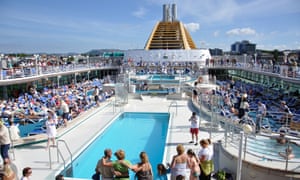
| Breath of fresh air? Passengers on the sundeck of P&O’s Oceana. Photograph: Greg Balfour Evans/Alamy |
A C4 Dispatches investigation reveals how ultra-fine particles emitted by cruise liners’ engines are worrying both medical scientists and environmentalists
Passengers on cruise ships could be exposing themselves to dangerous levels of pollution, according to an investigation by Channel 4’s Dispatches team that found some public areas on the ships’ decks were more polluted than the world’s worst-affected cities.
The undercover investigation, which will be broadcast tonight at 8pm, focused on the levels of “ultra-fine particles” found in the air on and around cruise ships, from the fuel the ships’ engines burn. These particles are so small – around a thousandth of the width of a human hair – that they can enter the bloodstream via the lungs.
More than 1.9 million people from the UK travel on a cruise each year and there is growing concern among the scientific community about the health risks.
Dispatches used a P-Trak ultrafine particle counter to measure the ultra-fine particulates suspended in the air on board P&O Cruises’ ship Oceana. The Oceana is more than 250 metres long, 15 storeys high and can carry more than 2,000 passengers.
The device found 84,000 ultra-fine particulates per cubic centimetre on the deck downwind of, and directly next to, the Oceana’s funnels. That’s more than double the amount found at London’s Piccadilly Circus, where the number of ultra-fine particulates per cubic centimetre was 38,400.
Speaking to the Guardian, Dr Matthew Loxham, a specialist in air pollution at the University of Southampton, said these were the levels of pollution you would expect to find in cities such as Delhi or Shanghai. As for the health risks, there is, he says, cause for concern.
“From a scientific point of view, we know that pollution causes adverse health effects even in the short term,” he said. “On a ship deck, you’re exposed to higher levels of pollution so you may get symptoms such as runny nose, cough, dry eyes or a higher risk of asthma attacks. For those that are predisposed, there may be a higher risk of stroke or heart attack.”
However he added that it is difficult to quantify the increase in risk for individual passengers.
“If you had a large enough number of people, you would be likely to see a quantifiable increase,” he said. “But it’s difficult to say with individuals. Asthmatics, particularly, might find it harder to breath, need their medication more, or find the air triggers an asthma attack.”
Large ships run on heavy fuel oil, which is legally permitted to contain 3.5% sulphur – that’s 3,500 times what is permitted in road fuel. In EU ports and waters, ships are legally required to switch to a cleaner diesel, but even this, capped at 0.1% sulphur, is allowed to contain up to 100 times more sulphur than road fuel.
Loxham said: “If the cruise ships are complying with the law and there is still this level of pollutants, the question really is: are these laws fit for purpose?”
As well as impacting on the health of passengers, crew and those who live beside docks, cruise ships are also having an impact on the global environment.
John Maggs, president of the Clean Shipping Coalition, told Dispatches: “Most large ships burn heavy fuel oil. It’s a residual product from the refining industry, so after the refiners have produced the petrol and diesel we put in our cars, they’re left with what is essentially a waste product. It’s called residual fuel, or heavy fuel oil.”
From an environmental point of view, it’s bad because of the air pollution caused by the very high sulphur content. The shipping industry, however, has traditionally liked it because it’s much cheaper than other fuels.”
Also speaking to the Dispatch team, Daniel Rieger of the German environment association NABU (Nature And Biodiversity Conservation Union) said: “Ships cause not only greenhouse gas emissions, but also sulphur oxides, nitrogen oxides and particulate matter. Per day one cruise ship emits as much particulate matter as a million cars. So 30 cruise ships pollute as much as all the cars in the United Kingdom.”
Responding to the Dispatches team, P&O Cruises said: “Since 2005 we have reduced our fuel consumption by … 28%, with the accompanying reduction in air emissions.”
It added that the Oceana is to be fitted with exhaust gas cleaning systems, which are already “installed on 60 ships across its brands… This action significantly improves the quality of air emissions… Soot and particulate matter reductions in excess of 80% have been achieved.”
P&O also said that in 2014 it had reduced CO2 emissions by 20% and “has renewed its goal to continue reducing the rate”.
It said: “The health, safety and welfare of guests and crew across all our ships is our absolute highest priority… We recognise that there is a public interest… related to particulate matter and related health issues”.
By Will Coldwell
By Will Coldwell

