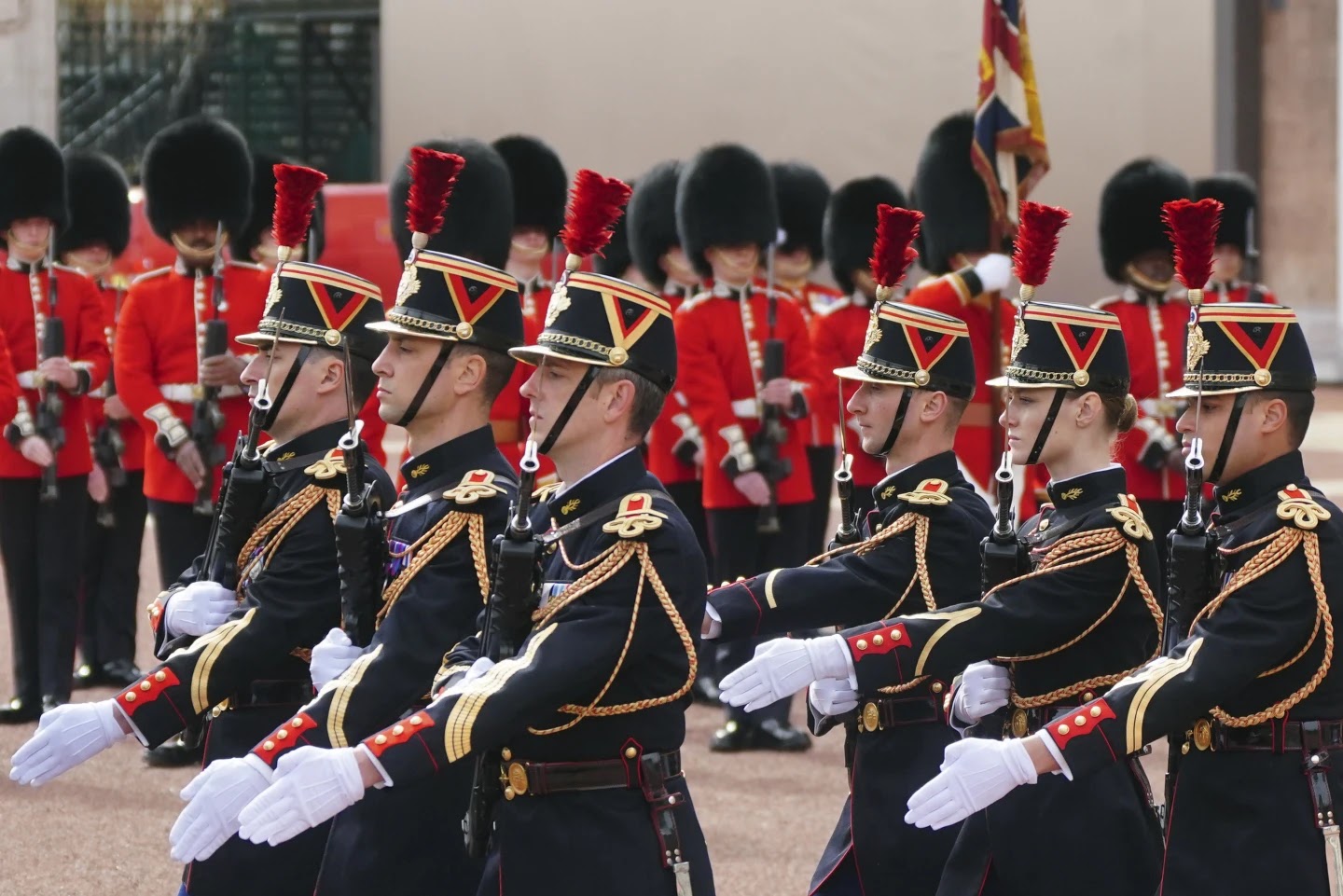
French troops joined their British counterparts in the famous Changing of the Guard ceremony outside Buckingham Palace for the first time Monday, marching together in a display of solidarity between Britain and France amid the war in Ukraine.
At a parallel ceremony in Paris, British soldiers wearing tall bearskin hats took part in an unprecedented joint military parade in front of the presidential Elysée Palace, as the French army choir sang the two national anthems, “God Save the King” and “La Marseillaise.”
The twin events were to celebrate the 120th anniversary of the Entente Cordiale, the 1904 diplomatic agreement between Britain and France that paved the way for their collaboration in both World War I and World War II.
In a video message posted on social media on Monday, French President Emmanuel Macron said the alliance serves as a foundation for deepening Anglo-French relations particularly at a time of the return of war.
“Our Entente Cordiale remains as relevant as ever,” Macron said. “Faced with the resurgence of war in Europe, we stand together to defend the values we share and to support Ukraine as it defends itself against its aggressor.”
British Foreign Secretary David Cameron and his French counterpart, Stéphane Séjourné, used a joint opinion piece published Monday in the Daily Telegraph to urge allies to boost funding for Ukraine.
“It is not for France and Britain alone to solve these challenges. But, together, we can rally others to join us in overcoming them,” they wrote. “We must do even more to ensure we defeat Russia. The world is watching – and will judge us if we fail.”
Prince Edward and his wife Sophie inspected the joint parade in London, which included 32 members of the Gendarmerie’s Garde Républicaine and 40 guardsmen from the Scots Guards. Edward and Sophie were representing King Charles III, who is continuing his cancer treatment and was not at Buckingham Palace.
It was the first time a country that isn’t part of the Commonwealth group of nations has taken part in the traditional Changing of the Guard ceremony, though the French troops did not participate in guarding the royal residence — a ceremonial duty that can only be performed by U.K. or Commonwealth troops.
In Paris, 16 members of the Coldstream Guards were the first foreign troops ever to take part in guarding the French presidential residence.
Britain and France said Monday’s ceremonies were part of a wider program this year to celebrate the two countries’ historic military and diplomatic ties. This includes major events in Normandy in June to commemorate the service of Allied veterans who fought to liberate France from Nazi occupation.
Last year, King Charles chose France as the destination for his first foreign visit after becoming monarch. The state visit, which was planned for March but was postponed to September amid large demonstrations in France, was a statement underlining the ties between the two countries.
BY SYLVIA HUI
Monday, April 8, 2024
Sunday, April 7, 2024
Israeli Favorite Ryanair Set To Resume Flights To Israel
A favorite airline among Israelis has announced it will resume flights to and from the Jewish state this summer, just a few weeks after the company said it would not return until the fall.
Low-cost Irish airline Ryanair said flights to and from Israel’s Ben Gurion Airport will resume on June 2, the Israel Airports Authority said on Thursday. The airline is set to open 20 flights per week, going to places such as Berlin, Budapest, and Paphos, among others.
Ryanair is especially popular among Israelis due to its extremely low costs compared to major airline companies. In many cases flights can cost under $60 roundtrip, without checked baggage.
The decision by Ryanair comes as many airlines have begun resuming flights to Israel.
Most airlines canceled flights to the Jewish state shortly following Hamas’ Oct. 7 massacre across southern Israel due to the ensuing war in Gaza.
Last month, Delta Air Lines announced that it would resume nonstop flights on June 7, saying it will continue to “closely monitor the situation in Israel in conjunction with government and private-sector partners.”
Airlines such as Air France and Etihad Airways, among others, have also resumed flights to Israel, though with fewer than before the war. The lack of international options has burdened Israelis due to rising costs, in some cases 50-100 percent more expensive than before Oct. 7.
Due to the high costs, short supply of flights, and fear by some people to fly to Israel, tourist entries into the country are much lower than in years past. For example, January 2024 saw 59,000 tourists enter the country versus 271,000 in the same month last year.
https://www.algemeiner.com/author/fritzhand
Low-cost Irish airline Ryanair said flights to and from Israel’s Ben Gurion Airport will resume on June 2, the Israel Airports Authority said on Thursday. The airline is set to open 20 flights per week, going to places such as Berlin, Budapest, and Paphos, among others.
Ryanair is especially popular among Israelis due to its extremely low costs compared to major airline companies. In many cases flights can cost under $60 roundtrip, without checked baggage.
The decision by Ryanair comes as many airlines have begun resuming flights to Israel.
Most airlines canceled flights to the Jewish state shortly following Hamas’ Oct. 7 massacre across southern Israel due to the ensuing war in Gaza.
Last month, Delta Air Lines announced that it would resume nonstop flights on June 7, saying it will continue to “closely monitor the situation in Israel in conjunction with government and private-sector partners.”
Airlines such as Air France and Etihad Airways, among others, have also resumed flights to Israel, though with fewer than before the war. The lack of international options has burdened Israelis due to rising costs, in some cases 50-100 percent more expensive than before Oct. 7.
Due to the high costs, short supply of flights, and fear by some people to fly to Israel, tourist entries into the country are much lower than in years past. For example, January 2024 saw 59,000 tourists enter the country versus 271,000 in the same month last year.
https://www.algemeiner.com/author/fritzhand
Saturday, April 6, 2024
UK Airports Given More Time To Get New Scanners In Place That Will Lift Liquid Restrictions
Drink it or bin it: That phrase should have become history this summer at all U.K. airports.
But it’s set to persist for at least another year after the British government said it will grant extensions to several large U.K. airports unable to meet the June 1 deadline to fully install new scanning technology. The airports include London’s two biggest, Heathrow and Gatwick.
The new scanners use computed tomography, commonly known as a CT scan, to produce clearer images. They are being rolled out globally, including in the U.S. and across Europe, and will allow passengers to go through security with two liters (70 ounces) of liquid in their hand luggage — rather than the current paltry 100 milliliters (3.5 ounces).
They will also mean laptops and tablets won’t need to be removed from bags — saving even more time.
The restrictions were introduced around the world in 2006 following a foiled terror plot to blow up planes flying from London to the U.S. with homemade liquid bombs. They were not expected to be in place for 18 years and have been cited as one of, if not the, biggest cause of delays at airport security checks.
A deadline for the new technology to be in place at U.K. airports had originally been set for Dec. 2022 but that was delayed to this summer as a result of the huge disruption caused by the coronavirus pandemic.
The new deadline comes after airports reported that they were struggling to install the scanners ahead of the busy summer holiday period, largely due to supply chain delays and construction difficulties caused by the weight of the machines.
The Department for Transport said the extensions will be granted on a case by case basis and that it was exploring how financial penalties could be imposed for further non-compliance.
It did not provide a breakdown of the situation for each airport, citing security concerns, but said that by the start of June about half of passengers flying from U.K. airports will be processed by the new scanners. London City Airport, a popular short-haul airport, has already successfully introduced the new scanners, as has Teeside Airport in the northeast of England.
“These cutting-edge scanners will make air travel safer and easier for passengers by strengthening security even further,” said Transport Secretary Mark Harper.
“The U.K. is leading the world with its rollout of this technology, but it’s important we give those airports yet to meet the deadline a second chance to get the job done. Until they do, passengers should continue to check before travelling.”
Heathrow has previously said it expects to have new scanners in all security lanes sometime this summer, while Gatwick expects to complete the program by the end of March next year. Manchester Airports Group, which runs Manchester, East Midlands and London Stansted airports, said its scanners will be fully rolled out in 2025.
“Airports are making excellent progress in delivering these multi-million-pound investment programmes, which will ensure the U.K. remains at the forefront of aviation security in the years ahead,” said Karen Dee, chief executive of the trade body Airport Operators Association.
Naomi Leach, deputy editor of consumer magazine Which? Travel, said passengers leaving the U.K. should be warned about potential problems and delays ahead as different rules will apply at different airports.
“It’s imperative that these changes are made as quickly as possible and that the rules at different airports are communicated clearly to passengers in the meantime,” she said.
If not, it’s going to be heard again.
Drink it or bin it.
BY PAN PYLAS, AP
But it’s set to persist for at least another year after the British government said it will grant extensions to several large U.K. airports unable to meet the June 1 deadline to fully install new scanning technology. The airports include London’s two biggest, Heathrow and Gatwick.
The new scanners use computed tomography, commonly known as a CT scan, to produce clearer images. They are being rolled out globally, including in the U.S. and across Europe, and will allow passengers to go through security with two liters (70 ounces) of liquid in their hand luggage — rather than the current paltry 100 milliliters (3.5 ounces).
They will also mean laptops and tablets won’t need to be removed from bags — saving even more time.
The restrictions were introduced around the world in 2006 following a foiled terror plot to blow up planes flying from London to the U.S. with homemade liquid bombs. They were not expected to be in place for 18 years and have been cited as one of, if not the, biggest cause of delays at airport security checks.
A deadline for the new technology to be in place at U.K. airports had originally been set for Dec. 2022 but that was delayed to this summer as a result of the huge disruption caused by the coronavirus pandemic.
The new deadline comes after airports reported that they were struggling to install the scanners ahead of the busy summer holiday period, largely due to supply chain delays and construction difficulties caused by the weight of the machines.
The Department for Transport said the extensions will be granted on a case by case basis and that it was exploring how financial penalties could be imposed for further non-compliance.
It did not provide a breakdown of the situation for each airport, citing security concerns, but said that by the start of June about half of passengers flying from U.K. airports will be processed by the new scanners. London City Airport, a popular short-haul airport, has already successfully introduced the new scanners, as has Teeside Airport in the northeast of England.
“These cutting-edge scanners will make air travel safer and easier for passengers by strengthening security even further,” said Transport Secretary Mark Harper.
“The U.K. is leading the world with its rollout of this technology, but it’s important we give those airports yet to meet the deadline a second chance to get the job done. Until they do, passengers should continue to check before travelling.”
Heathrow has previously said it expects to have new scanners in all security lanes sometime this summer, while Gatwick expects to complete the program by the end of March next year. Manchester Airports Group, which runs Manchester, East Midlands and London Stansted airports, said its scanners will be fully rolled out in 2025.
“Airports are making excellent progress in delivering these multi-million-pound investment programmes, which will ensure the U.K. remains at the forefront of aviation security in the years ahead,” said Karen Dee, chief executive of the trade body Airport Operators Association.
Naomi Leach, deputy editor of consumer magazine Which? Travel, said passengers leaving the U.K. should be warned about potential problems and delays ahead as different rules will apply at different airports.
“It’s imperative that these changes are made as quickly as possible and that the rules at different airports are communicated clearly to passengers in the meantime,” she said.
If not, it’s going to be heard again.
Drink it or bin it.
BY PAN PYLAS, AP
Friday, April 5, 2024
Klaus Mäkelä, Just 28, To Become Chicago Symphony Orchestra Music Director In 2027
Klaus Mäkelä was hired Tuesday to succeed Riccardo Muti as music director of the Chicago Symphony Orchestra and will become the youngest head since its start in 1891.
A Finn who turned 28 in January, Mäkelä has had an astonishing rise in the music world, becoming principal guest conductor of the Swedish Radio Symphony Orchestra in 2018-19, then chief conductor of the Oslo Philharmonic in 2020-21 and music director of the Orchestre de Paris in 2021-22. He is to start a five-year term as chief conductor the Royal Concertgebouw Orchestra in the Netherlands in 2027-28 after his contracts in Norway and France expire.
Mäkelä will become CSO music director designate immediately and start a five-year tenure in 2027-28, conducting a minimum 14 weeks per season. Mäkelä will be the youngest U.S. music director with a major orchestra since Gustavo Dudamel was 28 when he started with the Los Angeles Philharmonic in 2009.
“It’s just something which I don’t think about,” Mäkelä said during an interview with The Associated Press. “I was just reminded when I started in Amsterdam that I’m actually not even young, (Willem) Mengelberg was 24 when he started.”
Muti was music director for 13 seasons before stepping down last summer ahead of his 82nd birthday. Mäkelä will be 31 years, seven months, 16 days when he starts on Sept. 1, 2027. The previous youngest head of the orchestra was Frederick Stock at 32 years, 5 months, 1 day when he was hired on April 11, 1905, to succeed founding music director Theodore Thomas.
Mäkelä will take over an orchestra far older than he is. Among 93 members, Muti made 32 appointments and Daniel Barenboim 28, with most of the remainder by Georg Solti. Principal trombone Jay Friedman and harpist Lynne Turner were hired by Fritz Reiner, music director from 1953-62.
“What I like about Chicago Symphony is there is quite a big part of it which still sounds like it sounded with Reiner,” Mäkelä said.
He first led the CSO in April 2022 in a program that included Stravinsky’s “The Firebird.”
“When you conduct an orchestra for the first time, it’s somehow a chemistry thing,” Mäkelä said. “I felt that, OK, this orchestra they were willing to go to places with me which I had not had done with other orchestras.”
CSO president Jeff Alexander attended the first rehearsal.
“You said, ‘Good morning. Let’s begin’ and went right into the music,” Alexander recalled during a joint interview. “Very often a guest conductor will talk and talk and talk about the piece, but I think the musicians appreciated just getting to work. So I stayed for the first 10 or 15 minutes and I can tell you I already felt there was something really special happening.”
Mäkelä returned in February 2023 for Mahler’s Fifth Symphony. Alexander then started negotiations. The announcement was timed ahead of Mäkelä‘s performances with the CSO this week that include Shostakovich’s 10th Symphony.
“When you see Klaus conduct, there’s such a connection between him and the orchestra, and you can just feel it, and then between him and the audience,” Alexander said.
Mäkelä's hiring comes at a time when several other major U.S. institutions have upcoming podium vacancies, including the Cleveland Orchestra, Los Angeles Philharmonic, Los Angeles Opera and San Francisco Symphony Orchestra. As music director of a U.S. orchestra, Mäkelä’s role will include a fundraising component.
“I don’t think it will actually be so drastically different from the work in Amsterdam and in Paris,” he said. “In Oslo we have 100% of the funding is from the state and zero is private but then already in Amsterdam it’s 50-50 and there’s a lot of work to be done, and it’s also very much in my interest because then we can achieve things together if we find the right partnerships.”
Mäkelä played cello as a child — his father was a cello teacher and his mother a piano instructor. He remembers attending concerts given by Finnish conductor Hannu Lintu in Helsinki and decided his future vocation when he was 7 and singing in the children’s chorus at the Finnish National Opera in Bizet’s “Carmen.” He was riveted while watching the conductor on a backstage monitor.
“It sounds like a silly story, but it’s really true — from that moment,” Mäkelä said.
Studying cello at the Sibelius Academy, he took a conducting class with Jorma Panula, whose pupils have included Esa-Pekka Salonen and Susanna Mälkki. He was first included as a Helsinki Philharmonic cellist when he was 15, then was asked to conduct. He first conducted the Oslo Philharmonic in May 2018, and a string of debuts followed. He made his first Berlin Philharmonic appearance in April 2023 and is to make his Vienna Philharmonic debut this December. Decca Classics signed him as an exclusive recording artist in 2021, a rarity in 21st century classical music.
With all the symphonic work, Mäkelä has found little time for opera, where one-to-two-month stays are the norm.
He lives in Helsinki but hadn’t been there this year until late March. Mäkelä spends most of his time in Paris and Oslo, and getting scores to the right location proves time-consuming.
“I have FedEx and DHL and UPS all the time, and of course I always forget the score,” he said. “I want to have my own scores because I write things.”
He already is thinking about his initial programs in Chicago.
“It needs to be something which is a very clear start, a clear new chapter,” he said. “It needs to be music which keeps both me and the orchestra a little bit on our toes, because this needs to be everything else than comfort zone.”
BY RONALD BLUM, AP
A Finn who turned 28 in January, Mäkelä has had an astonishing rise in the music world, becoming principal guest conductor of the Swedish Radio Symphony Orchestra in 2018-19, then chief conductor of the Oslo Philharmonic in 2020-21 and music director of the Orchestre de Paris in 2021-22. He is to start a five-year term as chief conductor the Royal Concertgebouw Orchestra in the Netherlands in 2027-28 after his contracts in Norway and France expire.
Mäkelä will become CSO music director designate immediately and start a five-year tenure in 2027-28, conducting a minimum 14 weeks per season. Mäkelä will be the youngest U.S. music director with a major orchestra since Gustavo Dudamel was 28 when he started with the Los Angeles Philharmonic in 2009.
“It’s just something which I don’t think about,” Mäkelä said during an interview with The Associated Press. “I was just reminded when I started in Amsterdam that I’m actually not even young, (Willem) Mengelberg was 24 when he started.”
Muti was music director for 13 seasons before stepping down last summer ahead of his 82nd birthday. Mäkelä will be 31 years, seven months, 16 days when he starts on Sept. 1, 2027. The previous youngest head of the orchestra was Frederick Stock at 32 years, 5 months, 1 day when he was hired on April 11, 1905, to succeed founding music director Theodore Thomas.
Mäkelä will take over an orchestra far older than he is. Among 93 members, Muti made 32 appointments and Daniel Barenboim 28, with most of the remainder by Georg Solti. Principal trombone Jay Friedman and harpist Lynne Turner were hired by Fritz Reiner, music director from 1953-62.
“What I like about Chicago Symphony is there is quite a big part of it which still sounds like it sounded with Reiner,” Mäkelä said.
He first led the CSO in April 2022 in a program that included Stravinsky’s “The Firebird.”
“When you conduct an orchestra for the first time, it’s somehow a chemistry thing,” Mäkelä said. “I felt that, OK, this orchestra they were willing to go to places with me which I had not had done with other orchestras.”
CSO president Jeff Alexander attended the first rehearsal.
“You said, ‘Good morning. Let’s begin’ and went right into the music,” Alexander recalled during a joint interview. “Very often a guest conductor will talk and talk and talk about the piece, but I think the musicians appreciated just getting to work. So I stayed for the first 10 or 15 minutes and I can tell you I already felt there was something really special happening.”
Mäkelä returned in February 2023 for Mahler’s Fifth Symphony. Alexander then started negotiations. The announcement was timed ahead of Mäkelä‘s performances with the CSO this week that include Shostakovich’s 10th Symphony.
“When you see Klaus conduct, there’s such a connection between him and the orchestra, and you can just feel it, and then between him and the audience,” Alexander said.
Mäkelä's hiring comes at a time when several other major U.S. institutions have upcoming podium vacancies, including the Cleveland Orchestra, Los Angeles Philharmonic, Los Angeles Opera and San Francisco Symphony Orchestra. As music director of a U.S. orchestra, Mäkelä’s role will include a fundraising component.
“I don’t think it will actually be so drastically different from the work in Amsterdam and in Paris,” he said. “In Oslo we have 100% of the funding is from the state and zero is private but then already in Amsterdam it’s 50-50 and there’s a lot of work to be done, and it’s also very much in my interest because then we can achieve things together if we find the right partnerships.”
Mäkelä played cello as a child — his father was a cello teacher and his mother a piano instructor. He remembers attending concerts given by Finnish conductor Hannu Lintu in Helsinki and decided his future vocation when he was 7 and singing in the children’s chorus at the Finnish National Opera in Bizet’s “Carmen.” He was riveted while watching the conductor on a backstage monitor.
“It sounds like a silly story, but it’s really true — from that moment,” Mäkelä said.
Studying cello at the Sibelius Academy, he took a conducting class with Jorma Panula, whose pupils have included Esa-Pekka Salonen and Susanna Mälkki. He was first included as a Helsinki Philharmonic cellist when he was 15, then was asked to conduct. He first conducted the Oslo Philharmonic in May 2018, and a string of debuts followed. He made his first Berlin Philharmonic appearance in April 2023 and is to make his Vienna Philharmonic debut this December. Decca Classics signed him as an exclusive recording artist in 2021, a rarity in 21st century classical music.
With all the symphonic work, Mäkelä has found little time for opera, where one-to-two-month stays are the norm.
He lives in Helsinki but hadn’t been there this year until late March. Mäkelä spends most of his time in Paris and Oslo, and getting scores to the right location proves time-consuming.
“I have FedEx and DHL and UPS all the time, and of course I always forget the score,” he said. “I want to have my own scores because I write things.”
He already is thinking about his initial programs in Chicago.
“It needs to be something which is a very clear start, a clear new chapter,” he said. “It needs to be music which keeps both me and the orchestra a little bit on our toes, because this needs to be everything else than comfort zone.”
BY RONALD BLUM, AP
Thursday, April 4, 2024
Edelweiss To Launch Airbus A350 Service, Initially To Las Vegas And Vancouver
Edelweiss will debut Airbus A350 service in Switzerland, with the first of six aircraft joining the fleet in April 2025.
Las Vegas and Vancouver are the initial long-haul destinations for the Airbus A350, with flights commencing from mid-May 2025. Ticket bookings for Airbus A350 long-haul flights will open from mid-May 2024.
The environmentally friendly Airbus A350-900, replacing older A340-300s, boasts cutting-edge technology for increased efficiency and reduced emissions, consuming 25% less fuel and emitting 25% less CO2
By André Orban
Las Vegas and Vancouver are the initial long-haul destinations for the Airbus A350, with flights commencing from mid-May 2025. Ticket bookings for Airbus A350 long-haul flights will open from mid-May 2024.
The environmentally friendly Airbus A350-900, replacing older A340-300s, boasts cutting-edge technology for increased efficiency and reduced emissions, consuming 25% less fuel and emitting 25% less CO2
By André Orban
Wednesday, April 3, 2024
Sullenberger Aviation Museum In Charlotte, North Carolina, Announces June 1 Opening Date
Sullenberger Aviation Museum, the premier aviation museum of the Southeast, announced today it will officially open its doors to the public on Saturday, June 1, at 10 a.m. Capt. C.B. "Sully" Sullenberger, who, along with his crew, maneuvered the famed "Miracle on the Hudson" landing – and for whom the Museum is named – will be in Charlotte to celebrate during a week of opening activities.
The Museum will be open Tuesday through Saturday from 10 a.m. to 4:30 p.m., and Sunday from noon to 4:30 p.m., except Thanksgiving Day, Christmas Day, and New Year's Day. A limited number of tickets for opening day (June 1) are now available for purchase at a special rate of $5 per ticket. Tickets for all other dates through Labor Day have also been released for sale. Regular admission prices are $24 for adults; $20 for seniors, veterans, military, and educators; and $18 for students (ages 5 to 17). Members and children under five are always free. Tickets can be purchased here: https://www.sullenbergeraviation.org/buy-tickets/.
In addition, memberships for the Museum's Frequent Flyer Program are now available. Annual membership costs range from $75 for an Individual membership to $200 for a Family Plus package, which includes free admission for two adults, a caregiver, and up to six children. Perks of membership include free admission for 12 months, free parking, early registration for camps and workshops, and discounts on select events, programs, and merchandise.
The Museum will also offer a Welcome program designed for individuals receiving SNAP/EBT benefits. After opening day, tickets will be available for advance or onsite purchase for $3 per person. A valid SNAP/EBT card will be required for entry. A reduced-price membership is also available through the website for $30 for a Family Plus Welcome membership good for 12 months. Welcome Members will be asked to show a valid SNAP/EBT card the first time they use their membership.
"Charter Members," those who purchase any level of membership before April 30, 2024, will receive six additional months of membership and an invitation to a sneak peek event at the Museum before the doors open to the public.
When it opens, Sullenberger Aviation Museum will be one of the world's leading institutions honoring and exploring the wonder of flight. But it's more than just a collection of historic aircraft. Through its expanded mission, the Museum will serve as a vehicle of opportunity to inspire, educate, and elevate the next generation of innovators. Equitable access to career exploration in fields related to science, technology, engineering, and math (STEM) are critical to driving innovation and economic growth in the Charlotte region. A primary focus of the Museum will be providing transformative experiences and opportunities to communities who have traditionally been underrepresented in the aviation industry, especially women and people of color.
"After years of hard work and dedication from our incredible staff and Board of Directors, as well as an unwavering belief in our mission from generous corporate donors, individual donors, and elected officials, we could not be more excited to open the doors to Sullenberger Aviation Museum," said Museum Board Chair Tim Miller. "This project would not have been possible without the support of our volunteers, especially our Board Chair Emeritus Marc Oken, who cast a new vision, assembled an amazing team, and led the Museum's $34 million fundraising effort."
Museum President Stephen Saucier added, "Our reimagined galleries and immersive storytelling encompass much more than a new facility, as we now have the privilege to serve as a convener of opportunity, advancing equity and access to careers in aviation throughout the Carolinas and beyond. We look forward to welcoming curious lifelong learners of all ages through our doors in just a few short months."
Sullenberger Aviation Museum is especially committed to accessibility and will offer wheelchair-accessible exhibits and sensory-friendly backpacks so that everyone can explore the wonder of flight. The Museum will also foster access through its Flight Forward program, a consortium of North Carolina aviation industry and educational professionals, several colleges and universities, trade schools, and workforce development groups. This workforce collaborative will work together to create strategic opportunities for student training, networking, and recruitment across STEM-based fields.
From an exhibition standpoint, the Museum will feature three thematic areas:
-- Innovation Nation will explore the risks, failures, and triumphs that have advanced aviation. This area features replicas of the Wright Brothers' Flyer and Glider planes, a Vietnam-era F-4S Phantom II, one of only two manufactured Skystreak planes used to test breaking the sound barrier, and a P-80 (TV-1 Shooting Star), one of the first jet fighters used during combat, to name a few.
Innovation Nation will also house the A320 from US Airways Flight 1549, better known as the "Miracle on the Hudson," and a corresponding exhibit. Flight 1549 has been part of the Museum's collection since 2011, but when the Museum reopens it will include new artifacts and mementos, including letters from passengers to Capt. Sullenberger.
-- In the Aviation Society exhibition, guests will be introduced to the diverse group of people who contribute to the aviation industry locally and globally. In addition to these personal narratives, the area features an F-14 that is rumored to have made an appearance on the tarmac in "Top Gun," an ERCO Ercoupe, an American Champion Citabria, and more iconic aircraft.
-- The Museum will open its final thematic area, called Aviation City, later this fall. Aviation City will live in the Museum's historic WPA/Douglas hangar and will survey the economic and cultural development of Charlotte and the Carolinas' past, present and future. This area features an F-84 Thunderjet, a Stearman biplane, and a Lockheed T-33, among others.
Each thematic area will feature hands-on, interactive activities like flight simulators, wind tunnels, photobooths, and games appropriate for guests of all ages. The Museum also features a makerspace where visitors can explore, design, and problem-solve via hands-on learning experiences and tools, including a paper airplane launcher and target, 3D printers, cardboard engineering, and snap circuits.
For more information and to sign up for museum updates, visit www.sullenbergeraviation.org.
The Museum will be open Tuesday through Saturday from 10 a.m. to 4:30 p.m., and Sunday from noon to 4:30 p.m., except Thanksgiving Day, Christmas Day, and New Year's Day. A limited number of tickets for opening day (June 1) are now available for purchase at a special rate of $5 per ticket. Tickets for all other dates through Labor Day have also been released for sale. Regular admission prices are $24 for adults; $20 for seniors, veterans, military, and educators; and $18 for students (ages 5 to 17). Members and children under five are always free. Tickets can be purchased here: https://www.sullenbergeraviation.org/buy-tickets/.
In addition, memberships for the Museum's Frequent Flyer Program are now available. Annual membership costs range from $75 for an Individual membership to $200 for a Family Plus package, which includes free admission for two adults, a caregiver, and up to six children. Perks of membership include free admission for 12 months, free parking, early registration for camps and workshops, and discounts on select events, programs, and merchandise.
The Museum will also offer a Welcome program designed for individuals receiving SNAP/EBT benefits. After opening day, tickets will be available for advance or onsite purchase for $3 per person. A valid SNAP/EBT card will be required for entry. A reduced-price membership is also available through the website for $30 for a Family Plus Welcome membership good for 12 months. Welcome Members will be asked to show a valid SNAP/EBT card the first time they use their membership.
"Charter Members," those who purchase any level of membership before April 30, 2024, will receive six additional months of membership and an invitation to a sneak peek event at the Museum before the doors open to the public.
When it opens, Sullenberger Aviation Museum will be one of the world's leading institutions honoring and exploring the wonder of flight. But it's more than just a collection of historic aircraft. Through its expanded mission, the Museum will serve as a vehicle of opportunity to inspire, educate, and elevate the next generation of innovators. Equitable access to career exploration in fields related to science, technology, engineering, and math (STEM) are critical to driving innovation and economic growth in the Charlotte region. A primary focus of the Museum will be providing transformative experiences and opportunities to communities who have traditionally been underrepresented in the aviation industry, especially women and people of color.
"After years of hard work and dedication from our incredible staff and Board of Directors, as well as an unwavering belief in our mission from generous corporate donors, individual donors, and elected officials, we could not be more excited to open the doors to Sullenberger Aviation Museum," said Museum Board Chair Tim Miller. "This project would not have been possible without the support of our volunteers, especially our Board Chair Emeritus Marc Oken, who cast a new vision, assembled an amazing team, and led the Museum's $34 million fundraising effort."
Museum President Stephen Saucier added, "Our reimagined galleries and immersive storytelling encompass much more than a new facility, as we now have the privilege to serve as a convener of opportunity, advancing equity and access to careers in aviation throughout the Carolinas and beyond. We look forward to welcoming curious lifelong learners of all ages through our doors in just a few short months."
Sullenberger Aviation Museum is especially committed to accessibility and will offer wheelchair-accessible exhibits and sensory-friendly backpacks so that everyone can explore the wonder of flight. The Museum will also foster access through its Flight Forward program, a consortium of North Carolina aviation industry and educational professionals, several colleges and universities, trade schools, and workforce development groups. This workforce collaborative will work together to create strategic opportunities for student training, networking, and recruitment across STEM-based fields.
From an exhibition standpoint, the Museum will feature three thematic areas:
-- Innovation Nation will explore the risks, failures, and triumphs that have advanced aviation. This area features replicas of the Wright Brothers' Flyer and Glider planes, a Vietnam-era F-4S Phantom II, one of only two manufactured Skystreak planes used to test breaking the sound barrier, and a P-80 (TV-1 Shooting Star), one of the first jet fighters used during combat, to name a few.
Innovation Nation will also house the A320 from US Airways Flight 1549, better known as the "Miracle on the Hudson," and a corresponding exhibit. Flight 1549 has been part of the Museum's collection since 2011, but when the Museum reopens it will include new artifacts and mementos, including letters from passengers to Capt. Sullenberger.
-- In the Aviation Society exhibition, guests will be introduced to the diverse group of people who contribute to the aviation industry locally and globally. In addition to these personal narratives, the area features an F-14 that is rumored to have made an appearance on the tarmac in "Top Gun," an ERCO Ercoupe, an American Champion Citabria, and more iconic aircraft.
-- The Museum will open its final thematic area, called Aviation City, later this fall. Aviation City will live in the Museum's historic WPA/Douglas hangar and will survey the economic and cultural development of Charlotte and the Carolinas' past, present and future. This area features an F-84 Thunderjet, a Stearman biplane, and a Lockheed T-33, among others.
Each thematic area will feature hands-on, interactive activities like flight simulators, wind tunnels, photobooths, and games appropriate for guests of all ages. The Museum also features a makerspace where visitors can explore, design, and problem-solve via hands-on learning experiences and tools, including a paper airplane launcher and target, 3D printers, cardboard engineering, and snap circuits.
For more information and to sign up for museum updates, visit www.sullenbergeraviation.org.
Tuesday, April 2, 2024
United Airlines Makes A Baggage Change Passengers Will Like
The airline said it is already "seeing an increase in gate and boarding satisfaction."
Particularly on low-cost flights and in the lower fare classes on longer flights, the issue of overhead baggage has become a perpetual struggle for both passengers and airlines.
After airlines started making it more and more expensive to bring a stowed bag on a short flight (mainstream carriers will generally include at least one free suitcase on a transatlantic flight), more passengers have been trying to reduce their expenses by packing all their items into a carry-on and bringing it aboard the plane. While this is a great strategy individually, this creates overhead compartment crowding and leads to airlines having to check the larger overhead bags for free when room runs out.
Air carriers have been looking at different ways to overcome the problem and, on March 26, United Airlines announced that it would be making the overhead bins on some of its newer planes larger. Without specifying the exact dimensions, United said that it would be retrofitting the bins on 50 of its current Embraer E175 jets by the end of 2024.
United Airlines says it is 'helping to eliminate the need to gate check bags'
These planes have 76 seats each and are generally used for shorter, domestic flights (the kind during which anyone not traveling in business or having additional perks through travel or a credit card generally has to pay to stow a suitcase.)
"Customer sentiment for the new overhead bins and signature interiors has been extremely positive," United's Chief Customer Officer Linda Jojo said in a statement. "By helping to eliminate the need to gate check bags, we are seeing an increase in gate and boarding satisfaction."
According to United, this will bring down the number of people who need to check their bags at the gate to one million passengers on over 150,000 E175 flights per year. Jojo further said that they are looking to streamline the baggage rules and "create an industry-leading experience for all our customers, whether they're on an international or regional flight."
Overhead bin issues persist as airlines make checking a bag more expensive
At the end of February, United raised the cost of checking a bag to $35 if booked online at least 24 hours before the flight and $40 if booked at the airport. A second suitcase will cost travelers $50. Those three prices are all a $5 increase from what the airline had been charging for the last four years.
This change was part of a domino effect in which other airlines such as JetBlue Airways, Alaska Airlines and American Airlines all followed each other in increasing their baggage fees.
The reasons for the change stated by the airlines consistently came down to inflation and the rising cost of running an airline but, with checking a bag becoming more and more expensive, there has also been a spike in people looking to fit their belongings into cabin-size bags. Planes, many of which are several decades old, were in turn generally built at a time when more people were able to check bags for free and brought fewer and smaller bags into the cabin.
https://www.thestreet.com/author/veronika-bondarenko
Particularly on low-cost flights and in the lower fare classes on longer flights, the issue of overhead baggage has become a perpetual struggle for both passengers and airlines.
After airlines started making it more and more expensive to bring a stowed bag on a short flight (mainstream carriers will generally include at least one free suitcase on a transatlantic flight), more passengers have been trying to reduce their expenses by packing all their items into a carry-on and bringing it aboard the plane. While this is a great strategy individually, this creates overhead compartment crowding and leads to airlines having to check the larger overhead bags for free when room runs out.
Air carriers have been looking at different ways to overcome the problem and, on March 26, United Airlines announced that it would be making the overhead bins on some of its newer planes larger. Without specifying the exact dimensions, United said that it would be retrofitting the bins on 50 of its current Embraer E175 jets by the end of 2024.
United Airlines says it is 'helping to eliminate the need to gate check bags'
These planes have 76 seats each and are generally used for shorter, domestic flights (the kind during which anyone not traveling in business or having additional perks through travel or a credit card generally has to pay to stow a suitcase.)
"Customer sentiment for the new overhead bins and signature interiors has been extremely positive," United's Chief Customer Officer Linda Jojo said in a statement. "By helping to eliminate the need to gate check bags, we are seeing an increase in gate and boarding satisfaction."
According to United, this will bring down the number of people who need to check their bags at the gate to one million passengers on over 150,000 E175 flights per year. Jojo further said that they are looking to streamline the baggage rules and "create an industry-leading experience for all our customers, whether they're on an international or regional flight."
Overhead bin issues persist as airlines make checking a bag more expensive
At the end of February, United raised the cost of checking a bag to $35 if booked online at least 24 hours before the flight and $40 if booked at the airport. A second suitcase will cost travelers $50. Those three prices are all a $5 increase from what the airline had been charging for the last four years.
This change was part of a domino effect in which other airlines such as JetBlue Airways, Alaska Airlines and American Airlines all followed each other in increasing their baggage fees.
The reasons for the change stated by the airlines consistently came down to inflation and the rising cost of running an airline but, with checking a bag becoming more and more expensive, there has also been a spike in people looking to fit their belongings into cabin-size bags. Planes, many of which are several decades old, were in turn generally built at a time when more people were able to check bags for free and brought fewer and smaller bags into the cabin.
https://www.thestreet.com/author/veronika-bondarenko
Subscribe to:
Posts (Atom)


