Showing posts with label Best cities for art in America. Show all posts

Friday, February 21, 2020

Alexander Calder Will Get A Prime Museum Site On The Benjamin Franklin Parkway In Philadelphia, Across From Barnes And Rodin

"Eagle," a 40 foot sculpture by Alexander Calder on loan to the Philadelphia Museum of Art in 1999 and 2000.
A little more than two decades after a Calder museum was first proposed for the Benjamin Franklin Parkway, the long-dormant idea has blossomed again, funding has materialized, and backers say that, by spring 2021, construction should get underway between 21st and 22nd Streets across from the Barnes Foundation and the Rodin Museum.
Many details of the project, which would feature works by the endlessly inventive Alexander Calder, creator of the mobile, still have to be worked out, but supporters say they are committed for the long haul. Major funders include the Neubauer Family Foundation, the Pew Charitable Trusts, and the estate of H.F. “Gerry” Lenfest.

The works for display, which have not yet been selected, will be lent by the New York-based Calder Foundation for 99 years and would rotate through the Philadelphia facility, known informally as Calder Philadelphia. The art will be displayed in and around a building with a prominent garden.
Herzog & de Meuron, the Pritzker Prize-winning architects behind London’s Tate Modern, have signed on to the project, but no design renderings are yet available.
“We don’t know what we’re going to call it, but it’s not a museum,” said Alexander S.C. Rower, president of the Calder Foundation and grandson of the artist.

“This will involve a different way to engage art than what is usual with a museum,” he said. The idea, Rower said, is to create a more intimate experience for viewers and allow them to get closer to the artwork, free of the restrictions that normally dominate a museum setting.
“The experience is where the art happens,” he said. “This will not be a picture on a wall. This will be a place of introspection.”
He called the new structure and grounds a “sanctuary” as opposed to a museum.
1:18
Joseph Neubauer, trustee of the Neubauer Family Foundation and one of the prime movers for the project, said that Calder’s sculptures, his stabiles and mobiles, would most likely be the defining feature of the facility and grounds.
“You need to be able to walk around it and experience” the sculpture, Neubauer said. “This is all about the individual experience with individual pieces of art.”

Rower said the building and grounds, located on the same two-acre site as the earlier, never-built Calder museum, are envisioned to encourage contemplation. The building will include galleries of some sort.
Neubauer said the size of the structure will be “modest, maybe 15-, 17-, 20,000 square feet, plus the garden."
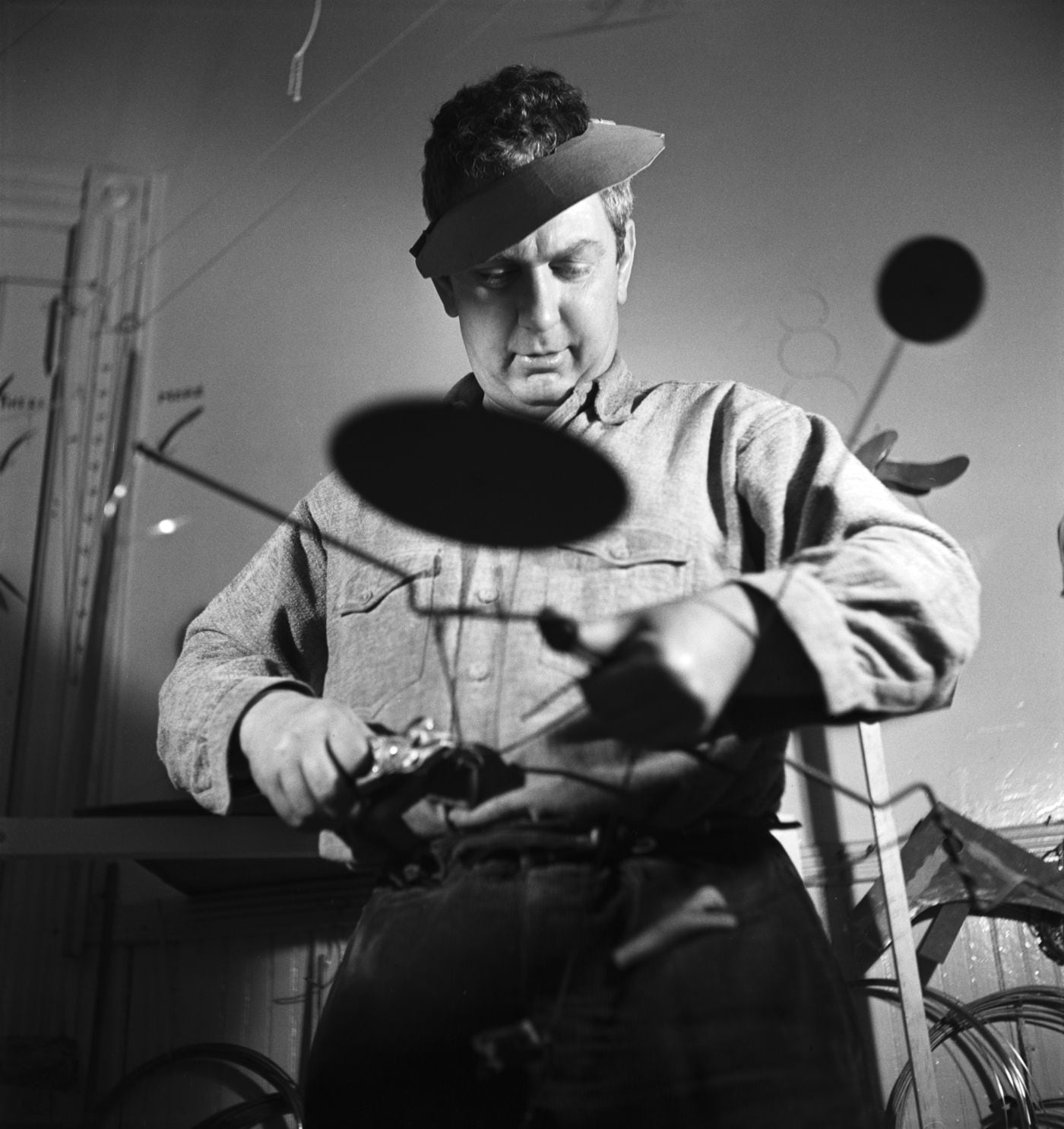
Alexander Calder in his New York City storefront studio, 1936.
IMAGE BY HERBERT MATTER
Alexander Calder in his New York City storefront studio, 1936.
The site will be leased from the city and must go through normal approvals, including a City Council review and approval of the lease agreement. Terms of the agreement have not been set as yet. No city funding is involved in the project. (The site is open space, part of Fairmount Park. PennDot is currently using it as staging for the Vine Street and Chestnut Street reconstructions, but that use is temporary, city officials said.)
“Gardens are very important; you can’t assume they are just simple," Neubauer continued, discussing the configuration of the two-acre site. "This will be very welcoming to the public. We are going to try to activate the block for the public.”
The project, according to Neubauer, will cost about $50 million.
“Most of the money is coming from philanthropy,” he said, including funds from an anonymous donor along with the Neubauer, Pew, and Lenfest contributions. Additional support will come from the state.
The money is almost completely raised, he said, "We’re fairly close.”
Edward G. Rendell, former mayor and governor, who pushed for the initial museum back in 1999, said he found the revival of the idea “very gratifying.”

“There’s no doubt in my mind that Philadelphia is the only place for it,” he said. “Calder’s influence is felt all over the city, particularly in City Hall. This may be the final piece of the puzzle for the Parkway."
Diane Dalto Woosnam, who was Rendell’s deputy city representative for arts and culture and the city’s point person on the first Calder museum plan, said that she believed the site and the city have “always been perfect," adding: "But in true Philly fashion, it took 25 years for everyone to agree.”
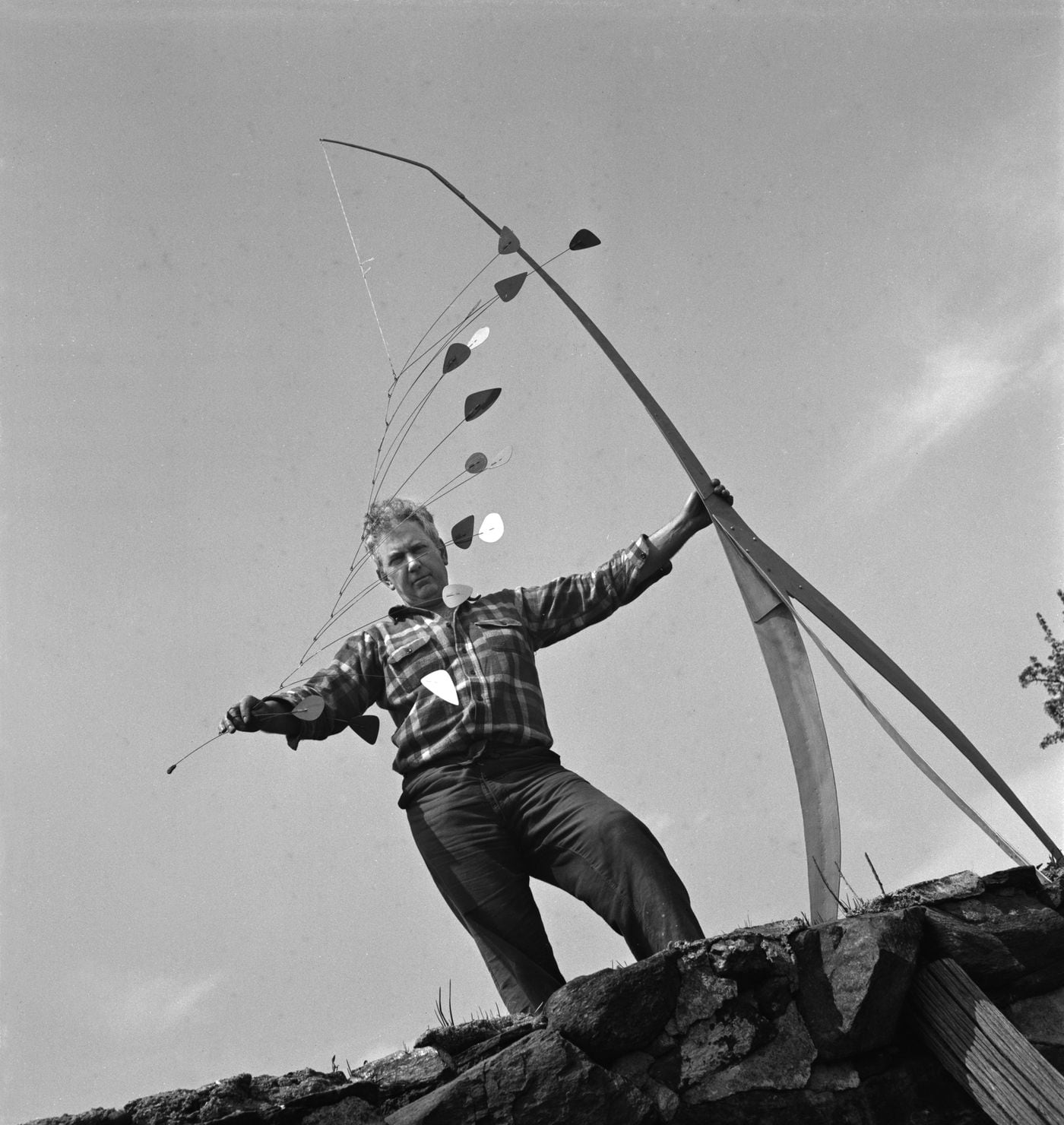
Calder with Giraffe (1941), Roxbury, Conn., 1941. Image by Herbert Matter
COURTESY CALDER FOUNDATION
Calder with Giraffe (1941), Roxbury, Conn., 1941. Image by Herbert Matter
The site of Calder Philadelphia underscores three generations of Calder family artwork along the Parkway as a defining factor on the Philadelphia cityscape. City Hall features the work of Calder’s grandfather Alexander Milne Calder, who created the major sculptures adorning the building, most prominently the statue of William Penn at the top.
Alexander Calder’s father, Alexander Stirling Calder, is famous for designing Swann Fountain on Logan Square a couple of blocks from what will be Calder Philadelphia. And one of Alexander Calder’s most intriguing mobiles, Ghost, hangs above the grand indoor entrance hall of the Philadelphia Museum of Art.
Works from Calder’s father and grandfather will also be featured in the new facility.
“This is a major accomplishment for Philadelphia,” said Rebecca W. Rimel, president and chief executive of the Pew Charitable Trusts. “The artistry of the Calder family is an important part of the fabric of our city. ... A home on the Parkway for some of Calder’s most consequential works will advance the city’s reputation as a world-class arts destination and enhance its appeal to national and international visitors.”
And there are other public works by Alexander Calder within shouting distance of the planned museum’s site.
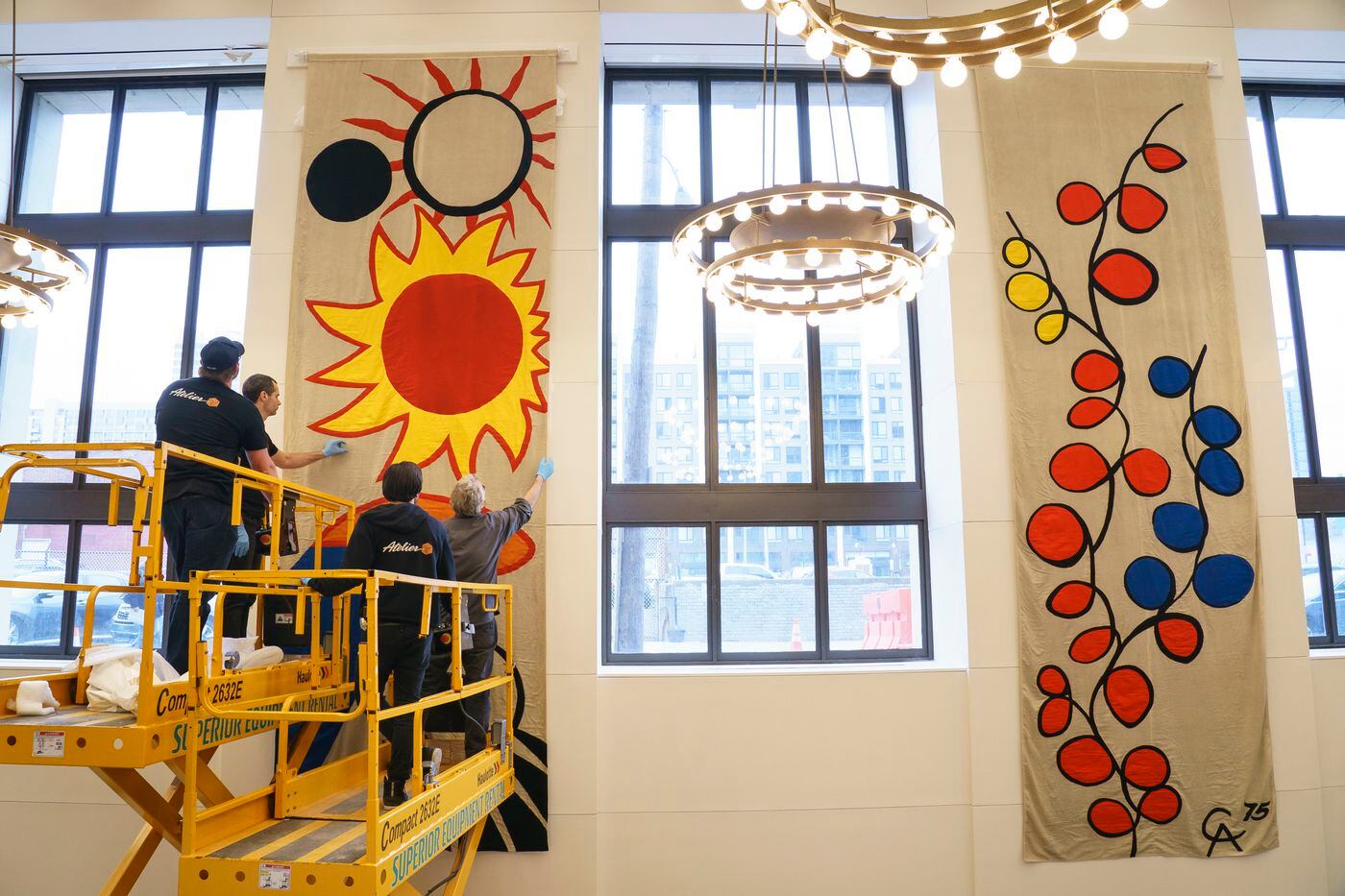
Banners created by Alexander Calder in the 1970s, lost and out of view for most of the last 35 years, are installed at the Free Library of Philadelphia last month.
JESSICA GRIFFIN / STAFF PHOTOGRAPHER
Banners created by Alexander Calder in the 1970s, lost and out of view for most of the last 35 years, are installed at the Free Library of Philadelphia last month.
The Central Branch of the Free Library of Philadelphia, for instance, just began hanging eight newly conserved banners the artist designed in 1975 for Centre Square across from City Hall. The banners vanished when the atrium in the building was renovated in the 1980s. They were found in a storage closet about 15 years later and are now going up again in the library’s Heim Center for Cultural and Civic Engagement.
Mayor Jim Kenney described the Calder family’s work as being literally "woven into the fabric of the city for more than a century.”
Alexander Calder was born in 1898 in Lawnton, Dauphin County, and spent his childhood in Philadelphia. Most of his artwork was created in New York City, France, and in Connecticut. He died in 1976.
Calder Philadelphia will be an independent nonprofit with its own board of directors. Backers of the project said they are working out a collaborative relationship with the Barnes Foundation for select administrative, curatorial, educational, and operational services.
None of those details have been firmed up, yet.
The Calder Foundation’s Rower said selection of the artworks, the number of artworks, how they will be displayed, and other physical details await design renderings.

“How many? We don’t know,” he said. “Yet it will be exactly the right number for the design.”
“Our program is diagonally across from the Rodin,” he said. “The greatest sculptor of the 19th century and the greatest sculptor of the 20th century. That’s the dialogue

Tuesday, January 27, 2015

The Philadelphia Museum Of Art To Be The Only U.S. Stop For A Tremendous International Exhibition Of Monet, Renoir, Degas And More This Summer

Philadelphia Museum of Art
The Philadelphia Museum of Art will be the only American stop for a blockbuster exhibition of Impressionist artwork this summer.
(Photo courtesy Philadelphia Museum of Art)
Monet, Pissarro, Renoir, Sisley, Degas and Manet are among the most celebrated names in fine art today, but these Impressionists might not have known success without the support of one ambitious Parisian art dealer: Paul Durand-Ruel.
Lovers of these and other great Impressionist artists largely have Durand-Ruel to thank for recognizing the beauty of the work long before the style was appreciated in mainstream circles.
This summer, the Philadelphia Museum of Art welcomes a groundbreaking special exhibition that tells the story of the bold art dealer and displays many of the works he championed.
Discovering the Impressionists: Paul Durand-Ruel and the New Painting celebrates the ambitious and visionary Durand-Ruel who supported and helped elevate a new style of painting with a three-month marquee exhibition.
On view in the Philadelphia Museum of Art’s Dorrance Special Exhibition Galleries, the exhibit will showcase more than 80 works by such artists as Monet, Pissarro, Renoir, Sisley, Degas and Manet to trace Durand-Ruel’s role in the development of Impressionism.
With just three stops on an international tour, the Philadelphia Museum of Art is the only museum in America to show this groundbreaking exhibit.
Organized by the Philadelphia Museum of Art, the National Gallery in London and by the Réunion des Musées Nationaux – Grand Palais, in collaboration with the Musée d’Orsay in Paris, Discovering the Impressionists will show in only Paris and London before making its final stop in Philadelphia.
This exhibition is sure to leave an incredible impression on Philadelphia.
Discovering the Impressionists: Paul Durand-Ruel and the New Painting
When: June 24-September 13, 2015
Where: Philadelphia Museum of Art, 2600 Benjamin Franklin Parkway
Cost: $25, adults; $23, seniors; $20, students and youth (ages 13–18); $12 children (ages 5–12); free, children 4 and under
More info: www.philamuseum.org
Philadelphia Museum of Art Impressionism
Claude Monet’s oil on canvas painting The Artist’s Garden in Argenteuil (A Corner of the Garden with Dahlias) was painted in 1873 and is just one of the many, many works of art that will visit Philadelphia this summer. (National Gallery of Art, Washington, Gift of Janice H. Levin, in Honor of the 50th) Anniversary of the National Gallery of Art


Follow us on Twitter: @TraveloreReport

Saturday, November 8, 2014

Philadelphia Is Emerging As One Of America's Most Creative Cities


The city's history now has a big chapter on the creative arts, as its growing renaissance finds ever-inventive ways of expressing itself 

Although Philadelphia once had a reputation for insularity, unhealthy food (hello, cheesesteak) and badly behaved sports fans, the city is busy reinventing itself. The restaurant scene is becoming one of the nation's best, and once-derelict neighbourhoods are rapidly gentrifying. But it's the evolving arts scene that is playing the biggest part in transforming Philadelphia into a serious destination, no longer bypassed in favour of New York just two hours' drive away. 
The Philadelphia Museum of Art and the Barnes Foundation are world-class museums, hosting bigger and better exhibitions every year. And in recent times the northern neighbourhoods, home to vast, unused industrial spaces, have attracted artists from all over the USA, enticed by the low rents. Warehouses and abandoned factories in Fishtown and Kensington contain scores of studios and workshops; cooperative spaces for artists working in clay, wood or 3D printing now have waiting lists. On the first Friday of every month, galleries host events that combine visual arts, live music and cases of Pabst Blue Ribbon beer. It's an enticing combination of upstarts and established institutions that's fuelling the most exciting arts scene in the USA.

Philadelphia Museum of Art 

Referred to colloquially simply as 'the art museum', the PMA sits at the top of the Benjamin Franklin Parkway, lording it over the city. It's one of the country's largest art repositories and the permanent collection (arms and armour, costumes and textiles, Old Masters, seminal works of modern art) attracts visitors from around the world. Architect Frank Gehry has just unveiled plans to extend the museum with new, underground galleries. On Friday evenings, it stays open until 8.45pm for Art After 5, with live music, food, drinks and guided gallery tours. 

WHAT'S ON

An exhibition of works on paper by Richard Pousette-Dart opens 13 September; a major retrospective of American photographer Paul Strand opens 21 October. 2600 Benjamin Franklin Parkway (+1 215 763 8100; www.philamuseum.org). Closed Monday. Entrance about £12

The Barnes Foundation

The Barnes Foundation opened on the Benjamin Franklin Parkway in 2012, after a long and passionately fought legal battle over its move from the Philadelphia suburbs. Once a private collection, the stunning array of works by Cézanne, Picasso and Renoir (more than 160 by the latter alone) makes this a must-visit for devotees of Impressionist and early modernist art - though the gallery has also shown works by major contemporary artists such as Ellsworth Kelly. 

WHAT'S ON

A comprehensive exhibition of the paintings of William Glackens, American realist painter, opens 8 November. Glackens was highly influential in creating the Barns Collection, making this a 'must-see' exhibit for art lovers.  2025 Benjamin Franklin Parkway (+1 215 278 7000; www.barnesfoundation.org). Closed Monday. Entrance about £13


Pennsylvania Academy of the Fine Arts

PAFA is one of the oldest museums and art schools in the USA, and its collection of American art is unparalleled. A clear lineage runs from 19th-century pieces by Thomas Eakins and Winslow Homer to more recent work by Nancy Graves and Frank Stella. Smaller and quieter than both the PMA and the Barnes, this Frank Furness-designed museum is restful yet stimulating.  

WHAT'S ON

Opening 13 September is a show of visual art by director David Lynch (once a PAFA student), followed on 3 October by an exhibition of post-Fukushima-disaster photography by Eiko Otake and William Johnston. 118 North Broad Street (+1 215 972 7600; www.pafa.org). Closed Monday. Entrance about £9

Crane Arts

A large-scale renovation in 2005 turned this former plumbing warehouse and seafood processing plant in South Kensington into a home for a number of arts-related businesses. Many original fixtures, such as the working elevators, are still there. The Icebox (once used to store frozen fish) hosts site-specific installations that are always worth seeing: one artist created a series of colourful inflatables (left) that made the enormous space seem crowded. 1400 North American Street (+1 215 232 3203;www.cranearts.com). Open Wednesday-Saturday, noon-6pm. Free

Rebekah Templeton Contemporary Art

When founders Sarah Eberle and Ben Will opened this spot in 2007 it was one of the first galleries in the rough and ready Kensington neighbourhood, and it's still one of the best. It usually hosts solo shows and has a history of supporting contemporary artists working in new media and installation. Bold or subtle, the work here is never boring. 173 West Girard Ave (+1 267 519 3884; www.rebekahtempleton.com). Open weekends, noon-6pm, or by appointment. Free

Vox Populi

An artist-run space, Vox Populi promotes under-represented Philly-based artists, which, for the visitor, means getting an early look at the kind of work not found in mainstream shows. The film screenings, solo/group shows and exchange programmes with other galleries offer a fresh perspective and a sense of humour.

WHAT'S ON

Go for one of the First Friday openings (5 September, 3 October) when the space is open until 10pm. 319 North 11th Street (+1 215 238 1236;www.voxpopuligallery.org). Open Wednesday-Sunday, noon-6pm. Free 


Performance Garage

Dance fans have plenty to choose from in Philadelphia, but this is a reliable venue for dynamic shows from an international line-up of companies. The studio was formerly a stable, then an automobile garage - a heritage referenced in a recent performance when dancers drove a car into the space. Expect to see anything from ball gowns to hula-hoops on stage. 

WHAT'S ON

In September the Garage is hosting a number of acts during the city's Fringe Festival. 1515 Brandywine Street (+1 215 569 4060;www.performancegarage.org)

Underground Arts

This cavernous warehouse basement has an edgy feel, cut-price drinks and a range of musical shows from the eclectic (venerable surf-rock group Man or Astro-man?) to the conventional (indie-rock darlings Bosnian Rainbows). Gaps in the calendar are filled with comedy, spoken word and open-micnights. Don't expect comfortable seats or subtle lighting - this is where you come to dance, clap, sing along or heckle. 

WHAT'S ON

Upcoming shows include Norwegian singer Sondre Lerche on 25 September, and actor/comedian John Hodgman (often seen on The Daily Show) on 17 October. 1200 Callowhill Street (no phone; www.undergroundarts.org)

World Cafe Live

Since 2004, this west Philadelphia venue has been providing what the founders call 'live music for grown-ups'. This means that in addition to a line-up of well-known bands, this place also has clean bathrooms, comfy seats and clear sightlines. Food is healthy (garlic houmous and quinoa salad) and there's a good selection of wine by the glass; most shows end by 10.30pm. 

WHAT'S ON

In September, Dinosaur Jr founder J Mascis, indie-pop-rock duo Pomplamoose and Brazilian band Sambadá. 3025 Walnut Street (+1 215 222 1400; www.philly.worldcafelive.com

Painted Bride art center

This performance venue has been luring visitors to its corner of the Old City neighbourhood for four decades, but the programming is fresh and innovative. There's avant-garde photography, group karaoke and percussion orchestra as well as traditional dance and theatre performances. 

WHAT'S ON

Up-and-coming dancers on 3 and 4 October; on 21 October there's an open-mic story-telling competition. 230 Vine Street (+1 215 925 9914;www.paintedbride.org)
This feature first appeared in Condé Nast Traveller USA Special September 2014
Follow us on Twitter: @TraveloreReport

Saturday, May 10, 2014

The 10 Best City Art Districts Around The USA

The pride and joy of Philly's arts scene is on Benjamin Franklin Parkway.
The Parkway is home to the Barnes Foundtation in Philadelphia, a 3,000-piece collection focusing on French Impressionist, Post-Impressionist, American and African art and sculpture.  (Photo: Photo by R. Kennedy for GPTMC)
It's hard to beat a fun, fulfilling art district for a wholesome day of bargain-priced family entertainment. Cities are quickly catching onto the trend, many boasting several art districts catering to different tastes. Here are just a few we like.
Atlanta: It's certainly not size that makes Atlanta's petit Castleberry Hill area such a satisfying art district, but rather its atmosphere. Located on a short, easily walkable stretch of Walker Street, spilling out onto a couple parallel streets, Castleberry Hill is listed on the National Register of Historic Places and is home to artist lofts, more than 11 galleries and a variety of eateries. The area, the most complete warehouse district still surviving in the city, is also quite aesthetically pleasing, with many shops and lofts housed in early 20th-century warehouse buildings.
Baltimore: Baltimore's first neighborhood to be designated an arts and entertainment district, Station North, is an eclectic mix of people, architecture, arts, food and fun. The combination residential and commercial area covers the bases with all manner of theaters, cafés, galleries, music venues, restaurants and bars on offer. Many artist studios and residential lofts are housed in restored former industrial buildings and beautiful early 20th century row homes.
Cleveland: Four miles from downtown Cleveland sits one of the most concentrated square miles of arts and culture in the nation: University Circle. The area is home to more than 20 artistic and cultural venues including the Cleveland Museum of Art,Cleveland Museum of Contemporary ArtCleveland Institute of Art, and Severance Hall (winter home of the renowned Cleveland Orchestra). Other visitor enticements include the Cleveland Museum of Natural HistoryCleveland Botanical Garden, and the Western Reserve Historical Society.
Dallas: Everything is bigger in Texas and the Dallas Arts District is no exception. One of the largest concentrated urban arts districts in the United States, the area spans 19 acres and is home to four buildings designed by Pritzker-prize wining architects. Among the attractions are the Dallas Museum of Art (offering free general admission),the Nasher Sculpture Center, the Crow Collection of Asian Art (also offering free admission), the Morton H. Meyerson Dallas Symphony Center, the AT&T Performing Arts CenterDallas City Performance Hall and more.
Los Angeles: Downtown LA is home to an unexpectedly stout art district, dubbed "Gallery Row." The area (situated along Main and Spring Streets, between 2nd and 9th Streets) is lined with cutting-edge art galleries which, on the second Thursday of every month, host the wildly popular Downtown Art Walk. Those who visit outside of this monthly, jovial art carnival can still happily occupy themselves admiring the area's profusion of sculptures and street art.
Milwaukee: An alluring concentration of art galleries, theaters, exclusive boutiques, specialty stores and antique shops can be found in Milwaukee's Historic Third Ward, a six square block area located south of downtown, along the Milwaukee River. The heartening revitalization of this turn-of-the-century warehouse and manufacturing district has rightfully caused visitors to compare it to New York's SoHo neighborhood. Its continued development includes a burgeoning restaurant and nightlife scene.
Philadelphia: The pride and joy of Philly's arts scene is on Benjamin Franklin Parkway, aka the Parkway Museums District, home to the Philadelphia Museum of Art, the third largest art museum in the country, the Rodin Museum, the most extensive public collection of Auguste Rodin's works outside Paris, including The Thinker, theBarnes FoundationMoore College of Artand much more. There's also a variety of pubic sculpture and architecture as well as the Franklin Institute and the Academy of Natural Sciences.
Phoenix: The Roosevelt Row Arts District (RoRo) in downtown Phoenix is a walkable, creative district bedecked with galleries, quirky shops and exhibits by both up-and-coming and old favorite artists. The monthly First Fridays Artwalk includes participation by more than 70 galleries and art-friendly businesses who open their doors, creating what may be the nation's largest, self-guided art walk. From its humble artist beginnings in 1993, the neighborhood has developed to include award-winning restaurants, galleries, boutiques and live music venues.
Raleigh: The Warehouse District is a trendy six-block area adorned with repurposed red brick warehouse spaces and other old buildings which are being used for myriad independently owned businesses. CAM Raleigh, the only non-collecting contemporary art museum in North Carolina, is the core of this burgeoning area surrounded by art galleries and studios like Rebus WorksDesignbox and Flanders Art Gallery. Fashion is also well represented in the Warehouse District, including Raleigh Denim Workshop and Curatory, just steps away from the CAM, where custom jeans are hand sewn on vintage machines. For those who consider chocolate an art form (and if not, why not?) there's Videri Chocolate Factory.
San Diego: The Mediterranean-style village of La Jolla may be best known as a well-trodden Southern California vacation destination, but step back from the coastline strip and one will also find one of San Diego's most vibrant arts neighborhoods. Highlights include Thumbprint and their urban art movement based on outsider art, street art and graffiti, and the chic Scott White Contemporary Art Gallery which promotes emerging and mid-career artists as well as renowned modern and contemporary artists. Along the coast is "Murals of La Jolla," conceived in 2010, which features more than a dozen artists whose work has transformed the coastline into an outdoor contemporary art gallery.
Contributed by Leif Pettersen, USA Today