Showing posts with label Best American Cities. Show all posts

Friday, February 21, 2020

Alexander Calder Will Get A Prime Museum Site On The Benjamin Franklin Parkway In Philadelphia, Across From Barnes And Rodin

"Eagle," a 40 foot sculpture by Alexander Calder on loan to the Philadelphia Museum of Art in 1999 and 2000.
A little more than two decades after a Calder museum was first proposed for the Benjamin Franklin Parkway, the long-dormant idea has blossomed again, funding has materialized, and backers say that, by spring 2021, construction should get underway between 21st and 22nd Streets across from the Barnes Foundation and the Rodin Museum.
Many details of the project, which would feature works by the endlessly inventive Alexander Calder, creator of the mobile, still have to be worked out, but supporters say they are committed for the long haul. Major funders include the Neubauer Family Foundation, the Pew Charitable Trusts, and the estate of H.F. “Gerry” Lenfest.

The works for display, which have not yet been selected, will be lent by the New York-based Calder Foundation for 99 years and would rotate through the Philadelphia facility, known informally as Calder Philadelphia. The art will be displayed in and around a building with a prominent garden.
Herzog & de Meuron, the Pritzker Prize-winning architects behind London’s Tate Modern, have signed on to the project, but no design renderings are yet available.
“We don’t know what we’re going to call it, but it’s not a museum,” said Alexander S.C. Rower, president of the Calder Foundation and grandson of the artist.

“This will involve a different way to engage art than what is usual with a museum,” he said. The idea, Rower said, is to create a more intimate experience for viewers and allow them to get closer to the artwork, free of the restrictions that normally dominate a museum setting.
“The experience is where the art happens,” he said. “This will not be a picture on a wall. This will be a place of introspection.”
He called the new structure and grounds a “sanctuary” as opposed to a museum.
1:18
Joseph Neubauer, trustee of the Neubauer Family Foundation and one of the prime movers for the project, said that Calder’s sculptures, his stabiles and mobiles, would most likely be the defining feature of the facility and grounds.
“You need to be able to walk around it and experience” the sculpture, Neubauer said. “This is all about the individual experience with individual pieces of art.”

Rower said the building and grounds, located on the same two-acre site as the earlier, never-built Calder museum, are envisioned to encourage contemplation. The building will include galleries of some sort.
Neubauer said the size of the structure will be “modest, maybe 15-, 17-, 20,000 square feet, plus the garden."
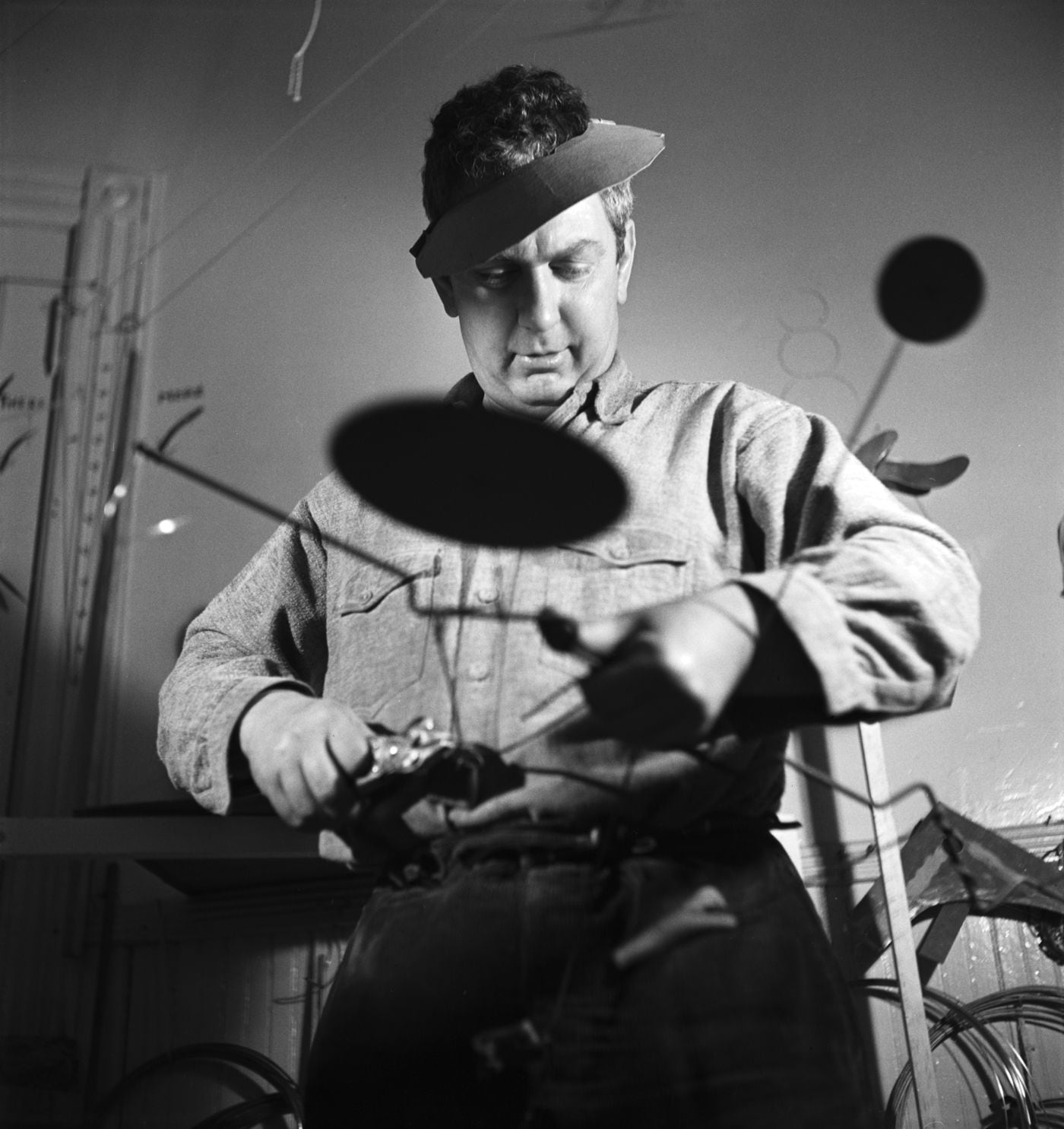
Alexander Calder in his New York City storefront studio, 1936.
IMAGE BY HERBERT MATTER
Alexander Calder in his New York City storefront studio, 1936.
The site will be leased from the city and must go through normal approvals, including a City Council review and approval of the lease agreement. Terms of the agreement have not been set as yet. No city funding is involved in the project. (The site is open space, part of Fairmount Park. PennDot is currently using it as staging for the Vine Street and Chestnut Street reconstructions, but that use is temporary, city officials said.)
“Gardens are very important; you can’t assume they are just simple," Neubauer continued, discussing the configuration of the two-acre site. "This will be very welcoming to the public. We are going to try to activate the block for the public.”
The project, according to Neubauer, will cost about $50 million.
“Most of the money is coming from philanthropy,” he said, including funds from an anonymous donor along with the Neubauer, Pew, and Lenfest contributions. Additional support will come from the state.
The money is almost completely raised, he said, "We’re fairly close.”
Edward G. Rendell, former mayor and governor, who pushed for the initial museum back in 1999, said he found the revival of the idea “very gratifying.”

“There’s no doubt in my mind that Philadelphia is the only place for it,” he said. “Calder’s influence is felt all over the city, particularly in City Hall. This may be the final piece of the puzzle for the Parkway."
Diane Dalto Woosnam, who was Rendell’s deputy city representative for arts and culture and the city’s point person on the first Calder museum plan, said that she believed the site and the city have “always been perfect," adding: "But in true Philly fashion, it took 25 years for everyone to agree.”
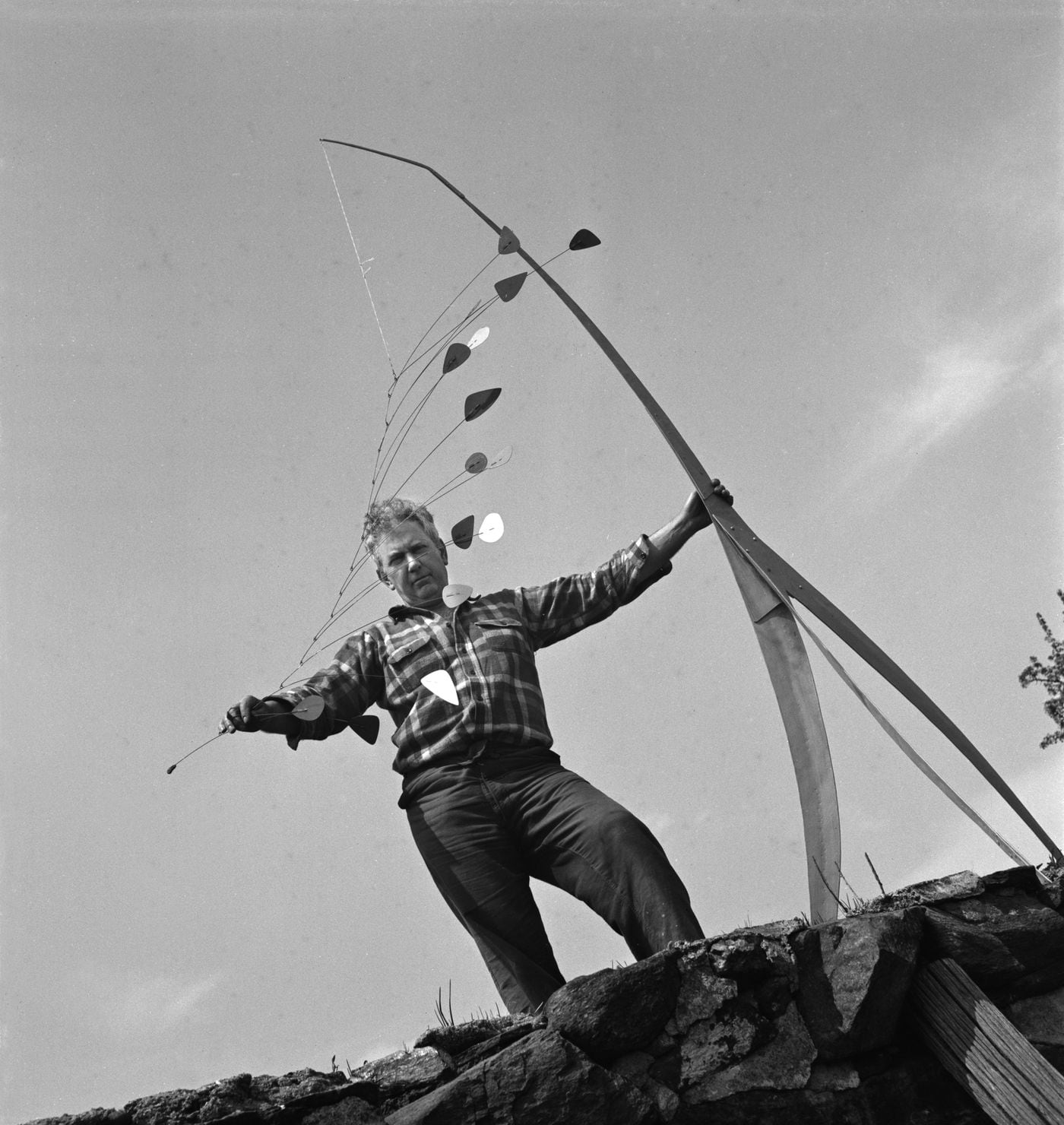
Calder with Giraffe (1941), Roxbury, Conn., 1941. Image by Herbert Matter
COURTESY CALDER FOUNDATION
Calder with Giraffe (1941), Roxbury, Conn., 1941. Image by Herbert Matter
The site of Calder Philadelphia underscores three generations of Calder family artwork along the Parkway as a defining factor on the Philadelphia cityscape. City Hall features the work of Calder’s grandfather Alexander Milne Calder, who created the major sculptures adorning the building, most prominently the statue of William Penn at the top.
Alexander Calder’s father, Alexander Stirling Calder, is famous for designing Swann Fountain on Logan Square a couple of blocks from what will be Calder Philadelphia. And one of Alexander Calder’s most intriguing mobiles, Ghost, hangs above the grand indoor entrance hall of the Philadelphia Museum of Art.
Works from Calder’s father and grandfather will also be featured in the new facility.
“This is a major accomplishment for Philadelphia,” said Rebecca W. Rimel, president and chief executive of the Pew Charitable Trusts. “The artistry of the Calder family is an important part of the fabric of our city. ... A home on the Parkway for some of Calder’s most consequential works will advance the city’s reputation as a world-class arts destination and enhance its appeal to national and international visitors.”
And there are other public works by Alexander Calder within shouting distance of the planned museum’s site.
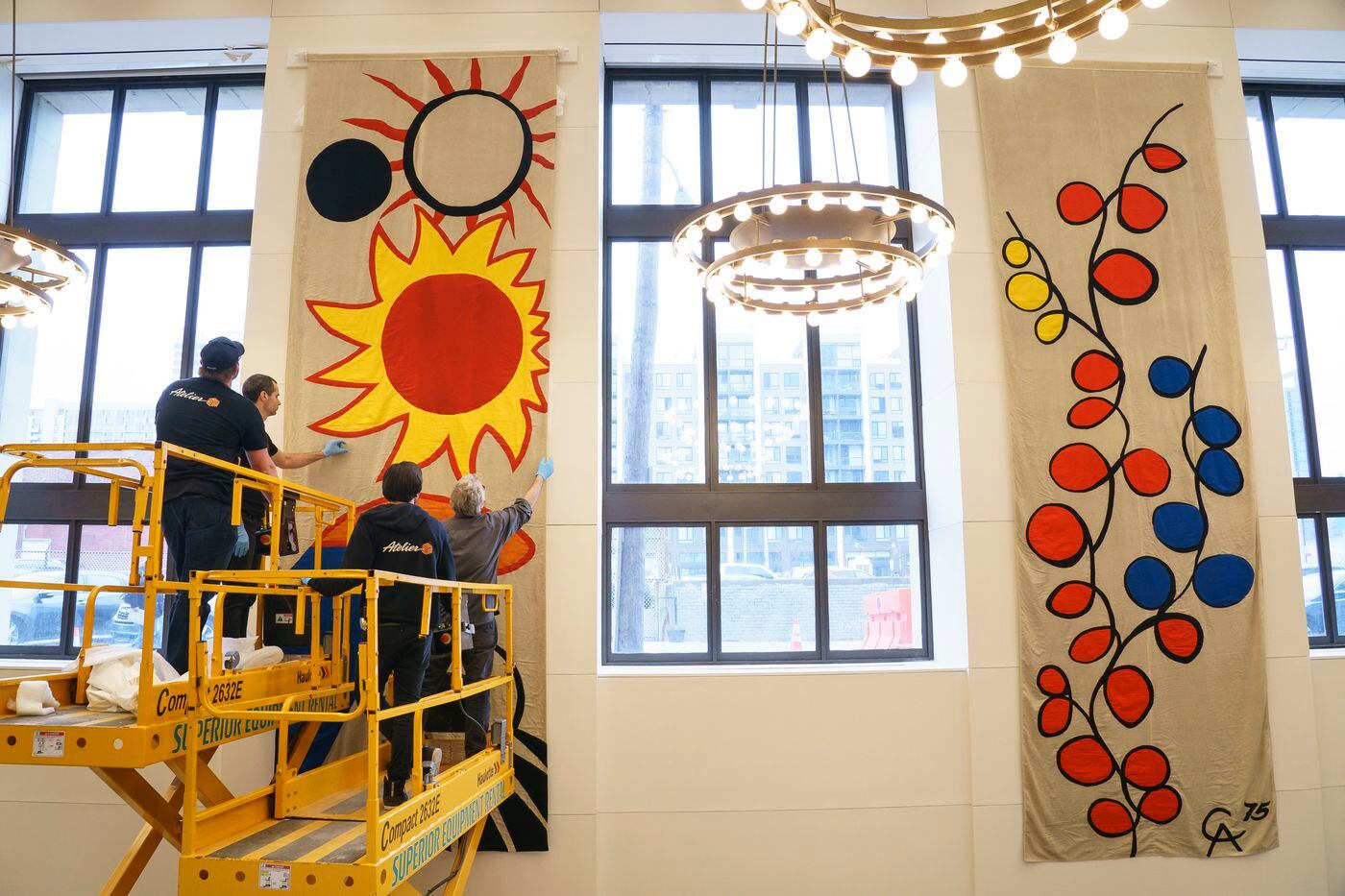
Banners created by Alexander Calder in the 1970s, lost and out of view for most of the last 35 years, are installed at the Free Library of Philadelphia last month.
JESSICA GRIFFIN / STAFF PHOTOGRAPHER
Banners created by Alexander Calder in the 1970s, lost and out of view for most of the last 35 years, are installed at the Free Library of Philadelphia last month.
The Central Branch of the Free Library of Philadelphia, for instance, just began hanging eight newly conserved banners the artist designed in 1975 for Centre Square across from City Hall. The banners vanished when the atrium in the building was renovated in the 1980s. They were found in a storage closet about 15 years later and are now going up again in the library’s Heim Center for Cultural and Civic Engagement.
Mayor Jim Kenney described the Calder family’s work as being literally "woven into the fabric of the city for more than a century.”
Alexander Calder was born in 1898 in Lawnton, Dauphin County, and spent his childhood in Philadelphia. Most of his artwork was created in New York City, France, and in Connecticut. He died in 1976.
Calder Philadelphia will be an independent nonprofit with its own board of directors. Backers of the project said they are working out a collaborative relationship with the Barnes Foundation for select administrative, curatorial, educational, and operational services.
None of those details have been firmed up, yet.
The Calder Foundation’s Rower said selection of the artworks, the number of artworks, how they will be displayed, and other physical details await design renderings.

“How many? We don’t know,” he said. “Yet it will be exactly the right number for the design.”
“Our program is diagonally across from the Rodin,” he said. “The greatest sculptor of the 19th century and the greatest sculptor of the 20th century. That’s the dialogue

Wednesday, August 1, 2018

The Essential Guide To Visiting Philadelphia, A World-Class City With Something For Everyone

Fairmount Park   Dilworth Park
Philadelphia’s Belmont Plateau in Fairmount Park (left) is a popular spot to gather and enjoy skyline views. Dilworth Park (right), on the west side of Philadelphia City Hall, is both one of William Penn’s original squares and a busy urban park.

Credit: Photos by R. Kennedy (left) and M. Fischetti (right) for VISIT PHILADELPHIA®


PHILADELPHIA – Every year, visitors to Philadelphia get to know the city’s history, customs, cuisine, dialect and landscape during their visits. Both first-time travelers and returning natives discover and rediscover a diverse, neighborhood-based  metropolis with a downtown that’s easy to navigate on one’s own or via public transit. Philly regularly receives raves in The New York Times, Bon Appétit, Travel + Leisure, Lonely Planet and Condé Nast Traveler, yet doesn’t stand one bit for pretense. Here are the basics any visitor to Philadelphia should know:
Well-Planned City:
  • Layout – Seventeenth-century city planner William Penn envisioned the grid of streets that comprise Philadelphia’s downtown, Center City. Perpendicular streets run north-south (they’re numbered) and east-west (many named for trees: Walnut, Locust, Spruce). What would be 1st Street is named Front Street. What would be 14th Street is Broad Street. Two rivers, the Schuylkill and the Delaware (dividing Pennsylvania from New Jersey), form the western and eastern boundaries of Center City; Vine Street and South Street form north-south boundaries. Today, Penn continues to give direction to the city. His statue atop City Hall points northeast.
  • Exceptions to the Layout – The century-old, mile-long Benjamin Franklin Parkway cuts diagonally through Center City’s grid, from near City Hall, past the famous LOVE Park to the Philadelphia Museum of Art. Modeled after Paris’ Champs-Élysées, the parkway is home to the Barnes Foundation, The Franklin Institute, The Academy of Natural Sciences of Drexel University, the Rodin Museum and the Philadelphia Museum of Art. East Passyunk Avenueruns diagonally through South Philly, passing through a row of restaurants and shops, past cheesesteak rivals Geno Steaks and Pat’s King of Steaks and ending at colorful South Street. Frankford Avenue begins near Delaware Avenue before heading northeast through Fishtown and Kensington, where Penn’s grid transforms into more of a web. Parkway, 16th to 26th Streets, parkwaymuseumsdistrictphiladelphia.org; Passyunk, Broad & McKean to South Streets, visiteastpassyunk.com; Frankford, Delaware Avenue to Northeast Philly, frankfordavearts.org
  • Greene Country Towne – Penn also planned Center City’s five main squares, part of his vision for a “greene countrie town.” Today, these city-block parks are called Rittenhouse Square, in one of Philly’s most desirable neighborhoods; Washington Square, home to the Tomb of the Unknown Soldier; Franklin Square, with a playground and carousel; Logan Square, now a circle along the Benjamin Franklin Parkway with the Swann Memorial Fountain; and Center Square, where City Hall and Dilworth Park reside. Rittenhouse, 18th & Walnut Streets, friendsofrittenhouse.org; Washington, 7th & Walnut Streets; Franklin, 6th & Race Streets, historicphiladelphia.org; Logan, 19th Street & Benjamin Franklin Parkway; Center Square/Dilworth Park, Broad & Market Streets, (215) 440-5500, dilworthpark.org
Getting Around:
  • By Foot or Wheelchair – Locals like to self-propel. It’s the easiest way to get around. WalkScore ranks Philadelphia as the country’s fifth most pedestrian-friendly large city.
  • Indego – Cyclists can traverse the city’s 240 miles of bike lanes by using this popular bike-share program. More than 120 docking stations have simple credit card machines that take less than a minute to use. A day pass is $10 for unlimited 30-minute rides; any ride over 30 minutes is an additional $4. rideindego.com
  • Philly PHLASH Downtown Loop™ – Fast, convenient and affordable: That’s the purple PHLASH bus. Riders pay $2 per ride, $5 for a one-day pass to reach 22 stops along its attraction-heavy route. The PHLASH runs daily in the summer and winter holiday seasons, and on Fridays, Saturdays and Sundays in the fall. ridephillyphlash.com
  • SEPTA (Southeastern Public Transit Authority) – The region’s public transit system includes subways, buses, trolleys and suburban rail lines. The Broad Street Line subway runs north and south along Broad Street and connects to the sports stadiums of South Philadelphia, with express service during games. The Market-Frankford Line (called “the El” for its above-ground portions) travels east and west beneath Market Street, connecting to northeastern neighborhoods Northern Liberties and Fishtown and to University City/West Philly in the other direction. Numbered bus lines cover nearly every other block of the city. For subways and buses, riders can pay $2.50 in cash (exact change), or purchase a reloadable SEPTA Key Card, which offers several fare options. Riders can also purchase an individual or Family Independence Pass; both provide unlimited travel for one whole day, for one low fare. septa.org
  • Taxis – They’re easy to flag down, especially in Center City. Look for the light on, on the top.
  • Uber, Lyft, 215-Get-A-Cab – Need a ride? There are apps for that. uber.com, lyft.com, 215getacab.com
Historic Essentials:
  • Independence National Historical Park – America’s most historic square mile is a must-see of America’s origins. Visitors can pick up free, timed tickets to tour esteemed Independence Hall, the UNESCO World Heritage Site where the Declaration of Independence was signed, the U.S. Constitution was created, and the Annual Reminders, the country’s earliest organized and recurring LGBTQ rights demonstrations, took place. Nearby, the no-ticket-required Liberty Bell Center displays the beloved symbol of freedom, continuous inspiration for believers in civil rights. On the same block, the open-air site The President’s House: Freedom and Slavery in the Making of a New Nation tells of the nine Africans U.S. President George Washington enslaved there. (215) 965-2305, nps.gov/inde
  • Valley Forge National Historical Park – In the harsh winter of 1777-1778, Washington’s Continental Army encamped here. Today, the site honors the sacrifice and strength of those who helped secure freedom for the United States. Valley Forge National Historical Park offers a variety of programming throughout the year, including ranger programs, guided tours and living history demonstrations. Open year round with the exception of Christmas, Thanksgiving and New Year’s Day, when grounds are open, but park buildings are closed. 1400 N. Outer Line Drive, King of Prussia, (610) 783-1099, nps.gov/vafo
Art & Architecture:
  • Barnes Foundation – This world-renowned collection contains Impressionist, Post-Impressionist and early Modern paintings, along with Old Master works, Native American jewelry and African sculpture. 2025 Benjamin Franklin Parkway, (215) 278-7200, barnesfoundation.org
  • Boathouse Row – Ten charming, 19th-century crew clubhouses comprise this National Historical Landmark along the Schuylkill River. Still in use, the boathouses serve local colleges and universities. At night, lights frame the buildings, providing one of Philadelphia’s most recognizable—and Instagram-worthy—landmarks. 1 Boathouse Row, boathouserow.org
  • Mural Arts Philadelphia – Founded in 1984 as an anti-graffiti initiative, this world-renowned mural program uses art to ignite change in communities, transforming public spaces and individual lives. To date, the program has produced nearly 4,000 murals, available to view on one’s own or via a number of tours. 128 N. Broad Street, (215) 925-3633, muralarts.org  
  • Philadelphia City Hall – The Second Empire building at the intersection of Broad and Market Streets has been the home to Philadelphia city government for more than a century. The elaborate masonry structure, once the tallest building in the U.S., remains, at 14.5 acres, the country’s largest municipal building. The observation deck below the 37-foot bronze statue of William Penn atop the clock tower offers tours on weekdays and select Saturdays, and the building hosts two-hour building tours. Broad & Market Street, (267) 514-4757, phlvisitorcenter.com/CityHall 
  • Philadelphia Museum of Art – The crown jewel of the Benjamin Franklin Parkway offers an astounding art collection spans more than 2,000 years and includes sculpture, paintings, textiles, arms and armor, photography, prints and drawings. The site was also immortalized in the classic Rocky film franchise. To this day, visitors jog up the steps to reenact Stallone’s famous scene. 2600 Benjamin Franklin Parkway, (215) 763-8100, philamuseum.org
  • African American Museum in Philadelphia (AAMP) – The very first museum funded by a major city to showcase and preserve the African-American history and culture opened in 1976 and remains home to an extensive collection of artifacts and hosts a number of artistic and cultural events. 701 Arch Street, (215) 574-0380, aampmuseum.org
  • National Museum of American Jewish History – Also established in 1976 is this only U.S. museum dedicated exclusively to the American Jewish experience. More than 30,000 artifacts comprise the world’s largest collection of Jewish Americana; the venue hosts public and educaitonal programs, events and lectures. 5th & Market Streets, (215) 923-3811, nmajh.org
All About The Food:
  • Cheesesteaks – Born in South Philly, this meat-and-cheese (onion optional) sandwich is most frequently purchased at 24/7 operations Pat’s King of Steaks (where it was invented) and nearby Geno’s Steaks, Pennsport’s neon-lit Tony Luke’s, South Street’s Jim’s Steaks and North Philly’s famedMax’s Steaks. Geno’s, 1219 S. 9th Street, (215) 389-0659, genosteaks.com; Pat’s, 1237 E. Passyunk Avenue, patskingofsteaks.com; Tony Luke’s, 39 E. Oregon Avenue,(215) 551-5725, tonylukes.com; Jim’s, 400 South Street, (215) 928-1911, jimssouthstreet.com; Max’s, 3653 Germantown Avenue, (215) 229-9048
  • Hoagies – Outside of the 215/267/484/445 area codes, these sandwiches often go by “subs” or “heroes.” Philly’s hoagie game is serious: The bread has to be just right—slightly crunchy on the outside yet soft enough to allow bites through to deli meat, cheese and toppings. South Philly spots such as Chickie’s Italian Deli and Cosmi’s Deli are classic; places like Primo Hoagies are reliably omnipresent. Chickie’s, 1014 Federal Street, (215) 462-8040, chickiesdeli.com, Cosmi’s, 1501 S. 8th Street, (215) 468-6093, cosmideli.com, Primo, various locations, primohoagies.com
  • Roast Pork – The Philly sandwich many locals consider to be the real hometown favorite consists of a quality long Italian roll, savory sliced pork, provolone cheese and broccoli rabe or garlicky spinach. Some people add long hots (peppers) for even more flavor. Two popular places people go for roast pork are the Reading Terminal Market’s Tommy DiNic’s and John’s Roast Pork, on the edge of South Philadelphia’s Pennsport neighborhood. DiNic’s, 12th & Arch Streets, (215) 923-6175, tommydinics.com; John’s, 14 Snyder Avenue, (215) 463-1951, johnsroastpork.com
  • Soft Pretzels – Early German settlers introduced this doughy delight. In the morning, locals can dip pretzels into cream cheese; typically, mustard is the condiment of choice. Soft pretzels are standard fare at food carts, and often sourced at South Philly’s Center City Pretzel Co. and throughout the region atPhilly Pretzel Factory franchises. Center City, 816 Washington Avenue, (215) 463-5664, centercitypretzel.com, Pretzel Factory, phillypretzelfactory.com
  • Water Ice – Erstwhile referred to as Italian ice, this smoother-than-a-snow cone, better-than-a-shaved ice has flavor mixed in, not poured on top. Lemon and cherry win the most-ordered contest, though the sweet treat comes in a variety of flavors. South Philadelphia’s circa 1945 John’s Water Ice, multipleRita’s Italian Ice locations, and West Philly’s Siddiq’s Real Fruit Water Ice keep people cool in the warmer months. John’s, 701 Christian Street, (215) 925-6955, johnswaterice.com; Rita’s, ritasice.com; Siddiq’s, 264 S. 60th Street, (215) 410-6513, siddiqswaterice.com
  • Food Hubs – For these and more Philly flavors, the Reading Terminal Market and S. 9th Street Italian Market serve as culinary catchalls. The former houses 80 vendors of regional specialties and global cuisine in an historic onetime train terminal. The latter lines multiple South Philly blocks with merchants selling produce, cheeses, tacos, pasta, meats, spices and more. Reading Terminal, 12th & Filbert Streets, (215) 922-2317, readingterminalmarket.org, Italian Market, S. 9th Street, between Christian & Federal Streets, (215) 278-2903, italianmarketphilly.org
The Dialect:
  • Pronunciations – Many Philadelphia natives have a distinctive way of pronouncing local names. Schuylkill, as in the river or the I-76 expressway, is skool-kil. Passyunk, the South Philadelphia avenue and neighborhood, is pash-shunk.
  • Philly Accent – Water is wooder. Many words that start with st- tend to get more of a sht- treatment, making street sound like street. The pronoun “our” sounds like are, and “orange” gets the same sound at its start—are-ange. “Bagel” goes by beg-el (but soft pretzels are better; see above). And jeet? That’s how caring Philadelphians ask if a person has eaten.
The Dictionary:
  • gravy /grey-vee/ noun: a South Philadelphia term for red Italian sauce. Villa Di Roma makes gravy like my grandmom’s.
  • hoagie /hoh-gee/ noun: a hero or sub sandwich. The block party is sure to have hoagies, cheesesteaks and soft pretzels.
  • jawn /jawn/ noun: a thing, person or place; multi-purpose fill-in-the-blank word. Wave that jawn when the parade goes by.
  • the Linc /thÉ™ lingk/ noun: short for Lincoln Financial Field. “E-A-G-L-E-S: Eagles!” echoes, well, really, everywhere.
  • Mummers /muhm-er/ noun: costumed musicians and irreverent revelers who march up Broad Street on New Year’s Day. You know Uncle Jimmie. He’s a Mummer.
  • yo /yoh/ interjection: greeting; used to get someone’s attention. Yo! Who’s dat at the top of City Hall?
  • water ice /wood-er ahys/ noun: Italian ice treat. When it’s August, lemon water ice hits the spot.
  • Wawa /wah-wah/ noun: convenience store native to Philadelphia region. Stop at Wawa for a Classic hoagie and some Tastykakes before the game.

VISIT PHILADELPHIA® is our name and our mission. As the region’s official tourism marketing agency, we build Greater Philadelphia’s image, drive visitation and boost the economy.

On Greater Philadelphia’s official visitor website and blog, visitphilly.com and uwishunu.com, visitors can explore things to do, upcoming events, themed itineraries and hotel packages. Compelling photography and videos, interactive maps and detailed visitor information make the sites effective trip-planning tools. Along with Visit Philly social media channels, the online platforms communicate directly with consumers. Travelers can also call and stop into the Independence Visitor Center for additional information and tickets.