Showing posts with label Museums in Philadelphia. Show all posts

Wednesday, September 13, 2023

Penn Museum In Philadelphia To Begin A Monumental $54 Million Transformation Of Its Ancient Egypt And Nubia Galleries

This fall, the Penn Museum will embark on its largest renovation in the institution's 136-year-history: Transforming the 14,000-square-foot Ancient Egypt and Nubia Galleries, which will unveil an unprecedented experience among North American museums.

To make way for this multi-year construction project, the current Egypt Gallery, which first opened in 1926, will close to the public on November 6, 2023 for the safety of guests and staff. University of Pennsylvania archaeologists have been excavating in Egypt and Nubia for more than a century. These excavations built the Museum's collection of about 50,000 Egyptian and Nubian objects, which spans from 4,000 BCE through the 7th Century CE-one of the largest in the United States.

To showcase this collection during the Egypt Gallery's closure, an exhibition, Ancient Egypt: From Discovery to Display, will stay open during construction. Egyptian artifacts will also be on view in the Africa Galleries and the new Eastern Mediterranean Gallery. Other permanent galleries illuminating the vibrant cultures of Africa, Asia, the Americas, the Mediterranean, and the Middle East, special exhibitions, and year-round programming will still be part of a Penn Museum visit.

The Museum will continue to host weddings and private events of all sizes in its exquisite historic spaces such as the Sphinx Gallery, the Rotunda, the Upper Baugh Gallery-a new event location as of fall 2023-the rooftop terrace, and its scenic outdoor gardens.

The next phase in the Museum's ongoing Building Transformation, reimagining the Ancient Egypt and Nubia Galleries, will unfold in two phases: the Main Level and Upper Level.

With a targeted opening date near the end of 2026, the galleries on the Main Level will focus on Life and Afterlife in Ancient Egypt. The large central gallery will be anchored by the limestone tomb chapel of Kaipure, which has not been on display in its complete state for more than 30 years. Dating back to 2,300 BCE in Saqqara, the tomb chapel was a place where priests would perform funerary rituals and leave offerings to ensure the deceased would prosper in the Afterlife.

The Upper Level will showcase gods, kings, and pharaohs-including a breathtaking monument: the 3,000-year-old palace of the Pharaoh Merenptah, with 30-foot-tall columns on display at their full height for the first time since their excavation more than 100 years ago. These galleries are targeted for completion by late 2028.

"Unveiling the Ancient Egypt and Nubia Galleries will be a feat of major significance and a point of cultural pride for the Greater Philadelphia region and beyond. Nowhere else outside of Egypt will visitors be able to walk through soaring architectural elements of an ancient Egyptian palace-it is worth the wait," says Dr. Christopher Woods, Williams Director at the Penn Museum. "These galleries will provide an unparalleled opportunity to glimpse a day in the life of ancient Egyptians and Nubians-not only powerful, famous pharaohs, but also working citizens who fueled two of the world's oldest and enduring societies."

One-hour private tours of the Egypt Gallery are available every Saturday and Sunday in October. Cost is $24 per person and includes Penn Museum admission for the entire day. For Penn Museum members, the cost is $12.

In addition, the Museum has launched an Experience Ancient Egypt Giveaway, offering a chance to win prizes inspired by its world-renowned Egyptian collection, including a private gallery tour for up to 10 people. The sweepstakes will run through September 18, 2023.

Sunday, November 5 will be the final opportunity for guests to visit the current Egypt Gallery, which spotlights artifacts such as a golden mask, sarcophagus lid, and the seated statue of the Pharaoh Ramses II (1290-1224 BCE) from the temple of Harsaphes.
Access to all galleries and exhibitions is included with Penn Museum admission.

For more information, please visit: https://www.penn.museum/

Friday, September 1, 2023

Former Family Court Building To Become Hotel, African American Museum To Move To Philadelphia's Benjamin Franklin Parkway

Two developers have been selected to lead the transformation of Philadelphia's former Family Court building into a new hotel on the Benjamin Franklin Parkway.

Philadelphia-based National Real Estate Development and Washington, D.C.-based Frontier Development & Hospitality Group were named Wednesday as the firms that will renovate the historic building at 1801 Vine St. Another lot at 1901 Wood St., behind the Free Library of Philadelphia, will become the new home of the African American Museum in Philadelphia.

The Family Court building was built in 1941 and served the municipal court system until 2014, when the city relocated its functions to a new address at 1501 Arch St. The building, reminiscent of the palace architecture of La Place de la Concorde in Paris, has been unoccupied since 2017.

Plans for the building include a boutique hotel with a restaurant and bar and event spaces meant to liven up the entrance on Vine Street. The project also will include the expansion of the Free Library's Parkway Central building with the creation of the new Children and Family Center.

The soonest the hotel renovation and new buildings could be completed is 2028, officials with the city and the public-private Philadelphia Industrial Development Corp. said Tuesday.

Last August, the city and PIDC narrowed down the field of proposals to four developers, who were required to include the new location for the AAMP as part of the bidding process. The museum is leaving its longtime home at 701 Arch St. to become part of the Parkway's "Museum Mile." Philadelphia was the first city in the U.S. to build a museum like the AAMP when it opened its doors during the city's bicentennial celebrations in 1976.

“This project stands as a testament to our commitment to honoring the past while building a future that reflects our values and aspirations," Mayor Jim Kenney said. "The African American Museum of Philadelphia's relocation to a brand new facility on the Parkway, the city’s most celebrated cultural thoroughfare, signifies a historic move that rightfully places it alongside Philadelphia’s most prestigious museums."

In 2020, the city withdrew the renovation contract it previously had awarded to Peebles Corp., a Black-owned development firm that also sought to turn the Family Court building into a hotel. That project was delayed for several years by cost considerations, including the developer's effort to obtain tax credits by gaining historic designation for the building. The city ultimately cited the uncertain outlook of the hotel industry during the pandemic as the reason for exiting its partnership with Peebles Corp.

National Real Estate Development and Frontier Development & Hospitality Group will partner with Method Co., Smith & Roller and BKP Development Group, giving the new project minority equity ownership as required by the city.

The 247,000-square-foot Family Court building was designed by Philadelphia architect John Torrey Windrim as a twin to the Free Library, which was completed in 1927. In addition to being listed on the National Register of Historic Places, the exterior of the Family Court building and 37 New Deal-era murals painted inside are listed on the city's historic register.

The lot behind the Free Library covers about 88,000 square feet and was formerly owned by the Philadelphia Parking Authority. The Free Library expansion was also a requirement of the lot's development.

National Real Estate Development has a growing portfolio of projects in Philadelphia, including the East Market mixed-use development that added more than 560 apartments to Center City in recent years. The company is currently building a multifamily residence at 2nd and Spring Garden streets and has other large developments in Los Angeles, San Francisco and Washington, D.C.Frontier Development & Hospitality Group has developed condos in Philadelphia and has extensive experience with hotel projects in other cities.

Various approvals, permits and negotiated terms between the city and the two developers still remain to be worked out before construction on the project can begin. City officials did not provide an estimated budget for the redevelopment and its separate pieces.

The contract for the Family Court building comes against the backdrop of much larger plans to reimagine the Ben Franklin Parkway as a greener, more walkable stretch. The city is currently gathering public feedback about conceptual goals and amenities that could help bring new life to the Parkway.

Frontier Development & Hospitality Group has developed condos in Philadelphia and has extensive experience with hotel projects in other cities.

Various approvals, permits and negotiated terms between the city and the two developers still remain to be worked out before construction on the project can begin. City officials did not provide an estimated budget for the redevelopment and its separate pieces.

The contract for the Family Court building comes against the backdrop of much larger plans to reimagine the Ben Franklin Parkway as a greener, more walkable stretch. The city is currently gathering public feedback about conceptual goals and amenities that could help bring new life to the Parkway.

Source: https://www.phillyvoice.com/staff-contributors/michael-tanenbaum/

Thursday, June 3, 2021

The Barnes Foundation Presents "Suzanne Valadon: Model, Painter, Rebel" Opening Sept. 26


First major US exhibition dedicated to Suzanne Valadon, groundbreaking French model and painter

September 26, 2021–January 9, 2022

Philadelphia, PA. —This fall, the Barnes Foundation will present Suzanne Valadon: Model, Painter, Rebel, the first exhibition dedicated to the French artist and model Suzanne Valadon at a major US arts institution. The first self-taught woman to exhibit at the Salon de la Sociéte Nationale des Beaux-Arts, Valadon challenged behavioral codes with her art and lifestyle, breaking new ground with her unapologetic portraits and nudes. On view in the Barnes’s Roberts Gallery from September 26, 2021, through January 9, 2022, this exhibition considers Valadon’s rich contribution to the early 20th-century art world and features representative works from all stages of her career.

Major support for Suzanne Valadon: Model, Painter, Rebel has been provided by The Pew Center for Arts & Heritage. Additional support is provided by Comcast NBCUniversal and Denise Littlefield Sobel.

From a childhood marked by poverty and neglect to a career as a popular artist’s model, Suzanne Valadon (born Marie-Clementine Valadon, 1865–1938) defied the odds to become a successful painter. Passionate about art from an early age, she modeled in her teens for artists including Pierre-Auguste Renoir and Henri de Toulouse-Lautrec. Edgar Degas encouraged her earliest artistic efforts, praising the use of line in her drawings and introducing her to printmaking techniques. Later, when she turned to painting, she exhibited her work regularly at the Salon des Indépendants and the Salon d’Automne. Valadon made a living from her art at a time when women faced countless obstacles to professional success, but despite these accomplishments, her work has received scant attention outside of France.

“Placing Suzanne Valadon’s work in dialogue with the late 19th- and early 20th-century French paintings in the Barnes collection—created primarily by her male counterparts—raises questions of representation and access throughout art history,” says Thom Collins, Neubauer Family Executive Director and President of the Barnes Foundation. “Through this exhibition, we aim to draw attention to the ways in which many artists of merit are unjustly neglected because of biases surrounding gender, sexuality, ethnicity, and class. We are proud to present the first major US exhibition dedicated to Valadon, a remarkable and underexplored artist, and bring renewed attention to her significant body of work.”

Curated by Nancy Ireson, Deputy Director for Collections and Exhibitions & Gund Family Chief Curator, the exhibition features approximately 55 works, including paintings, drawings, and prints created between 1890 and 1932. The exhibition is structured around a series of themes, including the artist’s representations of her family and her exploration of the female body. Refusing to follow artistic trends and continuously faithful to figurative representation, Valadon developed a distinctive pictorial language characterized by decisive lines and bold coloration.

Exhibition highlights include:

Adam and Eve, 1909 (Centre Pompidou, Paris, Gift of the State, 1937): In the early stages of her passionate relationship with André Utter—a man more than 20 years her junior—Valadon made this self-portrait in which she depicts herself as Eve to Utter’s Adam. When the work was first exhibited, it did not include the fig leaves, which she added at a later stage. Self-Portrait, 1927 (Private collection, on deposit to the Musée Utrillo-Valadon, Sannois): Valadon painted frequent self-portraits and, as she aged, did not shy away from changes in her appearance. Here, as a middle-aged woman, she addresses the viewer unapologetically.

The Blue Room, 1923 (Centre Pompidou – Musée National d’Art Modern/CCI, Paris, on deposit to Musée des Beaux-Arts de Limoges, Gift of the State, 1924): Seen by many as Valadon’s finest work, The Blue Room reinvented artistic traditions, with its sumptuously decorated interior that envelops a clothed, smoking woman.

Family Portrait, 1912 (Musée d'Orsay, Paris, on display at the Centre Pompidou – Musée national d’art modern/CCI, Gift to the Musées Nationaux by M. Cahen-Salvador in memory of Madame Fontenelle-Pomaret, 1976): Head of an unconventional household, Valadon paints herself at the center of her family: her young lover by her side, her elderly mother behind, and her melancholy son in the foreground. Black Venus, 1919 (Centre Pompidou, Paris, – Musée National d’Art Moderne/CCI, Paris, on deposit to Musée des Beaux-Arts de Menton, Gift of M. Charles Wakefield-Mori, 1939): In one of a series of works that feature an unidentified Black model, Valadon seems to challenge classical tradition, a subject that is discussed in detail in the exhibition catalogue.

“Little known in the United States, Suzanne Valadon produced works in the early 20th century that even now challenge viewers with their unapologetic exploration of female desire and the challenges of marriage and motherhood,” says Ireson. “Though Valadon’s portraits and nudes were groundbreaking, their reception was often overshadowed by reactions to her personal life. Her second marriage to a far younger man was met with disapproval, and her fame as an artist was eclipsed by that of her son, Maurice Utrillo. This exhibition and catalogue tell Valadon’s story through her art, shining new light on her important work and career.”

RELATED PROGRAMMING

Public Programs:

Curatorial Talk Saturday, September 25, 2021 A talk by curator Nancy Ireson about the exhibition.

First Friday! October 1, 2021, 6-9pm First Friday! at the Barnes takes place on the first Friday of each month and programming in October will include a performance by a female-identifying performer.

PECO Free First Sunday Family Day October 3, 2021, 10 am–5 pm The Barnes’s monthly PECO Free First Sunday Family Day offers free admission and, in October, programming will explore exhibition themes related to women breaking boundaries through the creative lens.

Lecture Series: The Female Gaze in Contemporary Art and Media October and November (Three evening talks, dates TBA) Everyone is familiar with the “male gaze,” whether or not they know the term. It is ubiquitous in Western art and media, in the way that paintings, movies, films, television, novels, and ads depict the world from a masculine, heterosexual point of view, presenting women as sexual objects for the pleasure of the male spectator. But what happens when women interrupt the male gaze and use art—visual or otherwise—as a space for expressing their own perspectives and desires?

Inspired by Valadon’s taboo-breaking paintings, this lecture series features contemporary women artists working in a variety of media who turn the tables on this entrenched power dynamic. In their works, women occupy the position of gazer (rather than gazed-at), expressing a view on the world—and on sexual desire—that is not often seen. Among the questions these talks will address: why does the female gaze provoke societal discomfort? Why is female lust still so bizarrely off-limits in mainstream American culture—think of the reaction to Megan Thee Stallion and Cardi B. How do race and class factor into these questions?

For more details, please visit: https://www.barnesfoundation.org/plan-your-visit-new

Tuesday, November 10, 2020

The Faith and Liberty Discovery Center Will Open On Philadelphia's Independence Mall In May 2021, And Other 2021 Museum Openings.

If there's ever been a time to reflect on one's values and the meaning of life, it's been 2020. To aid this collective soul-searching, The Faith and Liberty Discovery Center will open on Philadelphia's Independence Mall in May 2021. Designed to highlight the relationship between faith and freedom in America from its founding through today, the $60 million attraction will offer an immersive and interactive experience facilitated by technology that is new to the museum environment. An adjacent Faith and Liberty Trail will use app technology to bring to life historic buildings – both present and past – as part of the experience. Geared to people of all faiths and no faith, the Center will feature six distinct galleries that explore the common values among three historic instruments: The Declaration of Independence, the U.S. Constitution, and the Bible.
Each gallery – based individually on faith, justice, liberty, unity, hope, and love – will offer outsized media experiences geared to "getting people out of their phones and giving them an experience they can't get at home," says Doug Fortney of Zenith Systems, which is developing the technology that will drive a memorable visitor journey through the Center. Guests will be able to continue their experience even after they leave the Center using The Faith and Liberty Trail app, which will connect several historic and religious sites in Old City Philadelphia. It will guide people to these locations across the city and allow them to stand in many historic religious locations directly influenced by the Bible. The immersive experience is being designed by the award-winning firm Local Projects, which spearheaded the 9/11 Memorial & Museum and ranks among the nation's most innovative design agencies. Zenith Systems is articulating the design through cutting-edge technology that will bring to life the interactive galleries, a 3D theater, and an education center. Along with Faith and Liberty, other museums to explore opening in 2021: · Academy Museum of Motion Pictures (Los Angeles, CA)
· Comic-Con Museum (San Diego, CA)
· United States Marshals Museum (Fort Smith, AR)
· The Museum of the Southern Jewish Experience (New Orleans, LA)
· THE LUME Indianapolis (Indianapolis, IN)

Friday, October 23, 2020

National Museum of American Jewish History In Philadelphia To Honor Magicians Houdini And David Copperfield

PHILADELPHIA (AP) — The Philadelphia-based National Museum of American Jewish History will honor two men who entertained the world with their magic.
The museum announced on Thursday it will induct illusionists Harry Houdini and David Copperfield into its hall of fame on Dec. 12. The museum says the award recognizes the achievements and contributions of American Jews “who share and exemplify the ideals of the stories explored in the museum.” Houdini was born Erik Weisz in Hungary in 1874 and came to America when he was 4 years old. The son of a rabbi, he toured the U.S. and the world as a magician until his death in 1926 at age 52.
Copperfield, 64, was born David Kotkin in New Jersey. He has earned 21 Emmy Awards, and will accept the honor from his International Museum and Library of the Conjuring Arts in Las Vegas. “From immigrant Harry Houdini to first-generation American David Copperfield, this event clearly demonstrates what’s possible when individuals are simply given the chance to be great,” said museum trustee Sharon Tobin Kestenbaum. Previous recipients of the museum’s award include the late Supreme Court Justice Ruth Bader Ginsburg and director Steven Spielberg.

Thursday, July 30, 2020

National Constitution Center Announces Plans To Reopen To The Public August 5, 2020, With Free Admission Through September 5, 2020


Center announces new 19th Amendment exhibit will open on August 26, 2020, the 100th anniversary of the certification of the amendment, which granted women the right to vote.


Philadelphia, PA– Today, the National Constitution Center announced it will reopen to the public on August 5, 2020, with free admission for all visitors through September 5, 2020, made possible in part thanks to support from PECO. The Center has developed a multi-phased approach that prioritizes the health and safety of staff and visitors and takes into account state and city guidelines, close coordination with city officials and partners in Historic Philadelphia, and ongoing discussions with its own staff and museum peers around the country.


“We are thrilled to welcome back visitors to the National Constitution Center where learners of all ages can learn about the text, history, and meaning of the Constitution just steps from where it was drafted and signed,” said National Constitution Center President and CEO Jeffrey Rosen. “Since we closed the building temporarily on March 14, the enthusiasm for our online classes, town halls, and podcasts has been overwhelming, and the Constitution Center is now the fourth most visited museum website in America. While carefully complying with public health guidelines, it’s wonderful to be able to reopen our doors and welcome visitors back to the Center free of charge.”


The Center’s plans emphasize the safety of museum guests and staff in compliance with local and state health agencies as well as the Centers for Disease Control and Prevention. These protocols include increased sanitation, required mask wearing by staff and visitors, contactless ticketing, limited gallery capacities, one-way visitor flow, as well as modifications to encourage social distancing and use of hand sanitizer throughout the building. Visitors will be required to reserve timed tickets in advance, available online at  constitutioncenter.org/tickets. A full list of protocols and a guide for what visitors can expect can be found at constitutioncenter.org/safely-reopening.


The National Constitution Center will begin operations on a modified schedule. During this phase, the Center will be open Wednesday through Saturday from 10 a.m. to 3 p.m. The museum experience will include the Center’s newest exhibit, Civil War and Reconstruction: The Battle for Freedom and Equality; the multimedia theatrical production of Freedom Rising, streamed live on the Grand Hall Overlook; and the iconic Signers’ Hall.


The National Constitution Center’s exhibit commemorating the centennial anniversary of voting rights for women, The 19th Amendment: How Women Won the Vote, will open on August 26, the 100th anniversary of the amendment’s certification. The exhibit will trace the triumphs and struggles that led to the ratification of the 19th Amendment, and will feature some of the many women who transformed constitutional history—including Elizabeth Cady Stanton, Alice Paul, and Ida B. Wells—and will allow visitors to better understand the long fight for women’s suffrage.


The exhibit is part of the Center’s  Women and the Constitution initiative. Support for the exhibit and the initiative come from the Horace W. Goldsmith Foundation, Mauree Jane and Mark W. Perry, John P. & Anne Welsh McNulty Foundation, The Snider Foundation, The McLean Contributionship, Glenmede, SteegeThomson Communications, and Sarah and David Andrews.


The National Constitution Center will continue to offer a robust schedule of live online classes throughout the upcoming school year, as well as online America’s Town Hall programs on timely topics. Information about upcoming programs is available at constitutioncenter.org/calendar


About the National Constitution Center

The National Constitution Center in Philadelphia brings together people of all ages and perspectives, across America and around the world, to learn about, debate, and celebrate the greatest vision of human freedom in history, the U.S. Constitution. A private, nonprofit organization, the Center serves as America’s leading platform for constitutional education and debate, fulfilling its congressional charter “to disseminate information about the U.S. Constitution on a nonpartisan basis.” As the Museum of We the People, the Center brings the Constitution to life for visitors of all ages through interactive programs and exhibits. As America’s Town Hall, the Center brings the leading conservative and liberal thought leaders together to debate the Constitution on all media platforms. As a Headquarters for Civic Education, the Center delivers the best educational programs and online resources that inspire citizens and engage all Americans in learning about the U.S. Constitution. For more information, call 215-409-6700 or visit constitutioncenter.org.

Friday, February 21, 2020

Alexander Calder Will Get A Prime Museum Site On The Benjamin Franklin Parkway In Philadelphia, Across From Barnes And Rodin

"Eagle," a 40 foot sculpture by Alexander Calder on loan to the Philadelphia Museum of Art in 1999 and 2000.
A little more than two decades after a Calder museum was first proposed for the Benjamin Franklin Parkway, the long-dormant idea has blossomed again, funding has materialized, and backers say that, by spring 2021, construction should get underway between 21st and 22nd Streets across from the Barnes Foundation and the Rodin Museum.
Many details of the project, which would feature works by the endlessly inventive Alexander Calder, creator of the mobile, still have to be worked out, but supporters say they are committed for the long haul. Major funders include the Neubauer Family Foundation, the Pew Charitable Trusts, and the estate of H.F. “Gerry” Lenfest.

The works for display, which have not yet been selected, will be lent by the New York-based Calder Foundation for 99 years and would rotate through the Philadelphia facility, known informally as Calder Philadelphia. The art will be displayed in and around a building with a prominent garden.
Herzog & de Meuron, the Pritzker Prize-winning architects behind London’s Tate Modern, have signed on to the project, but no design renderings are yet available.
“We don’t know what we’re going to call it, but it’s not a museum,” said Alexander S.C. Rower, president of the Calder Foundation and grandson of the artist.

“This will involve a different way to engage art than what is usual with a museum,” he said. The idea, Rower said, is to create a more intimate experience for viewers and allow them to get closer to the artwork, free of the restrictions that normally dominate a museum setting.
“The experience is where the art happens,” he said. “This will not be a picture on a wall. This will be a place of introspection.”
He called the new structure and grounds a “sanctuary” as opposed to a museum.
1:18
Joseph Neubauer, trustee of the Neubauer Family Foundation and one of the prime movers for the project, said that Calder’s sculptures, his stabiles and mobiles, would most likely be the defining feature of the facility and grounds.
“You need to be able to walk around it and experience” the sculpture, Neubauer said. “This is all about the individual experience with individual pieces of art.”

Rower said the building and grounds, located on the same two-acre site as the earlier, never-built Calder museum, are envisioned to encourage contemplation. The building will include galleries of some sort.
Neubauer said the size of the structure will be “modest, maybe 15-, 17-, 20,000 square feet, plus the garden."

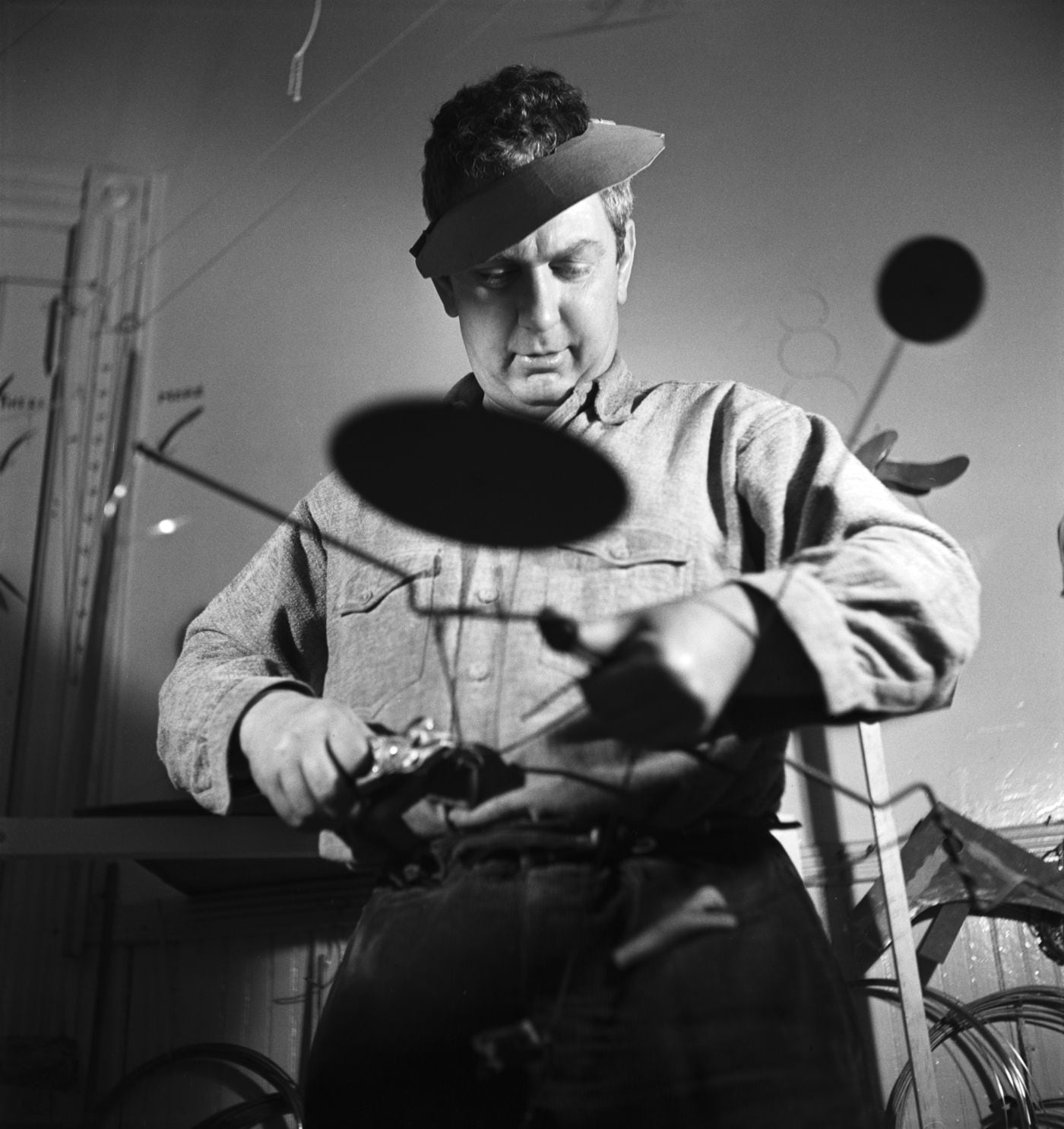
Alexander Calder in his New York City storefront studio, 1936.
IMAGE BY HERBERT MATTER
Alexander Calder in his New York City storefront studio, 1936.
The site will be leased from the city and must go through normal approvals, including a City Council review and approval of the lease agreement. Terms of the agreement have not been set as yet. No city funding is involved in the project. (The site is open space, part of Fairmount Park. PennDot is currently using it as staging for the Vine Street and Chestnut Street reconstructions, but that use is temporary, city officials said.)
“Gardens are very important; you can’t assume they are just simple," Neubauer continued, discussing the configuration of the two-acre site. "This will be very welcoming to the public. We are going to try to activate the block for the public.”
The project, according to Neubauer, will cost about $50 million.
“Most of the money is coming from philanthropy,” he said, including funds from an anonymous donor along with the Neubauer, Pew, and Lenfest contributions. Additional support will come from the state.
The money is almost completely raised, he said, "We’re fairly close.”
Edward G. Rendell, former mayor and governor, who pushed for the initial museum back in 1999, said he found the revival of the idea “very gratifying.”

“There’s no doubt in my mind that Philadelphia is the only place for it,” he said. “Calder’s influence is felt all over the city, particularly in City Hall. This may be the final piece of the puzzle for the Parkway."
Diane Dalto Woosnam, who was Rendell’s deputy city representative for arts and culture and the city’s point person on the first Calder museum plan, said that she believed the site and the city have “always been perfect," adding: "But in true Philly fashion, it took 25 years for everyone to agree.”

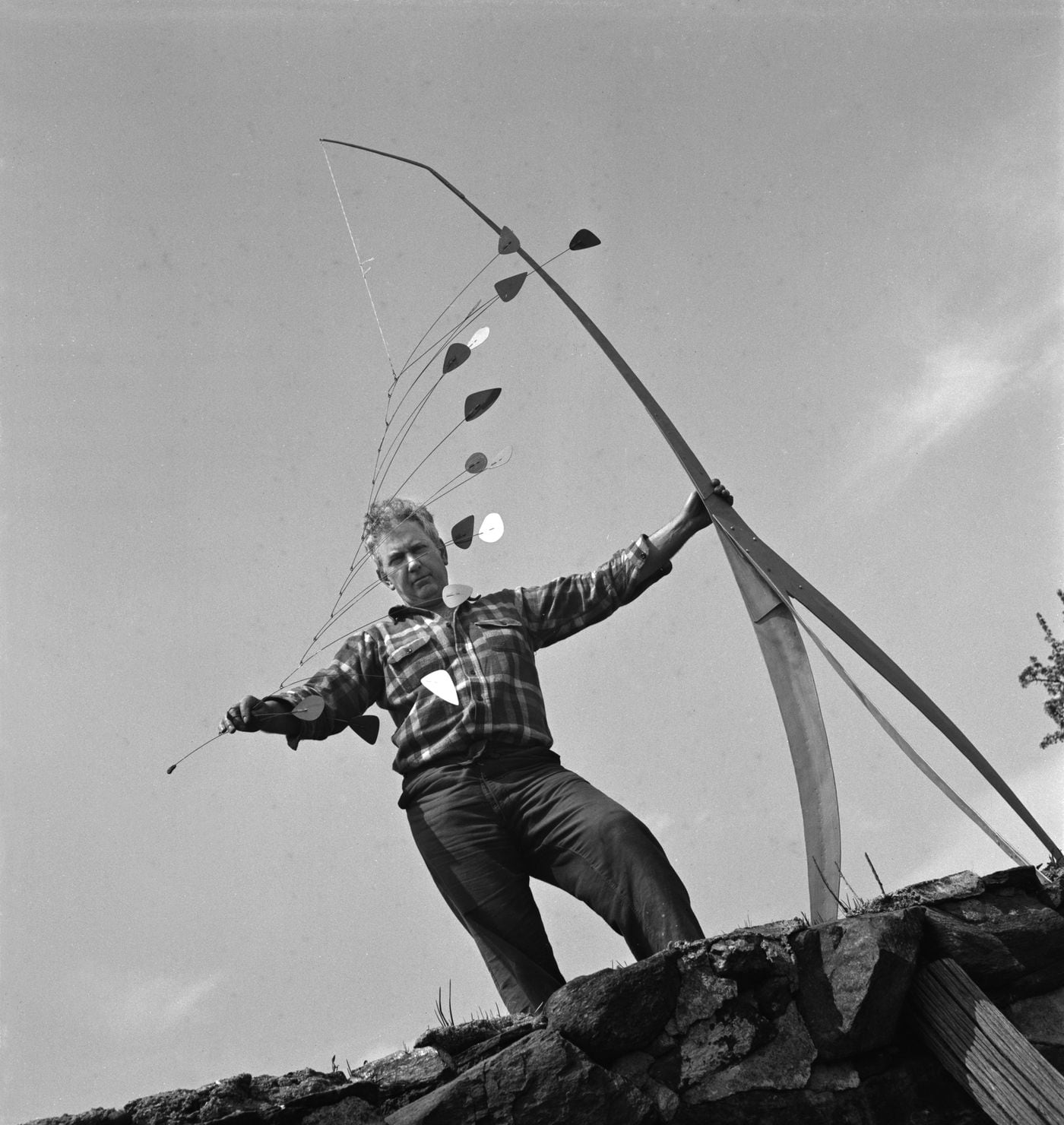
Calder with Giraffe (1941), Roxbury, Conn., 1941. Image by Herbert Matter
COURTESY CALDER FOUNDATION
Calder with Giraffe (1941), Roxbury, Conn., 1941. Image by Herbert Matter
The site of Calder Philadelphia underscores three generations of Calder family artwork along the Parkway as a defining factor on the Philadelphia cityscape. City Hall features the work of Calder’s grandfather Alexander Milne Calder, who created the major sculptures adorning the building, most prominently the statue of William Penn at the top.
Alexander Calder’s father, Alexander Stirling Calder, is famous for designing Swann Fountain on Logan Square a couple of blocks from what will be Calder Philadelphia. And one of Alexander Calder’s most intriguing mobiles, Ghost, hangs above the grand indoor entrance hall of the Philadelphia Museum of Art.
Works from Calder’s father and grandfather will also be featured in the new facility.
“This is a major accomplishment for Philadelphia,” said Rebecca W. Rimel, president and chief executive of the Pew Charitable Trusts. “The artistry of the Calder family is an important part of the fabric of our city. ... A home on the Parkway for some of Calder’s most consequential works will advance the city’s reputation as a world-class arts destination and enhance its appeal to national and international visitors.”
And there are other public works by Alexander Calder within shouting distance of the planned museum’s site.

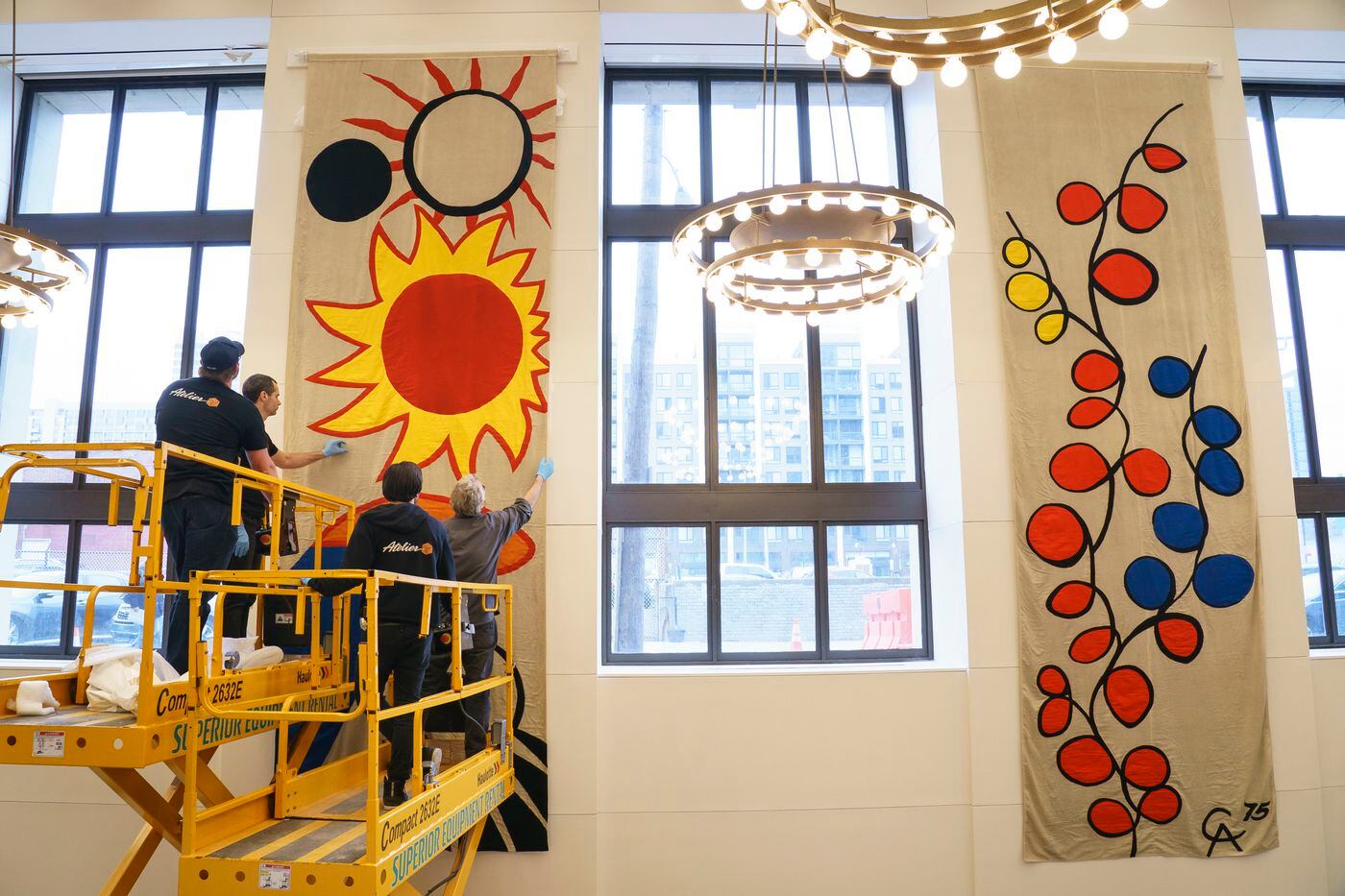
Banners created by Alexander Calder in the 1970s, lost and out of view for most of the last 35 years, are installed at the Free Library of Philadelphia last month.
JESSICA GRIFFIN / STAFF PHOTOGRAPHER
Banners created by Alexander Calder in the 1970s, lost and out of view for most of the last 35 years, are installed at the Free Library of Philadelphia last month.
The Central Branch of the Free Library of Philadelphia, for instance, just began hanging eight newly conserved banners the artist designed in 1975 for Centre Square across from City Hall. The banners vanished when the atrium in the building was renovated in the 1980s. They were found in a storage closet about 15 years later and are now going up again in the library’s Heim Center for Cultural and Civic Engagement.
Mayor Jim Kenney described the Calder family’s work as being literally "woven into the fabric of the city for more than a century.”
Alexander Calder was born in 1898 in Lawnton, Dauphin County, and spent his childhood in Philadelphia. Most of his artwork was created in New York City, France, and in Connecticut. He died in 1976.
Calder Philadelphia will be an independent nonprofit with its own board of directors. Backers of the project said they are working out a collaborative relationship with the Barnes Foundation for select administrative, curatorial, educational, and operational services.
None of those details have been firmed up, yet.
The Calder Foundation’s Rower said selection of the artworks, the number of artworks, how they will be displayed, and other physical details await design renderings.

“How many? We don’t know,” he said. “Yet it will be exactly the right number for the design.”
“Our program is diagonally across from the Rodin,” he said. “The greatest sculptor of the 19th century and the greatest sculptor of the 20th century. That’s the dialogue

Wednesday, January 29, 2020

National Museum Of American Jewish History Explores Successful Human Rights Campaign In Power Of Protest: The Movement To Free Soviet Jews


Panel Exhibition on view through March 15, 2020


Traveling exhibition Power of Protest: The Movement to Free Soviet Jews has returned to the National Museum of American Jewish History (NMAJH), where the exhibition was created. Power of Protest explores one of the most successful human rights campaigns to date. The panel exhibition showcases Americans’ efforts in the late 1960s through 1990 to free refuseniks—Jews who lived in the Soviet Union and were denied the rights to live freely, practice Judaism, or leave the country due to their religion. It is on view at NMAJH through March 15, 2020 and is included in free admission.
“The successful movement to free Soviet Jews has compelling connections to modern-day advocacy, highlighting how grassroots efforts can have an enormous impact. This exhibition serves as a reminder of how individuals can help preserve, protect, and expand America’s unique promise of religious freedom, even for individuals on the other side of the world,” says Dr. Josh Perelman, NMAJH chief curator and director of exhibitions and interpretation.
Power of Protest: The Movement to Free Soviet Jews walks visitors through the human rights campaign that took place on behalf of Soviet Jews, one that brought together organizations, student activists, community leaders, and thousands of individuals—and reached the highest echelons of the American government. Americans staged public demonstrations across the country, held massive rallies, and called for politicians to speak out. The exhibition celebrates the struggles and successes of this movement, as well as the experiences of Jewish emigrants from the U.S.S.R. who came to the United States and have contributed in countless ways to American society and culture. Their stories of courage offer meaningful opportunities for conversations and activism surrounding immigration, the reception of refugees, and the continuing limits on political and religious freedom placed on minorities around the world.
Power of Protest: The Movement to Free Soviet Jews highlights stories of everyday Americans who performed extraordinary acts of bravery to help Soviet Jews, from Philadelphians Elaine and David Ravich who smuggled out tape recordings of conversations during their 1978 visit to the Soviet Union, to Leslie Schaffer of Reno, Nevada who used gum wrappers to discreetly transport information about refuseniks in 1982, to Constance and Joseph Smukler of Philadelphia who helped several well-known Soviet Jews win their freedom. Visitors will learn about individual refuseniks, from human rights activist and Israeli politician Natan Sharansky to Google co-founder Sergey Brin. The exhibition features a number of powerful graphics, rather than physical artifacts. A handbill advertising a performance by musician Mary Travers—of Peter, Paul, and Mary—at a 1984 rally for Soviet Jewry represents the singers, musicians, and artists who raised their voices in protest. A 1981 letter written by Sheryl Sandberg (now COO of Facebook) to her bat mitzvah “twin” exemplifies the thousands of American children who “twinned” their Jewish coming-of-age ceremonies with Soviet peers denied that experience. Inspired by protest buttons popular across movements around the world, visitors can take home a pin featuring the hashtag #PowerofProtest to celebrate the exhibition, commemorate the historic milestone, and highlight the contemporary significance of fighting for one’s beliefs.
Power of Protest: The Movement to Free Soviet Jews is a small-scale, free-standing exhibition consisting of 11 panels designed to travel—giving small galleries, libraries, synagogues, Jewish community centers, universities, and historic societies across the country the opportunity to revisit and raise awareness of this important movement. To inquire about bringing the panel exhibition to your community, contact exhibitions@nmajh.org.


For more information, visit NMAJH.org/sovietjews.

The National Museum of American Jewish History was awarded a generous $150,000 grant by the Institute of Museum and Library Services (IMLS) to support the exhibition’s development. The grant is part of IMLS’s Museums for America program, which backs projects that strengthen the ability of an individual museum to serve its public.
The exhibition was organized by the National Museum of American Jewish History’s Chief Curator, Director of Exhibitions and Interpretation Josh Perelman and former content coordinator Yigal Kotler. The exhibition’s advisory committee includes Gal Beckerman (historian, journalist, and author), Sandra Cahn (Co-Founder, Limmud FSU), Margy-Ruth Davis (Founder and Chair, Perry Davis Associates; Former Executive Director, Greater New York Conference on Soviet Jewry), Marina Furman (Regional Director, Jewish National Fund), Zvi Gitelman (Preston R. Tisch Professor of Judaic Studies, University of Michigan), Jerry Goodman (Founding Executive Director, National Conference on Soviet Jewry), Malcolm Hoenlein (Executive Vice Chairman of the Conference of Presidents of Major American Jewish Organizations; Founding Executive Director, Greater New York Conference on Soviet Jewry), Pamela Nadell (Patrick Clendenen Chair in Women's and Gender History and Director of the Jewish Studies Program, American University), Jonathan Sarna (NMAJH’s Chief Historian; University Professor and Joseph H. and Belle R. Braun Professor of American Jewish History, Brandeis University), Roman Shmulenson (Executive Director, Council of Jewish Emigre Community Organizations), David Shneer (Louis P. Singer Endowed Chair in Jewish History, University of Colorado), Lance Sussman (Rabbi at Congregation Keneseth Israel), and Beth Wenger (Moritz and Josephine Berg Professor of History and Chair of the History Department, University of Pennsylvania).

Power of Protest was created by the National Museum of American Jewish History in Philadelphia. The exhibition is supported, in part, through a Museums for America grant from the Institute of Museum and Library Services, a government agency dedicated to advancing innovation, lifelong learning, and cultural and civic engagement. Additional support provided by Alkemy X, the Charlestein Family in memory of Malvina and Morton Charlestein, and the Genesis Philanthropy Group.


About the National Museum of American Jewish History
The National Museum of American Jewish History (NMAJH), located on historic Independence Mall in Philadelphia, brings to life the more than 360-year history of Jews in America. Tracing the stories of how Jewish immigrants became Jewish Americans, the Museum invites visitors of all backgrounds to share their own stories and reflect on how their histories and identities shape and are shaped by the American experience. An open door for all, NMAJH honors the past and contributes to a better future by sharing the power of imagination and ideas, culture and community, leadership and service, in ways that turn inspiration into action.
Visiting NMAJH
NMAJH is located at 101 South Independence Mall East at the corner of Fifth and Market Streets in Philadelphia. Museum hours are Tuesday to Friday, 10:00 am - 5:00 pm, and Saturday and Sunday 10:00 am - 5:30 pm. NMAJH is closed most Mondays, including federal holidays and some Jewish holidays. Admission to the core exhibition is free through February 2020. Children 12 and under, Museum Members, and active military with ID are always free. For more information on hours and admission, visit NMAJH.org or call 215.923.3811. Connect with the Museum on FacebookInstagram, and Twitter.

Thursday, January 31, 2019

Ancient Egypt: From Discovery To Display Behind-the-Scenes With The Penn Museum’s Renowned Egyptian Collection, Opening Saturday February 23

Image result for Penn Museum

PHILADELPHIA – Opening February 23, Ancient Egypt: From Discovery to Display provides visitors a once-in-a-lifetime opportunity to walk in the shoes of an archaeologist. Explore the journey artifacts take on their way to museum display, from excavation to conservation to storage and research. More than 200 fascinating objects, many of which have never been on view before, are included throughout the three-part, 6,000-square-foot exhibition. Eventually, these objects will become a part of the re-envisioned Ancient Egypt and Nubia Galleries, a much-anticipated cornerstone of the Museum’s Building Transformation.

Model Egyptian Boat.jpg

“Unlike most exhibitions about ancient Egypt, Ancient Egypt: From Discovery to Display provides an insider’s look into how objects are excavated, conserved, and stored—treating visitors to a unique experience of the Museum’s world-renowned Egyptian collection as we prepare for the renewal of the full Ancient Egypt and Nubia galleries,” says Dr. Jennifer Houser Wegner, exhibition curator.

In the exhibition’s first stop, visitors are introduced to what life was like in ancient Egypt through objects representing gods, royalty, and everyday individuals. Highlights include a wooden stela (memorial sculpture) from 662–525 BCE that honors two versions of a sun god and a life-sized memorial statue depicting the overseer of priests. But, then, visitors begin to “peel back the layers,” as they follow artifacts through their journeys—in reverse.

In the second gallery, Museum-goers will get a closer look at breathtaking artifacts from the Old Kingdom, also known as the “Age of the Pyramids,” starting in 2613 BCE, through the time of Cleopatra’s death in 30 BCE. Objects in this “visible storage” section include two magical model boats (a sailboat and a rowboat) featured in the critically-acclaimed Smithsonian book History of the World in 1,000 Objectsa stunning turquoise-colored glazed ceramic ware necklacethe 2,000-year-old mummy of a young woman, and a child mummy that was recently CT scanned in partnership with the Children’s Hospital of Philadelphia (CHOP).

The final gallery, also known as the highly-popular Artifact Lab, will provide visitors with an opportunity to learn more about excavation and to observe conservators in action as they work to preserve Egyptian artifacts, including the mummy of a 40-year-old named Hapi-Men and his dogexquisite gold jewelry worn by the ancient Egyptians, and an intricate model of the throne room of the Palace of Merenptah (the 13th son of Ramesses II), the columns and portals of which will be erected at full height in the Ancient Egypt and Nubia galleries. They’ll also be able to ask questions of the conservators during “Open Window” timeframes: Tuesdays through Fridays from 11–11:30 a.m. and 1:30–2 p.m., and Saturdays and Sundays from 12–12:30 p.m. and 3–3:30 p.m.

Ancient Egypt: From Discovery to Display invites visitors to see more than 200 Egyptian objects spanning a period of nearly 2,600 years in an unprecedented context, providing a sneak preview into what will be a crowning jewel in the Museum’s extensive Building Transformation project, the Ancient Egypt and Nubia Galleries.

About the Penn Museum
Since 1887, the Museum has transformed understanding of the human experience. Dedicated to ongoing cross-cultural discovery, the Museum’s exhibitions and events welcome everyone to uncover the mystery of the ancient past and find one’s own place in the arc of human history. For more information, visit penn.museum or call 215.898.4000.