Showing posts with label Alexander Calder. Show all posts

Wednesday, September 10, 2025

The Calder Mobile Returns To Pittsburgh International Airport

I think it looks sensational. It’s one of the largest and most important mobiles. So it’s such an incredible asset for Pittsburgh to have.”
THE ALEXANDER CALDER MOBILE IS NOW INSTALLED IN THE ATRIUM OF THE NEW LANDSIDE TERMINAL AT PITTSBURGH INTERNATIONAL AIRPORT. | PHOTO BY VIRGINIA LINN

That’s the assessment of Alex J. Taylor, a renowned expert on the work of Alexander Calder upon seeing the artist’s 500-pound mobile called “Pittsburgh” now installed in the atrium area of the new landside terminal of Pittsburgh International Airport. Calder created the piece for the Carnegie International in 1958, and it’s been displayed now at three different Pittsburgh airport terminals since 1959.

“It looks much more delicate in this setting than it did in its prior space,” Taylor added.

The mobile, which carries an insurance value of $12 million, was the centerpiece of the airport’s media tour on Thursday that aimed to showcase much of the new artwork that graces the new terminal — even on the outside of the five-story parking garage.

“The idea from the beginning was not to build an airport in Pittsburgh, but to build Pittsburgh’s airport,” said Christina Cassotis, airport CEO. “It needed to reflect and serve this community by bringing in the assets of the community and putting them on display for the world to see. And we know Pittsburgh punches way above its weight when it comes to arts and culture and has a rich legacy of doing so.”

There are 15 artists who have contributed their work, 80% of whom are from Pittsburgh.
CHRISTINA CASSOTIS (FAR RIGHT), CEO OF PITTSBURGH INTERNATIONAL AIRPORT, STANDS WITH SEVERAL OF THE ARTISTS WHO HAVE CONTRIBUTED WORKS TO THE NEW LANDSIDE TERMINAL AND OTHER AREAS. | PHOTO BY VIRGINIA LINN

Calder, a Pennsylvania native who died in 1976, had several of his mobiles displayed at airports around the country, with one of the largest still hanging at John F. Kennedy International Airport in New York City, Taylor said. “Some of those other airports, like Dallas and Chicago, lost them,” he added.

Still, the Calder mobile has a bit of a spotted history in Pittsburgh. After it was purchased by G. David Thompson and donated to Allegheny County, the county decided — without Calder’s permission — to paint the mobile yellow and green, the official colors of Allegheny County, said Taylor, an Australian who is associate professor in the Department of History of Art and Architecture at the University of Pittsburgh.

“He was very grumpy about it,” he said about Calder. Later, the mobile was painted red — an action that Calder approved — but the color came out more pink. Then, changes were made to prevent the mobile paddles from moving with the air currents. Another time, they put what Taylor called “a horrendous advertising booth” underneath the mobile.

“It was treated very poorly. It wasn’t until the 1970s that it was restored to its original colors” of black and white, like it is today.

“I think in the ’50s, airport officials probably didn’t quite understand what this thing was and the idea that they could repaint it probably didn’t seem so outrageous to them,” he said. “Of course now we understand it’s one of [Calder’s] greatest works.”

Keny Marshall, arts and culture manager at the airport, said the mobile, which had been removed from the current terminal a while ago, was in good shape and all it needed was a cleaning before they installed it last week.

Calder Gardens in Philadelphia will open to the public on September 21, 2025, following a celebratory week of special events, and you can now purchase memberships and advance tickets online. In the lead-up to its inauguration, Calder Gardens announced the September 2025 opening in January 2025, unveiled its new website and visual identity in May 2025, and in 2022, the design by Herzog & de Meuron was unveiled for the Philadelphia cultural destination. For more information, please visit: https://caldergardens.org/

https://www.pittsburghmagazine.com/author/virginia-linn/

Friday, January 10, 2025

The Long-Awaited Calder Gardens To Open On Philadelphia's Benjamin Franklin Parkway In Summer 2025

Featuring a building conceived by Pritzker Prize-winning design practice Herzog & de Meuron and gardens by internationally acclaimed Dutch landscape designer Piet Oudolf, Calder Gardens is dedicated to the art and ideas of Alexander Calder, a native Philadelphian who is considered one of the most innovative and influential artists of the 20th century.

Featuring galleries illuminated by natural light, in a structure ensconced in a flowing landscape of native and flowering species, Calder Gardens will present a rotating selection of masterworks from the Calder Foundation, New York, including mobiles, stabiles, monumental sculptures, and paintings. “The esthetic value of these objects cannot be arrived at by reasoning,” Calder wrote in 1933. “Familiarization is necessary.” Installed both indoors and outdoors, Calder’s art will be in constant dialogue with nature and the changing atmospheres of the seasons. Calder Gardens will provide the public with a singular place for contemplation and reflection, as well as abundant opportunities for learning and community building through a schedule of inclusive public programs and special events.

“Our intention for Calder Gardens is not only to create the ideal environment for the public to encounter my grandfather’s work but also to elevate personal contemplation and reflection,” said Alexander S. C. Rower, President of the Calder Foundation. “Calder’s role as a pioneer of experiential art is essential to his legacy. For viewers who open themselves up to the possibilities of his mobiles and stabiles, the unexpected takes root. His objects continuously unfold in real time.”

Calder was born in Philadelphia in 1898, and his connections to the city are grounded in the rich artistic lineage of his family. A trio of iconic installations by three generations of Calders can be found along the Benjamin Franklin Parkway: at the southeast end, atop City Hall, stands the monumental statue William Penn (c. 1886–94) by the artist’s grandfather Alexander Milne Calder; at the midpoint sits Swann Memorial Fountain (1924) by his father Alexander Stirling Calder; and at the northwest end is Calder’s own 1964 mobile The Ghost, which hangs majestically in the main hall of the Philadelphia Museum of Art. Thus Calder Gardens brings into the 21st century the legacy of a Philadelphia family whose work has defined and enriched the city for over a century.

About the Design

Crafted specifically for the presentation of Calder’s work, the landscape and architecture of Calder Gardens will unfold as a choreographed progression that moves visitors from the quotidian city context to a more contemplative realm beyond the traditional museum experience, allowing them to engage with art as a personal, real-time encounter—as the artist intended.

“This was actually an open-ended process rather than a finished concept based on a fixed program. A kind of conceptual path which made us carve out the ground rather than build forms and volumes above—we were looking for space to present Calder’s work in a new and unprecedented way,” said Jacques Herzog, founding partner along with Pierre de Meuron of Herzog & de Meuron. “That space in the making eventually grew into a whole sequence of different galleries and also rather unexpected spaces, niches and gardens; such as the apse and the quasi-galleries or open plan gallery, the sunken or vestige gardens. And not only galleries in the classical sense, but every corner and angle, every stair and corridor should be offering itself up as a place to put art.”

Discreetly nestled into the landscape, Herzog & de Meuron’s almost 18,000 sq ft structure will be sheathed in softly reflective metal cladding that blurs the boundaries between architecture and the natural world—the material and the immaterial.

Departing the busy Parkway, visitors will approach the building along a path that winds through a meadow-like landscape punctuated by trees, arriving at the main entrance on the building’s north façade. Beyond the threshold, a sequence of spaces will reveal themselves below ground level as distinct volumes that will house a constantly changing display of Calder’s most acclaimed works. Large windows will wash the interiors with natural light and frame both the shifting geometries of Calder’s work and views of different gardens conceived as outdoor galleries. A Sunken Garden and Vestige Garden, visible from within the building through expansive glazing that likewise permits visitors outdoors to see into the building’s exhibition spaces. Quiet but theatrical, Herzog & de Meuron’s design has been conceived to amplify the impact of the artworks—to encourage engagement with their kinetic properties by affording visitors many different vantage points—and catalyze discovery and reflection.

The seamless relationship between the built elements designed by Herzog & de Meuron and the gardens envisioned by Piet Oudolf is central to the philosophy of Calder Gardens. The site will be distinguished by its naturalistic four-season garden, intending to create an entirely different experience than all other cultivated, manicured gardens on the Parkway.

“I see my gardens as living sculptures where change is constant,” Oudolf said. “The site is like a canvas to work on, and each plant has a personality that must work with the others. The composition of the garden is variable and will evolve through the seasons. For Calder Gardens, the horticultural design must also serve the works of art. My hope is that people will take the time to stand still and think here, to fully experience these elements together and have an 4 emotional reaction that stays with them long after their visit. It’s not about what you see, but what you sense.”

Thursday, September 8, 2022

Design Unveiled For Calder Gardens A New National And International Cultural Destination In Downtown Philadelphia On Benjamin Franklin Parkway

World renowned design firm Herzog & de Meuron and acclaimed landscape designer Piet Oudolf have conceived a place where art and nature combine for reflection, contemplation, and learning
The Board of Trustees of Calder Gardens has unveiled the design for its new site on the Benjamin Franklin Parkway in the heart of downtown Philadelphia. Featuring a building conceived by Pritzker Prize-winning design practice Herzog & de Meuron and gardens by internationally acclaimed Dutch landscape designer Piet Oudolf, the project is dedicated to the art and ideas of Alexander Calder, a native Philadelphian who is considered one of the most innovative and influential artists of the 20th century.

Galleries will be illuminated by natural light, in a structure ensconced in a flowing landscape of native and flowering species, Calder Gardens will present a rotating selection of masterworks from the Calder Foundation, New York, including mobiles, stabiles, monumental sculptures, and paintings. “The esthetic value of these objects cannot be arrived at by reasoning,” Calder wrote in 1933. “Familiarization is necessary.” Installed both indoors and outdoors, Calder’s art will be in constant dialogue with nature and the changing atmospheres of the seasons. Calder Gardens will provide the public with a singular place for contemplation and reflection, as well as abundant opportunities for learning and community building through a schedule of inclusive public programs and special events.

“Our intention for Calder Gardens is not only to create the ideal environment for the public to encounter my grandfather’s work but also to elevate personal contemplation and reflection,” said Alexander S. C. Rower, President of the Calder Foundation. “Calder’s role as a pioneer of experiential art is essential to his legacy. For viewers who open themselves up to the possibilities of his mobiles and stabiles, the unexpected takes root. His objects continuously unfold in real time.”

Calder was born in Philadelphia in 1898, and his connections to the city are grounded in the rich artistic lineage of his family. A trio of iconic installations by three generations of Calders can be found along the Benjamin Franklin Parkway: at the southeast end, atop City Hall, stands the monumental statue William Penn (c. 1886–94) by the artist’s grandfather Alexander Milne Calder; at the midpoint sits Swann Memorial Foundation (1924) by his father Alexander Stirling Calder; and at the northwest end is Calder’s own 1964 mobile The Ghost, which hangs majestically in the main hall of the Philadelphia Museum of Art. Thus Calder Gardens brings into the 21st century the legacy of a Philadelphia family whose work has defined and enriched the city for over a century.

About the Design

Crafted specifically for the presentation of Calder’s work, the landscape and architecture of Calder Gardens will unfold as a choreographed progression that moves visitors from the quotidian city context to a more contemplative realm beyond the traditional museum experience, allowing them to engage with art as a personal, real-time encounter—as the artist intended.

“This was actually an open-ended process rather than a finished concept based on a fixed program. A kind of conceptual path which made us carve out the ground rather than build forms and volumes above—we were looking for space to present Calder’s work in a new and unprecedented way,” said Jacques Herzog, founding partner along with Pierre de Meuron of Herzog & de Meuron. “That space in the making eventually grew into a whole sequence of different galleries and also rather unexpected spaces, niches and gardens; such as the apse and the quasi-galleries or open plan gallery, the sunken or vestige gardens. And not only galleries in the classical sense, but every corner and angle, every stair and corridor should be offering itself up as a place to put art.”

Discreetly nestled into the landscape, Herzog & de Meuron’s almost 18,000 sq ft structure will be sheathed in softly reflective metal cladding that blurs the boundaries between architecture and the natural world—the material and the immaterial.

Departing the busy Parkway, visitors will approach the building along a path that winds through a meadow-like landscape punctuated by trees, arriving at the main entrance on the building’s north façade. Beyond the threshold, a sequence of spaces will reveal themselves below ground level as distinct volumes that will house a constantly changing display of Calder’s most acclaimed works. Large windows will wash the interiors with natural light and frame both the shifting geometries of Calder’s work and views of different gardens conceived as outdoor galleries. A Sunken Garden and Vestige Garden, visible from within the building through expansive glazing that likewise permits visitors outdoors to see into the building’s exhibition spaces. Quiet but theatrical, Herzog & de Meuron’s design has been conceived to amplify the impact of the artworks—to encourage engagement with their kinetic properties by affording visitors many different vantage points—and catalyze discovery and reflection.

The seamless relationship between the built elements designed by Herzog & de Meuron and the gardens envisioned by Piet Oudolf is central to the philosophy of Calder Gardens. The site will be distinguished by its naturalistic four-season garden, intending to create an entirely different experience than all other cultivated, manicured gardens on the Parkway.

“I see my gardens as living sculptures where change is constant,” Oudolf said. “The site is like a canvas to work on, and each plant has a personality that must work with the others. The composition of the garden is variable and will evolve through the seasons. For Calder Gardens, the horticultural design must also serve the works of art. My hope is that people will take the time to stand still and think here, to fully experience these elements together and have an emotional reaction that stays with them long after their visit. It’s not about what you see, but what you sense.”

About Calder Gardens

The nonprofit Calder Gardens was launched by a group of Philadelphia philanthropists working in collaboration with the Calder Foundation and partnership with the City of Philadelphia and the Commonwealth of Pennsylvania. While governed by its board and curatorial committee, Calder Gardens will be operated by the Barnes Foundation—a renowned cultural and educational institution—to provide administrative, operational, and educational programming support when the new site opens to the public in what constitutes a new model for institutional sustainability and efficiency.

The Calder Gardens Board announced its selection of Herzog & de Meuron as Design Consultants in 2020. Ballinger will be the project’s Executive Architects. Presented before the Philadelphia Art Commission this week, the Basel, Switzerland-based firm’s design has been developed over the past two and a half years through intensive collaboration with the organization’s board, the Calder Foundation, and, since 2021, Piet Oudolf. The shared goal has been to create a place where art and nature merge uniquely: the 1.8-acre Calder Gardens site—situated between 21st and 22nd Streets, across from the Barnes Foundation—will be a sanctuary-like retreat for Philadelphia residents and visitors alike, and a complement to the existing configuration of internationally acclaimed arts institutions that line the Parkway. “Calder Gardens marks a culturally rich Parkway,” said Joe Neubauer, Founder of the Neubauer Family Foundation and lead funder of the initiative.

In addition to lead funding from the Neubauer Family Foundation, the Calder Gardens project has been brought to fruition by numerous philanthropists and private foundations, including The Pew Charitable Trusts, the Estate of H.F. (Gerry) Lenfest, and an anonymous donor. The project is also supported by the Commonwealth’s Redevelopment Assistance Capital Program. The $70 million projected budget for Calder Gardens will include a substantial endowment to provide ongoing operating support and has been raised through the generous contributions of these patrons.

Sue Urahn, president and chief executive officer of The Pew Charitable Trusts, said, “Pew is very pleased to support Calder Gardens and we are excited to see the plans for it begin to take shape. The new public space will be a wonderful addition to the Parkway and enhance Philadelphia’s reputation as a world-class city in which to live, work, and visit.” “The Calder family is integral to the history and now the future of Philadelphia. I am grateful for the range of partners that will bring Calder Gardens and the amazing art and ideas to the Parkway,” said Jim Kenney, Mayor of Philadelphia. “This will continue to build upon an evergrowing arts and culture presence in our great city, further enhancing the city's cultural experiences for visitors and residents alike.”

Marsha Perelman, President of the Board, Calder Gardens, said of the design unveiled today, “To honor Calder’s work in a project of this significance, we engaged some of the world’s most respected and experienced talents. Herzog & de Meuron and Piet Oudolf are universally admired for their work on cultural sites. They know what it takes to create an unparalleled art experience and to challenge conventions to expand our minds and senses. I am thrilled that Philadelphians will be able to benefit from this unique experience in their own city.” Calder Gardens is scheduled to open in 2024.

The public can learn more about Calder Gardens online at caldergardens.org and on social media @Calder_Gardens on Instagram and Twitter.

Friday, February 21, 2020

Alexander Calder Will Get A Prime Museum Site On The Benjamin Franklin Parkway In Philadelphia, Across From Barnes And Rodin

"Eagle," a 40 foot sculpture by Alexander Calder on loan to the Philadelphia Museum of Art in 1999 and 2000.
A little more than two decades after a Calder museum was first proposed for the Benjamin Franklin Parkway, the long-dormant idea has blossomed again, funding has materialized, and backers say that, by spring 2021, construction should get underway between 21st and 22nd Streets across from the Barnes Foundation and the Rodin Museum.
Many details of the project, which would feature works by the endlessly inventive Alexander Calder, creator of the mobile, still have to be worked out, but supporters say they are committed for the long haul. Major funders include the Neubauer Family Foundation, the Pew Charitable Trusts, and the estate of H.F. “Gerry” Lenfest.

The works for display, which have not yet been selected, will be lent by the New York-based Calder Foundation for 99 years and would rotate through the Philadelphia facility, known informally as Calder Philadelphia. The art will be displayed in and around a building with a prominent garden.
Herzog & de Meuron, the Pritzker Prize-winning architects behind London’s Tate Modern, have signed on to the project, but no design renderings are yet available.
“We don’t know what we’re going to call it, but it’s not a museum,” said Alexander S.C. Rower, president of the Calder Foundation and grandson of the artist.

“This will involve a different way to engage art than what is usual with a museum,” he said. The idea, Rower said, is to create a more intimate experience for viewers and allow them to get closer to the artwork, free of the restrictions that normally dominate a museum setting.
“The experience is where the art happens,” he said. “This will not be a picture on a wall. This will be a place of introspection.”
He called the new structure and grounds a “sanctuary” as opposed to a museum.
1:18
Joseph Neubauer, trustee of the Neubauer Family Foundation and one of the prime movers for the project, said that Calder’s sculptures, his stabiles and mobiles, would most likely be the defining feature of the facility and grounds.
“You need to be able to walk around it and experience” the sculpture, Neubauer said. “This is all about the individual experience with individual pieces of art.”

Rower said the building and grounds, located on the same two-acre site as the earlier, never-built Calder museum, are envisioned to encourage contemplation. The building will include galleries of some sort.
Neubauer said the size of the structure will be “modest, maybe 15-, 17-, 20,000 square feet, plus the garden."

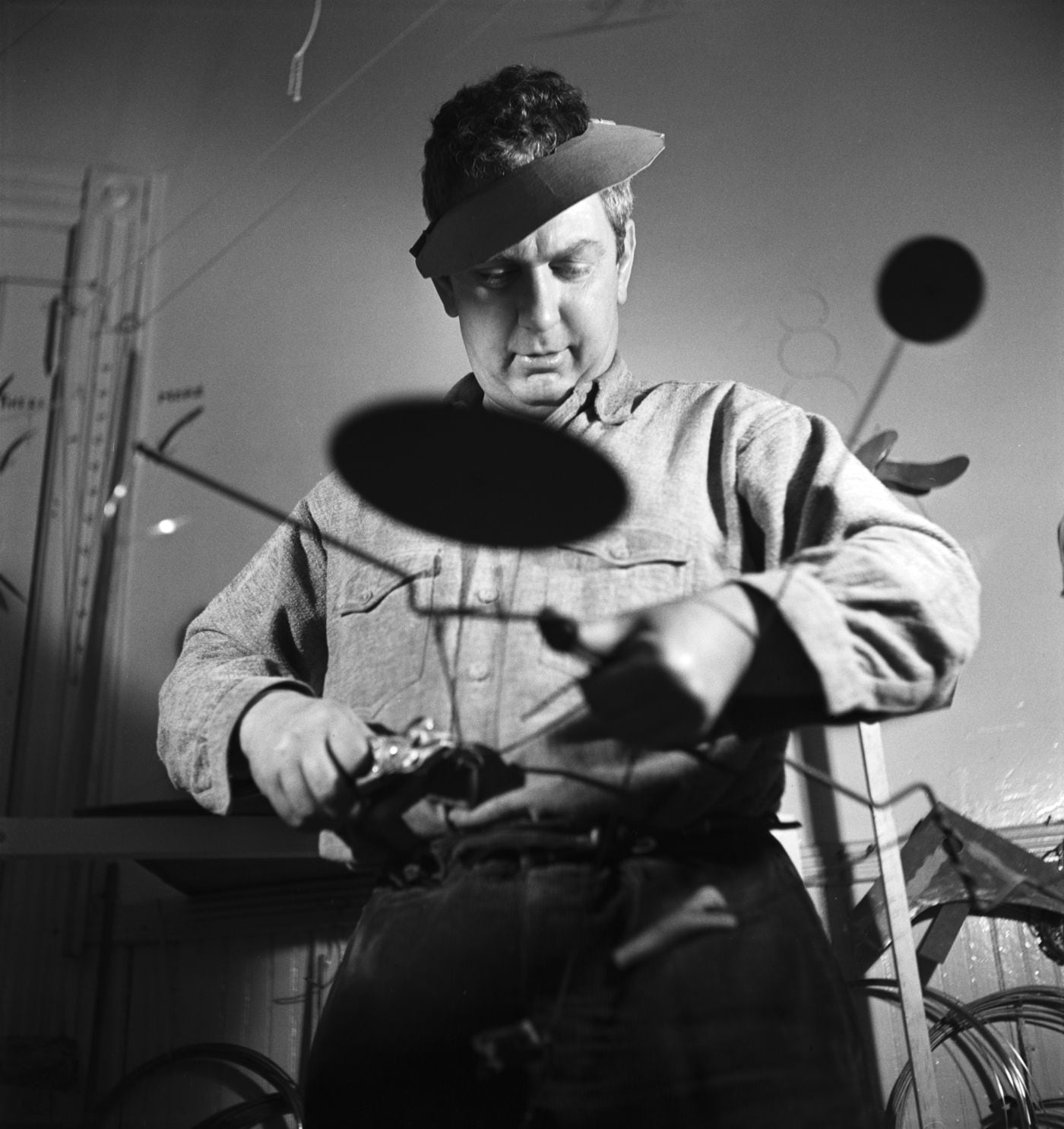
Alexander Calder in his New York City storefront studio, 1936.
IMAGE BY HERBERT MATTER
Alexander Calder in his New York City storefront studio, 1936.
The site will be leased from the city and must go through normal approvals, including a City Council review and approval of the lease agreement. Terms of the agreement have not been set as yet. No city funding is involved in the project. (The site is open space, part of Fairmount Park. PennDot is currently using it as staging for the Vine Street and Chestnut Street reconstructions, but that use is temporary, city officials said.)
“Gardens are very important; you can’t assume they are just simple," Neubauer continued, discussing the configuration of the two-acre site. "This will be very welcoming to the public. We are going to try to activate the block for the public.”
The project, according to Neubauer, will cost about $50 million.
“Most of the money is coming from philanthropy,” he said, including funds from an anonymous donor along with the Neubauer, Pew, and Lenfest contributions. Additional support will come from the state.
The money is almost completely raised, he said, "We’re fairly close.”
Edward G. Rendell, former mayor and governor, who pushed for the initial museum back in 1999, said he found the revival of the idea “very gratifying.”

“There’s no doubt in my mind that Philadelphia is the only place for it,” he said. “Calder’s influence is felt all over the city, particularly in City Hall. This may be the final piece of the puzzle for the Parkway."
Diane Dalto Woosnam, who was Rendell’s deputy city representative for arts and culture and the city’s point person on the first Calder museum plan, said that she believed the site and the city have “always been perfect," adding: "But in true Philly fashion, it took 25 years for everyone to agree.”

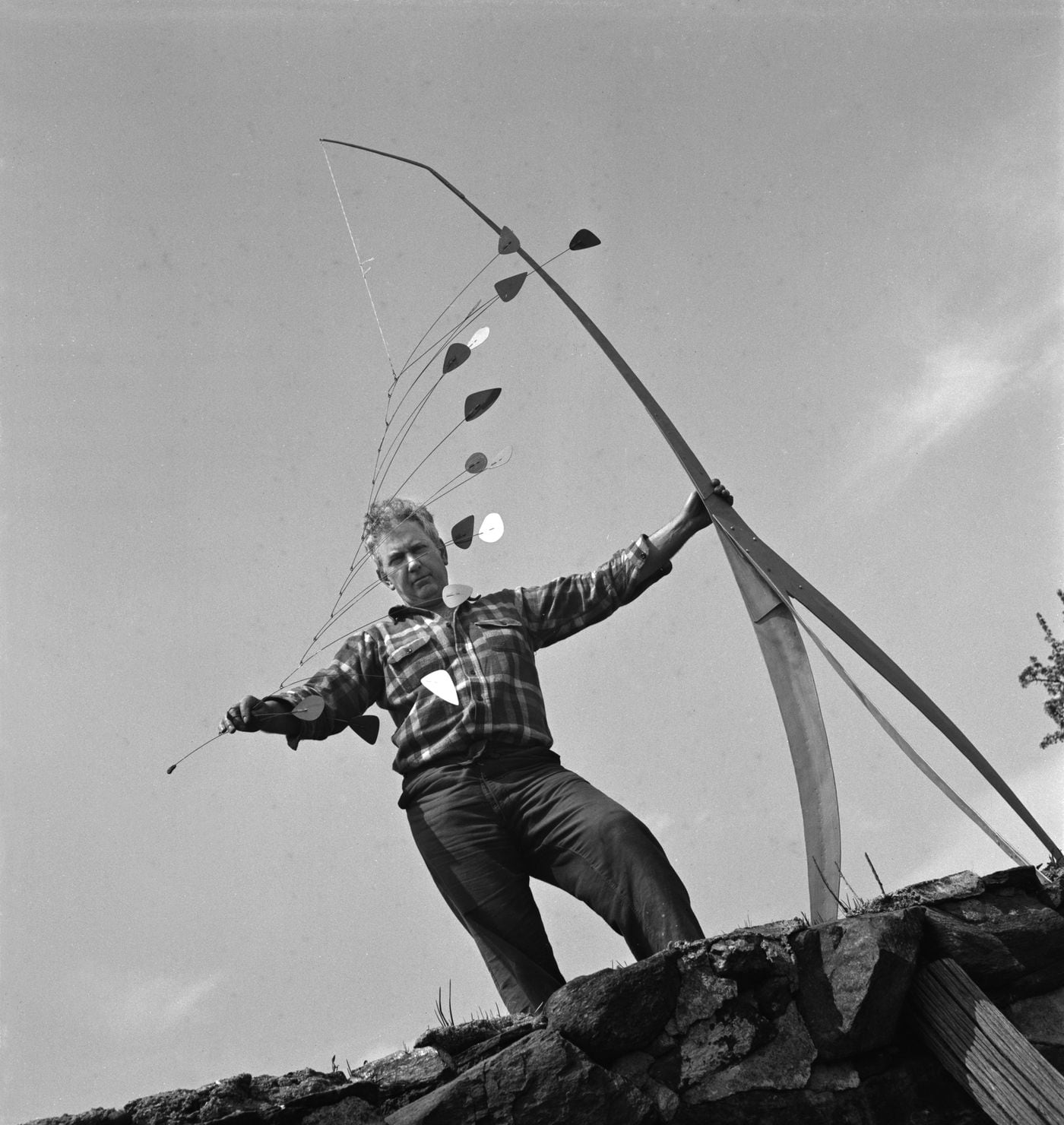
Calder with Giraffe (1941), Roxbury, Conn., 1941. Image by Herbert Matter
COURTESY CALDER FOUNDATION
Calder with Giraffe (1941), Roxbury, Conn., 1941. Image by Herbert Matter
The site of Calder Philadelphia underscores three generations of Calder family artwork along the Parkway as a defining factor on the Philadelphia cityscape. City Hall features the work of Calder’s grandfather Alexander Milne Calder, who created the major sculptures adorning the building, most prominently the statue of William Penn at the top.
Alexander Calder’s father, Alexander Stirling Calder, is famous for designing Swann Fountain on Logan Square a couple of blocks from what will be Calder Philadelphia. And one of Alexander Calder’s most intriguing mobiles, Ghost, hangs above the grand indoor entrance hall of the Philadelphia Museum of Art.
Works from Calder’s father and grandfather will also be featured in the new facility.
“This is a major accomplishment for Philadelphia,” said Rebecca W. Rimel, president and chief executive of the Pew Charitable Trusts. “The artistry of the Calder family is an important part of the fabric of our city. ... A home on the Parkway for some of Calder’s most consequential works will advance the city’s reputation as a world-class arts destination and enhance its appeal to national and international visitors.”
And there are other public works by Alexander Calder within shouting distance of the planned museum’s site.

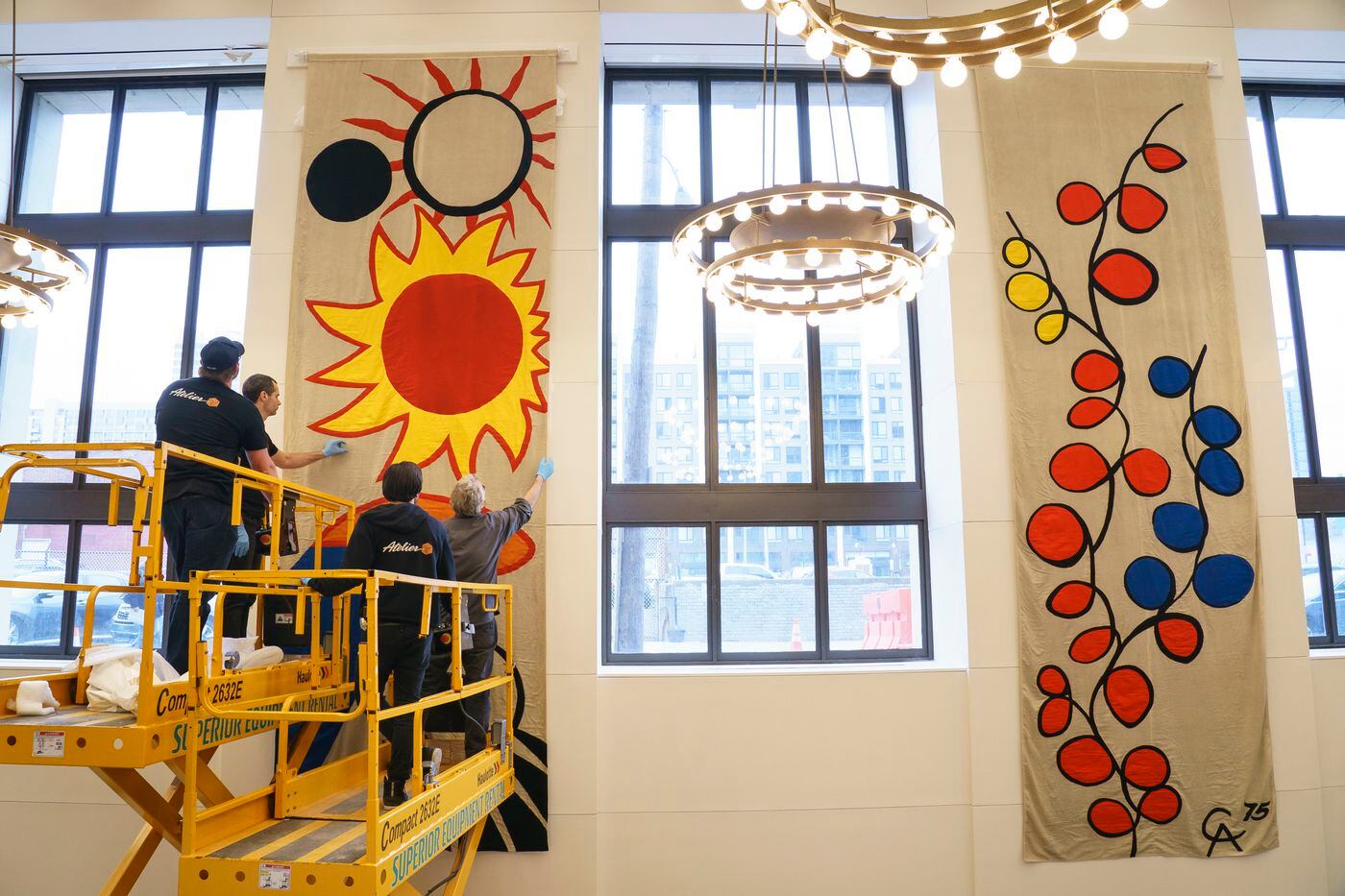
Banners created by Alexander Calder in the 1970s, lost and out of view for most of the last 35 years, are installed at the Free Library of Philadelphia last month.
JESSICA GRIFFIN / STAFF PHOTOGRAPHER
Banners created by Alexander Calder in the 1970s, lost and out of view for most of the last 35 years, are installed at the Free Library of Philadelphia last month.
The Central Branch of the Free Library of Philadelphia, for instance, just began hanging eight newly conserved banners the artist designed in 1975 for Centre Square across from City Hall. The banners vanished when the atrium in the building was renovated in the 1980s. They were found in a storage closet about 15 years later and are now going up again in the library’s Heim Center for Cultural and Civic Engagement.
Mayor Jim Kenney described the Calder family’s work as being literally "woven into the fabric of the city for more than a century.”
Alexander Calder was born in 1898 in Lawnton, Dauphin County, and spent his childhood in Philadelphia. Most of his artwork was created in New York City, France, and in Connecticut. He died in 1976.
Calder Philadelphia will be an independent nonprofit with its own board of directors. Backers of the project said they are working out a collaborative relationship with the Barnes Foundation for select administrative, curatorial, educational, and operational services.
None of those details have been firmed up, yet.
The Calder Foundation’s Rower said selection of the artworks, the number of artworks, how they will be displayed, and other physical details await design renderings.

“How many? We don’t know,” he said. “Yet it will be exactly the right number for the design.”
“Our program is diagonally across from the Rodin,” he said. “The greatest sculptor of the 19th century and the greatest sculptor of the 20th century. That’s the dialogue